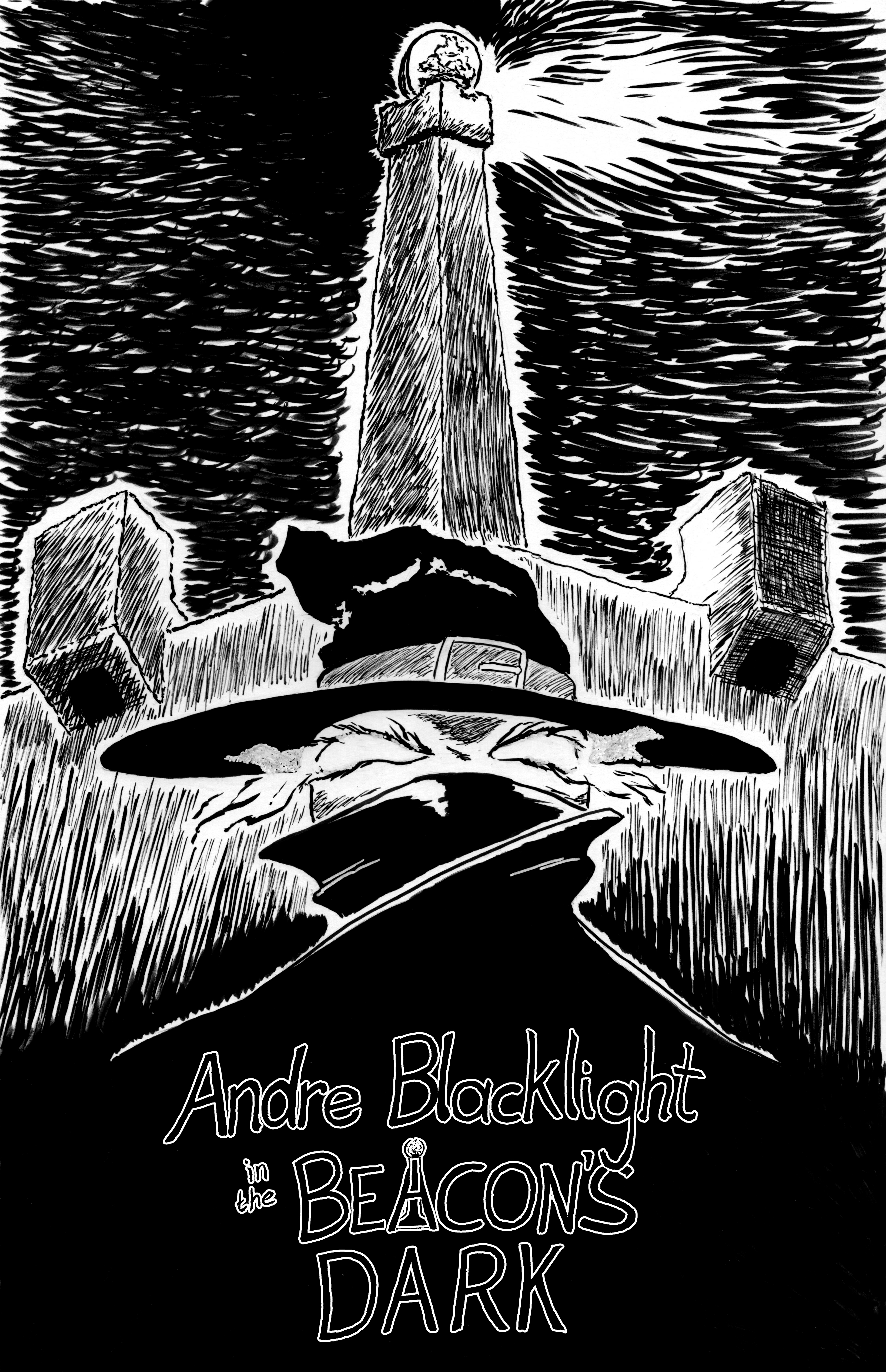
Andre woke up to an unfamiliar sensation, like the world was slowly moving beneath him for some reason. It wasn’t the whole world, of course, just the ship rocking beneath him as the waves lapped against it, but he had never woken up on a ship before and the experience alarmed him. Andre began to roll out of bed but stopped short with a groan when he realized he was sore all over his body, from the place where his head and neck met all the way down to the knuckles of his toes.
His side was particularly tender. It might have been his imagination but Andre felt like he could identify exactly where the goblin cat had scratched him by the burning sensation in his ribs. He probed at the injury carefully, surprised to find it had been rebandaged while he was asleep. Finally Andre opened his eyes and took stock of his situation.
There wasn’t much to see. A little light came in through a small porthole high up in the room’s wall, filling the small storage room with thin yellow light. Andre lay atop a pile of blankets that served as a makeshift bed. The rest of the room was full of barrels emitting strange, harsh scents he couldn’t identify. Behind his head was a door, which he didn’t notice until it opened and Isobela slipped in through it.
“I thought I heard you making noise in here,” she said, kneeling beside him and placing a hand on his forehead. “It’s about time you were up and about.”
“Is it?” Andre asked, trying to work out what was going on. “Did I miss call time for the show?”
“No, though that’s no credit to you.” She set a bucket of water on the floor, pulled a rag out and wrung the water from it then began gently sponging down his forehead. “We didn’t perform in the city yesterday, the whole city was a madhouse.”
“Yesterday?” Andre frowned, trying to count out the days in his head.
“You’ve been asleep for almost two days,” Isobela said, lifting up his tunic to examine the dressing on the wound in Andre’s side. “We were worried your cut was infected. It finally stopped weeping overnight so hopefully it will heal without needing any serious attention from me.”
Andre clamped his hands at his side to keep them away from his neck, which still bore the marks of the last time she’d given an injury serious attention. “How did you find me here?”
She smiled. “The captain sent a few of his men to fetch us.”
He tried to sit up again, saying, “Then we should get back to the rest of the troupe soon.”
“They’re aboard already,” Isobela said, pushing him back down. “We’ve been invited to perform in Torrence to celebrate the Prince’s upcoming wedding and the Maestro thinks it would be a good place to spend the rainy season as well.”
“Ah.” For the first time in what seemed like ages, Andre let himself relax. “Then they’re gone.”
“If you mean your friends then I haven’t seen them, although someone did leave this in the room with you.” She reached up and pulled a package wrapped in wax paper off the top of one of the barrels. “The sailor who showed us where you were said it was for you.”
He studied the thing for a moment, confused. “What is it?”
“Not my place to tamper with it, though if you want to tell us after you open it both the Maestro and I have been dying to know.”
Andre crinkled the package in his hands. It felt like cloth, which was a bit curious but maybe not surprising given how many different costumes he’d left the troupe with. Maybe Sophia had repaired the damaged ones for him. He figured it couldn’t hurt to let Isobela see what it was so he untied the twine and pulled it open. Inside he found a couple of notes on top of a small pile of fabric that unfolded into two articles of clothing.
The first was his hat. The leather hat band had been removed and placed inside it then the pointed top had been carefully folded over to fit it into the package. Its broad brim still cast an unnaturally dark shadow but the points of light beneath it had faded until they were almost impossible to make out. Andre wondered if the magic the Fair Folk had given it was fading or if he just needed to put it on again to refresh it.
He set the hat aside and examined the garment beneath it. At first glance he thought it was some kind of shirt or tunic but as he unfolded it and held it up he realized it was a long cloak with a high collar. The fabric had a smooth, satiny sheen to it. The harder he tried to study it the fewer details he could make out, the cloth turning nearly transparent in front of his eyes.
Andre set it aside before it fully vanished, picked up the notes and read the one on top.
Andre,
My mother and I made this for you. Hopefully it will be compensation for the clothes you lent us last night, some of which we could not salvage. We wove the scraps together with a bit of cat fur. Not the most refined materials but the result should be useful to you, especially if you choose to continue with your new role. If it should ever need repair, come to my shop in Torrence. I will fix it at no charge.
Sophia
He read the note twice, at once grateful for a gift far beyond anything he expected and annoyed that she hadn’t included any directions for how exactly the thing worked. Clearly it wouldn’t make him invisible all the time, which was handy, but he would have to work out how to turn it invisible when he needed it. He moved on to the next note, which was longer and written in a much bolder hand.
Andre,
My duties force me to continue on my way before I can properly offer you the thanks I owe you. Not only have you worked tirelessly to ensure the safety of my family, you have done so with very little profit in view for yourself. I am not a rich man, nor am I or my patrons in a position to make your great services to us known. My daughter assures me you have little interest in such things and, based on our own brief acquaintance, I can believe it.
That doesn’t absolve me of the necessity of offering some payment for the services you have done for me. First, I have arranged for your troupe to perform at the wedding festival of a notable figure we are both acquainted with. Hopefully this will help you travel safely, at least for the next few months, as the Captain will safely see you to Ansio and onwards to Torrence, where enthusiastic audiences will doubtless flock to you in abundance.
Beyond that, I can offer only two pieces of advice.
Avoid the Borgias. They are wealthy and powerful, to be sure, and their leader spends freely on art and performances just as much as anything else so he may seem a tempting ally for one such as yourself. But I have seen much of what he does in the shadowed corners of Nerona and I assure you, the things you have seen from him here are very tame in comparison to what he is truly capable of. Do not accept any offer he may give you.
Also, it would be best not to return to Fionni, at least not under the name you gave to Phillipe. Already the tale of what happened in the Citadel has spread. I and my patron are grateful for your work but the Magistrate and his men are unlikely to forgive the humiliation or the deaths that came with it. Until the situation changes, consider the city closed to you.
Stay well, Andre, and may we meet again.
Coraggio del Rhodes
Andre lowered the note to find Isabela studying the cloak with a critical eye. “This is very well made. Did the girl stitch it?”
“Yes, Sophia is a raveller and aspiring seamstress, hoping to open a shop in Torrence.”
“Oh?” Isobela gave him an amused look. “Her work is quite good. Is she interested in travelling? We could use a costumer and it would let her stretch her skills much further than making the same ‘fashionable’ dresses every season.”
“She seemed quite set on her own place.” He wasn’t sure why Isobela was suddenly interested in adding a seamstress to the troupe when she’d always insisted it was better if all the stagehands knew enough to keep their wardrobe intact. “Besides, she’s already left and I doubt we’re going to see each other again.”
“Ah! That’s often the way of things.” She tutted and neatly folded his cloak, setting it aside so she could sit beside him on the blanket and wrap one arm gently around his waist. She pulled his head down and rested it on her shoulder and patted his cheek softly. “It will work out.”
He wasn’t sure what brought on Isobela’s sudden burst of motherly affection but Andre decided not to question it. The last few days had been horrible. Now that Sophia, Bella, Charissa and Ragi were gone, and with no show in the near future, he felt a bit lost. After such simple, straightforward focus on a single task it was hard having nothing to direct his energy towards.
He tried to clear his mind and let his body relax. Andre really wanted to work on something but his wounds still ached and he was sure his mind was just as tired.
However, while his body was happy to sit at rest his thoughts had just woken up. Memories of his adventure in and under the fortress were beginning to stir and everything from the panic of being trapped underhill to the pain of the goblin cat’s claws clamored for his attention. Andre took deep breaths, trying to clear them away, but it didn’t work. So he focused on the gentle rocking of the boat and the reassuring touch of Isobela, fingering the rough fabric of the blanket to ground him in the here and now.
After some time, he couldn’t say how much, the memories receded one by one. He had bargained with the Fair Folk, escaped the goblin cat, left fire between himself and the guards and even escaped from the stolen sight of the Blind Man. He was safe.
Except, under it all were the parting words of the King of Scars.
Andre straightened up, pulling his head away from Isobela’s touch, and said, “Tell me about when you and the Maestro found me.”
She frowned, confused by the sudden request. “You haven’t asked about that in years, Andre.”
“I know. But now I need to hear it again.”
Her expression said she didn’t understand but she nodded anyway and began the tale.

