On the Issue of Andor

Andor is one of the few Disney Star Wars projects that has received any kind of widespread praise in the last year or two. However, when the conclusion of the series came out earlier this year it wound up in the center of a great deal of controversy. A lot of time was spent discussing one five minute sequence in the third episode of the second season. The questions at issue were very interesting to me. The discussion itself struck me as… superficial.

Because the issue at hand is a very bothersome one, let me be upfront with the topic. In the third episode of Andor season 2 Bix, the heroine of the series, is nearly raped by an Imperial officer. This was a significant event in her character arc for the season but it was also very divisive.

Basically all of the controversy revolved around whether rape was a topic suited to Star Wars. Many felt such a nasty thematic element was against the spirit of the story. While there is some merit to that discussion, as a way to understand audience expectations and how to fulfill or subvert them, I feel the story itself was badly served. The reason for that is simple. The audience had a reaction to the story as presented and the Internet’s band of media critics had a reaction to that reaction but the elements of the story itself went unanalyzed.

You see, most of the discussion of that episode of Andor was about whether the audience had the right reaction. Critics didn’t question why audiences had the reaction they did. It is that second question that is most important, in my humble opinion. Attempting to point an audience towards a “correct” reaction is generally a vain waste of time whereas finding the source of the reaction may allow you to work around it.

So, today, we’ll attempt to address Andor season 2, episode 3.

But first, one thing I heard many critics say to dismiss the audience reaction to rape as a plot element was that rape was very tame compared to the war, slavery and planetary extinction of the original Star Wars trilogy. Saying a single attempt at sexual assault was somehow against the spirit of the series supposedly makes no sense in this paradigm. I feel this argument overlooks one critical element.

War, slavery and genocide are all outside the experience of most modern Westerners. On the other hand, rape is sadly still a somewhat common element of modern life. As a result, touching on this particular subject is much more likely to provoke a powerful emotional response than the other topics. Thus it must be handled with a greater level of care than these other topics if you want the audience to hear your message.

And there was a very specific message buried in this part of Andor’s narrative.

Many people have noted that the planet Ghorman, where most of the season’s action takes place is heavily patterned on occupied France during the Second World War. The local language is spoken like French, although the vocabulary is different. The clothing is also vaguely French, after a fashion.

Bix’s attempted assault doesn’t take place on Ghorman but thematically it’s connected to the ideas of occupation and intimidation the Ghorman storyline embodies. So before we directly address Bix we need to discuss another story. It takes place in a place that is like France, but isn’t French, where the people express themselves through song and a terrible empire is starting to make its presence felt.

Captain Louie Renoult is the chief of police in Casablanca, Morocco in 1941. As a French official he answers to the city of Vichy, where a collaborationist government has reached an agreement with Adolph Hitler’s Germany. While Europe is far from Casablanca its troubles are not.

Louie is expected to play host to Major Strausser, a German officer who has come seeking the resistance leader Victor Lazlo. Louie doesn’t like the Major but he’s a charming man and manages to fake good cheer when around the German for quite some time. Matters come to a head when Louie takes Strausser to Rick’s Cafe Americano.

While in Rick’s some of Strausser’s men commandeer the piano and begin singing a rowdy drinking song. The patrons aren’t happy about it but they’re not sure what the right thing to do in response is. Victor Lazlo, who is also visiting Rick’s that night, gets up in front of the house band and demands they play “La Marseillaise,” the French national anthem. He leads the bar in a rousing rendition of the tune, shouting down the boisterous Germans.

This angers Strausser. He doesn’t have ultimate authority over Casablanca so he turns to Louie and demands the bar be closed. Renault doesn’t want to do it. However we’ve already seen the power Strausser holds over him. Power rooted in the Nazi war machine and the fate of an occupied people, power enough to hold sway over even a police captain in his own city. So Louie relents and he shuts down the bar.

This is a pivotal moment in the movie’s story and a classic scene in movie history but that’s not what makes it significant for us today. Instead, what makes it important is how it illuminates events earlier in the film.

Before Rick’s is shut down the eponymous proprietor is approached by a Bulgarian refugee named Annina. She is fleeing Europe with her husband and they need an exit visa to leave town. All such papers need to be approved by the chief of police and Louie is happy to sign them. For a fee.

The problem is Annina and her husband don’t have the money to pay off Louie. Her husband is trying to win the money at the roulette table but if he cannot win it Louie has offered to make a separate deal with Annina. He will sign the papers in exchange for sex. She isn’t sure he will uphold the deal and Louie sends her to Rick, expecting that Rick will vouch for him.

Instead, Rick has his roulette dealer rig the game so her husband wins.

This little story has a happy ending but the dialog during it makes it clear that this is not the first time Louie has made this deal with a desperate woman, nor will it be the last. Now, to modern eyes and ears that may sound harmless. Prostitution isn’t a positive thing but in today’s permissive culture most will probably think exchanging sex for a life saving opportunity is acceptable. Louie ultimately sides with the good guys and doesn’t do that kind of thing anymore so it’s fine, right?

Well, no. See, this is where the scene with Strausser comes into play, casting its long shadow over the rest of the movie. The threat of violence he represents underlies everything the refugees of Casablanca do. If Louie cannot resist the might of the Wehrmacht how can they? Even if we accept that Louie’s deal with Annina is nothing more than an exchange of sex for services; if the exchange is made under threat it is still deeply immoral. Everything Annina does is under threat from the Nazis. She would not make this deal if she did not fear for her life.

Or, in other words, Louie is a serial rapist.

By leveraging the power of the Nazi regime he can extract endless sexual favors from refugees while flattering himself a philanthropist. It is ugly, scummy and incredibly evil. What makes it so incredibly unsettling is how easy it is to give him a pass for it. Louie is somewhat handsome, very charismatic and generally good natured. He does, in fact, uphold his end of the bargain and sign the papers so his victims can escape the city like they wish. In time he will turn against the Nazis and join Rick in the French Resistance.

But that does not undo his crimes.

With that established, let’s turn back to Annina for a moment, as she is the closest analog to Bix in this example. Consider her dialog with Rick. There are two lines she says of particular note.

“If someone loved you very much, so that your happiness was the only thing that she wanted in the whole world, but she did a bad thing to make certain of it, could you forgive her?”

“He never knew, and the girl kept this bad thing locked in her heart?”

Note the way Annina phrases these questions. She doesn’t say what she intends to do, just that she is considering a bad thing. She’s anxious to know if she could be forgiven. She intends to keep the entire matter locked away forever, telling no one. Keep this in mind as a reference.

Let’s get back to the main focus of this post. Bix is the central character of this scene and it’s important to say a few things about her before we talk about the specific events of the scene in question. First of all, Bix is a member of a burgeoning resistance movement. In her role as such she was previously captured and tortured by the Imperial Security Bureau. This has kept her out of action in the second season as she recovers her physical and emotional ability to take part in resistance activities.

The problem with that is that Bix is currently a refugee. She’s not on her home planet and doesn’t have any of the paperwork she needs to escape official scrutiny. She’s not alone in that predicament, of course. Lots of people throughout the galaxy are refugees. However, her life as a resistance fighter makes this issue particularly dangerous for her.

The issue comes to a head when an Imperial officer named Lt. Krole discovers Bix. Krole learns that Bix has no papers and offers to make the issue go away in exchange for sex. She turns him down. Krole forces the issue and Bix hits him with a power tool, fracturing his skull and eventually leading to his death.

However, Krole lives long enough to die in a public place, in front of another Imperial officer. Bix looks this officer in the face and tells him, “He tried to rape me.”

This is the line that provoked such a strong reaction from audiences, prompted the writing of multiple audiences and led to several heated debates among culture critics on livestreams. All of which missed the point save one, which we’ll get to. The question that everyone has overlooked is simple and straightforward.

In this situation, would Bix have said these five words?

No. No she would not have.

I will build my case from the particulars outwards. First of all, Bix is talking to an Imperial officer, a category person who she has learned, through experience, temperament and ideology not to trust. Second, Bix is at her mental and emotional nadir of the entire season. She is still traumatized after being tortured by the ISB. It would be shocking if she revealed this secret to a close friend or lover without significant pressure from said trustworthy person.

Revealing it to an enemy, a stranger, on the street? Not a chance.

One of the greatest difficulties of combating sexual crimes is how reluctant victims are to discuss them. I point you back to Annina’s attitude in Casablanca. She calls it “a thing” she planned to keep “locked in her heart” when discussing pressure from Louie. Police and trauma counselors agree victims are reluctant to admit they’ve been raped. The behavior is deeply, wildly outside the norm for people who have been assaulted.

It is a possible reaction, of course. Everything happens once or twice and particularly resilient or motivated individuals might respond to that kind of trauma in a frank, open and assertive fashion. However Bix’s characterization is already deeply established by this point. She is not any of those things, at least not at this point in her life. In these scenes we are given no reason to expect Bix to act in a way that departs from the normal way – guilt, shame and silence.

Yet she does. Why?

Well, the answer is actually pretty simple. The show is working hard to show us all the excesses of authoritarian governments and one of those excesses is coercing sex from women. I previously mentioned that there was one discussion I heard that I felt tangentially touched on what I think happened in this moment. It’s this summary of the situation by YouTuber Little Platoon, which I’ve timestamped for your convenience:

Platoon points out that this is all to play up Bix’s forthcoming character arc, the hypocrisies of totalitarian rule and how this all plays into the themes Gilroy had for the show. I’ve attempted to locate the article he mentions but Gilroy did a lot of interviews around this time and I couldn’t locate a particular one that seemed to match what Platoon mentioned, so I can’t source that for you. That said, I think what Platoon says here is all true. The scene did have these goals, it was aiming to set out the evils of the situation very bluntly and obviously for the audience.

The problem is, Bix baldly stating the situation goes against her own motives and characterization up to this point as well as the way people generally react to this particular kind of trauma. It is the beginning of a change in Bix, sure, but she behaves almost as a character at the end of her arc. That kind of forthright behavior speaks to an emotional core the character just doesn’t have. Gilroy had Bix say something not because it is in keeping with her character and the situation but because he had a point to make.

That’s bad writing.

Exacerbating things is how it rubbed people the wrong way. I believe that happened for two reasons. First, recall that sexual assault is the greatest travesty most western people have encountered in their life. That makes them more emotional about it. It also makes them most familiar with it and how people react to it, which means they are far more likely to recognize when something is off in how a character reacts to it.

Second, this is the only time Gilroy speaks directly through his characters. Most of the time, he lets them speak for themselves, orchestrating things with a much subtler hand to get the outcomes he wants. The contrast in this moment is very striking.

Audiences aren’t stupid but they rarely fully realize why they’ve reacted the way they have when they are taking in a story. It often falls to critics to do the extra legwork and figure that out. For some reason, in the case of Andor, it didn’t happen anywhere that I’ve seen, so I’ve done my best to perform that analysis here. Of course, I doubt this analysis will spread far. The discourse over Andor is largely done with, at this point.

So I want to offer a little bit of extra value to this discussion, something authors should keep in mind when they approach these very fraught topics.

You have to get them right. The more people have experienced them, the greater that necessity. It is the goal of the storyteller to provoke an emotional response from their audience, to do so without getting caught and, ideally, to put the audience in the same emotional state as their characters. The more emotional baggage the audience can bring to your story the greater the danger they will wind up in an emotional place you did not anticipate.

You must know. Must know. Where you are leading your audience. The rockier the emotions you navigate the greater the chance you will lose them. This doesn’t mean you avoid them. Just that you must navigate these story beats with the greatest care of all. They are certainly not the point to preach your own message.

This is why Casablanca succeeded where Andor tripped up. That film does more than present you with the ugliness of a sexual predator using a totalitarian regime as cover for his crimes. If you’re not very careful, it will trick you into helping Louie excuse them. Where Andor loudly proclaims the things that make people hate the regime, Casablanca whispers that you would collaborate.

Even if Gilroy’s message in episode three could have been presented more skillfully I’m not sure it would be better than Casablanca’s. But that’s not for me to decide. I encourage you to study both examples of this theme and draw your own conclusions.
Empty Laughter

Art is a fascinating and difficult subject. It’s difficult to tell when art is being done well and, even when perfected, it still offers little more than an experience. It’s very powerful but, at the same time, almost entirely intangible. This may be why, for better or worse, art that explores the intricacies of making art is one of the most enduring genres of art in existence.

Akane-banashi is one of the best examples of this genre I’ve read. It’s a rich exploration of the difficulties that come with performing arts in the modern day, along with a meditation the egos and rivalries that make most artistic circles go around. At the same time, it’s very down to earth. The most recent story arc, the Zuiun Cup competition, was a fascinating blending of the all the story’s usual thematic elements with an added twist to it.

This particular story is about the problem of the artist themselves.

Before we talk too much about that, some context.

Akane Ozaki follows in her father’s footsteps, studying the Japanese comedy format known as rakugo. Her goal is to show up the influential figures in the entertainment industry who effectively blacklisted her dad, ruining his career. The name at the top of her list is Issho Arakawa.

After years of studying under Shiguma Arakawa, her father’s mentor, Akane becomes a professional rakugoka (the term of art for a rakugo performer) and begins to make waves under the stage name Akane Arakawa. In time she learns about the history of the Arakawa school and her mentor’s rivalry with Issho. Finally, Shiguma performs an incomplete tale that has been passed down by the Arakawa for some fifty years, hoping she can finish it one day.

Shortly thereafter, Shiguma is diagnosed with throat cancer. The tumor is operable but the surgery leaves Shiguma’s voice too weak to continue performing. Shiguma’s four students are shared out among the four remaining Arakawa masters to continue their education. This is how Akane winds up apprenticed to Issho.

It is he who gives Akane the assignment to enter the Zuiun Cup and tells her to win without making the audience laugh. Let me remind you that rakugo is a form of comedy. As always, Issho is a magnificently obtuse antagonist.

The Zuiun Cup is a particularly noteworthy moment in the story as it hails back to Akane’s first encounter with Issho during the Karaku Cup. This was the moment that defined the conflict between Akane and Issho. Along the way she competed against two other up and coming rakugoka and faced the reality of trying to make a name with traditional artforms in the modern day. Clearly, our story is coming full circle in order to make a new point about Akane’s journey.

The full story of the Zuiun Cup is too long to examine fully here. What is important is that Akane comes into the competition with something to prove. (So do her two rivals, who have also made a return from the Karaku Cup, but they’re not important to this analysis.) Akane’s constant state of low key irritation with her mentor, along with Issho’s cryptic demands, has left her with a chip on her shoulder.

Not that this chip is a new thing but it is bigger these days.

The problem Akane faces is that her life has been lived making other people laugh. In many ways the tragedy that befell her father pushed her deeper into this way of living, creating a way for her to cope with the sudden transformation of her home life. Humor is a core part of her identity. She loves making people laugh and doing that is also her primary coping mechanism when she, herself, is upset.

Her challenge in the Zuiun Cup stems from the fact that rakugo is a highly traditional art form where each story is an entity in and of itself. These stories are guarded quite jealously. Before a story is entrusted to a new teller, the rakugoka must first prove that they understand the story. In order to do that they must put the story first.

What Issho challenges Akane to do is put herself aside, her own desire for laughter, her own grudges, and put the story first. However he does not say this directly. As always, he speaks in riddles. He does this in the hope that as his student struggles with his lesson she will develop a deeper appreciation for the artform than if he just handed her answers. Akane succeeds in this challenge but it’s a difficult thing for her to achieve.

After all, Issho isn’t asking her to master a skill but instead asking her to master herself.

The importance of this to art cannot be understated. In most forms of art you are asking people to believe something, moving an idea from within your mind into their mind via a medium of transmission that ranges from spoken word to sculpted stone. They must invest in the idea as much as you have, to the point where the fact that it isn’t real doesn’t matter. In storytelling we call this “the willing suspension of disbelief.” 

The catch to this is that belief must rest on something.

The more the creator inserts themselves into the art the more the creator is asking you to rest your belief on them, rather than on the idea they are conveying. That can work, in certain contexts. The more the art is about you the more sense it makes for your art to rely on how believable you are. (Of course, you must actually be trustworthy, as well, but that is neither here nor there.)

The problem arises as art becomes less and less about you and more and more about something else. All art contains a part of its creator, of course, but that’s not all art is. Truth, excellence and beauty are all important factors in art as well. More than that, art is often about people other than you.

When you bring your own agendas and priorities to stories about other people your own ego obscures what you are asking the audience to believe. At that moment you are undoing your own art. This creates a tension which can never be fully resolved and thus requires the constant vigilance of the artist.

The solution is to do exactly what Issho makes Akane do. Go back to basics and strip your art down to its essence. Pull as much of yourself out of your art as you can and see what you have, then only begin to let yourself back into the art once you are confident in its integrity. That way you can be sure there is room for the audience to invest as well.

The prize for this is not great. It is only the integrity of your work. However, the artist who doesn’t have that has nothing at all.

The Last Crime of Fisher Tiger

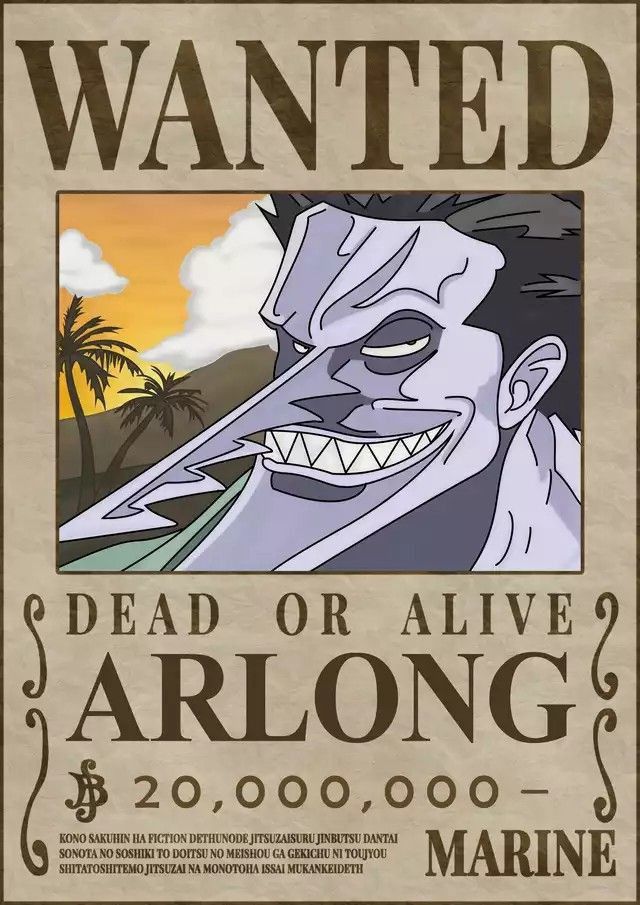
Behold, Arlong the Saw.

Long considered one of the first landmark villains of One Piece, Arlong casts a long shadow across the history of Oda’s pirate epic. In spite of appearing in only two significant story arcs and last appearing in the pages of Jump over a decade ago, he remains a formidable figure in Luffy’s rogue’s gallery. There are many reasons for that.

The first is the most obvious, which is his striking physical appearance. Oda isn’t known for his standard character designs but Arlong is extreme, even for him. The serrated nose and wild, glaring eyes makes the Fishman captain uniquely memorable, so much so that when his sister appears, a decade after Arlong’s last appearance, their shared pupils made it immediately obvious to most that the two characters were related.

Arlong’s physical stature is significant in no small part because of how closely tied it is to his other memorable characteristic – his bigotry.

The pure contempt Arlong holds for human beings comes from an obvious source. As a fishman, he is bigger, stronger and tougher than a human and he can breathe underwater to boot. He routinely demonstrates all those qualities to keep the people who pay him tribute in line. When they don’t pay up he feels no qualms in destroying their livelihoods or ending their lives in order to serve as an example to others. Why should a fishman care for the lives of humans, after all?

Arlong’s insistence on categorizing people by species eventually sets him at odds with the protagonist of One Piece, Monkey D. Luffy. Luffy is unable to grasp why human or fishman are such important categories to Arlong. However, as is often the case, Luffy would have been perfectly happy to ignore Arlong’s ugly prejudice and brutal regime if not for one little detail.

Luffy was trying to recruit a member of Arlong’s crew. The only human member, in point of fact.

Yes, as odd as it sounds the crew known as the Fishman Pirates had a bonafide human girl serving as their chief cartographer and navigator. Arlong brought on the orange haired girl when she was only eight. Nami offered to serve Arlong after the fishman murdered her mother, on the condition that Arlong would allow her to buy back her village for the measly price of 100,000,000 beri, the world’s standard currency. (For those wondering, that’s the rough equivalent of $1,000,000 USD circa the year 2000.)

Luffy meets Nami when she’s in the process of robbing another pirate crew and eventually follows her all the way back to Coco Village and the eventual showdown with Arlong. For the entirety of the storyline, we’re primed to hate Arlong. This is a carefully balanced thing on Oda’s part, because the story goes to great pains to make it clear not all fishmen are like Arlong. In particular, Oda introduces us to the character of Hachi, Arlong’s first mate.

Hachi is a very likeable character. He’s cheerful, helpful and never demonstrates any of the overt prejudice that so clearly defines his captain. He just seems to like people until they give him a reason not to. In this respect, he’s not that different from Luffy. However, Hachi is agreeable to Arlong’s bigotry, so he’s not perfect by any stretch of the imagination.

Yet Hachi is important. Of all the characters introduced in the Arlong Park he is the only one Luffy will meet again.

For the next seven years, more or less, of One Piece’s publishing history very little happens to change our mind about fishmen. We only meet one who isn’t a villain. We meet several more we don’t really care for. Then the Straw Hats arrive at Sabaody Archipelago, an anchorage on the doorstep of Fishmen Island, and they run into Hachi again.

They find him in a cage. He has been captured by human traffickers, who are using him as bait to capture prisoners for a slave auction. This, we learn, has been the fate of fishmen for centuries.

Sabaody Archipelago tells us a lot about the state of the world but for our purposes the most important thing it tells us is the fate of the fishmen. Arlong’s hatred for humanity was ugly and evil. However it sprung up from a fertile soil of other evils such as slavery, ostracisation and dehumanization. That context opens us up to a new understanding of the fishmen we’ve seen before. It prompts Nami to forgive Hachi for his role in Arlong’s pirates. And, ultimately, when we arrive on Fishman Island, it prepares us to hear the story of Fisher Tiger.

The great explorer Fisher Tiger is one of the heroes of Fishman Island and he stands in sharp contrast to the other major figure his story is intertwined with, Queen Otohime. However, in order to understand the crime of Fisher Tiger she is unimportant. So I plan to set her half of the storyline aside and those curious about it can read it at their leisure. They are quite separate stories, for the most part.

What is important to understand about Fisher Tiger is that he lived and died in the past. Luffy and the Straw Hats hear his tale from Tiger’s first mate, a fishman named Jinbei. Among the fishmen, Fisher Tiger is a legend. He united the forces of Arlong and the Fishman Pirates with many powerful warriors from the Ryugu Kingdom, Jinbei first among them, to create the Sun Pirates. Then he dedicated his life to raiding ships and freeing slaves.

To Fisher Tiger, the species of slave did not matter. Slavery was an equal opportunity evil and both humans and fishmen suffered from it. And Tiger was a man particularly suited to recognizing the evil of it, as Tiger himself had suffered the humiliation of being a slave. He was wise enough to see that freeing every slave would create a larger push to abolish the institution than just freeing a few. So he fought against all slavers, although the fishmen may have benefited most from it.

At the same time, Tiger forbid his pirates from senseless killing. While fighting carries the risk of death Tiger knew that any killing beyond that would undo all the work he was doing towards abolishing the system and set fishmen and humans at odds for decades to come. 

The combination of these two strategies made Fisher Tiger very effective.

Unfortunately, it only made him effective in creating pressure to abolish slavery, it did not do much to improve the reputation of fishmen in the wider world. This would eventually lead to his downfall. When not hunting slavers and freeing slaves the Sun Pirates would help liberated slaves find their way home. When they freed an eight year old human girl named Koala they naturally set out to do so.

However, Koala’s home village was fairly far inland. The whole crew couldn’t go with her, so Fisher Tiger took her there himself. Once Koala was reunited with her family Tiger headed back towards the sea but along the way he was ambushed by Marines.

The people of Koala’s village had notified the World Government there was a fishman in their town and they showed up to arrest Tiger. When he refused to surrender they opened fire. Tiger managed to escape this ambush but he was badly wounded. The Sun Pirates were also attacked and lost their ship but managed to capture the Marine ship instead.

Most of the Sun Pirates were fine but Fisher Tiger needed a blood transfusion to survive. The Marine ship had plenty of blood in stock in the sickbay but when it was offered to Tiger he screamed, “No! I would rather die than have their blood inside me!”

In the end, Fisher Tiger lost his long battle against the hatred he had harbored and died saying, “It’s foolish to die and leave only hatred as a legacy. I know that! But my reason is overpowered by the demon in my heart… I cannot love humans. Ever.”

At that moment this was Arlong the Saw.

At that moment, he was me.

After escaping Marine custody due to the influence of his crewmate Jinbei, Arlong would set sail for the eastern oceans with a bone in his teeth. He would take his vengeance on the humanity of those seas, saving his cruelest treatment for an eight year old girl he found begging for the freedom of her village. 

Thus the circle closes and we see the full weight of the evils that had piled up. Arlong was just one final stone in the ever growing pillar of prejudice, hatred and abuse that had been building and building over generations. Yet he might not have been as vile if he hadn’t watched his captain try to break that cycle and fail. If the cycle hadn’t looked so inevitable perhaps even Arlong could have been someone different.

The crime of Fisher Tiger wasn’t that he tried to change the world and end slavery. It was that he tried to change himself and couldn’t.

Around these parts I have a simple concept. That the goal of art is to create an emotional response in the audience. If you are telling a story, try to make the audience share that emotion with a character in the narrative. I call this emotional synchronization.

This storyline, what I call The Last Crime of Fisher Tiger, is buried in four larger story arcs told across a dozen years of publishing history. It is one of the greatest examples of the power of emotional synchronization I have encountered. Through the use of it Oda showed his audience a person they despised.

And let me tell you, we despised Arlong in those days.

Then, over time, Oda gradually maneuvered the audience until we experienced an overwhelming wave of sympathy for Arlong when we saw him heartbroken by Fisher Tiger’s death. This moment was quickly tied back to the Arlong we saw torture Nami, creating a powerful dissonance in the audience. Never have I seen a moral message so seamlessly integrated into a story with such clarity.

Anyone can say, “You, too, would be a monster.”

To take the hand of the audience and slowly and patiently walk them through the path that would make them a monster demands incredible skill. Many writers today wish to tell morality tales. Yet so many of those who attempt it fail miserably. Fisher Tiger is a powerful model they would do well to learn from.

But that isn’t all they should learn from.

After the death of Fisher Tiger a strange custom takes root in the Ryugu Kingdom. The fishmen there refuse to share their blood with any human who passes through their ports. The kingdom isn’t strong enough to directly defy the World Government and this becomes their way of protesting.

In modern times the Ryugu Kingdom is not a peaceful place. Luffy takes up their cause and fights on their behalf, doing much to warm the hearts of Fishman Island towards humans. But things don’t end cleanly. Luffy suffers quite a bit in the battle and at the end he’s in danger of bleeding out. His own crew doesn’t match his blood type. Yet none of the fishmen he’s just saved will help him.

So it falls to Jinbei, Fisher Tiger’s first mate, to break the custom and offer his own blood to Luffy. When Luffy recovers he finds himself linked to Jinbei in more ways than one. So he smiles and says, “Jinbei, join my crew.”

With that, for the first time in centuries, the wound is closed and the crimes of Fisher Tiger are redeemed by his successor. The dawn of the world grows a step closer, and we raise our sails with hope once more.

Revolutionary Incomprehension – On the One Piece Revolutions

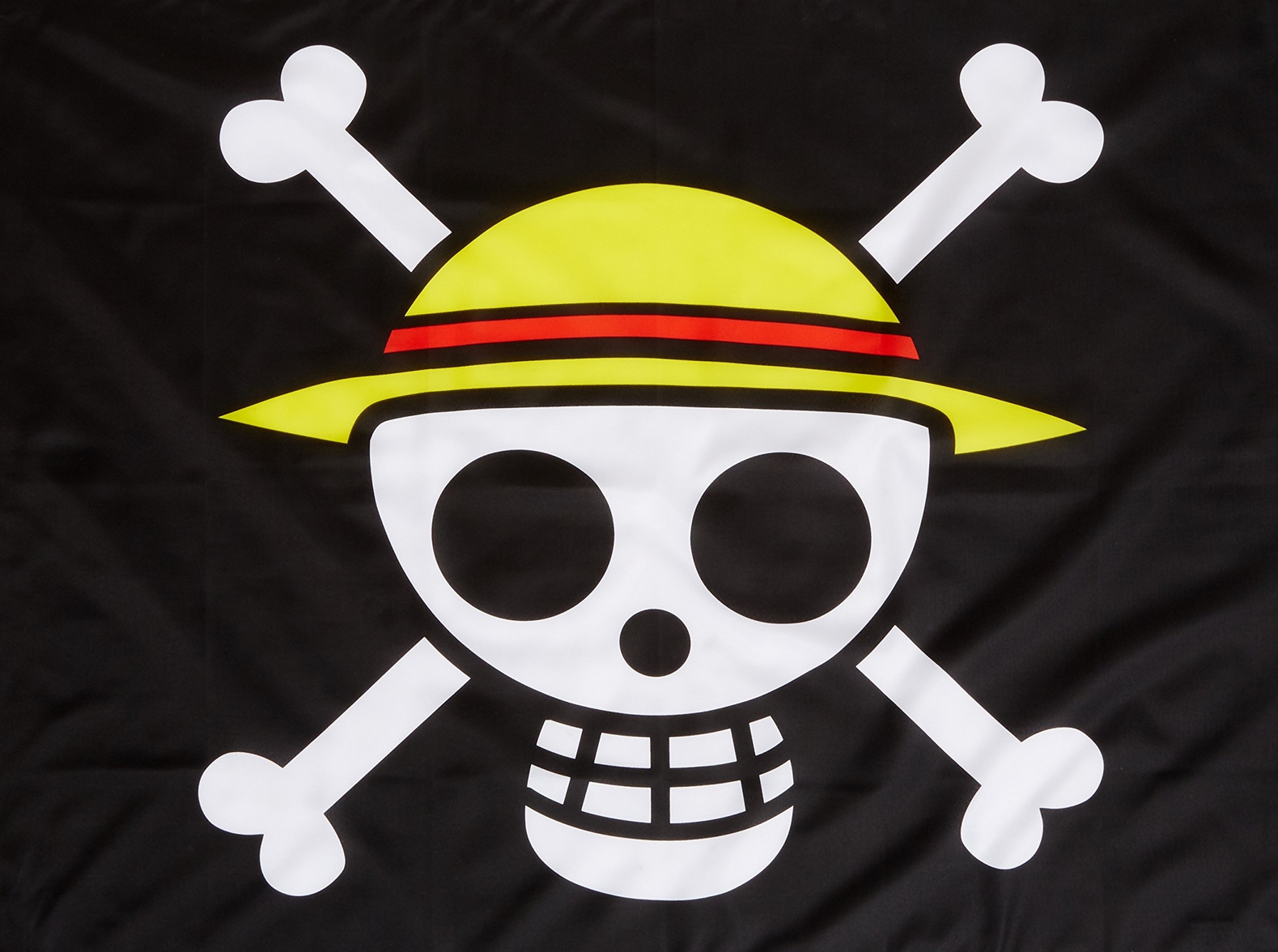
Behold the flag of the Straw Hat Pirates. Once the ensign of a single-masted caravel from the tamest ocean on Planet Bluestar, this flag now flies over the heads of nearly five thousand merry freebooters plying the Grand Line. The most powerful enforcers of the World Government avoid confronting those who fly it. In a world of fictional pirates, those who fly this flag are among the most known and most feared.

On Planet Earth this flag has marched on the capitals of Nepal and Madagascar. The young men and women marching under it have toppled those governments and declared themselves free. The flag has been spotted around Paris, but the French have not surrendered just yet.

As someone who has followed the adventures of the Straw Hats for some twenty years, I have mixed feelings about this.

On the one hand, it is wildly entertaining for me to know that Eiichiro Oda’s mythology has achieved a spot on the world stage. On the other hand, I feel like an important part of the story I know and love is being lost. 

Or perhaps it just hasn’t been seen. One of the most difficult elements of One Piece as a story is how stretched out it is and how buried many of its thematic elements are. Summarizing nearly thirty years of storytelling in one blog article isn’t possible. Summarizing the state of world politics on top of that demands even greater amounts of time and, further, isn’t something I’m well qualified to do.

So I am going to do something that I normally wouldn’t. I am going to point you to an excellent summary of the Nepalese and Madagascar revolutions as covered by Simon Whistler on his Warfronts vertical. Any attempt to recap these upheavals on my own would just be duplicating the work he and his team have already done.

Hopefully that satisfies your curiosity on the current event issues. The initial summary of the Nepal revolution also gives a reasonable summary of why the Gen Z revolutionaries might adopt the Straw Hat flag as their symbol. There are problems with this summary, of course. Simon pronounces Luffy’s name the way it’s spelled in English, for example, whereas the correct pronunciation is “loo-fee.”

Also, the revolutionary reading of One Piece is completely incorrect.

To put all my cards on the table, I am not the first man in the Straw Hat Grand Fleet to find fault with this reading of One Piece. Vice Admiral Liam of Grand Line Review has already done a decent job rebutting it. If you want to hear his thoughts on the issue I will include them here as well.

However, unlike Simon Whistler’s work I will be duplicating a part of Liam’s breakdown here, except from my own perspective. So let’s get started, shall we?

Just in case you didn’t watch the Warfronts videos, a brief argument for why One Piece is relevant to revolutionary movements around the globe goes like this: Planet Bluestar is under the control of a World Government. That government is incredibly tyrannical towards the people who cross it and is guilty of horrific crimes, including endorsing slavery, censorship of history and genocides. Everywhere you look, the people of Bluestar are in chains. 

However, when Monkey D. Luffy arrives in a new location he punches the local tyrants in the face and liberates the people. It is both cathartic and inspiring. The people transform the freed nation into a new, better place and Luffy sails onward, bringing the dawn of the world to the furthest reaches of the planet.

Thus, in conclusion, Monkey D. Luffy is a revolutionary figure whose example we should follow.

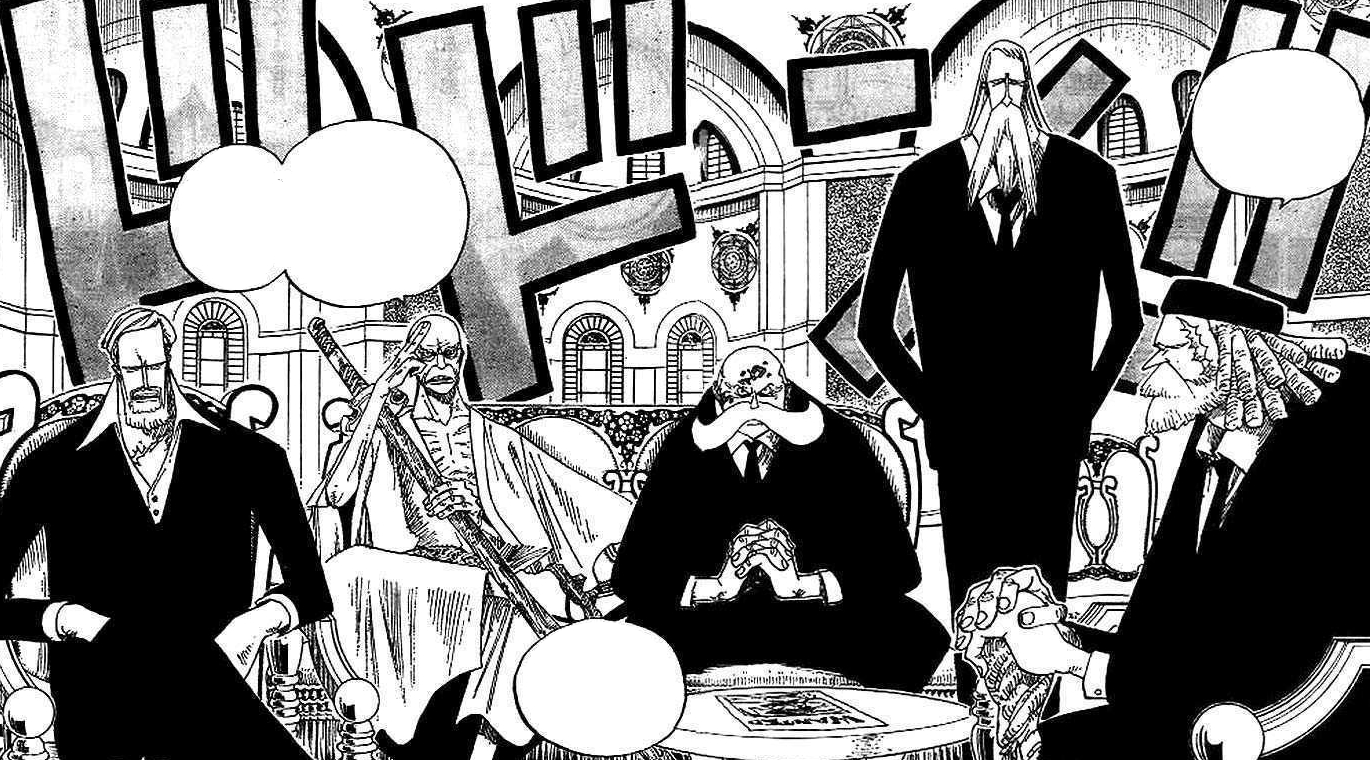
Let me begin my rebuttal to this premise by showing you this image.

These men are the Five Elder Planets, the supreme authoritative council of the World Government. They are one of the most significant antagonistic forces Luffy faces. They also share an important element with the Marine Admirals, another group of powerful World Government antagonists – they all seem to be based on real world people. However, where the Admirals are all based on Japanese actors the Elder Planets are a little more varied.

Let’s look at them from right to left, as Japanese is meant to be read.

The gentleman on the right is Saint Jaygarcia Saturn and his appearance is likely based on Giuseppe Garibaldi, a revolutionary Italian politician who contributed to the unification of the nation in the mid-Eighteenth Century.

Standing next to him is Saint Marcus Mars, whose appearance is probably based on Itagaki Taisuke, a member of the Meiji Revolution that overthrew the Japanese Shogunate and restored the Emperor to power.

Seated in the center in mustachioed splendor is Saint Topman Warcury, whose bald pate suggests his appearance is based on Mikhail Gorbachev, who held power during the revolutions that broke up the Soviet Union.

Beside him is Saint Ethanbaron V. Nuspar, who bears a strong resemblance to Mahatma Ghandi, the man who led the movement for Indian independence from Britain.

Finally, on the left is Saint Shepherd Ju Peter. It’s not clear if his appearance is based on any specific person but his name contains several hints that suggest he is based on Simon Peter, the disciple of Jesus who led the evangelical push that transformed the Roman Empire and, eventually, all of Europe through the establishment of Christianity.

For those keeping score at home, of the five supreme leaders of the World Government, all five are based on real world revolutionaries. There is a message in that, I think.

Very little is known about the founding of the World Government. It came at the end of a period of lost history known as the Void Century, a time period we, the audience, know very little about. All we know for sure is this: during the Void Century the world was ruled by a single, powerful nation. Other civilizations existed, of course, but they were all in thrall to this great power. That nation was eventually overthrown by a coalition of twenty other nations that banded together in a military alliance that would eventually become the World Government. In short, the World Government came into existence by revolting. It is, in and of itself, a commentary on revolutions.

It is not a flattering one.

However the World Government is not the only revolutionary thing to sail the seas of Bluestar. The Elder Planets are opposed by the world’s greatest criminal, Monkey D. Dragon, leader of the Revolutionary Army that works to destroy the World Government’s influence. Dragon has seen the evils of the world first hand and he despises them. His life’s work is to sweep the World Government and its founding families, the Tenryubito, from the face of Bluestar.

Names are important in storytelling but they are especially important in mythic storytelling. One Piece is a mythic tale and Dragon’s name is a signpost left for us from the earliest chapters of its narrative. Of course, it’s very easy to see that Monkey D. Dragon and Monkey D. Luffy must be related. In the Japanese name structure surnames come first so we see that these two come from the same family and thus it is no surprise that Dragon is Luffy’s father.

However, that’s not the only significance to Dragon’s name. It also draws another parallel between the Revolutionary Army and the World Government. The Army was founded by Dragon, the Revolutionary. The Government was founded by the Tenryubito, a term which translates to Celestial Dragons. Trust me, this is not superficial or a chance alignment. This is almost certainly a deliberate choice made to hint at the similar path the Tenryubito and Dragon are on (albeit at very different places along said path.)

Again, One Piece is not drawing flattering comparisons with its use of revolutionaries.

However, the analytical mind will no doubt object to this, recalling that the protagonist of the story is not Dragon but rather his son, Luffy. Surely the son will redeem the failures of his father. Clearly Luffy, who strives to be the most free person in the world, is the model revolutionaries should strive for. Right?

Well.

Let’s talk a little bit about Monkey D. Luffy.

Twice, when given the opportunity to overthrow the monarchs of Alabasta and Fishman Island, Luffy chooses to fight on behalf of those kings against the rebelling citizens instead.

In the kingdom of Dressrossa Luffy chooses to overthrow one monarch to restore the previous king to the throne.

On Drum Island Luffy approves of the election of Dalton as the new king of the nation.

One of Luffy’s first friends is Koby, a young boy who wants to join the Marines and defend the people from pirates. Luffy helps Koby to the nearest Marine base, parts ways on good terms and takes immense satisfaction whenever he hears that Koby’s career is going well, in spite of the fact that the Marines work for the World Government.

When his friend Camie is kidnapped by human traffickers Luffy searches the wares of several slave traders in an attempt to rescue her. He doesn’t lift a finger to help the other slaves he sees.

Luffy is a terrible revolutionary.

To be perfectly clear, Monkey D. Luffy has never once set out to overthrow the governing body or political structure of a nation. It’s not even certain he understands what governments or politics are. Monkey D. Luffy is out to have an adventure, to see new things and go new places, to eventually become King of the Pirates and thus, the most free man in the world.

The pirates, spies, Marines and governments that Luffy destroys are incidental to this process.

The protagonist of One Piece is a fascinating character. In many ways he is a chaos agent, pursuing his own ends without any regard for the social structures that stand in his way. He has no problem helping people he likes but insists he is not a hero. On the other hand, he also has no issue with fighting to the death when he runs into people who he hates.

Luffy is wild, violent, noisy and gluttonous. At the same time he is kind, friendly, warm and encouraging. It can be very difficult to square that circle in the abstract and if you are just looking at Luffy as some kind of a role model you are going to have a very hard time of it. If you are trying to understand him, let me suggest you begin by not viewing him as a role model. That said, analyzing Luffy is yet another thing outside the scope of this post.

What is important to the question of revolutions is how Luffy sets himself free.

You see, Luffy is always free. This is the great secret that underlies One Piece, that makes its protagonist so appealing and interesting to the audience and allows Luffy’s rougher edges to coexist with his softer side. Luffy is free for two reasons.

The first reason is that he takes everything as he finds it. Even if he hates a person, if they do something he likes he will praise them for it. Even if he likes a person, if they do something that makes him angry he will fight them over it. When Mr. 2 Bon Clay offered to work with the Straw Hats, in spite of the fact that Luffy had just destroyed Bon’s organization and sent his boss to jail, Luffy accepted immediately.

Luffy is free from expectations, he’s free from reputations and he is free of the past. With this freedom he chooses to progress towards a future that is promising for himself and those around him, up to the point where those around him actively get in his way. Because of this, Luffy has no need for revolutions. He’s already thrown off all the chains revolutionaries rage against and he didn’t have to scheme, assassinate or steal anything to do it.

The second reason Luffy is free is his own understanding of himself. When Luffy is confronted by Arlong, an amphibious bigot convinced of the superiority of his own species, Arlong asks what Luffy can do that makes him so special. Luffy responds by listing all the things he cannot do. He cannot cook, cannot fight with a sword, cannot lie and cannot navigate. His understanding of these limits drives him to seek out friends who will help him, whose strengths offset his weaknesses, who will make him more than he could be alone.

And, at the same time, Luffy uses the fullness of his own gifts to raise up those friends as far as he can. Because of this, Luffy has no need for revolutions. He has already organized a society that is as beneficial for himself and his friends as it is possible to be.

If Luffy were to spend all his time obsessing over systems and politics it would mean giving up the freedom he treasures. It would mean disregarding the friends who make him strong. It would mean seeing only the ugliness of the world, shackling himself far from the adventures and unexplored places he longs to see. Most of all, it would mean locking himself into the cycle of revolutions his father and the World Government represent, rather than chasing after something new.

There are many reasons to be skeptical of revolutionaries. Their focus on big picture systems frequently blinds them to the vicious damage they inflict on the people they claim to free. The flag of the Straw Hats represents the opposite of that. It’s the standard of a man who values his people and their dreams to the point he will not act until he figures out whether he can ensure everyone gets what they are aiming for.

Ultimately, Luffy is not a real person. He has powers beyond mortal men and he finds himself in situations where his own ideals and physical prowess are what are needed to solve problems. His approach to the ills of his world will rarely translate to ours. But his values often will. That’s why I hope more people will study those, and see what the story really says about them, rather than just mindlessly flying a flag without really understanding what it stands for.