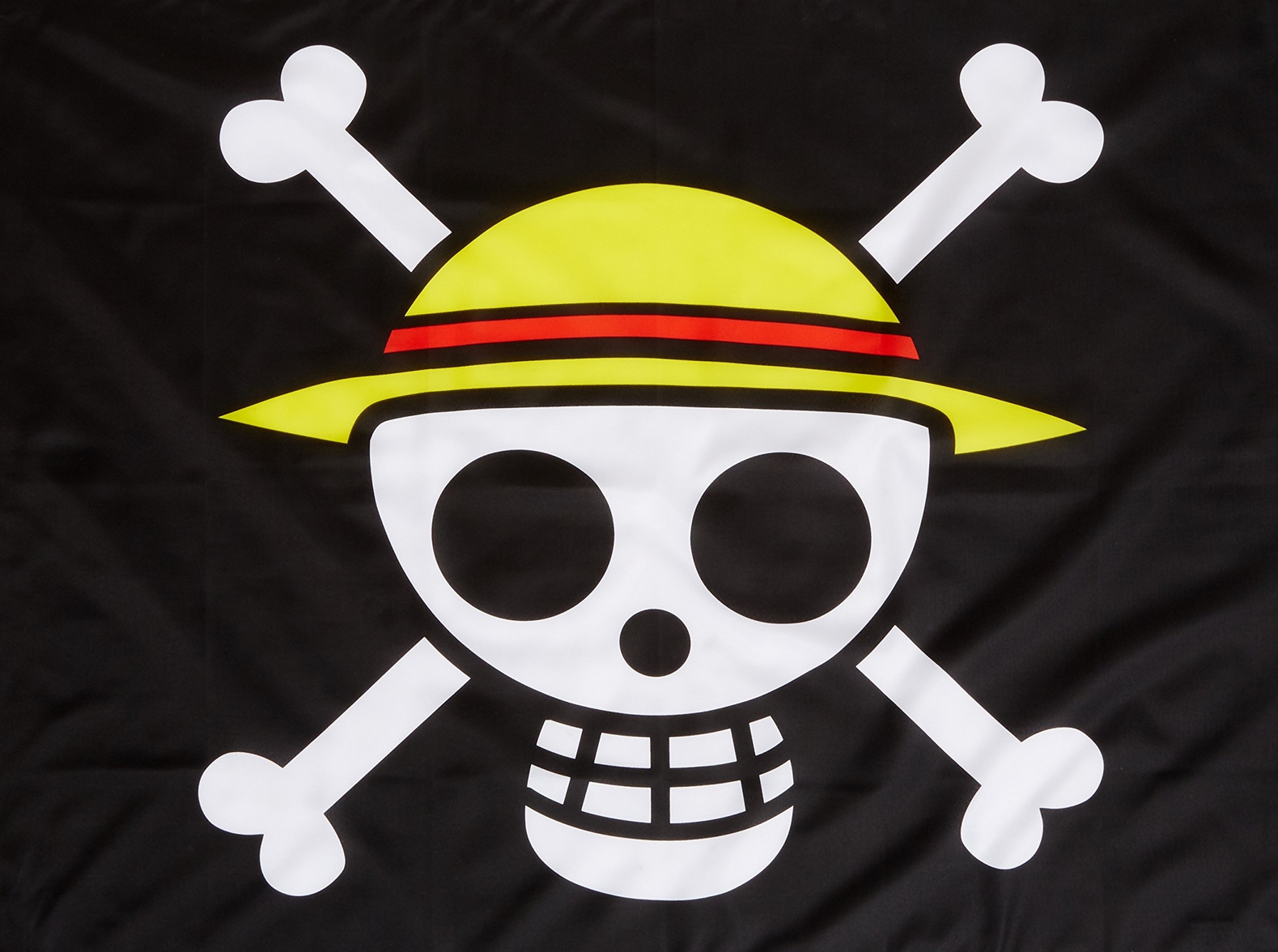
Behold the flag of the Straw Hat Pirates. Once the ensign of a single-masted caravel from the tamest ocean on Planet Bluestar, this flag now flies over the heads of nearly five thousand merry freebooters plying the Grand Line. The most powerful enforcers of the World Government avoid confronting those who fly it. In a world of fictional pirates, those who fly this flag are among the most known and most feared.
On Planet Earth this flag has marched on the capitals of Nepal and Madagascar. The young men and women marching under it have toppled those governments and declared themselves free. The flag has been spotted around Paris, but the French have not surrendered just yet.
As someone who has followed the adventures of the Straw Hats for some twenty years, I have mixed feelings about this.
On the one hand, it is wildly entertaining for me to know that Eiichiro Oda’s mythology has achieved a spot on the world stage. On the other hand, I feel like an important part of the story I know and love is being lost.
Or perhaps it just hasn’t been seen. One of the most difficult elements of One Piece as a story is how stretched out it is and how buried many of its thematic elements are. Summarizing nearly thirty years of storytelling in one blog article isn’t possible. Summarizing the state of world politics on top of that demands even greater amounts of time and, further, isn’t something I’m well qualified to do.
So I am going to do something that I normally wouldn’t. I am going to point you to an excellent summary of the Nepalese and Madagascar revolutions as covered by Simon Whistler on his Warfronts vertical. Any attempt to recap these upheavals on my own would just be duplicating the work he and his team have already done.
Hopefully that satisfies your curiosity on the current event issues. The initial summary of the Nepal revolution also gives a reasonable summary of why the Gen Z revolutionaries might adopt the Straw Hat flag as their symbol. There are problems with this summary, of course. Simon pronounces Luffy’s name the way it’s spelled in English, for example, whereas the correct pronunciation is “loo-fee.”
Also, the revolutionary reading of One Piece is completely incorrect.
To put all my cards on the table, I am not the first man in the Straw Hat Grand Fleet to find fault with this reading of One Piece. Vice Admiral Liam of Grand Line Review has already done a decent job rebutting it. If you want to hear his thoughts on the issue I will include them here as well.
However, unlike Simon Whistler’s work I will be duplicating a part of Liam’s breakdown here, except from my own perspective. So let’s get started, shall we?
Just in case you didn’t watch the Warfronts videos, a brief argument for why One Piece is relevant to revolutionary movements around the globe goes like this: Planet Bluestar is under the control of a World Government. That government is incredibly tyrannical towards the people who cross it and is guilty of horrific crimes, including endorsing slavery, censorship of history and genocides. Everywhere you look, the people of Bluestar are in chains.
However, when Monkey D. Luffy arrives in a new location he punches the local tyrants in the face and liberates the people. It is both cathartic and inspiring. The people transform the freed nation into a new, better place and Luffy sails onward, bringing the dawn of the world to the furthest reaches of the planet.
Thus, in conclusion, Monkey D. Luffy is a revolutionary figure whose example we should follow.
Let me begin my rebuttal to this premise by showing you this image.
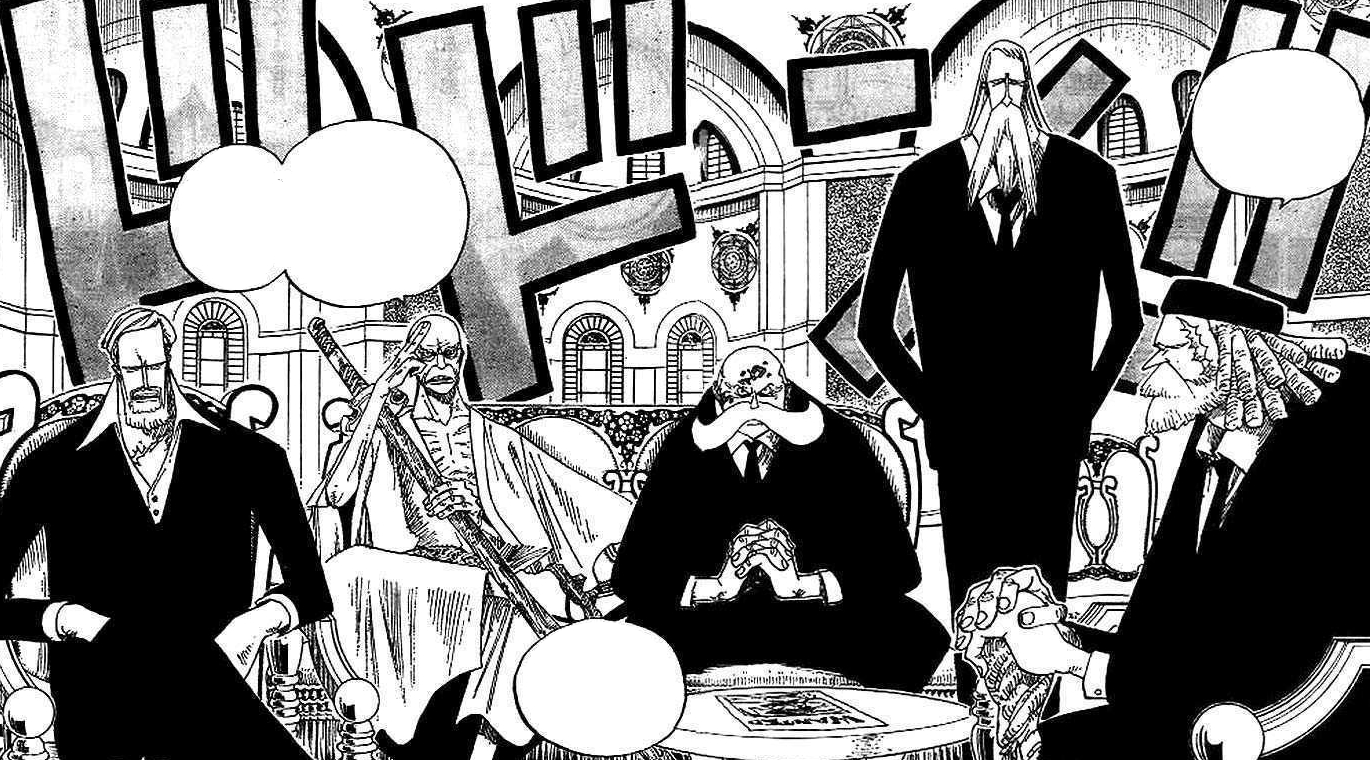
These men are the Five Elder Planets, the supreme authoritative council of the World Government. They are one of the most significant antagonistic forces Luffy faces. They also share an important element with the Marine Admirals, another group of powerful World Government antagonists – they all seem to be based on real world people. However, where the Admirals are all based on Japanese actors the Elder Planets are a little more varied.
Let’s look at them from right to left, as Japanese is meant to be read.
The gentleman on the right is Saint Jaygarcia Saturn and his appearance is likely based on Giuseppe Garibaldi, a revolutionary Italian politician who contributed to the unification of the nation in the mid-Eighteenth Century.
Standing next to him is Saint Marcus Mars, whose appearance is probably based on Itagaki Taisuke, a member of the Meiji Revolution that overthrew the Japanese Shogunate and restored the Emperor to power.
Seated in the center in mustachioed splendor is Saint Topman Warcury, whose bald pate suggests his appearance is based on Mikhail Gorbachev, who held power during the revolutions that broke up the Soviet Union.
Beside him is Saint Ethanbaron V. Nuspar, who bears a strong resemblance to Mahatma Ghandi, the man who led the movement for Indian independence from Britain.
Finally, on the left is Saint Shepherd Ju Peter. It’s not clear if his appearance is based on any specific person but his name contains several hints that suggest he is based on Simon Peter, the disciple of Jesus who led the evangelical push that transformed the Roman Empire and, eventually, all of Europe through the establishment of Christianity.
For those keeping score at home, of the five supreme leaders of the World Government, all five are based on real world revolutionaries. There is a message in that, I think.
Very little is known about the founding of the World Government. It came at the end of a period of lost history known as the Void Century, a time period we, the audience, know very little about. All we know for sure is this: during the Void Century the world was ruled by a single, powerful nation. Other civilizations existed, of course, but they were all in thrall to this great power. That nation was eventually overthrown by a coalition of twenty other nations that banded together in a military alliance that would eventually become the World Government. In short, the World Government came into existence by revolting. It is, in and of itself, a commentary on revolutions.
It is not a flattering one.
However the World Government is not the only revolutionary thing to sail the seas of Bluestar. The Elder Planets are opposed by the world’s greatest criminal, Monkey D. Dragon, leader of the Revolutionary Army that works to destroy the World Government’s influence. Dragon has seen the evils of the world first hand and he despises them. His life’s work is to sweep the World Government and its founding families, the Tenryubito, from the face of Bluestar.
Names are important in storytelling but they are especially important in mythic storytelling. One Piece is a mythic tale and Dragon’s name is a signpost left for us from the earliest chapters of its narrative. Of course, it’s very easy to see that Monkey D. Dragon and Monkey D. Luffy must be related. In the Japanese name structure surnames come first so we see that these two come from the same family and thus it is no surprise that Dragon is Luffy’s father.
However, that’s not the only significance to Dragon’s name. It also draws another parallel between the Revolutionary Army and the World Government. The Army was founded by Dragon, the Revolutionary. The Government was founded by the Tenryubito, a term which translates to Celestial Dragons. Trust me, this is not superficial or a chance alignment. This is almost certainly a deliberate choice made to hint at the similar path the Tenryubito and Dragon are on (albeit at very different places along said path.)
Again, One Piece is not drawing flattering comparisons with its use of revolutionaries.
However, the analytical mind will no doubt object to this, recalling that the protagonist of the story is not Dragon but rather his son, Luffy. Surely the son will redeem the failures of his father. Clearly Luffy, who strives to be the most free person in the world, is the model revolutionaries should strive for. Right?
Well.
Let’s talk a little bit about Monkey D. Luffy.
Twice, when given the opportunity to overthrow the monarchs of Alabasta and Fishman Island, Luffy chooses to fight on behalf of those kings against the rebelling citizens instead.
In the kingdom of Dressrossa Luffy chooses to overthrow one monarch to restore the previous king to the throne.
On Drum Island Luffy approves of the election of Dalton as the new king of the nation.
One of Luffy’s first friends is Koby, a young boy who wants to join the Marines and defend the people from pirates. Luffy helps Koby to the nearest Marine base, parts ways on good terms and takes immense satisfaction whenever he hears that Koby’s career is going well, in spite of the fact that the Marines work for the World Government.
When his friend Camie is kidnapped by human traffickers Luffy searches the wares of several slave traders in an attempt to rescue her. He doesn’t lift a finger to help the other slaves he sees.
Luffy is a terrible revolutionary.
To be perfectly clear, Monkey D. Luffy has never once set out to overthrow the governing body or political structure of a nation. It’s not even certain he understands what governments or politics are. Monkey D. Luffy is out to have an adventure, to see new things and go new places, to eventually become King of the Pirates and thus, the most free man in the world.
The pirates, spies, Marines and governments that Luffy destroys are incidental to this process.
The protagonist of One Piece is a fascinating character. In many ways he is a chaos agent, pursuing his own ends without any regard for the social structures that stand in his way. He has no problem helping people he likes but insists he is not a hero. On the other hand, he also has no issue with fighting to the death when he runs into people who he hates.
Luffy is wild, violent, noisy and gluttonous. At the same time he is kind, friendly, warm and encouraging. It can be very difficult to square that circle in the abstract and if you are just looking at Luffy as some kind of a role model you are going to have a very hard time of it. If you are trying to understand him, let me suggest you begin by not viewing him as a role model. That said, analyzing Luffy is yet another thing outside the scope of this post.
What is important to the question of revolutions is how Luffy sets himself free.
You see, Luffy is always free. This is the great secret that underlies One Piece, that makes its protagonist so appealing and interesting to the audience and allows Luffy’s rougher edges to coexist with his softer side. Luffy is free for two reasons.
The first reason is that he takes everything as he finds it. Even if he hates a person, if they do something he likes he will praise them for it. Even if he likes a person, if they do something that makes him angry he will fight them over it. When Mr. 2 Bon Clay offered to work with the Straw Hats, in spite of the fact that Luffy had just destroyed Bon’s organization and sent his boss to jail, Luffy accepted immediately.
Luffy is free from expectations, he’s free from reputations and he is free of the past. With this freedom he chooses to progress towards a future that is promising for himself and those around him, up to the point where those around him actively get in his way. Because of this, Luffy has no need for revolutions. He’s already thrown off all the chains revolutionaries rage against and he didn’t have to scheme, assassinate or steal anything to do it.
The second reason Luffy is free is his own understanding of himself. When Luffy is confronted by Arlong, an amphibious bigot convinced of the superiority of his own species, Arlong asks what Luffy can do that makes him so special. Luffy responds by listing all the things he cannot do. He cannot cook, cannot fight with a sword, cannot lie and cannot navigate. His understanding of these limits drives him to seek out friends who will help him, whose strengths offset his weaknesses, who will make him more than he could be alone.
And, at the same time, Luffy uses the fullness of his own gifts to raise up those friends as far as he can. Because of this, Luffy has no need for revolutions. He has already organized a society that is as beneficial for himself and his friends as it is possible to be.
If Luffy were to spend all his time obsessing over systems and politics it would mean giving up the freedom he treasures. It would mean disregarding the friends who make him strong. It would mean seeing only the ugliness of the world, shackling himself far from the adventures and unexplored places he longs to see. Most of all, it would mean locking himself into the cycle of revolutions his father and the World Government represent, rather than chasing after something new.
There are many reasons to be skeptical of revolutionaries. Their focus on big picture systems frequently blinds them to the vicious damage they inflict on the people they claim to free. The flag of the Straw Hats represents the opposite of that. It’s the standard of a man who values his people and their dreams to the point he will not act until he figures out whether he can ensure everyone gets what they are aiming for.
Ultimately, Luffy is not a real person. He has powers beyond mortal men and he finds himself in situations where his own ideals and physical prowess are what are needed to solve problems. His approach to the ills of his world will rarely translate to ours. But his values often will. That’s why I hope more people will study those, and see what the story really says about them, rather than just mindlessly flying a flag without really understanding what it stands for.
 Nate Chen Publications