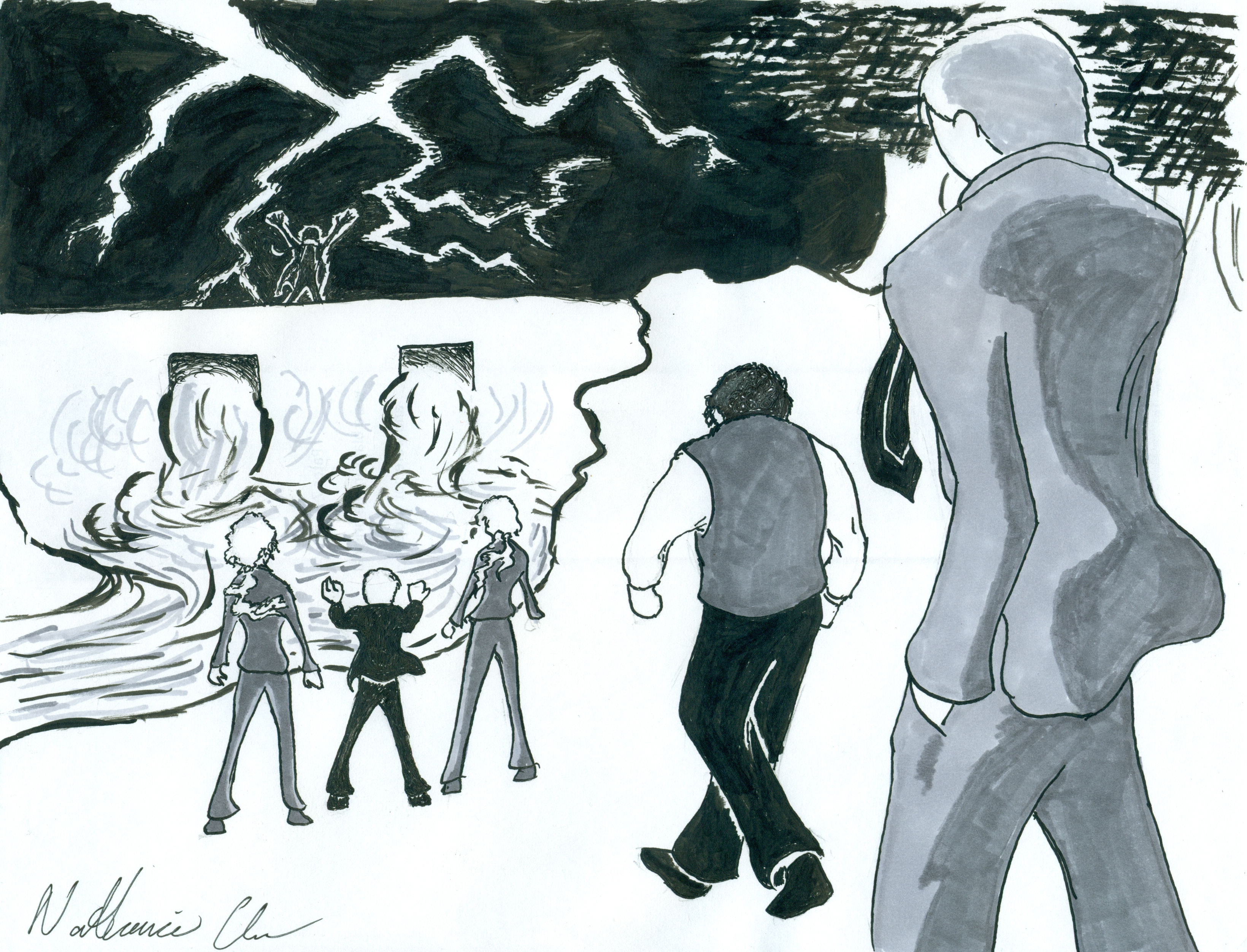
Local Theater: 1984

It’s theater time again. This show isn’t a happy one, it isn’t a fun one and it isn’t a family event. This time around, all for One Productions is taking us into the darkness of what could have been. We’re going to visit Big Brother.

George Orwell’s 1984 is one of the darkest visions of the human condition there has ever been. It surpasses Blade Runner, it surpasses Logan’s Run, it surpasses Brave New World. There’s no allowance for hope, or joy, or even fun in 1984. There’s only the all consuming power of the Party, paranoia, hate and despair.

The tale remains a classic because the people and the ideas it talks about are so eerily familiar. It’s something we could see happening at some point. There have been close shaves with these kinds of states before – Stalinism, Nazism, Maoism. Modern Cuba and North Korea. The list is long, and that’s just the last century or so.

We watch it to jolt ourselves out of comfort, to brace ourselves to confront the evil wherever it may raise it’s head. Come and see 1984. It will disturb you – and that will be a good thing.

Shows are May 2nd-4th and 9th-11th at the Main Branch of the Allen County Public Library. Ticket information can be found here.

Water Fall: Raging Rapids

One Week, One Day After the Michigan Avenue Proclamation 

Massif

The first time Double Helix made history he turned a couple of thousand square feet of Death Valley, Nevada to molten glass. That was during a routine set of exercise conducted when he first joined the Project. They were trying to establish a baseline for his talent. By the metrics we use he’s the strongest heat sink on record, weighing in as nearly twice as powerful as the next strongest we know of.

When he set out to show Circuit how making history was really done I got a little nervous. The man just doesn’t know the meaning of half measures.

But then, we were already making history. For the first time since the Civil War we had talents moving in teams that didn’t include oversight officers. Both Helix and Amp’s teams were pure talent. And as soon as we were away from the clearing around the chopper Samson leapt in front of the group and took off alone at a pace way beyond anything a normal human could hope to match. All the field oversight and tactical people who weren’t guarding our helicopter were in my group. In some respects I’d actually gotten the shorter end of the stick.

The guy I knew the least about was HiRes, he was supposedly invisible but I could still see him moving as clearly as I could see anything in a windy forest full of swaying trees – which isn’t that clearly, in case you were wondering. Jack and Dominic both insisted they didn’t know where he was and I was still going along with that, at least for the time being. Along with Mr. Not-So-Invisible and those two tactical leaders I had the rest of Helix’s tactical team and Agents Herrera and Sanders, giving me the Project’s foremost experts on Circuit’s history and tactics. Templeton had been forced to remain at the chopper with the other two members of my support team but Hush or Amplifier could forward his thoughts to us if we needed them.

I was sure Dom and Jack were reliable, they’d been in the Project longer than I had and I knew their records before they joined up. The rest, well, the biggest positive I knew of was that they worked with Helix. That means lots of field experience, most of it with situations teetering on the edge of disaster. But smooth running, uneventful operations? Those were a lot rarer in Helix’s casefiles. It made me a little nervous.

Of course, they’d all survived those situations, which had to mean something, right?

“You okay?” Dominic asked me, his eyes scanning back and forth as we lead our group forward. He was trailing just a half step behind me and to my left as we pushed through the thin undergrowth of southern Indiana river country.

“Circuit’s people have seen what I can do,” I said, a non sequitur that would make sense to him, if not the other people with us. A huge part, and I do mean vital, of what makes my talent effective is the fact that it comes as a surprise to people who have never encountered it before. Bullets, punches, getting hit by cars, none of it is particularly dangerous to me so long as I can keep my footing. Getting set on fire, breathing sleep gas, getting cut with a good sharp knife or just having a fire hose pointed at me, those are things that affect me just like everyone else. Most of the time I manage to wrap up tactical situations before anyone thinks of that kind of thing but this time I was walking into round three with a bunch of people who had not only seen me before but were used to the idea of talents existing and thinking of work arounds for that fact. It was making me a little nervous.

And when you put all those little cases of nerves together you got a great big helping of insecurity. I didn’t like the way things were shaping up at all and the loose dirt and random woodland detritus making the ground under my feet that much more unpredictable was just icing on the cake.

With the satellite intelligence we’d managed to gather and the cooperative efforts of a dozen of our best analysts we’d figured out which one of the three bunkers Circuit had built was likely to hold his headquarters. The general idea of my part of the operation was to cut through the woods and hit the bunker, try to take out the center of operations in case Helix or Samson’s end of things didn’t succeed or just serving as a distraction to help them on their way. It hadn’t escaped our notice that we were essentially playing Circuit’s game of parallel gambits against him but, in this case Analysis was fairly sure Circuit didn’t have the people to counter our separate moves even if he recognized our game.

According to Dom’s GPS we were most of the way to the bunker we wanted when we stopped to get our bearings at the intersection of two trails. We were almost at the end of the part of the park open to the public, most everything south of us was supposed to be undeveloped woodland. Dominic wanted to be absolutely sure of where we were before we left behind all usable landmarks, just in case Circuit decided keeping his communications grid up wasn’t worth letting us keep ours.

Dom had just confirmed that we were where he thought we were when the stern, stolid voice of Hush said, “I hear something in your area.”

After nearly a month of working with Amplifier this kind of thing didn’t bother me nearly as much as it would have before. Even Dom didn’t react much, just starting a little then asking, “Are you sure it’s not just an animal or something?”

“Trust me, animals don’t make nearly as much noise as people do, not when they’re in their native habitat.” It was hard to tell for sure but Hush sounded a little condescending as he said it, as if the inability to be quiet was a great failing on our part. “Samson has already gone inside his target and Helix’s group is nowhere near your location.”

“Got it, Hush,” I said. “We’ll deal with it. That’s what we’re here for.”

There was a moment of quiet, then, “Templeton says be careful. I’ll be listening.”

That rather creepy statement was Hush’s way of signing off. I turned to Dom and said, “Let’s take care of business.”

The National Guard had, with much reluctance, agreed to give us gear that matched our surroundings a little bit better than what Project Sumter kept on hand. Most of our work was done in the places where talents are likely to get noticed – in large towns or cities. There’s probably plenty of talented people out in the countryside, but they don’t get noticed nearly as often so we don’t know about them. So our guys, with the exception of Kesselman who was still pretty out of practice, aren’t trained for tactical situations out in the wilds. In case you were wondering, this was the National Guard’s biggest argument for why they should have handled Circuit rather than us.

I have to admit, watching our agents fan out along the side of the path in a rather clumsy fashion, I kind of saw where they were coming from. Still, it was our case and we had the experience. It was time to prove we were the best people for the job.

As soon as Dominic signaled that everyone was in position I walked out into the center of the crossroads, planted my feet, clasped my hands across my back and said, “May I have your attention, please. I am Special Agent Aluchinskii Massif of Project Sumter. This is a raid to apprehend the known terrorist and traitor calling himself Open Circuit, wanted in connection with the recent attack on Michigan Avenue, the death of an agent of the Federal Government and numerous other charges. If you surrender now and offer to testify you will be shown leniency during prosecution.”

There as a moment’s pause then I heard Hush, sounding about as amused as I’d ever heard him, saying, “They think you’re high and they’re daring each other to shoot you.”

Reports suggested Circuit had both hardened mercenaries and more run of the mill criminals working for him. I was guessing these were the latter. Just to make sure all the bases were covered I said, “If you resort to force we will respond in kind.”

Then they really did shoot me.

It was a pretty good shot, hit me just below the left collar bone and bounced off the vest I was wearing. Normally I wouldn’t have bothered with the bulky thing but footing was bad enough out in amongst nature that I didn’t want to be caught without one if I lost my footing. This time it wasn’t necessary as the bullet came to a total stop as soon as it touched me, all it’s forward momentum bleeding into the ground at my feet. I sighed and started forward at my usual deliberate pace.

One genius, who probably thought he was some kind of stone cold killer, came up out of the trees on the far side of the road, carefully squeezing off shots from his semiautomatic as he walked towards me. No doubt he though that since I was playing it cool and doing the impressive slow walking thing he had to do the same or loose face. Of course, he didn’t realize I was kind of bulletproof and he wasn’t. Not until one of his shots caught me square in the cheek and tumbled off without leaving anything worse than a light red mark, and that because the bullet was hot and not because of the force of the shot.

That was enough for him to realize he was tangling with something he didn’t understand but by then it was too late. He was close enough for me to reach out and grab his outstretched gun hand, twist his arm until the joints locked, then pull him off balance and straight into my knee. He doubled over and dropped to the ground, I kept hold of his arm only long enough to pull the gun from it before I let him go. Disassembling a pistol only takes a few seconds if you know what you’re doing and as long as you keep the gun barrel the rest of the pieces are useless but you have no chance of hurting yourself with a misfire or later giving up a weapon to your enemy. By the time that was done the other members of my hapless victim’s group were cursing loudly and had started shooting at me for real. I went to pay them a little visit.

I managed to drop another one with a quick grab and elbow combo, then grabbed a third by his leg, flipped him onto his back and wrenched his ankle until it made unhealthy sounds. That looked to be half of the little group out of commission but by that point they’d figured out that, just like a mummy in a bad horror movie, I couldn’t move much faster than a very deliberate walk and all they had to do was hustle a little bit faster than me stay out of reach. On the other hand, their bullets weren’t really doing much besides make me angry.

Of course all that attention on me kept them from noticing Jack’s group slipping around behind them and cutting them off. It was three on three and I meant to pitch in – not that I doubted Jack’s team but you can never be too certain in these kinds of situations. Problem was when I went to take the next step towards them I found my feet were stuck to the ground. I flashed back to the robbery at the Allen County Library at the same moment a hand landed on the back of my collar.

I twisted and hooked arms with my assailant, keeping her from throwing me to the ground. I couldn’t move my feet but that was less of a problem for someone with my training than it might have been for others. I dropped my hips and twisted, aiming to bring Grappler forward enough to hip check her to the ground. But somewhere in the process the arm I was holding became very slippery and I lost my grip. I heard, rather than saw, her staggering back a few steps. Then I heard someone yelling, “Grappler! Get back to the dam!”

At the same time I saw Dom and Teresa, who had flanked my other side to try and catch the guards in a pincer, moving up through the brush and exchanging gunfire with a new group somewhere in the distance. Grappler turned and bolted, her trail of movement quickly getting lost in the brush. I looked down at my feet, still stuck to the ground by the abused laws of friction, and tried to pull them free. After a couple of minutes effort Dominic joined me and said, “If you give it about fifteen minutes it should wear off.”

“I don’t know if we have that kind of time,” I said.

“Look on the bright side,” he replied. “At least she didn’t manage to lay you out flat on the ground.”

“I’m not sure we can afford to keep going,” Teresa added. “We’ve got six suspects in custody here. We can’t watch them and safely follow another squad of that size with the number of people we have on hand.”

“They said they were headed towards the dam,” I said.

She shifted and put her hands on her hips, a thoughtful pose for her. Then she shook her head and said, “Helix can look after himself.”

I just grunted and started investigating how big a patch of ground around me had been transformed to work like flypaper, thinking I might just take my shoes off and jump clear of the affected area. I’d determined that it was only a couple of feet wide and had just reached for my shoelaces when there was an impossibly loud cracking noise, followed by a sound like the waves on a distant beach. I glanced up, even though there was nothing to see. “Hush? Amp? What just happened?”

Fiction Index
Previous Chapter
Next Chapter

I Hate Zombies – Themes That Eat Your Brain

It’s part two of I Hate Zombies week. Here’s part one, in case you missed it.

If you were wondering, this post is not another screed of geeky nitpicking on why zombies are stupid, lazy plot devices that exist only to create irrational fear in the back of your mind. All that is true, but it’s kind of true of all plot devices and anyway it’s not what I’m on about today. Also let me say that it’s not related to my intense, longstanding, deep seated hate towards vampires, even though vampires and zombies probably share their origins in the bizarre behavior of people afflicted by rabies. I hate vampires for totally different reasons than those that drive my hatred of zombies. Maybe one day there will be time for I Hate Vampires week.

But this week, we look at zombies.

I’ve already hashed all my problems with zombies as the plague on Wednesday, so I’m going to ignore all the things that make zombies patently ridiculous. Anyone who’s seen a solid action movie knows that the patently ridiculous can actually be a selling point of a good story, so the real question is less, why are zombies ridiculous? And more, what keeps them from having redeeming value?

I’m going to pick on The Walking Dead again, or really a lot of the people I’ve heard talking about The Walking Dead. These people, from the reviewers on the internet to the guy I share my apartment with, insist the story is not about the zombies or fighting them, its about the characters and how they survive.

I’ve also noticed that The Talking Dead, a talk show which follows The Walking Dead, always contains a one to three minute slow-motion recap of all the zombie deaths that occurred in an episode. I take their assertions with a small salt shaker.

Now I’ve not watched this show, but I’ve read a volume or two of the graphic novels they’re based on. I’m hardly an expert on the series. But I’ve noticed that, just like most zombie stories, the general rational for people’s behavior is: “They do what they have to in order to survive. It’s a different world.”

And if you pay any attention to these stories, anyone who tries to stand on anything higher than pragmatism tends to wind up as zombie fodder quick. And as survival becomes more and more the goal of the characters they loose perspective, loose the ability to plan for anything but the next zombie attack, where their next meal is coming from. Sure, the logic holds up but what does it really offer the audience? It’s nifty that the writers have thought of all these ways to stay alive in unrealistic circumstances but you’re not really bringing anything relevant to day to day life and the typical zombie story doesn’t really uplift the audience, either, but leaves them with a grimmer, more selfish mindset.

Yes, the central characters of these stories often try to behave with generosity and decency. But by the end, nine times out of ten, we’ll find they’ve “accepted” the reality of the situation – everyone’s going to be a zombie in the end. Even if you die a natural death most zombie stories don’t let you stay down. Everyone’s just an enemy waiting to happen, and you can only coexist until they turn on you.

Which brings me to the next thing I hate about zombies, and that’s the blatant encouragement of violence. Now I love action movies as much as the next guy, and I’m particularly fond of stupid kung-fu flicks due to the pure athleticism the display, so I’m not saying violence has no place in storytelling. But the violence in zombie stories? It’s in a dimension all its own.

Beating zombies in the face with road signs until eyeballs fly, stabbing them through the mouth and into the brain with a sharpened wooden stake, blowing their skulls into fragments with a shotgun – zombie violence is brutal. Now you can say that they’re just dead bodies, not people anymore (and you’d be wrong, because your body is a part of you, whether it’s functioning or not) but the fact is this violence inevitably spills over onto the living people as arguments arise or people betray the group. Witness the brutal violence between the Governor and members of the central group in The Walking Dead, particularly the emasculation that takes place in the comic version. It doesn’t take long for the philosophy that everyone’s just a zombie waiting to happen to pour out into violence. Witness the brutal final fights between the newsies and the conspirators at the end of the Feed trilogy. And these are the examples from zombie fiction at it’s best. These are the stories that try their hardest to have some kind of meaning on top all the other mess. I’m just not sure it carries convincingly over the din of violence and nihilism, that it’s really worth hearing we’re just zombies waiting to happen, but at least before we become the rotting dead we can do something that the living will remember fondly for a time.

And perhaps that’s ultimately the thing I hate about zombies. It’s the implication that we’re all just mindless drones waiting to happen, at worst tearing one another down and leaving nothing but suffering and emptiness in our wake, or at best leaving a hollow happiness for a short time, that I really dislike about zombie stories. I write to try and make people a little more aware, a little more thoughtful, a little more devoted to God and one another. Could you do that with a zombie tale? I don’t know – maybe. But the tone and conventions that seem to run through them makes me doubt it.

I Hate Zombies – Because Braiiiins…

In honor of the recent conclusion of this season of The Walking Dead, I offer you this thought:

Zombies are stupid.

I don’t mean they’re mindless, shambling creatures of pure appetite, although there is definitely that to take into account. Rather, I mean that they are the result of very lazy storytelling, resulting in plots and themes that are full of more holes than their antagonists!

Now I should mention that most of my ire here is going to be directed at zombies as they appear in popular culture, movies like I Am Legend or 28 Days Later, or written fiction like World War Z (which, admittedly, I really enjoyed) or Feed. And, of course, The Walking Dead is a TV phenomenon about zombies in the “modern” vein. These modern zombies are supposed to be disease carriers, or possibly druggies, as opposed to creatures created by magic, evil spirits or other supernatural forces. I dislike supernatural undead, too, but this isn’t the set of posts for that particular gripe.

So what, exactly, are my gripes with the zombie plague horror story?

Let’s start with the zombies being disease ridden plague carriers. At some point, and I’m going to go out on a limb and guess that it was some kind of reaction to the incredible campiness of The Evil Dead franchise (DISCLAIMER: I’ve never watched these movies but there are stories…), it was decided that zombies as the result of sorcery or other supernatural meddling wouldn’t be taken seriously anymore. So people settled on this disease idea.

And that’s probably not a terrible idea, since people with rabies are likely the source of the zombie/vampire/ghoul/wraith ur-legends. The problem is, people insist on keeping the trappings of sorcerous zombies, like the person actually being dead, impervious to pain and not having body heat (to name a few). Problem is, these “more real” zombies are actually less believable than zombies that result from occult forces.

You see, moving takes energy. Living people get the energy to move around chemically, by metabolizing sugars from the food they eat. Zombies get energy by… well, no one ever bothers to think about this, because zombies are the result of writers being lazy and their audience letting them get away with it. Seriously, they don’t have a working metabolism so they can’t actually eat food or burn body fat. And if they did burn old tissue for fuel they’d quickly run their bodies down to nothing, because they never do more than sink their teeth into a victim before they run off after something else and a new zombie rises to take their place in the ranks of the horde. A “real” zombie would have to strip it’s victims to the bone to get enough calories to keep going, there wouldn’t be anything left to add to the ranks.

Which brings me to another aspect of lazy writing: with the exception of Feed, I’ve never read a zombie story where zombies went after anything other than humans. Why is that? There’s all those calories out there, waiting to keep the zombies going, and they ignore them! Likewise, how can zombies tell that other zombies are already plague carriers and should be left alone? Why not eat them, too?

At least drug addled zombies theoretically keep enough of their wits about them to recognize that they need food and water, but that doesn’t explain why they would desire to add to their ranks or why their drugs would spread to people bitten by them. The endless swarm is one of the defining characteristics of zombies, you can’t make one without the ability to spread the plague. I think that’s why you see so few plots with drug zombies in them.

And that reminds me of another thing. How do dead things move around, anyway? A juju zombie is a puppet for whatever evil is keeping it going, but a zombie that results from a disease? Most viruses and bacteria only have enough room in their DNA for mechanisms that allow them to replicate themselves and infect hosts to help them do it. Zombie fiction frequently tries to foist off zombie behavior as part of the infection’s reproduction drive but that’s just ridiculous.

It’s one thing to say that a virus can cause increased mucus production by settling in the sinuses, as a cold does, as part of it’s survival process. Rabies is the same – it infects nerve tissues, eventually causing inflammation of the brain that leads to violent behavior and biting attacks (which infect others) and death. These things are the results of the body’s normal attempts to fight off the disease, processes that just so happen to result in the disease spreading to other people as well. But when the body is dead there are no natural processes to spread the disease.

The zombie virus has to be doing all the work itself – firing the neurons that make the limbs move, processing visual and audio input to locate prey and then telling when you’ve successfully bitten the victim and it’s time to move on. The virus has to do all of that, and still be a small enough organism to be transmitted from one person to another by saliva. Are you starting to see why I find this idea so absurd?

Oh, and let’s not forget zombie resilience. Another thing that makes no sense. The human body is fairly delicate, people. Cut a muscle and all those around it become strained. The muscle fibers around the wound become overworked, pull apart and stop working and pretty soon you have a chain reaction that leaves the body immobilized. Sure, zombies won’t feel the pain – although I’m not sure why they won’t since they can still see and hear and sometimes smell – but that just means they won’t realize the body is breaking down, not that it’s still functional. Because it’s not.

And then there’s the 100% infection rate. No one ever survives a zombie bite. Why? It makes no sense. No one ever tries to justify it. We’re just told that’s the way it is. The writing is so lazy it’s infuriating.

I could go on. (Why don’t zombies get infested by maggots?) But the fact is, people are going to go right on creating novels, TV shows and movies based on zombies and ignoring the fact that they make no sense because they keep making money. Only a very few people will be turned off by the absurdities of the concept because a story with the right themes and good technique can overrule both logic and sense using style and humor.

My real problem with zombies runs a little deeper than that. Hopefully you’ll come back on Friday, when we dig a little deeper into the problem – maybe deep enough to bury it for good.

Water Fall: Cauldron Boiling

One Week, One Day After the Michigan Avenue Proclamation

Circuit

Hangman jerked up from her computer and yelled, “Circuit! They’re in the park!”

I slammed the updates SImeon had given me along with my morning coffee onto the table in the ops room and hurried over to her station. “Where? How did they get in?”

“They’re in the northeast quadrant, Heavy’s zone. I’m not sure how it got there without our seeing it but it looks like they brought a helicopter in.” She spun her monitor so I could see.

Sure enough there was a chopper, it’s blades spinning slowly, with a small group of a dozen or so people in a loose grouping around it. I spotted the distinctive stocky shape of Pastor Rodriguez, or Samson as they’d called him at the press conference, and nearby the leaner but equally tall man they’d called Aluchinskii Massif. He was exchanging words with a much shorter man who I guessed to be Double Helix. A few seconds later the two broke apart and the group separated into three distinct units. Helix left with two blonde women in tow, heading towards the southwest, Massif and Samson left with the bulk of the remain agents heading due south and the last two split the difference and went down the center.

“This isn’t good. I’d bet anything those two are wave makers.” I drummed my fingers impatiently on the desk. “Probably serving to relay messages between the two groups. They won’t even have communications we can knock out with the Empion grenades.” With a wave I caught the attention of one of the techs over at the maglev controls. “Switch over from the Empion launcher settings to manned flight. Then have Heavy meet me at crossroads seven.”

“Wait.” Hangman grabbed my arm as I was about to start towards the door. “Crossroads seven is between us and the big group, but Helix is headed almost straight for the dam and you’ll be nowhere near him. What if he’s trying to knock out our power supply?”

“He can’t,” I said with a grin. “Not right now. That’s the beauty of fall, Hangman. Heat sinks don’t create heat, they only rearrange what’s already there. They basically suck all the heat in an area into one central point – their heat sink. But they can only take so much heat out of the environment, once it gets cold enough they can’t pull the energy to them. For Helix, that point is roughly the freezing point of water.”

Hangman gave me a blank look for a moment, then pulled up the weather on her computer. “It’s thirty-five degrees outside.”

“Just warm enough he can effect changes, but not nearly enough to let him burn through concrete. He certainly won’t be breaking the dam with it.” I shrugged. “And even if he could, he’d have to be standing right in front of it. The water might evaporate before it could sweep him out of the way, but there’s no way he could do the same with the dam itself, even if it was the middle of summer. The rubble would crush him in an instant. Whatever he’s doing, it’s most likely a feint to cover for Sumter’s other group.”

“I see.” She toggled back to the screen displaying the drone footage. The intruders were now keeping under as much cover as possible, trying to avoid being spotted, so only glimpses of them could be made out through the brush. Hangman sighed and looked back up at me. “Stay in touch, I’ll let you know if they change directions. And be careful.”

“Careful?” I started backing towards the door, my hands spread in a helpless gesture. “If I wanted to do that, I’d have chosen a different line of work!”

Then I turned and ran out into the hallway. About twenty feet down there was a four way junction. Going straight would take you out of the bunker entirely, while turning in either direction the hall dead-ended about fifteen feet further on in a small closet containing an unusually large and strong maglev relay. I flipped my harness on with at thought at the same time I hit a switch on the wall. A two inch think steel door slid open and I flung myself up and out into the sky.

——–

Helix

“Explain to me exactly why it is you’re running off into the woods with a pair of gorgeous women?” Amplifier’s voice whispered in my ear.

“Not that,” I said, perhaps a bit too quickly.

“What?” Amplifier asked, her voice all innocence.

“Did you say something?” Frostburn asked at the same time.

I clamped down on an annoyed growl before it got too far. “Talking to Amp.”

“Got it,” the twins chorused.

My focus drifted back to an imaginary point just to my left, where I imagined Amplifier standing, even though she was probably several thousand feet away by that point, up in a tree with Hush. “Moving the three of us in a group is an integral part of this plan.”

“And I get that for the twins, since they’ve been together so long and they’ve got some secret to working together that makes them super scary.” Amp’s tone was back to frank, less playful. “But I don’t get why you’re running with them, and not the group that’s going after Circuit.”

“Because this time, we’re bringing overwhelming force. This time, there’s not going to be a clever backup plan and he’s not getting away with most of his resources intact. This time we’re hitting him with everything we’ve got.”

“And some things the National Guard’s got,” she added. “But-”

“Look, Amplifier, the dam has got to go. In order to do that safely, all three of us have to be involved. It’s as simple as that.” I turned my attention to the GPS tracker I was holding in one hand. Thankfully, Circuit either hadn’t noticed us or decided it was more important to keep his own ground level tech working than countering whatever advantages we got from the gear we’d brought along. “One mile to go, ladies,” I told the twins. “Start shifting the balance, if you would.”

Of the infinitely large number of things that comics get wrong in their depictions of super powers is the tendency to characterize people who create cold as using “cold energy” to reduce the temperature in an area is the one that annoys me the most. Perhaps that’s a very personal bias of mine, but I know for a fact that cold isn’t energy. Something that’s cold lacks energy, it’s so high up in a region’s thermal map that energy can’t pool deep enough to cover it. When cold spikes make an area cold all they’re really doing is pushing up on temperature so that the heat flows out of a region. Or, to use the simplified analogy, if heat sinks pile heat in to a specific place cold spikes throw it out of a specific place.

And when they brush the heat out it has to go somewhere.

Coldsnap and Frostburn started pushing as soon as I asked them to and all around us the air temperature plummeted as the shape of the temperature shifted. Before the excess heat could drain away into the surroundings I pressed down and captured it in a heat sink of my own. The twins weren’t making things very cold – we didn’t want to wipe out a huge swath of the park, after all – but the temperature did quickly drop down to about zero Fahrenheit. As we pushed on through the park it began to rain, then snow and our progress slowed. Since we hadn’t been moving that quickly due to the brush it took us another twenty minutes to push through the last mile to the dam.

I whispered a few words to Amp so she’d know we arrived then the twins really went to town. Circuit had built a large but kind of crude dam across the river in a natural depression there creating a natural lake that was at least four hundred feet wide and easily half a mile long. Mossburger, who was an electrical systems engineer before he joined Project Sumter, estimated that it was producing at least half the power for Circuit’s compound, possibly more. The Chain o’ Rivers park had a lot of places where a hydroelectric dam could have been built but this was the one that required the least set-up time and materials. But, by the same token, it was also the easiest to access.

The equipment that had come in and built the dam had left broken paths of foliage from the back access roads out to the construction site and those rutted roads were still easily found, if we had wanted to use them, but as it so happened we didn’t. Analysis wasn’t sure how many men Circuit had guarding his compound but odds were some of them had been detailed to watch the dam itself, as the hydroelectric production of the base was easily one of it’s most important features. So instead of approaching the dam from downriver we emerged from the woods along the shores of the newly created lake a few hundred feet upriver of the dam.

By this point I was holding a two foot wide ball of superheated air hot enough to glow with a dull red light and we were surrounded by plants that glistened with frost. Coldsnap was about sixty feet away to my left, her sister and equal distance to my right, so that I stood just outside the Venn diagram created by their overlapping cold spikes, soaking up the heat that was bleeding away from them greedily. With no trees or brush to get in the way the wind created by the unnatural differences in temperature kicked into high gear.

Then the girls decided to make it really cold.

They stepped out onto the lake, flash-freezing it from the surface all the way to the bottom. The heat rolling away from them, which had been just a trickle before, became a flood and it was suddenly all I could do to contain it. The twins, in the mean time, headed across the lake towards the dam at a quick walk, moving with total confidence on the ice. Since they’d declined the cleats I’d offered them when we were prepping for the mission I could only assume it was based on long experience. I didn’t have any such practice so I’d gone with the footgear.

Once Frostburn was within fifty feet of the dam it was my turn. I started out on the ice after them. The heat sink in my hands, now occupying a space bigger than I was, flash-melted the water under by feet and by the time I’d gone twenty feet I’d sunk into the ice so far the surface was over my head. I heard a gun shot or two but I hoped the winds would keep the shooter from hitting anything important and focused on crossing the two hundred slippery, uneven feet to the dam as quickly as possible.

I had almost melted down to the river bed when I got there. I could feel the cold spikes the twins were creating fading back towards the shoreline and quickly disappearing, so they were probably all right. But all of a sudden I was holding a six foot ball of plasma while surrounded by hundreds of cubic feet of frozen water and facing a twenty foot concrete wall. The only way out of this would be applied thermodynamics.

Hot things expand, cold things shrink. That’s basic physics. It’s what creates wind, for example. If you take an object and heat it, it will expand and push aside the things around it. When the intense heat I was holding came in contact with the dam the concrete began to groan. After a moment there was a bang and a crack ran through the dam like a bolt of lightning. I took a step back, letting some of the heat around me loose to flow back into my surroundings. Behind me, with no unnatural influence keeping it frozen, the lake began to thaw…

Fiction Index
Previous Chapter
Next Chapter

Word Building: Twenty Things About Dragons

It’s a given that our dragons are different. The word dragon was coined way back when dictionaries were laughably impractical – no consistent spellings, no printing press, abysmal literacy rate – and concepts generally spread by word of mouth. Obviously, no one had any clear idea what the word was supposed to mean when it was created, a situation that continues to this day.

Why should Terra Eternal be any different from here? Even with worlds-spanning political/cultural influence, sufficiently analyzed magic and a really weird sense of style, they never managed to sit down and rigidly define all their terms. But then, why tell you about it myself when they could do it in their own words?

  1. When I first encountered one of these beasts “dragon” was what the locals called it. I’ve since expanded the term to include anything over a certain size and scaly. The students of animal husbandry back home complain but never seem to want to go on one on my excursions to other worlds themselves, so for now the term stands. -Veronica Locke, Treatise on Creatures of Dream and Nightmare 
  2. They turn their head to the side like that? They’re not curious about something, just hungry. -Sean McLean, dragon hunter
  3. The locals insisted we take an interpreter with us to speak to the Lord of the Mountain. I wasn’t sure why, as several people  in our group spoke the local phoneme quite well. When we got about half way up the mountain, working our way along what looked like an enormous ridge, we heard something that sounded like a rockslide near the peak. Then our interpreter told us the Lord of the Mountain wanted us to kindly step off his tail. We determined that doing as he instructed was the best course of action. -Praetor Quentin Barton, Caldera Mountain scouting report
  4. I don’t care if it’s head and legs are covered in feathers. It’s larger than a dog and partly covered in scales. The zoological guidelines say that makes it a dragon! -Sopher Lawrence Nelson, in an argument with his colleague Sopher Ulrich Mann, just before the two had an opportunity to experience a dragon attack first hand
  5. To speak is the surest mark of the soul. Those that speak have a heart that they would share with others. To listen is the surest mark of wisdom. Those that listen value knowing others more than airing their own needs. To be kor’aj is to master both. –Thrinaveous, Kor’aj of the singing dragons of Lienz Mount
  6. Don’t trim the fat off the meat, if you do the meat turns leathery and tasteless when you cook it. You don’t want to try and eat a lean dragon – they only get that way if they’re sick. –15 Ways to Prepare Dragon, a Terra Geodesia cookbook
  7. Hev’anti winds between the worlds, Gigas holds up the sky, Jormungand lies within the earth, Dav’i churns within the depths. Such are the dragons that shake the worlds, order the earth and rule the nations of men. -Translation of a pottery fragment excavated from ancient burial grounds on Terra Interdictus
  8. “When the Swamp God cries, rivers will rise.” Another common saying in these regions, it serves more to illustrate the size of the swamp dwelling dragons than as an indication of their supposed supernatural power… -Sopher Novick Sanderson, Superstitions of the Swamplands
  9. The large horn on their head serves as a repository for chemicals extracted from the swamp plants they eat. These chemicals are siphoned down into sacs in their mouths and, when mixed together with the air, they burn. The creatures ducklike mouth also allows it to spread it’s flaming spittle across a wide swath, making them quite dangerous. But if caught and placed on a diet other than their natural one they loose the ability to spit fire and become quite harmless. – Sopher Emilio Rivera, Unusual Physiologies of the Brownland Swamps
  10. Hear that crashing sound? They’re not claiming territory or warning off others. Not even looking for mates. That’s their stomach rumbling. -Sean McLean, dragon hunter
  11. Undertaker’s Friend -slang for dragon hunters on Terra Incognita
  12. The Mountain cannot bow to cattle any more than the waves be stopped by sand. -The Lord of the Mountain, before the Three Day’s War
  13. Terra Interdictus was a world of firsts. It was the first world we found thinking creatures that were not human, and, in fact, the first world where we found intelligent dragons. And it was more than intelligent, it wielded magic and ruled a nation. Most of the humans and other thinking creatures lived under the tyranny of the dragons, and Vesuvius ultimately decided that we had no call to challenge their power. Thus it also became the first world we are forbidden to travel to and, in time, the first world to declare war against us. – Veronica Locke, Worlds I Have Seen and Known
  14. To the northwest of the city there’s a twenty foot tall gold statue of a lizard breathing fire in the direction of the city walls. Dozens of human statues about as tall as my hand are scattered on the ground, although we’re not sure if they’re prostrated in worship or if they’ve been killed. -Preliminary scouting report detailing the Screaming City on Terra Garrisoned
  15. The worst thing about the fliers is their landing. Smashing buildings, crushing the innocent underfoot, scaring animals into stampeding… and all that flying really works up an appetite.  -Sean McLean, dragon hunter
  16. New field guideline: Do not argue around dragons. -Sopher Ulrich Mann, to his colleague Sopher Lawrence Nelson, after surviving their first dragon attack
  17. We reached the top of the mountain only to discover that the dragon had dammed up a river there, creating it’s own private lake. I don’t know if it drank from it or relieved itself in it but I do know that it clearly intended it to have a second purpose – washing away troublesome visitors. The crater at the top is where the water used to sit. -Justinius Polonius Verica, Regulus Decima, reporting on his decima’s role in the Battle of Caldera Mountain
  18. Don’t know what it’s doing? It’s probably hungry. -Sean McLean, dragon hunter
  19. Hide. If you can’t, then run until you can. If you can’t get to a hiding place before you’re caught, try and cover yourself in something that tastes bad. At least they won’t enjoy your last meal. -Instructions on what to do during a dragon attack, as related by a Terra Incognita wilderness guide
  20. Some have suggested that I fear dragons because of their resemblance to Dagon, and thus remind me of the cult that tried to sacrifice me to him. Dagon, they tell me, was a Power, an incarnation of bruja magic, very different from the frequently mindless creatures of appetite we know most dragons are. The question that bothers me is, why can a thing not be both? -Veronica Locke, A Bestiary of Two Worlds (Fourth Edition)

For those wondering, “sopher” is the rough equivalent to “doctor” or “professor” in Terra Eternal’s vocabulary. Since it’s not covered in the last Endless Horizons world building post.

Cool Things: Dobrenica

There’s a genre called the “Ruritanian romance” that exists in fiction (and it’s one that you’re probably never going to see discussed in Genrely Speaking) where most or all of the story takes place in a small, fictional Germanic/Slavic nation somewhere in Eastern Europe. The genre is named for the country central to the first such story, Ruritania. Today, Ruritanian romances are a lot like Regency romances in that they tend to take place in a specific era and place, although Ruritanias are usually somewhere around the turn of the twentieth century and set in Europe where as Regency stories tend to be set in the beginning of the eighteen hundreds and set in England. Originally, Rurtanias were supposed to be exist in the same era the story was written, but that’s a convention that’s fallen out of style. The genre has also been spoofed mercilessly, and also kind of fallen out of style.

Enter author Sherwood Smith.

I have no idea how much study, world building, language lessons and rewriting Smith’s Dobrenica series entailed, but the result is quite impressive. Dobrenica is the quintessential Ruritania, a small, isolated and kind of backward nation in the mountains of Eastern Europe. It has a semi-monarchy, landed nobility, quaint little ways, gorgeous old manor houses complete with ghosts, keeps guarding passes full of vampires –

Wait, what?

Okay, okay, Coronets and Steel, the first novel Smith has written about Dobrenica, does not throw it’s readers for a loop like that. It’s not another Out of the Dark. From moment one we get the impression that our story is taking place more in an Uberwald kind of a world than a Ruritania kind of a world. Kim Murray, our protagonist, is more of clean cut college kid than a paranormal investigator, but fact is she can see weird things. When she travels from California to Europe to try and track down her mother’s genealogy she stumbles across ghosts all over the place. No surprise, Kim’s seen ghosts since she was a child and Europe’s got some ancient cities where a lot of people have died. Kim tries to ignore them, for the most part.

She can’t ignore the fact that she’s being mistaken for someone else. At first she doesn’t notice it. The ladies in that one dress shop were weirdly polite but she didn’t think much of it. It’s not until Kim meets a fantastically attractive man, who then politely drugs and abducts her, that she starts to think something might be amiss. Turns out that she’s a lookalike for the woman who’s engaged to Dobrenica’s crown prince! Said prince’s fiancee has gone AWOL, causing a lot of problems, and Kim is going to have to explain who she is and possibly play body double for her doppelganger. As for why all this is possible… well, remember how Kim was in Europe researching her genealogy?

As an employee of the largest public English language genealogy reference library in the world, I know that most people have nobility in their family tree somewhere. It just so happens that Kim’s is much more recent than most.

This adds another twist to Kim’s situation. Since she represents a noble line thought lost to Dobrenica sixty-plus years ago, her turning up adds a whole new layer of problems to an already complicated political landscape. Before things have played out, she’ll have to figure out where she stands in the midst of it all, how badly she’s in love with another woman’s affianced and what the heck is up with all this talk of the country occasionally disappearing off the map from time to time.

Not getting stabbed, shot or bitten by fiends of the night in the process is optional.

Again, the world building in the Dobrenica novels is quite impressive. The history of this fictitious country is clearly well developed and we get glimpses of it throughout, and the pastiche of real world languages the Dobrenicans speak reads much like you’d expect, rather than like a made up language. Just as importantly, while the elements of the weird are present throughout the story they don’t take it over, at least not until the third book which is markedly different from the first two. There’s no fourth, so I can’t say if that’s the beginning of a pattern or just a brief aberration.

Finally, the Dobrenican novels are romances in the modern sense of girl meets boy, accuses him of drugging her and then starts to warm up to him. I have no idea what the that says about our culture today, other than maybe it hasn’t changed much since the days courting involved clubs and caves (or tangle guns and spaceships). But Smith handles her characters well and is careful to keep them from becoming one-dimensional. With all the intrigue, hauntings and other stuff going on in Dobrenica how could they afford to pass on those other two dimensions?

While the plots of these books are solid and the characters keep your interest, the real reason you should read the Dobrenica novels is for Dobrenica. The country itself feels real, like you could hop a train out of Vienna and be there in a matter of hours. It’s an impressive bit of writing and worth experiencing even if world building isn’t your thing. If it is, then the Dobrenica novels are among the top ten books you need to read. They will not be a waste of your time.

Water Fall: Hydroelectric

Six Days After the Michigan Avenue Proclamation 

Circuit 

I’d just turned in after another day of waiting for the shoe to drop when Wallace banged on my door. The two days after taking out a drone with an Empion grenade had been difficult, with most of us slowly getting more and more tense as we looked for signs that Project Sumter, or whichever government organization had sent that drone, was getting ready to pay us a visit. In the mean time, I’d spent a lively afternoon tramping through the underbrush and trying to track down the Empion grenade we’d used to disable the drone on it’s way over the park.

In theory, the grenades were supposed to launch off the maglev relays, shut off all extraneous systems and trip an EMP. Then, with internal circuits shielded by a bit of pirated military tech, they’d switch back on, link up with the nearest maglev relay and swing back to the holding area. Unfortunately, the switch back on part wasn’t working exactly as intended. I’d spent part of the previous evening and most of that day arguing about why it might not be working with Davis. When I wasn’t doing that, I was arguing with Heavy or Grappler over how to best set our handful of perimeter guards. Most were mercenaries with some field experience and I wanted to leave them to their own devices, but Heavy felt they’d get out of hand if we let them have too much autonomy. Worse, a few squads were gangbangers and other petty thugs Heavy had scraped together and who weren’t thrilled with taking orders from anyone, but were willing to listen to someone with enough street cred to command their respect. Eventually we compromised on Heavy leading the crooks and the mercenaries working on their own. 

When I finally got to bed I was hoping for a solid five hours sleep before something else went wrong. It was not to be. 

I yanked the door open just as Wallace was raising his hand to knock again. He blinked at me looking more than a little surprised, perhaps not used to seeing me without a shirt on. Then he rallied and said, “The eyes we’ve had on the Sumter headquarters say they dispatched a helicopter around two o’clock this afternoon. Hangman’s trying to hack in and get their flight plan, but no idea where they were headed yet.” 

“They’re probably not coming directly here,” I said, drumming my fingers on the doorframe. “This location is in the middle of a jurisdictional nightmare, they can’t have cut the red tape in a day and a half, even if all five senators on the Talented Individuals Committee rally to the cause.” 

“Well, you said to tell you as soon as they made a move, and now you’ve been told,” Wallace said with a smile. “I’m going to hit the sack.” 

“You’re awful cheerful about this,” I said dryly. 

“Other than running some checks on the last turbine in the concrete dam, I haven’t had much to do today.” He shrugged. “Lots less stress than the rest of you. Good night, Circuit.” 

I watched him head off down the dreary hallway and turned back to flip the lights on and reached for my shirt. Wallace was a very phlegmatic man and took just about everything in stride but it wouldn’t do to run around the installation shirtless and start everyone talking. And I certainly wasn’t getting much sleep with Helix on the way. Might as well get a little work done. 

——– 

Helix 

The biggest sticking point was what we would use to enter the park. Kesselman was a certified helicopter pilot and more than familiar with the EC-155s the Project used on those rare occasions we needed to be airlifted into a situation. We used that to get out to our meeting with the National Guard and we wanted to go in using it too. The Guard, on the other hand, wanted to go in using a Black Hawk, which meant we’d have to rely on them for pilots. That, in turn, would give them the leverage to insist we take Guardsmen along as tactical support, instead of our usual teams. 

Even though there wasn’t enough room on a chopper for me, Massif, Samson, Amplifier, along with our assorted oversight agents and support teams plus Darryl and his team, I would still prefer that the tactical support we did bring had experience dealing with talents on both sides of the equation. To my surprise it was HiRes, the rookie from Darryl’s team, who gave us the leverage we needed to make the Guard go along with our plan. 

We’d been in and out of meetings and teleconferences with various military honchos the whole of the previous evening and we’d pretty much figured that we’d have to wait on Washington to break the stalemate. Voorman and the team oversight agents were in yet another meeting and the rest of us were sitting in the situation room, in case our knowledge of the enemy’s talents was needed, and HiRes’ head was surrounded by the faint rainbow effect I’d come to realize meant he was using his talent to somehow see things that were far away and, on occasion, around corners. My best guess was that he was bending light somehow, which was cool and creepy at the same time. It was also something I’d never heard of before, and I had to fight the urge to pry into what he could do with it. Not knowing that kind of thing was a novel experience after twenty years of working with talents. 

For most of the morning HiRes had been glancing around a lot, like he wasn’t used to all the hustle and bustle, but now he’d settled down and was just leaning back with his eyes half lidded, watching over the shoulder of various drone operators when he wasn’t skimming classified messages as the cryptologists decoded them. 

Forstburn and Coldsnap had been keeping up a constant string of chatter the whole time, deflecting attention from him by virtue of being cheerful and pretty, and I’d been eavesdropping between fielding the occasional question about Circuit’s methods. The status quo had held for nearly half an hour before HiRes quietly murmured, “They’re using drones.” 

“They told us they were sending in another wave of drones over the park at this morning’s briefing,” I said just as softly. “Nothing new there.” 

“Circuit’s people,” he said. “They have a couple of those high altitude surveillance drones that double as a sat uplink. They think that’s how he’s spotting and shooting down our drones as they come in.” 

“Well that’s a pain.” I pinched the bridge of my nose. “It sounds more and more like we’ll have to go in on foot. Jack will be thrilled. He can finally give that lecture on jungle warfare he’s been saving all this time.” 

“Assuming they don’t just give the job to the Guard,” Frostburn said. 

“Because they’re better suited for that kind of operation,” her sister added. 

“Drones are good.” HiRes’ eyes snapped fully open again and he sat up straight. “That means they’re spotting us visually and not by radar. I can make a chopper invisible but I can’t screw with radar waves.” 

“An invisible chopper.” I said, feeling my eyebrows creep towards my hairline. “That sounds too good to be true. What can go wrong here?” 

“It’s a two way street,” Coldsnap said. “When HiRes does his magic no one can see you but you can’t see anything, either. You have to rely on other senses, or leave a hole you can see out of.” 

“Your pilot should be able to fly us by instruments.” He waved his hand downwards. “And I can work it so we can see, and be seen, from the ground but not the sky. It’s all in where you choose to make the bends.” 

“I’ll assume that makes sense somehow.” I drummed my fingers on my knee. He was definitely bending light. Interesting. “Other potential disasters? Things the Guard might say to try and keep us from using this route?” 

“The public parts of the park have a PA system,” Frostburn said. “It wouldn’t be that hard to rewire it so it could listen, too. It’d be a cheap way to monitor those parts of the park and make sure we weren’t slipping through the underbrush. There might be listening stations all over the place by now. What if they hear us coming?” 

I laughed. “Don’t you have the silent man on your team?” 

“There’s a limit to how loud a sound can get before he can’t squash it anymore.” She tilted her head to one side, meaning she’d just thought of something. “Unless…” 

“Unless we have two wave makers working on it.” I pointed at HiRes. “Find Amplifier and Hush, get them together and see if it’s possible. I have a phone call to make.” 

I left the three of them to run errands and started looking for a quiet corner of the base, already scrolling through my contacts list for the number of a certain Senator who had just as much at stake in this case as I did. 

——– 

Circuit 

Wallace and Davis came to me late the next morning, neither one looking particularly well rested. I gave Wallace a rueful look and said, “I thought you were under no stress?” 

“I had an idea after talking to you last night,” he said with a shrug. “I wanted to see how practical it was so I checked with Davis. We were up most of the night getting the numbers crunched and some rough plans put together.” 

I suppressed a yawn and took a gulp of my coffee. “What kind of an idea are we talking about?” 

“One that will get us out of here by three tomorrow afternoon.” Davis handed me a sheaf of papers covered in sketches and notes. “Your plans call for us to make all our superconducting material and shape it into electromagnets here at Chainfall. But, with a few adjustments, we can turn CPC wire into magnets at Deepwoods, meaning can focus the hydroelectric capacity of here at Chainfall on manufacturing the superconductors. That cuts the time we have to stay here almost in half.” 

I glanced up from the plans he’d handed me. “Deepwoods?” 

“That’s what Hangman’s been calling the place up in Wisconson,” Wallace said. 

“I see.” I went back to the papers and said, “This looks feasible. Make the changes here as soon as possible. Davis, I want you to take all the completed materials we have at the end of the day and return to the northern installation and begin prepping it according to these spects.” 

“Just me?” He asked. 

“I need Wallace here to help me finish checking over the second hydroelectric turbine in the permanent dam.” I set the plans aside and stood up from my desk. “We’ve had drone overflights most of the morning and I was busy shooting them down. Once we get that second turbine working we’ll have enough electricity to keep a blanket of Empion mines airborne for half an hour, more than long enough to knock down anything that can come to us through the air. That means Sumter, or whoever winds up coming after us here, will have to come by ground.” 

“And by the time they can cut through the paperwork to do that we’ll be long gone,” Davis said with a smile. 

“Good work, boys,” I said with a smile. “As long as we keep the hydroelectric turbines intact I think it’s safe to say we’ve won this round.” 

“You make it sound like you expect to loose one of these days,” Davis said with a laugh. 

Wallace and I laughed too, but in the back of my mind the Thunderbird gambit gnawed on my conscience. Davis was uncomfortably close to the truth for once. Hopefully he, or worse Wallace or Hangman, wouldn’t see through to the endgame until it was time. 

But first there was Thunderclap. And before that, we’d have to keep the hydroelectric generators going for the next twenty-four hours. Simple enough, right? 

——– 

Helix 

A week and a day after the event the press had started calling the Michigan Avenue Proclamation we were flying low over the marshy forest that held Circuit’s latest supervillain’s lair. The Guard wasn’t happy about it, but the ability to put an invisible helicopter in the middle of the opposition’s base had tipped the turf war in our favor and we were going in to sort things out. 

As for flying invisible, it was really weird. If you looked up there was nothing visible but a nauseating pulse of twisted light over the chopper while the Indiana countryside continued to roll by undisturbed below us. On top of that, the combined efforts of Amplifier and Hush were suppressing most of the noise we were making, so the helicopter’s engines were making no more noise than the typical house fan. This also meant that if you wanted to say anything to anyone you had to yell at the top of your lungs, and even then our wave makers were pretty upset about it. 

But thankfully we made it safely to the landing zone in the northern part of the park, about two miles away from what our drone reconnaissance suggested was the center of Circuit’s clandestine instillation. It wasn’t really anything more than a small, level clearing well removed from the public areas of the park and all of Circuit’s territory that we could identify. It was really quite impressive the way he’d managed to smuggle enough materials and labor into the park to build three hardened bunkers and one smallish dam. There was probably an inside man in the DNR or something, Analysis and Records were going to spend months working out how it might have been done, but in the mean time it meant that we had a lot of work to do. 

Grandpa Wake used to tell stories about jumping huge distances, like the time he vaulted off a three story building onto a Panzer Mk. IV to bend the main gun out of shape. I’ll admit that I had a sneaking suspicion those stories were hyperbole, at least until Samson jumped twenty feet from the chopper to the ground and proceeded to secure our landing zone like nothing unusual had happened. Kesselman put us down without incident and the rest of us piled out in a less spectacular fashion. 

I glanced around and suppressed a slight shudder. The group included Teresa and the rest of our team, Massif and Screeton, Amplifier, Sanders, Darryl and his team and Sampson. In all, there were eight talents present, twice as many as I had ever seen in one place outside of a briefing room. “All right people,” I said, rubbing my hands together. “You all have your assignments. Circuit’s had his chance to make history. Let’s show him how to do it right.” 

Fiction Index
Previous Chapter
Next Chapter

Broken Homes – A Series in Transition

Normally I take this section and ramble about writing. Technical tricks, what I’ve been doing, what I think about the male gender, that kind of thing. Today, I’m going to talk about a subject I first introduced in my Wednesday segment: Ben Aaronovitch’s Rivers of London novels. 

If you haven’t read any of these excellent books let me just warn you –

There Will Be Spoilers 

– so if you’re not into that kind of thing then maybe you need to go read those books (or at least the first four, since you may be reading this in 2020 when there are considerably more books in the series.) The kind of discussion I’m aiming for today can’t really dodge around spoilers and still make sense, so I beg you to read the books or accept that going beyond this paragraph may ruin many things for you. Okay? 

Okay, so what’s this all about? If you’ve made it this far you undoubtedly already have a grasp on the themes and characters of Rivers of London and are wondering what, exactly, I’m going to go on about with this whole “series in transition” title and whatnot. It’s actually pretty simple. In Midnight Riot (Rivers of London for those of you across the pond) we’re introduced to all the major players in Peter Grant’s world and the general formula of the series is set. Said formula is (so far) thus: 

  1. The discovery of a body is described to us in fairly clinical detail. While Moon Over Soho and Whispers Underground don’t begin with this, things happening before the discovery of the body basically amount to a prologue. 

  2. Peter winds up on the case. In the first book this is a sizable chunk of story, since Peter isn’t yet a wizard-cop in training. In the other three it’s usually just a matter of getting the call from somewhere and showing up to get the rundown from the officers on the scene. 

  3. Investigation takes place. 

  4. Peter is drawn into unrelated matters pertaining to the balance of power in London’s supernatural community. 

  5. Investigation and politicking cross paths a couple of times. 

  6. Peter learns new spells! 

  7. There is a break in the case. 

  8. Peter puts all the pieces together and confronts the criminals. 

  9. Everyone lives weirder ever after. The level of weirdness keeps escalating, presumably because Peter isn’t a fully trained wizard yet. Although if his boss is any yardstick to measure by, full wizarding credentials doesn’t mean weirdness stops increasing. 

I don’t want to waste too much time breaking this formula down, and I know it’s very loose and not everything fits nicely everywhere. What I want to show is that, magical nonsense aside, the formula of a Rivers of London novel is much closer to a police procedural than the typical urban fantasy or even paranormal investigation novel. That’s important, because, with Broken Homes, the series is starting to make some changes. 

It’s been most apparent in the way Aaronovitch is building his myth arcs. The biggest arc, of course, revolves around the eponymous rivers. While the Thames is the biggest river in London it has a myriad of tributaries that run into it, and each river has an anthropomorphic embodiment that Peter and Nightingale have to deal with. The scariest of them is undoubtedly Tyburn, who is both magically and politically powerful, and ambitious. Exactly what her ambitions are is kind of unclear, even at this point, but it seems like the wizards of the Folly could be in the way. 

But the rivers were always going to be an issue. You could tell that from the first book – even if you read the American version, which was titled Midnight Riot rather than Rivers of London. What’s more interesting is how the other long-running elements in the books are snowballing into bigger and bigger hurdles. 

The first book introduced Mr. Punch, the embodiment of riot and unrest. He was the culprit in Peter’s first case with the Folly and, as a metaphysical manifestation of an abstract concept, he was not arrested and sent to jail but rather dragged deep into the Jungian unconsciousness of the city and staked to the ground. Later, in Whispers Underground, while Peter is buried in a collapsed subway station, he wanders into the past again and hears Punch still wailing in misery. One of the old riverine spirits warns him that the time will come when Peter will let Punch go of his own free will. Ominous, no? 

But Mr. Punch is far from the only recurring villain in the series. In Moon Over Soho we were introduced to the Faceless Man, a wizard who somehow learned Newtonian magic without getting the government’s blessing and is now using it in horrible, evil ways. He starts as a sidestory to Moon‘s primary plot, the investigation of jazz musicians who are dying mysteriously. But the two narrative threads converge when the Faceless Man tries to recruit the Jazz Vampires responsible for the deaths Peter is investigating. His involvement in Whispers Underground is less pronounced, but by the time we reach Broken Homes  things have changed. 

And this is what I mean by the series being in transition. The first three books were straight up murder investigations. Sure, they went all over the place because real people have messy lives and working out which part might have killed them can be a real headache sometimes. Worse, Peter wears many hats in his little department of two, and he has many responsibilities outside of the murders he looks into. But Broken Homes, while it opens with a body being found just like the first three, is never really about solving the murder. They never get any proof of whodunnit but by the end it’s pretty clear to everyone involved. 

Broken Homes is not about the who, it’s about the what. The Faceless Man is shaping up to be an honest to goodness supervillain, and the story this time around is less about whodunnit or how you’re going to prove it and more about running down the Faceless Man’s schemes. It’s kind of troublesome. 

If you remember Disappointment Deconstructed, we’ve talked before about how audience expectation can factor into how they receive a story. This is a perfect example. People who have read Rivers of London are used to a police procedural with paranormal elements. What we’ve gotten is closer to a traditional urban fantasy. The story itself isn’t bad, per se. But it’s not what I was expecting. 

In many ways, Broken Homes is a great example of how to introduce a major change in the direction of your story, in direct contrast to Out of the Dark. That said, if things continue on this path Rivers of London will slowly become less a police procedural with wonderfully quirky paranormal elements and more the traditional intrigue fueled urban fantasy. There’s nothing wrong with that, except the first is much rarer than the second. Only time will tell.

Classic Movies: The Maltese Falcon

What have we got here? Humphrey Bogart as Sam Spade, the prototypical hardboiled detective? Yes please! 

The Maltese Falcon is pretty much the iconic noir tale, and since noir is a genre that hasn’t had it’s day in Genrely Speaking yet I’ll take just a moment to define that term for you. Noir is a story that examines what the world would be like if everyone lived for their own self-interest, entirely without restraint. The one exception tends to be the protagonist, who has something that resembles a moral code, even if it’s not one that would make him welcome in everyday society. Needless to say, most noir stories take place on the seedier side of life. So with that said, what makes the Maltese Falcon such a prime example of this genre? 

Let’s start with Sam. He’s not a nice guy, he’s quite rough around the edges. He shows respect to Ruth Wonderly (Mary Astor) when she shows up in the office of his detective agency, but we quickly learn he has no qualms about playing around with his partner’s wife and when that partner turns up dead Sam has no qualms about taking over the business entirely. He does stay away from the wife after that, and sticks with the job he’s taken until the end, although part of that is simply because he knows he’ll never make it in the business unless he actually helps find his partner’s killer. Failing to do some things can ruin your reputation entirely. 

He also lies to everyone he meets, is ruthlessly cruel to a young, headstrong thug he meets in the opposition and fights like a man possessed. 

On the other hand – he does the job. He does stick with it until the end, makes sure all the crooks he meets are arrested and put in prison at least for a while, and finds his partner’s murderer. He does all this in spite of the fact that, for at least half an hour of the film, it’s fairly clear he’s stopped planning on getting money out of the deal. 

And you know what? That’s really what makes this movie entertaining. Sam Spade got a raw deal, no getting around that. His partner took a job that was a little fishy, got killed and left him holding the bag. Every person – everyone – that Sam tangles with is lying to him and may be out to kill him. He has to tangle with Peter Lorre as a rival (and that’s just creepy). And when it’s all said and done, he’s still broke. 

There’s something classic there. It’s not the clean, glorified kind of heroism we might like to see, but there’s a truth in it that we can’t always appreciate. Sometimes it is hard to see through all the lies, sometimes we don’t know who’s playing straight with us, sometimes we are too tired and too roughshod to handle the people around us kindly. But that doesn’t mean there isn’t a right thing to do, no matter how hard it is to see, and doing it will leave us feeling right, even if there’s no other reward in store for us. 

The Maltese Falcon is also the debut movie performance of Sydney Greenstreet. His performance will delight you, although you will have a hard time articulating why. Don’t worry, Greenstreet is always like this. 

There are a lot of classic tropes in The Maltese Falcon, to the point where listing them all is best left to some other website. Even if you don’t enjoy noir or crime dramas, it’s worth watching the movie just to see them executed so well. Best of all, the story is timeless. It could easily unfold in some shady dockside district in America today. 

So go watch it! And let me know what you think.