Heat Wave: Fire and Rain

Helix

The driver was starting up the van while we strapped in, Sanders and Herrera keeping a running chatter going over the radio, tracking the new intruder and speculating on whether he was the Enchanter, when I felt the change. It was a sort of prickly feeling at the back of the neck, followed by the kind of vertigo most people will only get from roller coasters. I sat bolt upright and wiped muffin crumbs and frosting off my hands and onto my pants, then clipped my headset, dangling on my shoulder by the wire that attached it to the transmitter on my belt, back over my ear and chimed in. “This is Helix. A heat sink just went active. I repeat, we have an active heat sink, and it’s not me.” I took a second to confirm the general impression I’d gotten when the sink had opened up. “Temperature is draining towards your side of the building, Sanders.”

“Acknowledged. Do you have an idea of this guy’s reach or floor yet?”

“I’ve only seen him once before. Give me a second.” This was pretty tricky stuff Sanders wanted, in part because he was asking me to translate stuff that people like me will judge instinctively into the more concrete measurements of modern science.

Pretty much every heat sink I’d ever known, from my grandmother down to the four I’d met through research programs, agreed that using the talent looks, or feels, a lot like a holding a drain open. Just push the lever down and heat drains into your hand. But Dr. Barnaby Higgs, who teaches at the Rose-Hulman Institute of Technology in his free time and headed up most of those research programs, says the more appropriate analogy for what actually happens is what he calls the wet dishrag model. According to this model, the world is just a giant rag and heat is like water. When I create a heat sink it’s like I’m wringing all the heat out of the space around me and leaving a little puddle of high temperature somewhere next to me.

According to this model, how hot a heat sink we can make isn’t governed by how much heat we can ‘hold’. Instead, it’s dependent on how much water there is in the rag and how hard we can wring it out, or how hot the world around us is out and how cool we can make it. Dr. Higgs assures me this makes more sense than the drain analogy, and that there’s even solid mathematical models to back it up. Since the secrecy of his work makes peer review impossible I tend to take him with a grain of salt, but since they have to justify all the money they spend on his research the Project still uses his model when discussing heat sinks.

Except you can’t talk about wringing out dishrags over the radio in official government law enforcement operations, it’s embarrassing. So the term ‘reach’ is used to refer to how large an area a heat sink can alter the temperature of, and the term ‘floor’ to refer to how cold we can make it get in that area. Knowing these factors tells us important things like how much wind sheer surveillance helicopters can expect or how quickly a person can melt through several inches of concrete.

After several years of practice I’ve learned to judge ambient temperature to within five degrees and it was easy to see that the Enchanter had wrung just about as much heat as he could from the world around him by the way his heat sink trembled as I brushed my senses over it. I turned my senses outward and searched for the edge of the Enchanter’s heat sink, where the headlong rush of heat down the drain turned into the sedate meandering of normal convection.

After a moment of ballpark estimates I said, “I think we’re looking at a reach of two to three blocks and a floor somewhere around fifty degrees.”

“And with this the Enchanter beat out the guy with a quarter mile reach and bottoms out at the freezing point?”

“Power isn’t control, Sanders, and going heat sink vs heat sink has more in common with juggling than wrestling.” The van lurched around the corner of the school building and started to pick up speed.

The guy at the monitors sat up straight and looked back at us, straining against his seat belt. “He’s climbing up the side of the building, heading towards the roof. Looks like he’s using that same trick Helix did when he chased the Chameleon up the side of the-”

“Yes, we remember that one, thanks,” I said, probably a little sharper than I should have. Amplifier gave me a look like she wanted to ask, but knew it was probably a waste of time. “Herrera. Let me go up after the Enchanter, the outside of the building is damaged already and I can make better time that way than you can going up the stairs.”

“Dunno if that’s a good call,” Jack put in, leaning forward to give me a disapproving look. “We work in teams for a reason.”

“Good reasons,” I said quickly. “But all signs point to the Enchanter working alone. And he can’t hurt me with nothing but heat.”

Herrera gave me a sharp glance. “I thought there were limits to a heat sink’s ability to control the temperature of their personal space.”

“There are,” I said. “But for me, it’s hard to hit that limit without a blast furnace handy. I’m the stronger heat sink, so I doubt he’ll pose a threat on that front. And he’d have to be an idiot to carry a gun to an arson, so he’s not going to be armed.”

Watching Herrera come to a decision was actually pretty impressive. Her face remained totally impassive but I could almost see the various factors being weighed behind her eyes. Risk to me if I went, risk the Enchanter would get away if I tackled him without back-up, risk he would get away if we all went the slow route, risk the building could get burned down in any of the above situations. But once everything was considered she arrived at her decision instantly. “Okay. Go on up.”

“Thanks, boss.”

She nodded, but I caught a flicker of concern behind her usual composed façade. She thought it was the right choice, but that didn’t mean she liked it.

The van screeched to a halt outside the school building. Herrera gave a quick glance around the van, making sure everyone was ready to go, then yelled, “Everybody out!” Then, as a quick aside to Amplifier, “Except for you. Sorry, but you’ll need to stay here.”

“I get it, Teresa. Still a civilian.” Then, much to my surprise, she turned and gave me a quick kiss on the cheek. “Good luck.”

Being a master of witty dialog, I managed to get past my surprise and say, “Right.”

Then I piled out of the van along with everyone else, training dictating my movements as my brain kept working on figuring out what just happened. As my shoes slapped the pavement I finally managed to get my train of thought back onto the Enchanter. Who was on the roof. Of the school.

Jack thumped to the ground just behind me and gave me a light slap on the back, which was still enough to send me staggering a step or two given given the weight difference and how I wasn’t exactly paying attention.

“What was that?” He asked quietly.

“I don’t know,” I said, shaking my head to clear the last distractions from it. “And neither do you.”

“Duly noted.” Jack chuckled and gave me a shove towards the wall. “Get up there. We’ll be up the stairs ASAP.”

The van had stopped by a side door that, if I remembered correctly, would let the rest of the team directly into the gymnasium. The Enchanter’s point of ascent was about a hundred feet further down the building, but still much closer than the stairs were inside – Jack would have to lead the team through several hallways just to get to the main roof access. Fortunately, this was one of the parts of the building we had most anticipated the Enchanter targeting, and so we’d studied it the most. There wasn’t much chance of Jack getting lost on his way to the stairs.

What we hadn’t planned for was a rooftop scenario. The most vulnerable part of the school building was the chemistry labs, which were still outfitted with that wonderfully safe set up where natural gas is pumped in to provide unlimited use of the burners. The labs were on the first floor, right next to the gymnasium, so we had anticipated the Enchanter entering through the basement or just burning through the wall to gain entrance. Starting on the roof, with two floors of storage, offices and classrooms between himself and the gas lines, didn’t seem to make a whole lot of sense.

Still, when you’re chasing a criminal you can’t putter around trying to figure out why he’s going where he’s going. It’s best to keep your eyes and ears open and try not to run into trouble before you get your man.

So I pounded along the side of the building, draining my own share of heat from the surrounding air, taking advantage of that extra reach and lower floor Sanders had been ribbing me about a minute ago, and started melting my way up the side of the building the tune of the tortured creaking of strained concrete. It was cold enough that I could see my breath and the first rumblings of thunder signaled that rain was on its way. That’s a natural and expected side effect of what I do, but it was also the same as sending up flares telling the Enchanter that I was coming – there was no way I was going to be able to catch him by surprise.

As I hauled myself up the side of the building I took note of a few quick facts. The Enchanter was bigger than I was, from the distance between his handholds I guessed at least six inches taller than me, and something he’d been wearing, like the drawstring of a hoodie or an untied shoelace, had gotten caught in the molten concrete and stuck there when it cooled again, leaving the scorched ends dangling in the rising wind. It suggested that the Enchanter might be a bit careless. Even so, I never would have guessed just how careless.

Almost as soon as I stuck my head over the side of the roof I heard a popping sound, barely audible above the growing wind created by the clashing pressure and temperature zones the Enchanter and I were making. In spite of the noise I could still identify the sound instantly and was grateful for the wind, because the Enchanter was apparently one of those rare idiots who actually would bring a gun along to an arson. Cursing, I scrambled up over the edge of the roof and bolted to one side, doing my best to avoid bullets.

As I dashed across the roof I made a mental note to plan my next gun battle someplace with more cover. Preferably the kind that comes from snipers.

The roof of the school building was mostly flat, with a handful of those mysterious, cone-topped pipes stick up here and there, a couple of large, gray boxes with fans that I assumed had something to do with heating and cooling the building and the lights that ringed the perimeter of the roof. There were two entrances, a trap door that came up from a large maintenance closet half way across the building and the large service elevator, which was used to haul up any large pieces of equipment that might be needed for the heating/cooling plants, located about twenty feet beyond the Enchanter. Since safety regulations don’t let them put in an elevator without a stairway beside it I knew that was where I could expect Jack and the rest of my team from.

But I estimated they were at least a good sixty seconds away, possibly closer to two minutes, and that’s a long time to be stuck on a roof with a gun wielding arsonist. So I took cover behind the nearest box of heating equipment, which was almost as tall as I was, allowing the heat I was holding to trail out behind me as I ran. The zone of superheated air clashed with the nearly freezing world around it and made the wind even worse. A marksman with a decent rifle could probably have hit me through it, but doing it with a handgun was pretty much out of the question, even if you were a world class shooter, which I suspected the Enchanter was not. So I managed to get behind the squat metal structure without getting shot, although from the sound of things it wasn’t for want of trying on his part.

In my frantic trip across the roof I managed to notice two things. First, the Enchanter fired eight shots total. I wasn’t sure what kind of gun he was using but that’s getting close to the limit for most pistols. Second, it looked like he was kneeling on the roof, in the process of carving a huge circle, maybe about ten feet wide, out of the concrete. About an eighth of the circle was already cut, noxious black smoke coiling out as the insulation in the roof burned. For a second, I wasn’t quite sure what he was doing.

And then I got it. The chemistry labs might be the simplest part of the school to set on fire from the point of view of a normal arsonist, but the Enchanter wasn’t a normal arsonist. He was a heat sink who was playing arsonist to show off – his careful choice of targets and letters to the police and Circuit pointed to that. He didn’t want to set the building on fire in a mundane fashion, he was playing up his talent for all the world to see. Rather than just set the most flammable part of the building on fire, he was going to drop a flaming portion of the ceiling onto the wooden gym floor.

I risked a peek around the corner of the box. The Enchanter was about a quarter of the way done with his cut. It wasn’t going fast by any means and I was sure that my showing up and bleeding off some of his heat wasn’t helping any. But it still looked like he would be done before the rest of my team got up onto the roof. If we were going to actually prevent a major fire, I’d have to do something right away.

But with the Enchanter armed and the both of us being heat sinks the first thing I would have to do is find some way to get closer to him before I could do much. I was wearing a bulletproof vest and the wind and rain would help me a lot more than they would him, but even going up against a gun that was half empty those were long odds. I racked my brains, trying to think up some way to get closer to the Enchanter without getting shot.

The problem with talents is they’re really not as versatile as comics and movies would suggest. I could have created a wall of super-heated air but some part of it has to be connected to me and the larger the wall the less hot it is. Even if I could make a wall large enough to shield my whole body and hot enough to melt bullets I’d still get splattered with fast moving grains of lead once they passed through, which might even be more dangerous than just taking a bullet to the vest. By the same token, the fact that I can’t let a heat sink out of contact with my hands means I can heat air into plasma under the right circumstances, but I can’t throw it at anyone.

But there are a lot of things that rely on heat that most people don’t think of as being driven by heat. Standing in the middle of a fierce but highly local thunderstorm, it wasn’t very hard for me to think of one. I pushed my heat sink to the limits, letting the heat pour in from all directions and settle into a flat, pulsing disk between my hands. By the time I was done I was holding a glowing disk of plasma half again as big around as I was tall, but only a few millimeters wide, over my head.

I slipped one hand free of keeping the disk in shape just long enough to switch off my headset, then worked my way over to the edge of my metal box again. There was no way to keep the Enchanter from noticing all the extra heat pouring towards my location but that was fine. I wanted him to be watching. In a single motion I stepped out from behind the air plant and dropped into a crouch, then flipped the disk of plasma towards the Enchanter like I was tossing the world’s biggest pizza. As soon as I let go of the heat sink I ducked my head down and shoved my fingers into my ears.

The result was closer to a thunderclap than a flash-bang and, even though I knew what was coming and had time to cover my ears, they were still set ringing. When I looked up the Enchanter was swaying, probably only upright because he hadn’t been standing in the first place. His heat sink was slipping away and his gun hand was clamped to his head.

I jumped up out of my crouch and sprinted across the twenty or so feet between us in my best time. I don’t think either of us could hear much at the moment so I didn’t bother trying to be quiet but I did come at him from one side, grabbing his gun arm and giving it an expert twist. The weapon clattered out of his hand and I gave it a quick kick to put it out of play for the moment.

Unfortunately that distracted me just long enough for the Enchanter to throw his weight to the side and come down on top of me. Now I’m in pretty good shape and Kesselman, an ex-Airborne soldier, makes sure we can all handle ourselves if things get up close and personal, but the Enchanter had at six or seven inches and at least fifty pounds on me, and I wasn’t in a position to try supporting all that right that moment, so we both wound up taking a tumble onto the roof.

In the mad scramble that followed I managed to grab hold of one of the Enchanter’s legs and tried to wrench it into one of those crazy, debilitating joint locks that Kesselman is so fond of, but before I could get the right leverage one of the Enchanter’s arms smashed me on the side of the head and I lost my grip. He took the opportunity to leap to his feet while I spun back with the hit and came up in a crouch.

At this point he made his second unbelievably reckless move for the night. He stepped in and aimed a kick at my stomach. Nothing fancy, like you might expect from someone with some kind of training, just picked up his foot and stuck it forward with all his weight behind it, like he was planning to walk all over my stomach and keep going. It might have worked, too, if we’d been closer together or he hadn’t still been off balance. As it was, I managed to slip by the kick and slam one elbow down on his thigh.

As his weight came down on it the Enchanter staggered, his arms flailing, and I took the opportunity to grab one and fire another punch into the soft spot just below the arm pit. He gasped and threw a hay maker at my stomach. My vest took a little bit of the impact but stopping punches is not what it’s designed to do. And like I said before, the Enchanter was bigger than me by a fair margin. He didn’t lay me out flat, but I did loose my grip on him a second time, staggering back a step and getting my foot wedged in the groove he’d cut into the roof.

I pulled it free with a curse but lost a few precious seconds doing it and this time the Enchanter wasn’t foolhardy enough to stick around for more. While I was working free he turned and staggered towards the door to the stairs, winded and woozy but still going at a decent clip. I followed him as soon as my foot was free but wasn’t terribly worried that he would get away at that point. The rest of my team would be on the stairs already. Even if he saw them coming up and escaped onto one of the upper floors, there were only so many places he could go.

As I started after the Enchanter again I noticed something weird. The service elevator door was opening, which made no sense. You never take the elevator into a potentially volatile situation, it’s like a fish jumping straight into a barrel, my team should be coming from the stairs. The Enchanter was clearly just as surprised, he actually hesitated for a few seconds before continuing towards the stairs.

Even stranger than the elevator doors opening was the fact that there was no elevator behind them.

And the fact that, even though there was no elevator, there was still a person inside, one hand stretched towards the Enchanter…

——–

Circuit

Sometimes I wonder why Grappler keeps chiding me for doing my own legwork. It helps keep me young. On the other hand, when I find myself climbing up an elevator shaft, secured by nothing but a quartet of electromagnets strapped around my arms and built into my boots, sometimes I do wonder if I really am getting to be too old for that kind of thing. What seems so simple in theory is often much more tiring in practice.

As I reached the top of the elevator shaft I checked my connection to the building power supply for the dozenth time. I’d had to pull it up, hand over hand, from where it rested on top of the elevator down in the basement and I was pretty sure it had taken some knocks on the side of the shaft as I pulled it up. It was a sturdy piece of equipment and I wasn’t too worried but it would be embarrassing if it slipped out of its socket or shorted out in the middle of something and I wound up with no charge left to power any of my gadgets or keep me from falling to my death in this elevator shaft.

Worse, about half way up the shaft someone had called the elevators to the second floor. I wasn’t sure what had caused that, but it was going to make getting back out of the building much more challenging.

But I managed to make it to the top of the elevator shaft without significant mishap. Once there I drew my SIG, stretched out with my talent and triggered the elevator door. What I saw was really more than I could have reasonably hoped for.

A man, about five foot ten, wearing a hooded sweatshirt and jeans in spite of the heat and jogging with a slight limp was headed towards me – or more likely, towards the stairway door just beyond my position. About ten feet behind him, just barely visible at the far side of the elevator door, a shorter man in dark colored body armor was starting in pursuit.

It didn’t take a genius to know that I was looking at the Enchanter and Double Helix. The two most problematic people in my life at the moment.

First things first.

The most effective way to deal with a problem like the Enchanter is simple. Target the center of mass and fire two shots in rapid succession. So that is what I did.

Previous Chapter
Next Chapter
Fiction Index
Genrely Speaking: Space Opera

If you’ve already read my first post on genres you may have already realized that the genres I’m talking about are not what you’re going to find in your typical library or bookstore. That’s because those genres are incredibly broad and ill-defined. For example, both steampunk and space opera can usually be found under the science fiction genre (or worse, under the sci-fi/fantasy genre) but, as we’re about to see, they’re wildly different kinds of stories.

So, how do we know a space opera when we see one? What are the forms and stylistic hallmarks of this genre?

1. It takes place in the future, often the far future, when mankind has traveled to and settled large parts of the galaxy. There’s almost always some kind of an empire, although it’s not necessarily owned and operated by humanity, and alien races that just can’t get along with humanity. Don’t expect the aliens to be too, you know, alien though. They’re probably analogs human cultures, belief systems or even corporations, used to give the reader a degree of removal from whatever is about to be said about them.

2. The struggle is political or sometimes ideological. If there are physical or military aspects of the conflict it will be quite clear that they are subordinate to whatever the major, galaxy spanning conflict is. In other words, it’s called space opera for a reason. The stories are big, lavish and about a subtle as a brick. Space opera is about the big, world-shaking stuff, and while there can and often are subthemes of romance (or other personal storylines) that’s not where the emphasis lies.

3. Technology is a prop or eyecandy, a part of the culture as opposed to a driving force. This is no small part of what sets space opera apart from other major forms of science fiction. Where many kinds of sci-fi focus on technology and progress, space opera is more a morality tale in new clothing, trying to jolt us out of our preconceived notions and into thinking about the world in a new way.

Generally, when people think of sci-fi space opera is what they think of. (And by that I mean Star Wars.) While there’s more to sci-fi than that, it’s still the most prominent.

What are the weaknesses of space opera? It’s tendency to create caricatures of people or groups of people is definitely a strike against it. When it’s not tweaking details to get it’s point across there can be full-blown unfortunate implications. In the hands of the careless, space opera is a dangerous thing. Also, in the midst of all that epic, space-faring action the importance of the individual character and his decisions can be lost, and much of the impact of the story with it.

What are the strengths of space opera? Quite frankly, a lot of people, myself included, find it cool. The scope most space opera reaches, along with the high quality special effects and tendency to memorable, over the top characters makes for great reading or watching.

As an author, space opera also gives you one of the best chances you’ll ever have to do some large scale world and culture building. (I haven’t written about culture building yet, in part because I haven’t done much of it myself. There’s also not much about it out there, which is a shame.)

But most of all, space opera is a great opportunity for fun, and there’s surprisingly little of that in sci-fi. If you have a space opera series you really love, whether in print or on the silver screen, share it in the comments. I’d love add a new title or two to my sci-fi reading list.

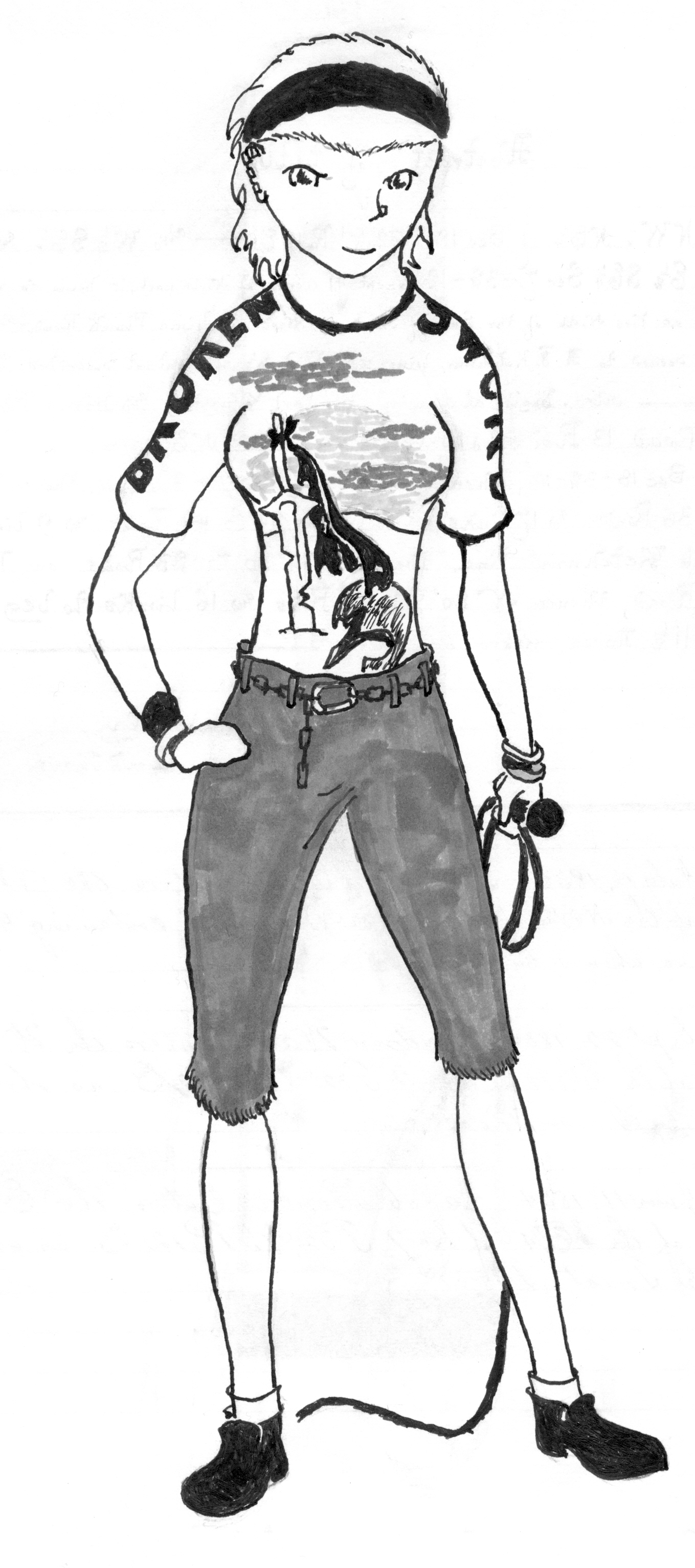
Original Art: Amplifier

I decided to be lazy* this week and post another page from my sketch book. This week’s subject: Amplifier, in her typical civilian dress (as opposed to her Biker Girl persona.)

amplifier0001

*for values of lazy that include doing things that are actually more time consuming than what I would usually be doing in this spot.

Heat Wave: Blown Fuses

Circuit

Rodriguez raised his eyebrows. “I have to admit, if you’re the independent justice seeking type you really aren’t doing a good job of representing yourself. You come off as very… hard edged.”

I laughed. “I thought you knew. We live in a world where one man’s justice is another man’s robbery. Justice is dead and we’re sitting on it’s gravestone. You’ll find that the world doesn’t know or care about justice.”

“You may find that kind of attitude fails to pay out.” He leaned back in his chair as far as he could while still keeping his hands on the desk. “Justice isn’t such a small thing as to fit in a person’s pocket, to be taken out whenever you need to check if something is right or wrong. It’s not a personal thing. It exists everywhere and is always the same. Justice measures us, not the other way around.”

“You know, I could almost like you under other circumstances.” I fished around in a belt pocket and pulled out a zip-tie, which I tossed on the desk. Then I stretched out a leg and tapped my foot against the exposed metal leg at one corner of the desk. “Why don’t you do us both a favor and make yourself good and secure.”

“Fine.” Rodriguez took the tie without protest and proceeded to firmly secure his wrist to the desk leg. While he worked on that I slipped around to the other side of the desk and checked the drawers. They were locked, as I suspected they might be, Barry apparently not wanting anyone to filch his office supplies while he was out. As I said, lazy not stupid. Bad as I felt about tying the pastor up, I didn’t want him letting himself out with a pair of scissors or something. The same line of thought led me to the wall to unplug Barry’s desk phone.

I straightened up and turned back to the desk to discover Rodriguez had pulled a small Bible out of his pocket and set it on the desk and was in the process of choosing a pen from the cup on the desk. He saw me staring at him, admittedly a little shocked at his incredible aplomb, and asked, “I don’t suppose you have any paper I could borrow? I haven’t worked much on this week’s sermon yet, and since I seem to have some time on my hands…”

“There really is more to you than meets the eye,” I said, shaking my head. “How did you even get in when the building was locked?”

“I borrowed a key from the groundskeeper. Someone from the church staff does this every year, so he’s used to the routine. Although this is something of a break from the normal.” Rodriguez shrugged. “I could say there’s more to you than meets the eye as well, but I suppose that goes without saying when a person is in disguise.”

That earned him a chuckle and I ducked into the first cubicle down the line and fished around for something to write on. As I did so, Rodriguez’ voice came drifting over the flimsy walls. “I have to wonder, if you’re not an arsonist and you’re not a vigilante of some sort, what are you?”

“Just a man here to advance his own goals.” I found a spiral bound notebook in the bottom drawer of the desk, which apparently belonged to someone less cautious than Barry was. I took it with me back out to the secretary’s desk. “I’m here to deal with a hindrance and once I’m done I’ll be gone. The fact that the hindrance happens to be a wanted arsonist is pure happenstance.”

“You sound suspiciously like a man trying to convince himself,” Rodriguez said, giving me an assessing gaze. “Are you here because of some kind of attachment to the building? Maybe a teacher you had growing up? Does one of your children attend here? In that case-”

“You are astoundingly naïve,” I said, slapping the notebook down on the desk and suppressing a wince as my shoulder twinged in protest. I leaned forward a bit and let Rodriguez get a good look at my eyes. What he saw there made him deflate a bit. “Try to understand that I see nothing here worth saving.

“Have you looked around this place lately, my friend?” I swept my arm through the air to indicate the entirety of the school. “It’s one of two things. A relic, a hopelessly outdated idea based on theories of education that haven’t held up, or it’s a blatant power grab by people who don’t loose a single moment’s sleep what their manipulations cost the next generation. To some people it’s one thing, to some the other, but neither one is good.”

I leaned down over the preacher and his books. “The only thing they teach here is complacency. Day after day the necessity of some system, any system is pounded into them and the teachers are there every step of the way to punish them if they’re the least bit different from their horrid little ideas of young people should be.” I jabbed a finger at his chest. “You’ve seen it, I’m sure. A quiet person is branded antisocial or depressed, an active person becomes ADHD, the best and brightest are pushed and pushed by their coaches or advanced coursework until they break, and on and on until the whole population is drugged into an exhausted stupor and fed whatever agenda their indoctrinater wants pushed. And when they leave they’re so dependent on the people telling them what to do they’re fit for nothing but corporate machines. Or worse, to be druggists and indoctrination agents themselves. This isn’t a place for youth. It’s a place for convicts.”

From Rodriguez’ uncomfortable expression, especially when I mentioned pushy coaches, I could tell that he knew what I was talking about. For a fleeting moment I wondered if he would agree to some sort of an arrangement that would let me stay in the building until the Enchanter was dealt with. Then he said, “That does happen, and much more than I like to admit. But that’s not the only system at work in these walls. Many people need these places, and we offer them a hope that reaches beyond the school walls.”

I sprang up from the desk in frustration. “Unbelievable. You’re supposed to be a righteous man, but you don’t even understand the first thing about righteousness, do you? You’re just as cowed by the glory of the establishment as everyone else.” I paced a few steps away then spun and jabbed my finger at the preacher in accusation. “Whatever happened to ‘teach your children my commands’? What about ‘make it your ambition to lead a quiet life, to work with your hands’?”

“You know the Bible,” he said, apparently a bit surprised by that. “But-”

“Of course I do,” I said, cutting him off with my gun hand. “And I know that it says ‘thou shalt not covet’. Not one of the rules they like to preach about, is it? Because that’s all they teach here. Be jealous. Want what everyone else has, but don’t worry, that’s the sacred virtue of fairness. And then they’re upset when people like me, who have had to work their entire lives to make a meaningful impact, don’t hand over what we’ve made meekly and quietly.”

The big man spread his hands in an infuriating ‘so what’ gesture. “Perhaps God has something even greater in mind for the meek.”

“Yes,” I said, dripping scorn. “Inherit the earth. We’ll see about that. Meanwhile, their priests stand behind their desks and preach the gospel of justice for the envious to thousands of children a year. This building cranks out more and more drones that will answer to the beck and call of their overlords so that their own jealousy can be assuaged. And you have the temerity to worship here. If you really followed this,” I banged one hand onto his Bible, “you’d be doing more than taking what scraps you can get after the future generation has been put through the meat grinder.”

“I know that not everything the schools do in the name of education is right, but no one can expect that.” Rodriguez offered a helpless shrug. “Do you really expect them to get it right for everyone?”

“I don’t. But a system is only useful when it benefits a majority, a large majority, of the people who go through it.” Once again I waved my hand to indicate the school, not as a building but as a calloused edifice to confinement and boredom. “This is fit for nothing more than ruination.”

“You can’t judge the whole world by just what you’ve experienced-”

“I know that!” I whirled and smashed my left hand into the flimsy cubicle wall behind me, ignoring the spike of pain that shot through my not quite healed fingers. The wall teetered for a moment but didn’t quite topple over. “I’ve done the research, I know what I’ve seen and I’ve watched the same thing happen too many times. Don’t preach to me, holy man. I’ve heard the gosple already, but there was nothing good about what was preached to me.” I turned back and glared at him over my mask. “I’ve seen it. And I’m going to end it – starting with the Enchanter. And I won’t stop until what we do for ourselves is a virtue again, and not a sign of disease.”

If there was one thing that has to be said, it’s that Rodriguez didn’t even blink. I was armed, masked and admittedly had wandered more than a little into monologuing territory while he was unarmed and tied to a desk. His refusal to so much as flinch was both impressive and annoying. Worse than his calm was the tinge of sadness underlying it. “You can’t fix it by playing the strongman. Say you do muscle your Enchanter out of the picture. Maybe you even make things a little better for a little while.” His free hand drifted over to rest on the Bible. “But unless you have something better to teach them, something to give them hope, you’ll just be another strong man in a long line.”

“As I said. We’ll see about that. I might have a surprise for you, down the line.” There might have been more to say after that, but before I could work it a tone in my ear warned me I had another incoming call. “Quite for a moment. Go ahead, Grappler.”

“Someone new on the south side of the building, Circuit. The Project looks like it’s starting to move in.”

“Understood. Start up the van and hold on standby until I-”

“Son of a-” Grappler’s voice faded into the background for a second and I heard a confused gabble of voices and a string of curses. “He’s climbing up the wall. I thought he was a heat sink, not a wall walker.”

“He’s cutting handholds into the wall,” I said, fishing around in my belt and pulling the connection for the elevator hookup free. “Not changing friction like you would. Get in position for retrieval on my signal. I’ll be on the roof.”

“Warming up the engine now.”

I hung up and headed back towards the door I’d originally entered through. The only elevator that went all the way up to the roof was that way. “Sorry to interrupt,” Rodriguez said as I got to the door. “But if there’s a chance of the building burning down do you think you could find it in your heart to let me loose?” He wiggled his zip-tied wrist for emphasis.

“There will be no burning today,” I said. “But there might be some shooting and definitely a lot of armed men running around. If you really want out, I’m sure you could drag that desk into a cubicle that has a pair of scissors handy. But if you want my advice, you’ll just shove it in front of the door and wait things out. You’ll be fine.”

I stepped out of the office, closed the door so Rodriguez couldn’t see where I was going and bolted down the hall. Although it didn’t register at the time, there was the the sound of something heavy bumping in the wall behind me as I sprinted away. But that would come later. For the moment, I had bigger problems to deal with.

Previous Chapter
Next Chapter
Fiction Index

Inspiration

Inspiration for writing comes from a host of places. Where you get your inspiration from will probably be as varied and unique as what you choose to write about. But it’s still important that you get out there and find your muse.

For the writer, inspiration is something that helps you find the right words to fit what you want to express. It’s not a crutch, you certainly shouldn’t need it every time you sit down to write. But knowing what helps the ideas flow can help you overcome those times when you sit down and confront the great white expanse of paper (or word processor) and try to come up with something worth sharing.

I don’t know most of you well enough to hazard a guess at what will best inspire you. So what I’m going to do is share a few things that really help when I’m trying to find the groove to write in.

1. Listen to music. This one is probably one of the most obvious and most talked about, so I ‘m going to get it out of the way first. Listening to music is a great way to get the ideas flowing, especially if it’s music that fits what you’re trying to write or just music that you love. If you can do both, that’s pure bonus.

2. Get moving. If you’re like most people, you probably sit down on your bum in a chair (or lay down on your stomach/back) and type/write while you’re composing. Getting up for a bit fora brief walk, cleaning off your desk (WARNING: this can set dangerous precedents) or just doing some jumping jacks by your desk can get the blood moving to the ol’ brain and help the ideas flow.

3. Eat something. Low blood sugar = low brain functions. Just don’t eat so much you get drowsy, that’s counter productive.

4. Read something. This is the intellectual equivalent of #3. Have something that will keep the ideas flowing with you when you write. If you’re writing part of your story that requires a great villain, keep Robert Greene’s The 48 Laws of Power handy and flip through it if you’re stuck. If humor’s what you need, you might keep Charles Schultz’s Peanuts or Bill Watterson’s Calvin and Hobbes on hand.

5. Talk it over.  Having a group of like-minded people who will go over ideas, share experiences and hack about new possibilities is a real boon to creative thought. If you can find a place to get that kind of input, take advantage of it.

6. Write something else. Now sometimes you just need to take a break and come back with a fresh perspective and new energy. But sometimes, in the act of writing something else you’ll write exactly what you need for the piece you were stuck on. Don’t worry about moving writing from one story or one piece to another. Usually it will be clear that what you’ve written fits better in one place than another, and if it’s not then at least you can go back to step #4.

Hopefully that’s enough to get you on your way to writing some good, solid stuff. As you scribble or type or touchscreen(?) away, pay attention to what your best ideas are and where they’re coming from. Once you get that discipline down, you’ll be able to pinpoint what your best sources of inspiration are, and then your ideas will never stop coming.

Cool Things: Inspector Lewis

For whatever reason, there are few people who can do a murder mystery like the British. (Yes, yes, everyone knows Edgar Allen Poe invented the mystery story. The British do them better.) They’ve produced smashing successes in print and TV, and I would presume in film and over radio waves. In fact, the quintessential reasoning detective is Sherlock Holmes, a British detective created by a British author. And let’s not get started on Dame Agatha. Given my love of mysteries and Great Britain’s outstanding presence in the field and it’s no surprise that many of my favorite detectives are British. I’ve already mentioned Peter Grant. Today’s specimen is a little more ordinary than PC Grant, though.

Detective Inspector (DI) Robert Lewis, former Sergeant to DI Endeavor Morse. Like many police detectives, and unlike many private detectives who tend to move around, the kinds of mayhem and death that make up a large part of DI Lewis’ day to day are defined by the place he lives. For Lewis, that means Oxford.

To us American rubes, Oxford is synonymous with higher education and the University of Oxford. There’s more to the city than that – for starters Oxford University is not the only institution of higher learning in town – but when Robbie Lewis gets called out you can be almost certain some kind of brainy, professorial type involved, if only so they can drive him nuts. It also serves the dual purpose of driving home one of the prime messages of the series: Education does not make you a better person. It just means you know things.

People in Oxford can do a lot of damage to themselves and others with the things they know.

The worst part is most of these brainy types are equipped with large amounts of esoteric knowledge and a passion for advertising it, even (especially) when committing murder. So, when it comes time to interview yet another suspect who knows too much about not enough, DI Lewis drags out his own Sergeant, DS James Hathaway, who attended university in that other place (Cambridge) and is more than willing to digest all the scholastic details of the case into something his boss can handle. His career path, from scholar pursuing a career in the clergy to Sergeant who gets little respect from the same kinds of academics who once praised his work, is a stark contrast to Lewis’ long career and clear satisfaction with his job.

In addition to being an excellent foil to Lewis, Hathaway serves to ask the philosophical questions. Does finding and punishing murderers really make anything better? Is it worthwhile? And when then pieces are all in place and the investigation is complete, who picks up the pieces of the lives that have been ruined?

While mystery series are about finding who’s done it, you won’t want to tune in week after week, or pick up title after title from the library or book store, unless you love the people who are solving them. Alone, Lewis’ brusque manner and direct approach to problems could make him a little too abrasive to be truly likable. Alone, Hathaway’s intellectualism and philosophizing could make him a little to cold or wishy-washy to assure us of his commitment. Together, they make a perfect team.

As for the mysteries themselves, Lewis is a police procedural, not to be confused with a detective story. While both of those categories will probably have their day in the Genrely Speaking segment, for now suffice it to say that the emphasis is on watching Lewis and Hathaway tromp around gathering miscellaneous testimony, expert opinion and trace evidence than overly convoluted murder scenarios or brilliant leaps of logic. Rarely will our heroes put all the pieces together before we do. In fact, the scripts are usually designed to have viewer and detective arrive at the solution at once. The entertainment is less about the puzzle and more about the fun in watching it solved.

And since the puzzles are put together by people from Oxford, you’ll even gain a greater appreciation for culture thrown in! Unless you’re like Inspector Lewis, in which case you can just shake your head and wonder how anyone managed to build Western Civilization when they had scholars like this around. It’s a mystery in and of itself, isn’t it?

Of course, we already know the answer to that. After all, where would we be without men like Lewis?

Heat Wave: Signal Static

Circuit

The biggest problem with trying to keep up surveillance on a building also being watched by a group of people who would dearly like to throw you in jail is that you must observe without being observed. That sounds simple in principle. With the right gear, which I certainly had access to, you can watch a building in close-to-real-time from the other side of the continent. So it was a simple matter to position my own surveillance team a few blocks further away from P.H.S. 44 than the Project’s teams and make sure they stayed out of the way during shift change.

The problem was, I also wanted to be in a position to respond to any signs of the Enchanter’s appearing on the scene. If I stayed with my surveillance team then by the time I could react to any situation developing the Project would already all over the scene and I’d have to somehow get through the inevitable cordon Project Sumter’s agents would have put in place.

The Project is inept and wasteful in a surprising number of ways, but there’s one thing you can say for them: They know how to keep the public out of situations under their purview. It’s pure survival for secret government agencies.

There were any number of ways I could have dealt with a running the Project’s secrecy gauntlet, ranging from the direct frontal assault to a couple of promising but still highly experimental forms of transportation. In particular, Davis has ideas for a creative maglev harness that I think has a lot of potential. But, since you don’t survive eight years in the dangerous business of dangerous villain armed with exceptional abilities without some small dose of self preservation, I’d finally settled on a more practical and elegant solution that was all the better for being unexpected.

I hid inside the building. Thus I ensured I was the first on the scene and avoided being cordoned out in one fell swoop.

Now it was more complicated and difficult than I make it sound, and it was also very uncomfortable and tedious. There was a lot of careful electronic manipulation and old-fashioned skullduggery involved. It was a great exercise in the kind of stealth and intrusion skills that I don’t use as often as I should, what with my having Heavy Water around to rely on. And, of course, it all went beautifully and I was never noticed in spite of all that was being done to ready the school for classes the next week. I could say more about it but I’d rather not bore anyone.

Suffice it to say that my injured hand and shoulder got both rest and exercise, enough to feel reasonably healed and useful by the end of my stay, and I got to know the school building very, very well. The building got a few new little additions that made my life easier as well. Things weren’t the best they could be, but only because hygiene can’t always be a top priority in my line of work. One of the things most people don’t think about when considering a career in supervillainy.

Actually, the worst part was the boredom. During the day I mostly confined myself to the basement of the building, a labyrinth of storage rooms, furnace equipment and half-forgotten junk. I passed some time working by mobile device, but there limits to what I could do down there. I managed to catch a little sleep, but maintenance workers were in the area enough that it wasn’t very restful. At nights I prowled the school building and prepared for the Enchanter’s arrival. Heavy and Grappler took turns phoning in status updates.

By Thursday I was getting restless. I was still sure that I was in the only logical location for the Enchanter’s next arson, but I was beginning to worry about moving things from Location Ten to the Chainfall site. Davis was a great engineer but only an average project manager, and for the duration of the Enchanter’s mischief Simeon was in town and thus away from the site. Regardless of who got the Enchanter, I suspected that my activities for the last few weeks were moving me up Sumter’s priority list, and that meant Chainfall, my next move in the ten year plan to deal with them, had to be ready before they figured out what I was up to. And I had scheduled my face to face meeting with Hangman for late the following week. It would be nice to finish with the Enchanter before then.

The handful of specialized subsystems I’d brought with me when I snuck into the school the second time were all in place by that point. And I know what you’re thinking, why not just install the surveillance package with everything else? The short answer is, because my surveillance systems went into the public areas of the building and for the most part, the rest did not. It was better to have a cover in place beforehand than try to improvise something if I was discovered sneaking around in tactical gear in the middle of the night. Even with everything in place, preparation always pays, so that evening I went out to check on things. After all, there was always a chance that something had been discovered or just moved out of place during the day’s activity.

First I called all three elevators in the building down to the basement. I was fortunate that the building had been renovated after accessibility regulations made elevators mandatory in multistory government buildings. Not because I needed them but because they were access points. I’d spliced into the power supply cables in each elevator so that I could draw power for my equipment directly from the building, instead of draining the far more limited supply in my vest and newly finished battery belt. When combined with a clunky but serviceable pair of electromagnetic boots it also became possible for me to climb up or down the elevator shaft, offering a way to move between floors that most people wouldn’t immediately notice and wasn’t covered by any of the observation equipment that came with the building or that Project Sumter had installed.

Once I was sure those were still in place and functional, the next step was to check that the splices I’d slipped into the Project’s surveillance equipment were still in place, so that I could replace live footage with canned recordings of empty hallways should the need arise. With that done I was left with the options of going down to the cafeteria and finding something to eat or braving the lingering heat on the rooftop long enough to check on the large electromagnets I’d left there, part of my countermeasure for prolematic heat sinks.

Since the route I’d taken around the school that evening left me near the offices I decided to cut through to the back access ladder and hit the roof first.

Offices might be a bit of a generous term for the schools administrative area. That part of the building was nestled into one corner of the top floor. The principle had his own office, since rank has its privileges, but most of the rest of the teachers just had cubicles along a narrow hallway, with Barry the secretary’s desk standing sentinel at one end and the other leading into a small back area with a kitchenette and a maintenance closet. Two hallways lead into the area and both opened into the small reception area where Barry normally lurks, so getting from the hall I was in to the hall I wanted should have been a simple matter of opening a door and turning a corner.

Instead, when I stepped into the office I found a man piling packages onto Barry’s desk. For a second we just stared at each other, two men with no business being in the building, each trying to figure out who the other was and what to do about it. I recovered first and snatched my pistol out of its holster, backpedaling a step just in case he decided to make an ill-advised grab for the weapon. In my line of work it’s widely understood that in close quarters guns belong to whoever wants them most, and while my instincts told me that pastor Rodriguez was retired from the street life that didn’t mean his instincts were entirely gone.

And hard as it was to believe, it was the pastor again. He had a huge sack with small boxes spilling out of it in one hand and a pile of greeting card envelopes sat on the desk near at hand. I wasn’t sure how he had made it past my surveillance and gotten into the building, but there he was and no point denying it. I had no idea what to do with him.

I was grateful that I had decided to go with a loose mask to cover the bottom half of my face, which, along with the fedora that was a standard part of my operating gear, removed just about any chance of being identified as the electrician from earlier in the week. That could have gotten awkward. “You know, if you’re the arsonist everyone’s been gossiping about recently I have to say you’ve come undersupplied,” Rodriguez said.

“Funny,” I said on reflex. “I was just thinking most arsonists don’t bring greeting cards for their victims to the scene of the crime. They don’t usually last long enough to be an efficient use of resources.”

“I don’t know about you but I came in through the front door,” Rodriguez said with a huff. “If you want to call the police and see which of us can give a better explanation for our being here that’s fine with me.”

That was a solid comeback but it only worked out if we were on even footing, and I suspected that the pastor was not the kind of man to carry a gun anymore. “A counter offer. How about you put that bag on the ground and have a seat behind that desk for the moment, and no one has to the ER tonight,” I said. With a sigh Rodriguez did as I asked. “Keep you hands on the desk, please.”

So far, my Hispanic friend had given no indication of recognizing me and was fairly compliant, both of which were good. I took a moment to check my phone and found that I had missed a call, probably blocked by the elevator shaft I was in a few minutes ago. I slipped the phone back into it’s belt pocket and used a twitch of talent to activate my Bluetooth headset and call Grappler back. She picked up almost immediately.

The first thing she said was, “You didn’t pick up.”

If it had been almost any other situation I would have been annoyed by the demanding tone in her voice, but on a job like this pretty much any deviation from the expected was an emergency. “I was in a part of the building with no signal,” I said, carefully choosing words that wouldn’t hint at exactly where I’d been in case Rodriguez hearing it made a difference. “I apologize.”

“There’s someone in the building with you,” Grappler said, wisely choosing to stick to business rather than lecturing me for not calling back sooner.

“I just  found him.” Rodriguez raised his eyebrows but didn’t say anything. “He’s not our man. Stay on the lookout for new arrivals. I’ll be here, keeping an eye on our new friend, so you should be able to reach me without difficulty.”

“Fine. Be careful, Circuit. I never will understand why it’s always gotta be you doing these things, but keep in mind that as long as you’re sticking your neck out like that all our jobs are on the line.” The line went dead.

I grunted and turned my full attention to the big man at the desk. “Now. This is more than a little inconvenient. What, pray tell, should I be doing with you?”

Previous Chapter
Next Chapter
Fiction Index

Author’s Obligations: Enrichment

The author has many duties and responsibilities – things you must keep in mind if you really wants to be considered an author. Your audience. Your story. And beyond that, the ways your story and your audience interact.

Every story should touch the reader in some way. Determining the exact whys and hows of that is part of your job as the writer, but there are some things that it’s worthwhile to keep in mind. One of these is the idea that your story should enrich the reader.

Now before we get into this, let me be clear. Some people are going to hear that and think that what I’m saying is that stories need to be family entertainment, that anything that wouldn’t have been made in the era of black and white film is outside the bounds of good story telling. While many of my favorite movies are in black and white and I’ve nothing against family entertainment as a rule, that’s not at all what I’m saying.

Sometimes, the author needs to wander into unsavory territory if he’s going to tell a good story. This post by Brian Bixby says that stories do not always need to be uplifting. I agree with this statement. Uplifting and enriching are not the same things.

Enrichment does not mean that the person always walks away feeling good. Enrichment does not mean we always look at what is easy, or nice or likable. Being a better person is not directly proportionate to how good we feel. Stories like Animal Farm, 1984 or Brave New World are very dark and unpleasant. You hardly walk away from them feeling great about yourself. They take a hard, honest look at what people are like and what they could be doing, should we let it come to pass. And when we finish with them, we can take what we’ve learned and make ourselves better with it.

Or not, there’s always that option, too.

The point is, the author must at least offer something enrich the reader, even if the reader doesn’t want it, or else he’s just wasted the reader’s time. If a story is nothing but words on a page, read and then forgotten, the author has taken his audience’s time and left them with nothing. That’s not writing, that’s theft.

Of course, not every story has to be as challenging as Animal Farm. Humor, suspense and slice-of-life all bring something to the table, be it large or small, that give the reader something. A joke to share with friends. A tricky situation to ponder and sharpen one’s mind on. A story to share and bond over.

It’s tempting to look at the big, heavy stories and think, “I want to write something like that.” But not every story is suited to carrying such heavy stuff. Read and practice and you’ll learn to gauge how deep and heavy a story is (but that’s undoubtedly a whole ‘nother post entirely.) Practice with little stories. Write out jokes. Retell favorite moments from books in your own words. Do it over and over again.

Most of all, write with purpose. At some point in your story process, ask yourself, “When people walk away from this, what do they take with them? Is it worth the reading?”

Then, write it out until it is.

Cool Things: The Beams Are Creaking

In keeping with tradition, I come with news of the season’s fourth and final all for One Productions play, The Beams Are Creaking.

First, a quick disclaimer: I’m not in this production. So if that’s been keeping you away please consider coming to this show!

Wait, you want to know what the show is about? Well, to put it simply it’s about the life of Dietrich Bonhoeffer, a German Lutheran pastor who lived in the first half of the twentieth century. He opposed the Nazi party and their takeover of the German churches and worked with Abwehr (a German Intelligence organization) as a part of the many attempts on the life of Adolf Hitler during the Second World War.

The Beams Are Creaking is a play about a hard time, when choosing to live well was not easy. Then again, living right is never easy and there’s much we can learn from people who have given their all in pursuing that end. Hopefully this production will have lessons for us all.

Shows are May 3rd – 5th and 10th – 13th, and will be at the Main branch of the Allen County Public Library. Ticket information can be found on afO’s blog.

Heat Wave: Simmer Until Done

Helix

“Stop blowing bubbles in your coffee, Helix.”

“It’s an aromatic beverage,” I mumbled. “If you can’t smell it half the fun is gone.”

“Coffee stirrers are not straws.” Amplifier leaned back against the wall of the van and sighed. “I’m not sure what I was expecting when you asked me out but it certainly wasn’t this.”

Bergstrum made a choking noise and quickly set down his own coffee. Jack gave me an amused nudge. “Asked out?”

“I asked her if she wanted to get out of the office tonight and see what we’d been up to.” I shrugged. “Any and all possible misconceptions arising from that are not my fault.”

“You’re a surprisingly devious person, Helix,” Herrera said as she flipped her cards over to show a hand with three tens and took the pot for the hand of poker they were playing, using a box as a table.

I frowned. “You’re obviously a card sharp, so I’d say it takes one to know one.”

“You’re just mad because you’ve been cleaned out already,” Kesselman muttered, anteing up for the next round.

You’re all holding up the game,” Bergstrum said, motioning impatiently for the cards to be dealt.

“And you’re all done seeing how long we can start sentences with the same word,” Jack added, shuffling the cards with his trademark methodical slowness.

“I kind of expected you to be a bit better at reading bluffs, Amp,” Kesselman said as he examined his cards. “Doesn’t super hearing help out any?”

“You’d be surprised the things it does and doesn’t help with.” Amplifier rocked forward again to toss in her ante and take her cards. “For starters, everyone sounds different when they lie, so if you don’t know someone fairly well it’s easy to miss their tells. I’m sure there’s some kind of common threads, but I haven’t needed to be a walking lie detector in the past so I really don’t have the experience to tell you what they are.”

Jack finished dealing the cards and asked, “Bets?”

I tuned the poker game out and went back to my reading, absently blowing bubbles in my coffee until Amplifier got annoyed enough to quietly kick me in the shins, an absent minded kind of point and counterpoint that would repeat itself several times in the next half hour. It would have been funny, except she was wearing the kind of heavy boots you could find at army surplus stores along with a jean skirt and yet another obscure band T-shirt. I wound up wishing I had put on full riot gear instead of just a vest for that day’s stakeout.

That, or just not suggested we invite Amplifier along as an observer.

While I was regretting having her along at the moment, it’s important that people thinking of joining the Project understand that very little of what we do is anything other than incredibly boring. The easiest way to do that is simply to sit them down in the middle of the most boring thing you can think of at let them feel what it’s like. Normally I’d have invited Amplifier along to a meeting with one of the Analysis department’s forensic accountants, but steakouts are in a special class all their own. Judging by her attitude at the moment she actually coping fairly well. She played poker, chatted and generally tried to keep people’s mind off the boredom without being overly distracting.

I was sorely tempted to give her some paperwork to see how she handled that, but she wasn’t cleared for anything I was going over at the moment. Still, all in all I was slowly warming up to the idea of recruiting Amplifier into the Project.

“What are you staring at?” Amplifier asked. I stifled the instinctive jerk, took a second to figure out that  I had been watching Amplifier intently for the last few seconds, or maybe minutes, and apparently it was starting to creep her out.

From the heat in my face I could tell I was blushing, but Jack saved me from answering. “You want to watch out, Amp. I know that look, it means he’s trying to figure out how he can put you to work. He always gets like that before he decides he’s going to rope someone into the Project. Ask Al Massif what it’s like to be sponsored by Helix – it’s different for everyone but it’s always trouble.”

I grunted and smoothed the papers I was reading out flat as a way to buy time.  “It’s not that big a deal.”

“If things are like this all the time a complicated job interview might be the most exciting part of the gig,” Amplifier said with a laugh.

“It could be worse. If you went with Agent Massif today, like Gearshift did, you’d have to spend all day in a van watching a school without the benefit of the human air conditioner over there.” Bergstrum nodded at me, in case there was doubt about who he was talking about.

“There are upsides,” Herrera said while dealing out a new hand. “For one thing, all talents get to visit Charleston, where the national Project headquarters is. You can even tour the historic Fort, if you want.”

“Really?” Amplifier pursed her lips. “Not that’s a real plus for me, although Charleston might be nice.” She glanced over at me. “What did you think of it?”

“I don’t go into the South,” I said. “The Shenandoahs don’t like me much.”

“How can an entire mountain range not like you?”

I ignored the question by looking back at my reading. I could hear Mona whispering in the back of my mind that, yes, telling he to mind her own business was rude, but I wasn’t really improving on that any by ignoring her. Which was true, but hey at least I was getting imaginary advice from someone other than Sanders now. My only other reaction to that thought was to grab one of the blueberry muffins Mona had sent along with us and start eating it.

There was an awkward pause then Jack said, “Play your cards, Amp. Trying to wrap your head around some things won’t do you any good now.”

Actually, I hoped she would never get caught up in any of my private little feuds, but since the reports we’d gotten suggested that Circuit had accessed her file as part of his general ransacking of our network perhaps it was already too late for that. In fact, what I was reading was a summary of the files Circuit had accessed via his backdoor in the few days it had been in place. Considering he was limited to a 3G cellular connection to send instructions and get data out, it was impressive how much he’d managed to do in such a short time.

A lot of it was straightforward stuff dealing with the Enchanter’s case, and I noticed Analysis had officially renamed the Firestarter to help make things less confusing, it looked like Circuit had grabbed all of our reports dating back to the point we were first sure we were dealing with a heat sink arsonist and not just an average nutcase. But on top of that he had poked around some in Massif’s record for the same time period and dug out as much as he could on my activities in the period between our brush in Morocco and the present.

He’d also done a few surprising things. He’d left hints as to where he expected the Enchanter to show up again by running a couple of data sifting jobs on our computers instead of his own, and as a result we knew that ol’ High School 44, where we were staked out, served every address the Enchanter had attacked. Mossburger had already concluded that a school was the next likely target, but it was nice to have the legwork determining which school taken care of for us.

Just to make sure all our bases were covered, while I watched this location with another team, Massif took his own team and another group to a nearby middle school and kept an eye on that. The first arson site wasn’t in that school zone, so it was considered a less likely target, but it never hurts to be thorough. Of course, with four talents, their oversight agents and their tactical teams all committed here in the city we were stretched a little thin, and it was a good thing there wasn’t another potential site to cover. Assuming we were right about the Enchanter’s next crime.

On top of poking his fingers into our open investigations there were apparently plenty of other little signs of Circuit’s break-in running around. There’d been a file full of messages addressed directly to me, each with a timestamp in the title, and instructions to read the one closest to the time his transmitter had been discovered. They ranged from congratulations on finding the device so fast to admonitions to work a little harder.

I’d wound up somewhere in the middle and gotten the message, “As expected. But good enough isn’t good enough for me, Helix. Try for above average next time.”

The techs were still finding traces of unauthorized access in the system, apparently Circuit had been busy with a bunch of other, less blatant activities as well as his obvious ones, mostly poking around in sensitive files relating to cataloging and researching talents. That information was still coming in and every so often the printer that was part of the van’s monitoring set-up would spit out a new printout and the techie currently manning the station would hand it to me. I’d gotten the privilege of looking it all over by virtue of being the most senior agent present, since Mona and Sanders were in the other van, watching the other side of the school.

I’d just been handed yet another set of papers when our techie sat bolt upright. “Someone’s approaching the building.”

Despite the fact that I was closest to the monitors and he was all the way on the other side of the poker game, and he only had the width of a full sized van to fit his considerable bulk through, Jack still managed to get past me and loom over the tech’s shoulder before I could get there. The man can move, and I’m not entirely ready to say it’s not some kind of talent unique to him.

“What are we looking at?” Jack asked, leaning down and crowding the tech through sheer bulk. “That guy, with the packages?”

“That’s the one.”

I edged around Jack for a better view. “Why is it, whenever we see that guy he’s carrying something?” He asked.

“Is that Rodriguez?” I shook my head in amazement. “What is he even doing here?”

“Michael told me that his church meets here,” Herrera said, crowding in behind us. “Classes start next week. Maybe he’s bringing something for the teachers?”

“People still do that?” Amplifier asked from somewhere in the back of the van.

“Apparently,” I muttered, feeling Jack’s question slowly turn over in the back of my mind. Always carrying something indeed. And there was the full U-Haul truck. And furniture at Mossburger’s that came from Rodriguez’ church. Very interesting. But the church pastor would have to wait, he wasn’t why I was here.

I scooted back and sat in my spot on the floor and tried to focus on something else. The latest pile of paperwork I’d been handed turned out not to be related to Circuit after all. It was from the Watch, the department who monitors the media and other sources for talents. The cover sheet said, “Notice: Legal Activity Involving Family of Project Personnel.”

There is some evidence that talents run in families, yours truly being a prime example, so the Watch runs searches that check names in news stories and police reports against databases of Project personnel. That way, we’d know if we needed to step if a talent’s cousin or younger sibling suddenly developed a talent under less than ideal conditions. Ideal conditions being under no stress and preferably away from people who didn’t already know about the existence of talented people, so that pretty much never happens.

After a few minutes reading I realized that this wasn’t a case of some talent’s kid brother getting in trouble with newly awakened abilities. With a sinking feeling in my stomach I realized it was probably going to be several times worse. Elizabeth Dawson’s mother had just reported her missing.

“Sanders’ observation team reports there’s someone approaching the building on their side.”

I groaned, folded up the paper and shoved it in my pocket, wondering if things could get any worse.

Previous Chapter
Next Chapter
Fiction Index