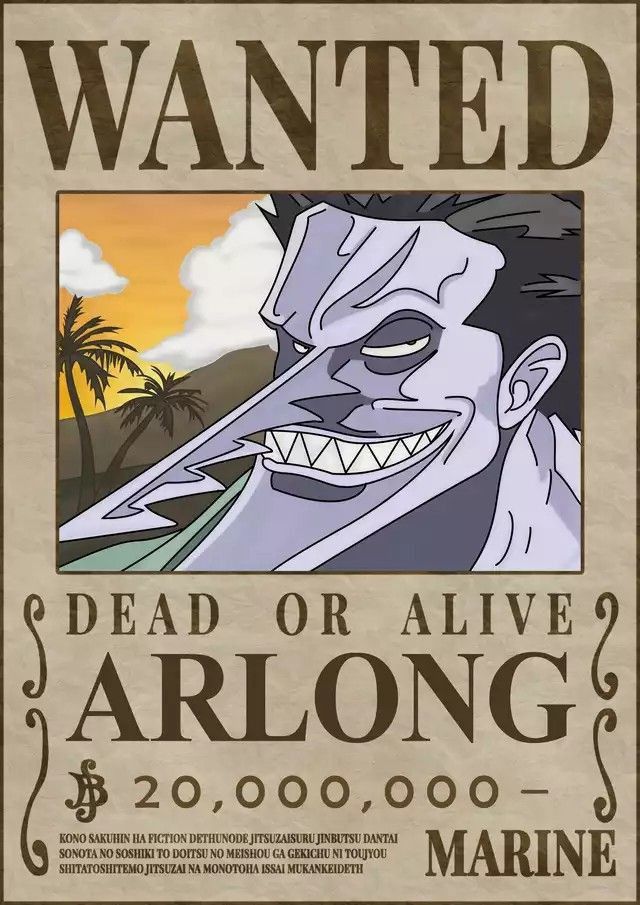
The Last Crime of Fisher Tiger

Behold, Arlong the Saw.

Long considered one of the first landmark villains of One Piece, Arlong casts a long shadow across the history of Oda’s pirate epic. In spite of appearing in only two significant story arcs and last appearing in the pages of Jump over a decade ago, he remains a formidable figure in Luffy’s rogue’s gallery. There are many reasons for that.

The first is the most obvious, which is his striking physical appearance. Oda isn’t known for his standard character designs but Arlong is extreme, even for him. The serrated nose and wild, glaring eyes makes the Fishman captain uniquely memorable, so much so that when his sister appears, a decade after Arlong’s last appearance, their shared pupils made it immediately obvious to most that the two characters were related.

Arlong’s physical stature is significant in no small part because of how closely tied it is to his other memorable characteristic – his bigotry.

The pure contempt Arlong holds for human beings comes from an obvious source. As a fishman, he is bigger, stronger and tougher than a human and he can breathe underwater to boot. He routinely demonstrates all those qualities to keep the people who pay him tribute in line. When they don’t pay up he feels no qualms in destroying their livelihoods or ending their lives in order to serve as an example to others. Why should a fishman care for the lives of humans, after all?

Arlong’s insistence on categorizing people by species eventually sets him at odds with the protagonist of One Piece, Monkey D. Luffy. Luffy is unable to grasp why human or fishman are such important categories to Arlong. However, as is often the case, Luffy would have been perfectly happy to ignore Arlong’s ugly prejudice and brutal regime if not for one little detail.

Luffy was trying to recruit a member of Arlong’s crew. The only human member, in point of fact.

Yes, as odd as it sounds the crew known as the Fishman Pirates had a bonafide human girl serving as their chief cartographer and navigator. Arlong brought on the orange haired girl when she was only eight. Nami offered to serve Arlong after the fishman murdered her mother, on the condition that Arlong would allow her to buy back her village for the measly price of 100,000,000 beri, the world’s standard currency. (For those wondering, that’s the rough equivalent of $1,000,000 USD circa the year 2000.)

Luffy meets Nami when she’s in the process of robbing another pirate crew and eventually follows her all the way back to Coco Village and the eventual showdown with Arlong. For the entirety of the storyline, we’re primed to hate Arlong. This is a carefully balanced thing on Oda’s part, because the story goes to great pains to make it clear not all fishmen are like Arlong. In particular, Oda introduces us to the character of Hachi, Arlong’s first mate.

Hachi is a very likeable character. He’s cheerful, helpful and never demonstrates any of the overt prejudice that so clearly defines his captain. He just seems to like people until they give him a reason not to. In this respect, he’s not that different from Luffy. However, Hachi is agreeable to Arlong’s bigotry, so he’s not perfect by any stretch of the imagination.

Yet Hachi is important. Of all the characters introduced in the Arlong Park he is the only one Luffy will meet again.

For the next seven years, more or less, of One Piece’s publishing history very little happens to change our mind about fishmen. We only meet one who isn’t a villain. We meet several more we don’t really care for. Then the Straw Hats arrive at Sabaody Archipelago, an anchorage on the doorstep of Fishmen Island, and they run into Hachi again.

They find him in a cage. He has been captured by human traffickers, who are using him as bait to capture prisoners for a slave auction. This, we learn, has been the fate of fishmen for centuries.

Sabaody Archipelago tells us a lot about the state of the world but for our purposes the most important thing it tells us is the fate of the fishmen. Arlong’s hatred for humanity was ugly and evil. However it sprung up from a fertile soil of other evils such as slavery, ostracisation and dehumanization. That context opens us up to a new understanding of the fishmen we’ve seen before. It prompts Nami to forgive Hachi for his role in Arlong’s pirates. And, ultimately, when we arrive on Fishman Island, it prepares us to hear the story of Fisher Tiger.

The great explorer Fisher Tiger is one of the heroes of Fishman Island and he stands in sharp contrast to the other major figure his story is intertwined with, Queen Otohime. However, in order to understand the crime of Fisher Tiger she is unimportant. So I plan to set her half of the storyline aside and those curious about it can read it at their leisure. They are quite separate stories, for the most part.

What is important to understand about Fisher Tiger is that he lived and died in the past. Luffy and the Straw Hats hear his tale from Tiger’s first mate, a fishman named Jinbei. Among the fishmen, Fisher Tiger is a legend. He united the forces of Arlong and the Fishman Pirates with many powerful warriors from the Ryugu Kingdom, Jinbei first among them, to create the Sun Pirates. Then he dedicated his life to raiding ships and freeing slaves.

To Fisher Tiger, the species of slave did not matter. Slavery was an equal opportunity evil and both humans and fishmen suffered from it. And Tiger was a man particularly suited to recognizing the evil of it, as Tiger himself had suffered the humiliation of being a slave. He was wise enough to see that freeing every slave would create a larger push to abolish the institution than just freeing a few. So he fought against all slavers, although the fishmen may have benefited most from it.

At the same time, Tiger forbid his pirates from senseless killing. While fighting carries the risk of death Tiger knew that any killing beyond that would undo all the work he was doing towards abolishing the system and set fishmen and humans at odds for decades to come. 

The combination of these two strategies made Fisher Tiger very effective.

Unfortunately, it only made him effective in creating pressure to abolish slavery, it did not do much to improve the reputation of fishmen in the wider world. This would eventually lead to his downfall. When not hunting slavers and freeing slaves the Sun Pirates would help liberated slaves find their way home. When they freed an eight year old human girl named Koala they naturally set out to do so.

However, Koala’s home village was fairly far inland. The whole crew couldn’t go with her, so Fisher Tiger took her there himself. Once Koala was reunited with her family Tiger headed back towards the sea but along the way he was ambushed by Marines.

The people of Koala’s village had notified the World Government there was a fishman in their town and they showed up to arrest Tiger. When he refused to surrender they opened fire. Tiger managed to escape this ambush but he was badly wounded. The Sun Pirates were also attacked and lost their ship but managed to capture the Marine ship instead.

Most of the Sun Pirates were fine but Fisher Tiger needed a blood transfusion to survive. The Marine ship had plenty of blood in stock in the sickbay but when it was offered to Tiger he screamed, “No! I would rather die than have their blood inside me!”

In the end, Fisher Tiger lost his long battle against the hatred he had harbored and died saying, “It’s foolish to die and leave only hatred as a legacy. I know that! But my reason is overpowered by the demon in my heart… I cannot love humans. Ever.”

At that moment this was Arlong the Saw.

At that moment, he was me.

After escaping Marine custody due to the influence of his crewmate Jinbei, Arlong would set sail for the eastern oceans with a bone in his teeth. He would take his vengeance on the humanity of those seas, saving his cruelest treatment for an eight year old girl he found begging for the freedom of her village. 

Thus the circle closes and we see the full weight of the evils that had piled up. Arlong was just one final stone in the ever growing pillar of prejudice, hatred and abuse that had been building and building over generations. Yet he might not have been as vile if he hadn’t watched his captain try to break that cycle and fail. If the cycle hadn’t looked so inevitable perhaps even Arlong could have been someone different.

The crime of Fisher Tiger wasn’t that he tried to change the world and end slavery. It was that he tried to change himself and couldn’t.

Around these parts I have a simple concept. That the goal of art is to create an emotional response in the audience. If you are telling a story, try to make the audience share that emotion with a character in the narrative. I call this emotional synchronization.

This storyline, what I call The Last Crime of Fisher Tiger, is buried in four larger story arcs told across a dozen years of publishing history. It is one of the greatest examples of the power of emotional synchronization I have encountered. Through the use of it Oda showed his audience a person they despised.

And let me tell you, we despised Arlong in those days.

Then, over time, Oda gradually maneuvered the audience until we experienced an overwhelming wave of sympathy for Arlong when we saw him heartbroken by Fisher Tiger’s death. This moment was quickly tied back to the Arlong we saw torture Nami, creating a powerful dissonance in the audience. Never have I seen a moral message so seamlessly integrated into a story with such clarity.

Anyone can say, “You, too, would be a monster.”

To take the hand of the audience and slowly and patiently walk them through the path that would make them a monster demands incredible skill. Many writers today wish to tell morality tales. Yet so many of those who attempt it fail miserably. Fisher Tiger is a powerful model they would do well to learn from.

But that isn’t all they should learn from.

After the death of Fisher Tiger a strange custom takes root in the Ryugu Kingdom. The fishmen there refuse to share their blood with any human who passes through their ports. The kingdom isn’t strong enough to directly defy the World Government and this becomes their way of protesting.

In modern times the Ryugu Kingdom is not a peaceful place. Luffy takes up their cause and fights on their behalf, doing much to warm the hearts of Fishman Island towards humans. But things don’t end cleanly. Luffy suffers quite a bit in the battle and at the end he’s in danger of bleeding out. His own crew doesn’t match his blood type. Yet none of the fishmen he’s just saved will help him.

So it falls to Jinbei, Fisher Tiger’s first mate, to break the custom and offer his own blood to Luffy. When Luffy recovers he finds himself linked to Jinbei in more ways than one. So he smiles and says, “Jinbei, join my crew.”

With that, for the first time in centuries, the wound is closed and the crimes of Fisher Tiger are redeemed by his successor. The dawn of the world grows a step closer, and we raise our sails with hope once more.

Revolutionary Incomprehension – On the One Piece Revolutions

Behold the flag of the Straw Hat Pirates. Once the ensign of a single-masted caravel from the tamest ocean on Planet Bluestar, this flag now flies over the heads of nearly five thousand merry freebooters plying the Grand Line. The most powerful enforcers of the World Government avoid confronting those who fly it. In a world of fictional pirates, those who fly this flag are among the most known and most feared.

On Planet Earth this flag has marched on the capitals of Nepal and Madagascar. The young men and women marching under it have toppled those governments and declared themselves free. The flag has been spotted around Paris, but the French have not surrendered just yet.

As someone who has followed the adventures of the Straw Hats for some twenty years, I have mixed feelings about this.

On the one hand, it is wildly entertaining for me to know that Eiichiro Oda’s mythology has achieved a spot on the world stage. On the other hand, I feel like an important part of the story I know and love is being lost. 

Or perhaps it just hasn’t been seen. One of the most difficult elements of One Piece as a story is how stretched out it is and how buried many of its thematic elements are. Summarizing nearly thirty years of storytelling in one blog article isn’t possible. Summarizing the state of world politics on top of that demands even greater amounts of time and, further, isn’t something I’m well qualified to do.

So I am going to do something that I normally wouldn’t. I am going to point you to an excellent summary of the Nepalese and Madagascar revolutions as covered by Simon Whistler on his Warfronts vertical. Any attempt to recap these upheavals on my own would just be duplicating the work he and his team have already done.

Hopefully that satisfies your curiosity on the current event issues. The initial summary of the Nepal revolution also gives a reasonable summary of why the Gen Z revolutionaries might adopt the Straw Hat flag as their symbol. There are problems with this summary, of course. Simon pronounces Luffy’s name the way it’s spelled in English, for example, whereas the correct pronunciation is “loo-fee.”

Also, the revolutionary reading of One Piece is completely incorrect.

To put all my cards on the table, I am not the first man in the Straw Hat Grand Fleet to find fault with this reading of One Piece. Vice Admiral Liam of Grand Line Review has already done a decent job rebutting it. If you want to hear his thoughts on the issue I will include them here as well.

However, unlike Simon Whistler’s work I will be duplicating a part of Liam’s breakdown here, except from my own perspective. So let’s get started, shall we?

Just in case you didn’t watch the Warfronts videos, a brief argument for why One Piece is relevant to revolutionary movements around the globe goes like this: Planet Bluestar is under the control of a World Government. That government is incredibly tyrannical towards the people who cross it and is guilty of horrific crimes, including endorsing slavery, censorship of history and genocides. Everywhere you look, the people of Bluestar are in chains. 

However, when Monkey D. Luffy arrives in a new location he punches the local tyrants in the face and liberates the people. It is both cathartic and inspiring. The people transform the freed nation into a new, better place and Luffy sails onward, bringing the dawn of the world to the furthest reaches of the planet.

Thus, in conclusion, Monkey D. Luffy is a revolutionary figure whose example we should follow.

Let me begin my rebuttal to this premise by showing you this image.

These men are the Five Elder Planets, the supreme authoritative council of the World Government. They are one of the most significant antagonistic forces Luffy faces. They also share an important element with the Marine Admirals, another group of powerful World Government antagonists – they all seem to be based on real world people. However, where the Admirals are all based on Japanese actors the Elder Planets are a little more varied.

Let’s look at them from right to left, as Japanese is meant to be read.

The gentleman on the right is Saint Jaygarcia Saturn and his appearance is likely based on Giuseppe Garibaldi, a revolutionary Italian politician who contributed to the unification of the nation in the mid-Eighteenth Century.

Standing next to him is Saint Marcus Mars, whose appearance is probably based on Itagaki Taisuke, a member of the Meiji Revolution that overthrew the Japanese Shogunate and restored the Emperor to power.

Seated in the center in mustachioed splendor is Saint Topman Warcury, whose bald pate suggests his appearance is based on Mikhail Gorbachev, who held power during the revolutions that broke up the Soviet Union.

Beside him is Saint Ethanbaron V. Nuspar, who bears a strong resemblance to Mahatma Ghandi, the man who led the movement for Indian independence from Britain.

Finally, on the left is Saint Shepherd Ju Peter. It’s not clear if his appearance is based on any specific person but his name contains several hints that suggest he is based on Simon Peter, the disciple of Jesus who led the evangelical push that transformed the Roman Empire and, eventually, all of Europe through the establishment of Christianity.

For those keeping score at home, of the five supreme leaders of the World Government, all five are based on real world revolutionaries. There is a message in that, I think.

Very little is known about the founding of the World Government. It came at the end of a period of lost history known as the Void Century, a time period we, the audience, know very little about. All we know for sure is this: during the Void Century the world was ruled by a single, powerful nation. Other civilizations existed, of course, but they were all in thrall to this great power. That nation was eventually overthrown by a coalition of twenty other nations that banded together in a military alliance that would eventually become the World Government. In short, the World Government came into existence by revolting. It is, in and of itself, a commentary on revolutions.

It is not a flattering one.

However the World Government is not the only revolutionary thing to sail the seas of Bluestar. The Elder Planets are opposed by the world’s greatest criminal, Monkey D. Dragon, leader of the Revolutionary Army that works to destroy the World Government’s influence. Dragon has seen the evils of the world first hand and he despises them. His life’s work is to sweep the World Government and its founding families, the Tenryubito, from the face of Bluestar.

Names are important in storytelling but they are especially important in mythic storytelling. One Piece is a mythic tale and Dragon’s name is a signpost left for us from the earliest chapters of its narrative. Of course, it’s very easy to see that Monkey D. Dragon and Monkey D. Luffy must be related. In the Japanese name structure surnames come first so we see that these two come from the same family and thus it is no surprise that Dragon is Luffy’s father.

However, that’s not the only significance to Dragon’s name. It also draws another parallel between the Revolutionary Army and the World Government. The Army was founded by Dragon, the Revolutionary. The Government was founded by the Tenryubito, a term which translates to Celestial Dragons. Trust me, this is not superficial or a chance alignment. This is almost certainly a deliberate choice made to hint at the similar path the Tenryubito and Dragon are on (albeit at very different places along said path.)

Again, One Piece is not drawing flattering comparisons with its use of revolutionaries.

However, the analytical mind will no doubt object to this, recalling that the protagonist of the story is not Dragon but rather his son, Luffy. Surely the son will redeem the failures of his father. Clearly Luffy, who strives to be the most free person in the world, is the model revolutionaries should strive for. Right?

Well.

Let’s talk a little bit about Monkey D. Luffy.

Twice, when given the opportunity to overthrow the monarchs of Alabasta and Fishman Island, Luffy chooses to fight on behalf of those kings against the rebelling citizens instead.

In the kingdom of Dressrossa Luffy chooses to overthrow one monarch to restore the previous king to the throne.

On Drum Island Luffy approves of the election of Dalton as the new king of the nation.

One of Luffy’s first friends is Koby, a young boy who wants to join the Marines and defend the people from pirates. Luffy helps Koby to the nearest Marine base, parts ways on good terms and takes immense satisfaction whenever he hears that Koby’s career is going well, in spite of the fact that the Marines work for the World Government.

When his friend Camie is kidnapped by human traffickers Luffy searches the wares of several slave traders in an attempt to rescue her. He doesn’t lift a finger to help the other slaves he sees.

Luffy is a terrible revolutionary.

To be perfectly clear, Monkey D. Luffy has never once set out to overthrow the governing body or political structure of a nation. It’s not even certain he understands what governments or politics are. Monkey D. Luffy is out to have an adventure, to see new things and go new places, to eventually become King of the Pirates and thus, the most free man in the world.

The pirates, spies, Marines and governments that Luffy destroys are incidental to this process.

The protagonist of One Piece is a fascinating character. In many ways he is a chaos agent, pursuing his own ends without any regard for the social structures that stand in his way. He has no problem helping people he likes but insists he is not a hero. On the other hand, he also has no issue with fighting to the death when he runs into people who he hates.

Luffy is wild, violent, noisy and gluttonous. At the same time he is kind, friendly, warm and encouraging. It can be very difficult to square that circle in the abstract and if you are just looking at Luffy as some kind of a role model you are going to have a very hard time of it. If you are trying to understand him, let me suggest you begin by not viewing him as a role model. That said, analyzing Luffy is yet another thing outside the scope of this post.

What is important to the question of revolutions is how Luffy sets himself free.

You see, Luffy is always free. This is the great secret that underlies One Piece, that makes its protagonist so appealing and interesting to the audience and allows Luffy’s rougher edges to coexist with his softer side. Luffy is free for two reasons.

The first reason is that he takes everything as he finds it. Even if he hates a person, if they do something he likes he will praise them for it. Even if he likes a person, if they do something that makes him angry he will fight them over it. When Mr. 2 Bon Clay offered to work with the Straw Hats, in spite of the fact that Luffy had just destroyed Bon’s organization and sent his boss to jail, Luffy accepted immediately.

Luffy is free from expectations, he’s free from reputations and he is free of the past. With this freedom he chooses to progress towards a future that is promising for himself and those around him, up to the point where those around him actively get in his way. Because of this, Luffy has no need for revolutions. He’s already thrown off all the chains revolutionaries rage against and he didn’t have to scheme, assassinate or steal anything to do it.

The second reason Luffy is free is his own understanding of himself. When Luffy is confronted by Arlong, an amphibious bigot convinced of the superiority of his own species, Arlong asks what Luffy can do that makes him so special. Luffy responds by listing all the things he cannot do. He cannot cook, cannot fight with a sword, cannot lie and cannot navigate. His understanding of these limits drives him to seek out friends who will help him, whose strengths offset his weaknesses, who will make him more than he could be alone.

And, at the same time, Luffy uses the fullness of his own gifts to raise up those friends as far as he can. Because of this, Luffy has no need for revolutions. He has already organized a society that is as beneficial for himself and his friends as it is possible to be.

If Luffy were to spend all his time obsessing over systems and politics it would mean giving up the freedom he treasures. It would mean disregarding the friends who make him strong. It would mean seeing only the ugliness of the world, shackling himself far from the adventures and unexplored places he longs to see. Most of all, it would mean locking himself into the cycle of revolutions his father and the World Government represent, rather than chasing after something new.

There are many reasons to be skeptical of revolutionaries. Their focus on big picture systems frequently blinds them to the vicious damage they inflict on the people they claim to free. The flag of the Straw Hats represents the opposite of that. It’s the standard of a man who values his people and their dreams to the point he will not act until he figures out whether he can ensure everyone gets what they are aiming for.

Ultimately, Luffy is not a real person. He has powers beyond mortal men and he finds himself in situations where his own ideals and physical prowess are what are needed to solve problems. His approach to the ills of his world will rarely translate to ours. But his values often will. That’s why I hope more people will study those, and see what the story really says about them, rather than just mindlessly flying a flag without really understanding what it stands for.

Check Out the 2025 Haunted Blog Crawl!

Reminder that four enterprising authors, myself included, have put together four spooky short stories for your enjoyment this Halloween! Be sure to check them out for your reading edification!

Siren Song by Nate Chen:
https://natechenpublications.com/2025/10/18/siren-song-haunted-blog-crawl-2025/

Escape by S. Kirk Pierzchala:
https://skirkpierzchala.substack.com/publish/post/176365260?r=2e33oq&utm_campaign=post&utm_medium=web&showWelcomeOnShare=false

Tell Them to Bury Me Shallow by From Under the Terebinth:
https://fromundertheterebinth.wordpress.com/2025/10/18/tell-them-to-bury-me-shallow/#more-22

General by Hannah Lannswift:
https://blog.reedsy.com/short-story/bviebi/

Bad People Hate This Movie – A Manifesting Mantra

Two weeks ago we discussed the many threads of manifesting culture that run through the film Captain Marvel. This is a part of a longer examination on the influence of New Thought on modern culture, a premise we began looking at in my discussion of the Gospel According to Southern California, and a study I’m hoping to continue today. These posts have performed very well so I hope that means you’re interested in talking about it as well.

The short of it is simple. Affirmation culture believes saying a thing makes it so. A quick scan of manifesting TicToks reveals most of the people who promote this lifestyle believe this power extends to the point of controlling other people. If you want people to respond to you in a certain way all you have to do is speak it into existence.

Sound unsettling? It really is, which may be why there are so many lists out there explaining how you can tell when it is happening. (Like this one.)

However, the fact that a thing cannot happen doesn’t prevent people from trying to make it happen, which is a distinction that is important to keep in mind. The conversation around Captain Marvel on the Internet in the days leading up to and following its release showed many attempts to manifest things. (And not entirely from the creators of the film. More on that later.) These threads of commentary demonstrate how SoCal’s religion of choice doesn’t just warp the art they produce. It also distorts attempts to discuss that art.

I am not the first person to notice this tendency. I found a review published at the time the movie was released that commented on the attempt to manifest trends around this movie at length. I found the author’s discussion of the marketing around Captain Marvel very fair and insightful. The attempt to turn just watching a movie into political activism was a very common theme of the time period, though it’s lost some favor in the last few years.

Marketers were not the only ones to partake in this kind of vision casting. This article on Vox dot com recounts a discussion between two women where the following is said by Constance Grady:

Captain Marvel has to make enough money to prove that movies starring women can do well, so that studio executives will make more of them. It has to be good enough to make up for decades of movies that relentlessly focused on the narratives of straight white men. It has to give women a superhero in whom they can see themselves and their lives.”

All of this is absurd. I’ve watched the movie and discussed the film last week and I can confidently say nothing that Grady insists the movie seeks to do is a part of the movie itself. She is just trying to manifest these things through the movie. She wants people to be thinking about these things and thus she speaks them into existence with her positive attitude and wide ranging public platform. Or, at least, that is the goal.

Note that reality is not a part of these musings. For example, the film Wonder Woman had already released at this point, making huge box office numbers and proving that movies starring women can do well (not that there was any doubt about that even before Wonder Woman.) In point of fact, Captain Marvel was almost certainly made because of Wonder Woman’s success. So Grady’s first desire was already fulfilled – a movie starring a woman did well and prompted executives to make more of them. 

That said, I don’t know if either movie really gave women a superhero in whom they could see themselves and their lives.

Grady’s other concerns seem equally as detached from the history of film. However that doesn’t actually undermine an attempt to manifest something, because reality is just another thing that was manifested. You can always remake history with enough work, right?

The problem there is that in order to manifest something you need positive emotions like joy and love. You can’t have negative emotions. This resulted in a huge secondary concern for the media apparatus around Captain Marvel, namely the so-called misogynistic trolls. Early on these were set up as the enemy scheming to undo all the work Captain Marvel was putting into making women bolder and more empowered. Of course Vox got into the action, opening its article about the film’s box office take by slamming the sexists. However they were not the only ones on the hunt for the Patriarchy and its anti-empowerment schemes. Even PBS credited most of the dislike for the movie on trolls.

Reviewers just giving their thoughts on the film felt the need to go out and make it clear their problems with the film didn’t make them raving women haters, as you can see in this review from YouTuber Cosmonaut Variety Hour:

The whole situation stinks of an attempt to manifest the opposition to your goal and sideline it as ontologically evil.

Now, to be as charitable as possible, not everything commenters pointed at as evidence of unwarranted hostility to the movie is purely manifesting behavior. For example, many people did post reviews of the movie on Rotten Tomatoes before the movie was available to the public. At least some of those reviews have to have been made by people who hadn’t seen the movie. Captain Marvel’s star, Brie Larson, had actively antagonized a large chunk of her audience and they weren’t amused by it but weaponizing the review scores isn’t the best way to voice that displeasure.

That said, it is the privilege of the audience to show their displeasure. It cannot simply be manifested away. In point of fact, by attempting to affirm their own product and manifest their critics into irrelevance they may have actually empowered them rather than diminished them. Certainly many of the people who pointed out the shortcomings of Captain Marvel as a story have more of a career than Larson these days.

Sadly this wasn’t the only case of manifesting around the movie. Many people who took issue with Larson’s hostile behavior during press tours would later spread rumors of her bad relationship with the cast of the film Avengers: Endgame. This also strikes me as an attempt to manifest something in the lives of others. There’s not a lot of evidence to back up this assertion, although that’s not surprising given how difficult such rumors are to disprove. It could just be typical gossip mongering. Either way, I don’t think it’s a positive part of media discourse to have such things eating up so much of the space.

This is particularly true because Captain Marvel needed a lot of critical feedback. It wasn’t a good movie and it had nowhere to go after it was done yet it still received a sequel in 2023, a film called The Marvels. Unlike Captain Marvel, The Marvels flopped badly, costing the studio a lot of money and effectively ending Larson’s career, at least in the movies. She has not announced a film role since.

These failures were also blamed on trolls.

Positivity had to be maintained so the film would manifest as intended. Negativity had to be shoved onto critics, or else their own vision will manifest instead. It’s a horrible approach to media analysis.

Worse, all this casting of blame is that it doesn’t ring very true. As noted in the Transmedia review linked at the beginning of this discussion, just going and sitting in a movie doesn’t feel like doing something for a cause. Just saying things doesn’t really change ourselves or others. Manifesting is not a viable way to create art or live our lives.

If we want good art, and I do, then it is incumbent upon us to do things, not just say them. Yet in art, particularly literary arts, that line becomes blurred very easily, as many of the things we do create words. It is quite gratifying to imagine that our skill with words creates reality. Thus, the lines between words and work is blurry and ignoring the line entirely stokes our ego.

This is why I think the dogmas of SoCal have caught on so easily among the creative classes of the West. Yet they have proven far more poisonous to us than those who espouse them anticipated. We cannot continue to live by this faith and enjoy the bounties of great art.

Art is a collaboration between creator and audience. You cannot just manifest the art and audience you want, you must exist in cooperation with both these things if you hope to create something enduring. The religion of Southern California tempts you dominate them, instead. Turning away from this doctrine doesn’t guarantee your art will improve but as long as you stick with it your skills will only rot away. Hollywood proves it. Learn from their mistakes.

2025 Haunted Blog Crawl Master Index

Welcome back to the 2025 Haunted Blog Crawl! The complete list of stories submitted to this project is found in this post! Thank you to everyone who submitted and everyone who takes the time to peruse these stories! This year’s submissions are:

Siren Song by Nate Chen:
https://natechenpublications.com/2025/10/18/siren-song-haunted-blog-crawl-2025/

Escape by S. Kirk Pierzchala:
https://skirkpierzchala.substack.com/publish/post/176365260?r=2e33oq&utm_campaign=post&utm_medium=web&showWelcomeOnShare=false

Tell Them to Bury Me Shallow by From Under the Terebinth:
https://fromundertheterebinth.wordpress.com/2025/10/18/tell-them-to-bury-me-shallow/#more-22

General by Hannah Lannswift:
https://blog.reedsy.com/short-story/bviebi/

Siren Song (Haunted Blog Crawl 2025)

“Bruce, Mira, I’d like you to meet my friend, Vincent Porter. We went to seminary together, he’s good people.”

“Pleased to meet you, Mr. and Mrs. Garrison.” Vince shook hands with Bruce, a tall but very skinny man who looked like the kind of person who ate only vegetable protein and exercised more than was healthy. “I hope Ed hasn’t been giving you any headaches.”

“He’s wonderful,” Mira said, a warm tone struggling against her pinched expression and haunted eyes. “Our kids love him. I’m sorry, Reverend Porter, Edward didn’t mention which church you worked at in town?”

“I work for Lighthouse Recovery Center, ma’am.”

It hadn’t seemed possible that her worries could get more obvious but her right eye picked up a nervous tic that clearly broadcast a new level of concern. “The rehab center?” She turned to her husband. “Honey, you don’t think Danica is involved with drugs, do you?”

“No one’s saying that,” Bruce said, waving for Ed and Vince to follow him in.“It’s just that Mr. Porter is used to seeing people wander off and figuring out where they’ve gone and when Ed suggested he help us look around I agreed.”

“I’m happy to do whatever I can,” Vince said, looking around as they walked into a small hallway by stairs upwards. Dim lights in the living room on the left lit the hall and the smell of garlic and bacon wafted through from the kitchen at the other end. “You’ve got a real advantage over what I usually do, too. The police won’t spend a whole lot of time hunting for an addict that wanders off but they’ll all turn out for a fourteen year old girl who’s gone missing. Has an officer arrived yet?”

“We haven’t called the police yet,” Mira said, looking mystified. “I wasn’t sure we needed to and she hasn’t been missing for twenty four hours yet, anyway. She came home from school and disappeared before we could eat dinner.”

“Waiting a day is a myth. You need to call and report her missing right now.” The Garrisons hesitated, confusion evident in their expressions, and Vince realized they were probably still confused by the unfamiliarity of their situation. He spun to face Ed. “Call now.”

His friend was already pulling out a cellphone, putting an arm on Mira’s shoulder and gently pushing her towards the living room. “I’ll get you started, Mira, but the dispatcher will want to get some details from you.”

Bruce made a motion to follow them but Vince made eye contact and tilted his head towards the stairs to the house’s second floor. The father raised his eyebrows and said, “You want to see her room?”

He actually wanted to talk to them separately but that was best left unsaid. “If you don’t mind. I won’t touch anything, better to leave that for the police, but it sounds like she left in a hurry and she might have left something out that she wouldn’t usually.”

“Right.” He started up the stairs, saying, “Do you want to talk to her brother?”

“Not yet. Is he still eating dinner?”

“Doing homework, I think.”

Bruce led him to a decent sized bedroom decorated with a distinct nautical theme. The desk backboard was stylized like an old fashioned ship’s wheel and had the name Danica engraved on a stylized prow jutting over the drawers. A red headed mermaid decorated the bedspread. A guitar sat in one corner and a pair of flipper shaped slippers poked out of the closet. Vince looked it over but didn’t see much out of place.

Not much but not nothing.

“Is Danica your daughter’s name?” He asked.

“Yes, her brother is George.”

Vince crossed to the desk and glanced over it, frowning. “Has she ever left the house without her cellphone since you got it for her?”

“No…” Bruce peered over his shoulder, looking more concerned. “But we make them put them in their rooms during dinner and we confiscate them if they aren’t plugged in and out of their hands during dinner and homework time.”

“You check often?”

“Most nights before and after dinner. It’s been there since I got home tonight.”

“The light in the corner is blinking,” Vince mused. “She’s got notifications. Can you unlock the phone and look at them?”

“Mira and I can unlock all the cellphones in this house,” Bruce said, sounding a bit defensive. He picked up the phone and unplugged it from the wall, thumbing at the screen as he muttered under his breath. Vince noted the phone case had a finned warrior with a trident on it. He tried to place the source of the art but couldn’t so he filed that away for later, if it was important. “Strange. It won’t unlock.”

Bruce popped the phone out of its case and turned its unadorned black body over in his hand, frowning. “This isn’t her phone. We got her the green one.”

“Can’t you read the notifications without unlocking the phone?”

“Yes.” He turned it face up again and started slightly. “Message from Brandon?”

“Boyfriend?”

“George’s friend.” Bruce keyed something into the phone and shook his head. “This is George’s phone. Why is it here? George!”

In spite of his wiry build Bruce was still able to put the fear of dad into his children and George appeared in the doorway before the second syllable in his name died away. He looked to be twelve or thirteen. “What’s up, dad?”

“Why does your sister have your phone?”

“She doesn’t!” George looked offended at the idea that his sister had touched anything of his. “Mine is on my dresser.”

The three of them trooped down the hall to George’s room where a phone case sat face down on a chest of drawers with a charging cable running into it. When Bruce turned it over they discovered there wasn’t a phone in the case, the cable was just taped to the case so it looked like there was something plugged in there.

Vince snorted. “That’s a new one. She must have moved his phone so it would take you longer to notice hers was missing. At least we know she planned this ahead of time.”

“Why?” George asked, clearly mystified by the idea.

“That’s not my area of expertise,” Vince admitted. “In my field of work it’s usually pretty obvious from the get go. I don’t suppose your daughter had any major changes in behavior in the last month or two? Has she possibly changed the way she dressed recently?”

“She’s been pretty normal,” Bruce said.

“Yeah, except she’s obsessed with that stupid fish musical,” George put in.

Bruce rolled his eyes. “Normal. Except I guess she started wearing halter tops again a couple of weeks ago even though she normally complains about the cold. Her mother’s been worried about it.”

Eyebrows raised, Vince said, “Short sleeves? Well, that’s unusual but doesn’t really help me. If it was one of my clients I’d expect things to go in the opposite direction so she could hide her arms.”

“She’s not getting high,” George said with the kind of impatience only middle schoolers could pull off. “Unless watching Disney movies constantly counts.”

“Not as far as the law is concerned,” Bruce said. Then he pointed towards George’s desk in a meaningful fashion. “Now get back to work.”

“Yeah, I’m working,” George said, slumping into his desk chair in adolescent fashion, poking his homework suspiciously.

As they went back down the stairs Bruce asked, “Does any of this help you any, Mr. Porter?”

“Sort of. I can’t tell you why your daughter is doing anything but I think I can help you find her. She’s got her phone with her, right?”

“Yes, but I don’t know if we can get the phone company to locate it very quickly,” Bruce said. “Don’t you need a warrant or something?”

“Maybe not, since it’s on your account,” Vince said. “Even if they’re willing to ping it for you it will still take a while to get ahold of someone who can, though. I think you can do one better. That phone was a Samsung, right? So your daughter must have a Google account.”

“Yes…” Bruce clearly wasn’t following what he was getting at.

“You can log into that, too, right? So pull her search history on her browser and Google Maps. Five times out of six we can tell where a client’s gone just by looking at their searches over the last twelve hours. Most people aren’t savvy enough to scrub that information.”

Bruce nodded vigorously, suddenly energized, and said, “Yes. That’s a good idea, let me grab my tablet.”

For the first time since arriving at the Garrison household Vince had a moment to himself. He took a deep breath and let it out, nerves jangling. He still wasn’t sure he should have let Ed drag him into this mess, he wasn’t a private detective. Sure, he’d gone looking for runaway addicts a few times but it wasn’t his favorite thing.

He glanced into the living room, to check on Ed and Mira, but found that they were still on the phone. Unsurprising, he hadn’t been upstairs more than a few minutes. He was considering going in to listen to their conversation when his own phone vibrated and chimed a soft series of musical tones.

He thought he’d set it to silent. Curious, Vince pulled it out of his jacket pocket and fumbled with the screen. To his surprise there wasn’t a notification on it. Maybe he’d cleared it by accident. He was about to unlock it when Bruce popped up carrying a tablet, saying, “I’ve got it here.”

Vince shoved his phone back in his pocket, assuming it couldn’t be that urgent, and said, “Let’s have a look.”

The search history didn’t hold much of interest but Danica had looked up a Lutheran Cemetery on New Jersey Street in Google Maps less than two hours ago. A shiver of nerves went down Vince’s back. “Do you have family buried there?”

“No.” Bruce looked incredibly annoyed. “This better not be some kind of Halloween thing. She said she was too old for trick or treating two years ago, you’d think she’d know she’s too old to hang out in graveyards.”

Vince looked at his watch. It wasn’t even nine o’clock yet but the cemetery was on the other side of the river and it could take them as long as an hour to get there, depending on traffic. “Well it’s getting late. We’d better get there before it gets on towards midnight.”

“Let me tell my wife then we’ll take my car.”

They arrived at the cemetery a few minutes before ten, piling out of the Garrison’s comically overlarge SUV, breath misting in the autumn air. Ed and Mira were still at the house, waiting for the local police to make an appearance. That left Vince and Bruce walking up to the graveyard’s gate and letting themselves in. Getting through didn’t take a lot of work. At some point there had been a lock on the gate but time and moisture had taken a toll on the latch and it didn’t look like it closed anymore.

Not that they had any illusions about that. The gates were wide open when they arrived and the only reason Bruce hadn’t driven right in was Vince counseling against it. As they walked towards the gate Bruce turned back to eye his parking job on the side of the drive, clearly concerned about someone on the main road clipping his ride. “Is there a reason we’re walking?”

“I’m hoping this makes the car more likely to start later.”

“Right.” Bruce turned his discontented gaze to Vince. “Are you worried about some kinda superstitious mumbo jumbo? Just cause it’s Halloween doesn’t mean the graveyard is haunted.”

“Let’s hope you’re right, Mr. Garrison.” However, when Vince crossed over into the cemetery’s confines he felt the change instantly. The air grew still. The birds grew quiet. His heart beat faster.

Something was amiss.

There were certain things that followed along behind the supernatural and a lot of them were starting to line up. Vince shot a sideways glance at Bruce, gauging the man’s temperament. Ed had mentioned the Garrisons both worked for some kind of software developer so they were probably level headed, logical people. The question was, were they too logical?

“Try calling Danica, Mr. Garrison.”

“Good idea.” Bruce fished his phone out and tinkered with it for a few seconds while Vince did his best to watch him out of the corner of his eye. Things turned out a lot different than he’d expected.

After a few seconds of waiting a distant trill of notes started drifting over the graves from the northern part of the cemetery. Vince blinked in surprise. He hadn’t expected Bruce to even get a signal, much less connect with his daughter. The two men headed towards the sound, Bruce picking up speed as he shoved his phone back into his jacket pocket.

“Danica!” His voice echoed off the headstones. “What are you doing out here? Do you have any idea how much trouble you’re in?”

As Vince jogged along behind him little details began jumping out at him. His feet were pounding on the ground yet they made no noise. The music in the distance kept playing in spite of the fact that Bruce had ended the call. The fact that the phone in the distance was playing the same tune his own phone had played when it rang at the Garrison house.

There was a strange, misshapen thing looming up at the far end of the graveyard, a dim light flickering near its base. The two men slowed to a stop on one side of a narrow dirt path, the noise and light coming from a structure on the other. It looked like a mausoleum of some kind, though it was hard to be sure. There were at least four pairs of pants draped haphazardly over the grave along with a mess of jackets and shirts. A line of five cellphones sat propped along the base.

One of them was still ringing.

Vince crossed the path and picked it up. It wasn’t green and it was still in a chunky, waterproof case so he guessed it wasn’t Danica’s. Tentatively he answered it saying, “Hello? Can I ask who this is?”

No one answered.

“I found this phone on the ground in a graveyard,” he went on. “Do you know who it belongs to?”

The phone chimed with the end of call tone. Confused, Vince looked at the phone but it had returned to the lock screen and he had no way of unlocking it and looking at the call history so he figured that was a dead end. He put the phone back on the ground.

Bruce was holding a glittery tank top and looking very confused. “Why would she take off her shirt in the middle of the night in a cemetery? With four other people? In October?”

It was a sensible enough question but Vince wasn’t sure this was the right time to focus on answering it. He dug through the clothes to get a good look at the mausoleum itself. As he pushed a pair of jeans aside he found himself staring at the stoney eyes of a mermaid carved into the side of the grave.

When he shoved the rest of the clothes to the side they tumbled to the ground in a rush of stale, greasy air. Vince swallowed hard. “Call Danica again.”

Bruce gave him a disbelieving look. “Again? Why! Her phone’s right there.”

“I want to hear the ringtone again.” By now the other man was looking at him like he’d grown another head but he pulled out his cellphone and dialed. A few seconds later a green phone started ringing. Vince pointed at the phone. “Have you ever heard that tune before? It’s not a default Samsung ringtone.”

“No, I don’t know the song,” Bruce snarled. “Is it important?”

“The other phone was playing the same tune when it rang,” Vince said, pulling his own phone out and looking at it. “When I was at your house mine rang with it, too.”

As he said it Danica’s phone stopped ringing, even though Bruce hadn’t touched his screen again. Confused, Bruce lifted the device to his ear and listened. After a few seconds he tapped the screen and shoved it back into his pocket. “Voicemail.”

“Sure.” Vince unlocked his phone and checked its volume. As he’d suspected, it was still set to silent. He put the phone down on the mausoleum and picked up the sleeve of a shirt, holding it to his nose and taking a long, deep breath. The smell of rancid bacon flooded his lungs.

Bruce yanked the shirt away from him, looking vaguely disgusted. “What the hell are you doing? This isn’t -” He paused and sniffed the air. “What is that?”

“Mr. Garrison, is there any reason you or your daughter might have visited this graveyard before? Or even this section of the river?”

Bruce stopped in the middle of lifting the shirt to his nose. “No? I can’t think of any reason for either of us to come here. She wasn’t a fan of the river, said it was too narrow for her. The closest she got was when she went surfing in the summer.”

Vince grimaced. “Stranger and stranger.”

Fog was creeping in from the river to the east, piling up around the gravestones and drifting past like waves in slow motion. The moisture in the air pressed down on them, soaking each breath and leaching warmth from the skin. It gave the world a dull, soft feeling. Yet it didn’t dull the senses quite enough to keep Vince from noticing the soft, distant sound of voices singing a familiar yet unknown tune.

He was running before all the implications had processed.

All that really mattered was that someone out there was singing the phantom tune and he was certain Danica was among them. As if to muddle the sound of the singers, all five phones behind him started ringing at once.

“Wait!” Bruce called, clearly wishing he could answer them. Maybe he hadn’t heard the song.

“Later!” Vince half wheezed, half yelled as he headed east towards the Sheboygan. “They’re by the river.”

The eastern wall of the cemetery was built of old, vine covered bricks stacked up to about shoulder height. He got a good grip on the top and scrambled over, his feet ripping leaves and branches down as they scrambled for purchase. The ground beyond the wall was lost to the fog. Vince pressed forward regardless, tripping over unseen rocks and gulleys, doing his best to see over the fog even though it was piling up higher and higher.

The stench of old meat and grease hung heavy in the air. His pulse pounded in his veins in staccato syncopation with his feet on the ground, his ears did their best to make out the distant melody over the competing percussion. He caught snatches of the lyrics.

“Forsake your legs and driest land… embrace the sea, never breathe again.”

The ground underfoot suddenly changed from dirt to pavement and Vince found himself charging across 17th Street. He caught a glimpse of headlights on his right. He wasn’t sure if Bruce was behind him but to be safe he yelled, “Car coming!”

A few seconds later he heard a car horn blaring behind him but no sound of impact so hopefully that turned out okay.

The fog cleared a little as Vince approached the river, rushing along some fifty feet beyond the road. The water churned, an unseen mass writhing just below the surface, and guttural sounds rumbled beneath the high, clear singing voices. Gasping for breath, he looked back and forth, hoping to find the source of the song.

There were four four kids clustered in the shadows of the New Jersey Street bridge, stripped naked and up to their waist in water.

If they had stayed bent down in the dark Vince would never have seen them. But when they hit a high note in the melody they jerked upright, dragging a thrashing girl up out of the water by her neck and shoulders, holding her there for just a moment as she gasped for air. Then they plunged her under again.

The shore of the Sheboygan River was all slick rocks and muddy grass, either sucking at his shoes or sending hims slipping and sliding as he ran. Vince had no idea how far it was from where he started to the bridge. What really mattered was that he didn’t cross the full distance before the malevolent presence that had watched him all night finally made itself known.

The pigs came churning up out of the water, growling and squealing in fury. The swarm of porcine demoniacs scrambled over each other as their short, stubby legs beat the river to froth with the slimy fins that replaced their hooves. In their beady, sunken eyes shone an ancient hatred.

Fear fell upon the river like a storm.

Vince’s sprint nearly became a retreat as sheer panic sank its fangs into his brain. He took a deep breath and begged for grace, not so much for himself as for the kids. Words boiled up out of him. “Enough, legion of the Gerasenes!” Rather than shying away from the pigs Vince strode out into the water among them, ignoring their shrieking calls. “Have you given up the refuge you were granted? Seek you again dry and arid places to wander while you wait for judgement?”

“It is not time!” He couldn’t see any one pig speaking, the words seemed to echo back and forth among the teaming throng. “It is not our time!”

The first rule of demons was simple. They didn’t matter. They could only distract you from your purpose. What mattered was those they oppressed. Vince fixed his eyes on the children in the water and slogged towards them. Forty feet. “You can be chained to your dungeon until your time.”

“We were given shelter here!” The pigs replied, pressing closer and closer to him yet never quite making contact. The water thrashed and a thick, viscous layer of putrid grease coated its surface, soaking Vince’s jeans, but the pigs themselves never touched him. “By what right would you take it away?”

“We were promised the right to such things, and even greater things than these.” Vince watched the dark patch of water ahead. Was it still churning as Danica struggled under water? Or had she gone still? What kind of damnable ritual were they trying to do?

“No power! No power!” The pigs screamed, churning the water white.

“Give me Danica Garrison,” Vince snarled, “or I will bind you to the driest wilderness until Judgement Day. I swear it on the name of Ya-”

The pigs plunged under the water so violently he was nearly thrown into the air by waves they threw up. The noise, the panic and the grease all vanished. Vince found himself in the shadow of the New Jersey bridge, a few feet from a girl floating face down in the river.

He immediately grabbed her under the arms, flipped her over and hauled her head up out of the water. Danica coughed and took a struggling breath. Vince began dragging her to shore, looking around frantically. When another pair of hands grabbed Danica he jumped, then realized it was just Bruce, wrapping his daughter in his coat. The man was white as a sheet but his grip on his daughter was solid. “Are they coming back?”

“They better not.” Even as he said it Vince knew that wasn’t a positive thing. “Danica, can you hear me?”

“Yes?” She said faintly.

“Let’s just get out of the water,” Bruce said.

Vince ignored him. “What are your friend’s names? I might still be able to break the hold on them with their names.”

“Oh.” The girl was still badly out of it but she managed to say, “RealmRazer47, Antigodz…”

He did his best not to cringe. It wasn’t the time for it. “Not user names, Danica, I need to know their real names. Did they ever tell you?”

She weakly shook her head, starting to cry.

“Then that’s the end of it. Let’s get her back to the car.”

Bruce gave him a curious look as they slogged up out of the river. “Is there anything we can do for the others?”

“Maybe. Maybe not. We’d have to find them, first. I know someone in the Sheriff’s Department, I’ll see what they can find out.” He dug his phone out of his pocket and tried to wake it up but the screen remained dark. Water trickled off of its case and the faint whiff of stale bacon came from it when he held the device up for a closer look. He sighed and put it back in his pocket. “Never mind. They finally got around to squashing our phones.”

The other man snorted. “This isn’t your first time with these things, is it?”

“Never met the pigs before.”

“That wasn’t what I asked.”

“It’s enough for now. We’ll talk more some place warmer.”

They trudged through the graveyard, ignoring the ringing phones by the mausoleum, only pausing long enough to grab Danica’s clothes, then bundled her into the SUV and cranked the heater up to full.

Just before they climbed in themselves Bruce said, “She doesn’t look right. What did those things do to my daughter?”

“They tried to kill her, Mr. Garrison. I think that would be obvious.”

“Yeah but… is she, like, possessed or something?”

“I don’t know right now,” Vince admitted. “It’s possible. I’m not the best person to suss that out, to be perfectly honest. I can give you a couple of names of people better qualified to figure that out, if you want. Ed might know a few others.”

“But what about that thing?”

Bruce had more to say but Vince held up a hand. “You’re letting it win, Mr. Garrison.”

“What?”

“Every moment you fixate on that thing you’re ignoring your daughter. They want you to think you’re dependent on what they decide. It’s their greatest deception. The first step to healing from their influence is walking away from them. That’s as true for you as it is for your daughter. Now what do you think she needs right now?”

Bruce took a deep breath and nodded. “Right. Let’s get her home and talk to her mother. We’ll take it from there. Sound good?”

Vince nodded. “As good as can be. Let’s get going.”

Captain Marvel – A Case Study in Manifesting Bad Story

Last week we talked about the role I feel the creeping influence of New Thought – more commonly known as “manifesting” or “affirmations” – had in the collapse of American storytelling. I originally intended to include a short discussion of what an affirmation film looks like but things got a bit out of hand. Last week’s post was nearly double my usual target length for an essay on writing without that section. It was already late and adding another 1,200 to 1,500 words to it wasn’t ideal. So this week you get that part of things.

Today we’re going to look at Captain Marvel (2019), a film from the MCU that was released near the peak of that franchise’s popularity. Also, a film I had not watched until just a few weeks ago. The things I do for this blog…

The story of Captain Marvel revolves around Carol Danvers (portrayed by Brie Larson), an American fighter pilot who is kidnapped and brainwashed by an alien race called the Kree so that she will use her abilities in service to their interstellar empire. 

In the beginning of the tale Carol was test flying a faster-than-light craft when it crashes, irradiating her in supernatural energy from the engine when it explodes. Instead of dying instantly, she gained superpowers. The energies that suffused Carol came from the Tesseract, one of the MCU’s six Infinity Stones, objects that govern the universe. 

As a fallout of this, Carol suffers from amnesia and is discovered by the Kree. They brainwash her to believe she is a Kree soldier and her different appearance and superpowers are a result of an accident. She wears a regulator that helps her use her powers safely and is told to control her emotions. She’s put under the command of a superior named Yon-Rogg, who answers directly to the Kree supercomputer called the Supreme Intelligence.

Eventually Carol returns to Earth, the lies that have been told to her are revealed and Carol chooses to control her power no longer. She awakens to her true potential, beats Yon-Rogg and throws the Kree off of Earth. 

As a story this narrative is not really interesting. Carol goes through the each stage of the narrative without playing much of an active role. She goes from place to place, listening to other people tell herself about herself. The events of the story in the present don’t have a lot of thematic ties to her past, revolving largely around Carol hunting a lost Kree on Earth while dodging shapeshifters called Skrulls. These events catalyze her learning she’s been brainwashed but don’t do much else.

However, as a vehicle for New Thought concepts the story is very interesting.

The first element in this is the kind of power Carol has, power drawn from the Tesseract and, from there, from an Infinity Stone. Carol is a literal conduit for a cosmological force. This is about as direct an analogy for the manifestation belief that you are a shard of the divine as you can get without putting the concept directly into the story.

The story itself, however, doesn’t establish this right away. It begins by showing us the “illusions” that Carol is surrounded by, the things that keep her from expressing her full potential right away. The movie opens on her talking with Yon-Rogg. In the course of this discussion he tells her not to get angry, avoid fear and most of all, don’t express humor. These are all framed as things that interfere with a soldier’s duties. Finally, Rogg points to her heart and tells her to stop thinking with that. Instead he points to her head and tells her to think with that, instead.

In affirmation calculus, clamping down on emotions is a way to cut you off from the divine, as negative emotions are signs you’re far from the source of your power and positive emotions help you draw out divinity. This is the first “lie” that New Thought insists people are taught. Modern society makes people too intellectual and too emotionless.

This leads directly to the movie’s second illusion, which comes about when Carol meets the Supreme Intelligence. Most of this exposition has more to do with the film’s plot than its themes, but it ends with an illuminating line. The Intelligence warns Carol, “What was given can be taken away.”

Manifesting is all about using the power you already have to get what you want using the divinity that is yours already. Since all things are divine by the nature of the universe, your divinity cannot be lost. However, the fear of losing something is presented as one of the most negative emotions a person can experience and one of the things most likely to keep you from realizing your own divinity.

The Supreme Intelligence directly threatening Carol in this way is an empty threat in this calculus, to be sure. But just making the threat can keep her under control.

Both of these themes are occasionally reinforced throughout the movie, especially in a flashback sequence where we walk through a jumble of Carol’s early memories. In this sequence she’s repeatedly told she can’t, or she’s too emotional. As Carol begins to remember her life on Earth she asks Rogg about it, who tells her she’s getting emotional and she should remember her training.

Finally, when Carol knows the truth and confronts the Supreme Intelligence about what happened to her the computer tells her, “Remember… without us…you’re weak. You’re flawed. Helpless. We saved you. Without us… you’re only human.”

Carol replies, “I’ve been fighting with one arm tied behind my back. But what happens… …when I’m finally set free?

During this sequence Carol removes the regulator that the Kree gave her and manifests her true abilities, allowing her to defeat all the Kree in and around the planet without significant effort. This sequence is obviously the moment when Carol realizes she is divine and embraces it. With the power of the cosmos on her side she easily tramples over the lies that tried to hold her back. This is the emotional and narrative climax of the film.

As climaxes go, it’s not a very inspiring one. There’s not a whole lot of build up to Carol’s decision to stop controlling herself and cutting loose. She just goes around talking to people until she decides to change sides. Her self control is never shown as an impediment, keeping her from connecting to the people around her. In fact, most people who meet Carol like her immediately. She manages to make her way through life just fine before finding “freedom” so it feels as if she just has an epiphany and chooses to do something else.

That’s a feasible path for a person to go down in real life but it isn’t the most satisfying story to hear. Carol’s personal journey is surrounded by events but those events don’t feel very impactful either. She meets Nick Fury and Phil Coulson, agents of the SHIELD organization that runs day to day things in the background of the MCU. She meets some Skrulls, one named Talos being the most important. Most importantly, she meets Maria Rambou, her former wingman in the Air Force.

These characters are the third interesting New Thought thread in the movie. Fury, Coulson and Mari all serve as reflections of Carol as she goes through her journey. It’s harder to see with the first two, as they are already preestablished characters who are written somewhat in line with their previous appearances. Discrepancies can be papered over by pointing out both men are younger in Carol’s story than they are in other portions of the MCU. Maria is a new character and her presence is more informative.

We never see Maria Rambou on her own, pursuing her own ends. When she speaks it is almost always to Carol, almost always about Carol. She’s not an independent character, but rather a mouthpiece to speak affirmations into Carol until she’s ready to sustain them on her own. Consider one of Maria’s longest lines of dialog in the film:

You are Carol Danvers. You are the woman on that black box risking her life to do the right thing. My best friend… who supported me as a mother, and a pilot when no one else did. You’re smart and funny, and a huge pain in the ass. And you are the most powerful person I knew, way before you could shoot fire from your fist. You hear me?”

Even when Maria talks about her own life in that line it is entirely about Carol’s impact on it. Carol is the only person who matters. It’s eerie, but very indicative of how manifestors look at other people.

Skrulls are another interesting element in the film. They can shapeshift, making them a simple metaphor for how affirmations shape our lives. They want to be someone else and then instantly manifest it, something that is noteworthy in affirmation culture. The fact that Skrulls are recast from definite villains in the comics to sympathetic figures in this film plays into the positive ideas the writers have for this idea. The fact that it might bother other people is never explored.

In fact the film doesn’t engage with many of the questions the movie sets forth. It doesn’t ask the hard questions about when emotions are more important than self control or vice versa. The movie isn’t interested in the effects Carol’s long disappearance might have on her friends and family. It doesn’t ask about the nature of the Kree-Skrull conflict. The idea that shapeshifters who lie about their appearance on a daily basis might be naturally more dangerous than people who don’t is hinted at but never expanded on. Carol simply strolls through all these things, decides how she wants to see them and proceeds as if her assumptions are true. These assumptions are never challenged.

In short, the movie simply manifests around its protagonist.

When Captain Marvel was first released I didn’t see much point in watching it. While I’ve enjoyed many offerings from the MCU I’ve never sought to partake right away and I’ve found the franchise in general to be a mixed bag. It has some high highs but there are very low lows in there as well and Marvel’s hit rate was fairly average to begin with and has declined drastically over the last five years. Captain Marvel was definitely near the beginning of that declining trend and reviews of the film didn’t inspire me to check it out. Now that I finally have watched it I don’t imagine I’ll go back to it again.

I don’t think Captain Marvel was the first New Thought film. There are probably many others, some that I suspect are much older than this one. Yet going back and looking through it was very informative for me. I hope you’ve found this discussion of the film’s religious threads interesting but we’re not quite done with it yet.

You see, affirmation culture isn’t just about manifesting the story. It’s about manifesting positivity around that story. That’s very, very important. So, if you’ll spare me just a bit more of your patience, in the next week or two we’ll take a look at how critics reacted to the movie, both positively and negatively. More importantly, we’ll take a look at how the critics reacted to each other, and try to draw some conclusions from that.

Since this will require a bit more work than just watching a movie and pulling up the film’s script I’m not sure when I’ll have this final installment into the New Thought Saga prepared but it will be before we return to fiction again. In the meantime, thanks for reading!

One Week Left!

A brief reminder that there’s one week left until the Haunted Blog Crawl submission window is closed! Please try to have a link to your story posted as a reply to the original post (or to this one) by the end of the 17th! If you’re late you can’t get in!

Okay, I’ll most likely go back and add your link to the master list. But I can’t promise it will be in a timely fashion.

Find the full details on the Haunted Blog Crawl in the original post here:

The Gospel According to Southern California

I’ve spent a lot of time over the last ten years or so trying to figure out how the art of storytelling has entered into such a prolonged decline. Any art form goes through swings and roundabouts, of course. Mediums ebb and flow. Trends are just that, trendy, and the public rarely hews to them for a long time. However, beginning somewhere around 2012, stories in all forms began to slip in quality in pronounced, drastic ways.

It began with novels and comics, where most storytelling trends begin. These are low risk mediums outside the mainstream, where experimentation is quick and cheap. However, over time this bizarre collapse in quality began to spread. What happened? Was it some kind of mass psychosis? A conspiracy of cultural revolutionaries? Perhaps the Aztecs were right after all and 2012 was just the end of the world as we knew it.

I have not been alone in my quest to understand the change in culture. Many, many other people have tried to analyze the trends and crack the code and, over the last five years or so, a few conclusions have been reached.

First, and most importantly, it’s not just a question of a decline in talent, although a certain amount of that has certainly taken place. However, some of the people producing terrible stories have produced excellent work in the past. Now they do not. Furthermore, the ebb and flow of talent is a part of any artform but this kind of collapse in artistic merit far outstrips the norm. So there has to be more to it than a question of talent.

Most pundits suggest artists have fallen into the grasp of a political ideology, a form of Marxism that reduces stories to a myopic obsession over the oppressed and the oppressor. This singular focus squeezes out many of the typical elements of good story. Character details, choices, consequences and more are all obscured behind the grandiose narrative of terrible, oppressive society and the virtuous but downtrodden masses.

There’s merit to this notion as well, because any kind of orthodoxy like this is going to put blinders on creatives that strips them of their ability to think artistically about their story. However, many great artists have fallen into this orthodoxy and still told great stories. This could even be a kind of Peter principle. Only so many good storytellers are out there and the bad ones are more vulnerable to this kind of groupthink, so we will see more stories toeing the party line doing terribly. While I think this is a factor I don’t think it’s the whole story.

About a year ago I wrote about the Empire of Southern California, which I believe is another part of the puzzle. If you want the full details you can read about them in the linked post but the highlights are simple. Most of our storytellers come from a handful of isolated, insular cultural centers like SoCal or university campuses. That limits their experiences to a very narrow sliver of real life. As a consequence they’re unequipped to tell stories that appeal to the majority of people. I still think that is the case. But when I wrote that blog post I said I still didn’t think I had all the pieces of the puzzle.

You may suspect, based on this long introduction and the title of this post, that I believe I have the missing piece.

If you did suspect this, you are correct.

In 1937 a man named Napoleon Hill published a book titled Think and Grow Rich, a book that has had a profound impact on American culture in the roughly ninety years since it was published. That may come as a surprise to you, since most people I’ve spoken to have never knowingly heard of Hill or his work. The reality is, they have heard his work. They just don’t know it.

The truth is Napoleon Hill’s schools of thought have infiltrated a breathtaking swath of modern American thought. Everything from self help to multilevel marketing groups draw on his ideas. Many self styled “Christian” preachers actually draw on his ideas as gospel and many of the most powerful and wealthy denizens of Silicon Valley, Hollywood and DC swear by some variety of Hill’s theosophy.

The high priestess of Hill’s religion is known to practically every American and she wields incredible power among the nation’s largest cultural power brokers. If you haven’t guessed who she is I’ll give you a hint. She owns her own TV network, which she uses to promote Hill’s gospel on a regular basis.

Her name is Oprah Winfrey. She calls herself a Christian but what she preaches is the power to manifest. So what does that mean and why is it bad for storytelling? Let’s break it down.

The technical term for Hill’s theosophy is New Thought. It contains ideas which he updated for the modern age but they are not really very new. Since New Thought is a clunky term I am generally going to abbreviate it to “manifesting” or “affirmation” as these are the core ideas of the movement. The basic idea of manifesting is that you can think about a thing and reality will warp around you until it becomes real.

This is possible because you are divine.

Let me stress that I am not exaggerating nor am I making a joke, manifesting is a theological assertion grounded in the belief that all things are fragments of the divine and the divine is what creates the world we see around us. Since we are supposedly divine we have within us the power that creates the world. All we have to do is become aware of that power then apply it by manifesting the world we want to live in. In short, we can think and grow rich.

The simplest way to do this is with words. Affirmations are generally cited as the easiest way to begin exercising the power of manifestation. Repeating phrases like “I am healthy” or “I am loved” over and over supposedly sharpens one’s powers until these simple truths manifest. To do this we must be in touch with the divine. 

To get in touch with the divine we have to vibrate at higher frequencies, which bring us closer to our true natures. We vibrate at higher frequencies when we experience joy and love, so we focus on those emotions, we affirm ourselves and the world itself bends to our whims. It might sound like there’s more to it than that but there’s really not.

This is because affirmations and manifesting are fraudulent ideas.

However, many, many people have bought into this fraud and believe it whole heartedly. Oprah isn’t the only one. Again, it has wormed its way into a huge number of places. I’m not going to break all of that down in this blog post. If you want an introduction to the history of the New Thought movement I recommend Melissa Doughtery’s book Happy Lies, which I read as my starting point for understanding the concepts.

What’s important for today’s topic is the effects that an affirmation mindset has on creative work. In my experience, they are entirely toxic.

The first, greatest example of that is the demand for positivity. Now in general the concepts of joy and love do not have to equate to positivity but in creative circles that is an association that has become very pernicious. When a creator is discussing a story their thoughts tend to hinge on how positive the discussion is.

Creators of failed projects will often blame their failure on the widespread discussion of the weaknesses of their project. Talk around many of the recent flops in the realm of scifi and superhero franchises are good case studies. The failure of Star Wars projects like The Acolyte or DC films like The Flash are often blamed on Internet critics spreading negativity. Conversely, people who speak highly of projects are credited with positivity. They are trying to help the project manifest, so they are viewed kindly.

All this means that the creators of failed projects cannot hear any kind of needed, critical feedback. This, more than anything, is the greatest weakness of the affirmation mindset regarding creativity. A creator who cannot stand critical feedback is already a failure. Let me reiterate, if you are trying to manifest a successful story you will fail. Just sitting and muttering to yourself is not the way to make a story come about, you must work relentlessly and be open to feedback, revision and hard, hard work.

Things only get worse from there.

If anyone who achieves a state of joy and love is uniquely in touch with their divine nature then anyone who contradicts them is a blasphemer. Clearly, they aren’t in touch with the divine. After all, if we all are shards of the divine spark when we are in touch with the divine we should all agree. In this way affirmation culture is given a pass for viewing anyone who contradicts it as evil. Far from god. Worthy of any and all condemnations that fall upon them.

Many people have noted the hostility of creators towards audiences over the last decade or so and with good reason. However, the source of this hostility is often blamed on mundane factors. An entitled background. Cultural siloing. A lack of appreciation for the economic realities of the situation. However, since learning about the details of manifesting, my view on the situation has changed radically and I now believe it’s much simpler. Most creatives view their critics as ontologically evil because by taking issue with mainstream creators in any way they are resisting attempts to manifest the divine.

Thus the rift between creator and audience widens.

Yet at a fundamental level, even if the impulse to fight with critics and vilify feedback were resisted I don’t think the gap between affirmation culture and American culture could ever close fully. (I stress American culture here mostly because it is American culture that has gone through a nosedive in the last decade.) It is true that in American culture there is a spirit of exceptionalism, that we are special. However, the notion that we have all we need within us already, that the spark of the divine will change reality if we only attend to it, runs contrary to our culture at large.

Americans value hard work, hustle and adapting to circumstance. American men, in particular, are always on the lookout for the next thing coming up in the world around them. The idea that we magically have everything we need within us already is highly counterintuitive to us. That has created an ever growing rift between the culture at large and our storytellers. Feedback on the technical shortcomings of story craft will not close that gap.

The idea that words can change reality is very intoxicating to the creative mindset. Making your way through the world by artistic craftsmanship is incredibly difficult and those who achieve it might really feel like they’ve cracked some cosmological secret. As someone still looking for a way to break out from the pack, I sympathize. 

Yet it’s not true.

The people who have become drunk on manifestation as the secret to success, wealth and virtue have strayed far from reality and that makes them dangerous in more ways than one. In the arts, it puts them at odds with their audience and unable to improve. Thus, their work rots on the vine. As with many issues caused by misguided religious movements, correcting the errors will take time, patience and grace from men and God. The first step is realizing the problem is there. The next will depend on the individual.

Every person tries to usurp reality in their own small ways. Find where you’ve done it and get back in touch with the way things really are. Then make the best work you can while confronting your shortcomings and, most importantly, don’t fall for the false promises of affirmation culture. It will take a long, long time but eventually things will change.

An Unfortunate Delay

Due to a very busy schedule this week I am unable to bring you a post of a quality that is to my satisfaction. I apologize for this. Two major, looming deadlines synchronized this week and I’ve been very busy. More on this at some point in the future. I hope to be back with you next week,

Nate