Quick look at what I’ve been doing this week.
Writing Vlog – 10-25-2023
Quick look at what I’ve been doing this week.
Quick look at what I’ve been doing this week.
We’re not going to be addressing systemic theology on a large scale today. It’s a huge topic that people can, and often do, study for their entire lives on a scope ranging from personal reflection to rigorous academic investigation. It’s also important to note that very few people embark on those studies. They’re not topics that interest most people nor is the study of them very accessible to most people, as writings and talks on systemic theology are generally addressed towards those who are already very aware of the questions and contradictions that they attempt to address. That doesn’t change the fact that big, world changing beliefs have days and years of constant, diligent, intelligent thought behind them. The problem this poses to a storyteller is twofold.
First, when dealing with anything as all encompassing as religion, if your story is going to address the topic then if you fail to adequately understand it you will come off as insulting and uninformed. Second, systematic theology is so complex, obscure and full of jargon most people aren’t familiar with it. The observant will notice that these two things are somewhat in tension.
There is no direct contradiction, mind you, but the first thing the average writer must work with is the fact that most people who profess a religion do not know the full intricacies and nuances of hundreds or thousands of years of religious study and meditation. That’s not a judgment, just a fact of life. I drive a car with only a basic understanding of what it is and I go to church with only a marginally greater understanding of God. What writers must understand is that systematic theology does exist. This is something modern Western culture seems to entirely reject, as if acknowledging the fact that people work hard to create coherent, consistent ways of understanding their beliefs is bad.
Modern writing’s approach to belief is the Bajoran approach. To the extent people believe anything, they engage with it as a way to promote a nebulously understood ‘good’ for their community that comes from the solidarity and continuity of religious expression. This approach identifies strengths of religion – solidarity and continuity – and mistakes them for the purpose. However, as stated in my introduction to this topic, we are defining religion as something that connects its adherents to a concept or being that transcends the material. Solidarity and continuity are certainly immaterial concepts. The problem with them is that they do not transcend the material, nor do those religions focused on them ever insist that they do.
Consider the Vulcan belief in logic. Nothing about logic is bound up in the Vulcan people, it is entirely abstract. If there were no Vulcans, logic would still exist. Its basic principles would still be discoverable by anyone with an ordered mind and a desire to systematize the world. In fact, it is the discovery of those principles that drives Vulcan belief. While the methods Vulcans use to discover logic are unique to their people and build a sense of shared community and understanding among them, logic is not dependent on Vulcans. In fact, Vulcans find particular insight from the methods used to uncover logic by other species.
In short, logic is transcendent. Logic is logic regardless of the who, what or where and will continue to be so no matter how much time passes.
The Klingon belief in honor is rooted in courage and conquest, virtues of a warrior who bends the universe to his will. In the far past, the Klingons were attacked by a spacefaring people. Their homeworld was stripped of many vital resources then the invaders departed, leaving the castoffs of their technology on Qo’nos. Impoverished and enraged by this travesty, the Klingons fell into petty infighting. Eventually they would be united by Kahless the Unforgettable, who conquered the planet, taught them the importance of honor then pointed his people towards the stars.
The Klingon understanding of honor is rooted in the example Kahless set. It stands in stark contrast to the Federation’s understanding of honor. Starfleet honor is rooted in loyalty, excellence and the promotion of the common good. And yet from the moment we first see Kirk meet Kor we see that these different senses of honor result in similar actions and attitudes. These similarities and contrasts are part of what make the Klingons such a powerful foil.
Honor is transcendent, it will exist whether or not anyone holds to it. And yet the ways people hold to it create a very rich and nuanced understanding of what exactly honor is and how we can try to reach it. By showing the many different shapes honor can take when it interacts with specific circumstances, personalities and cultures we get a better understanding of those conditions, peoples and cultures.
Neither the Vulcans nor the Klingons have anything approaching a systematic theology. At least not one that we see on camera. Even if creating such a thing was one of the goals the writers had when inventing these cultures they couldn’t have the depth of thought and nuance we see in the real world theologies of long lasting world religions.
Yet we can still see how the core, transcendent pillars of their beliefs function. They inform vast swaths of their cultures and thoughts and no one looks at them quite the same way. If there were a religion like the Klingons’ or the Vulcans’ I can easily believe it would have a systematic theology. By the same token, I don’t think members of those species would be upset with how their religions are presented in Star Trek. It is handled with nuance, depth and empathy, even if the writers are not adherents themselves.
The Bajoran religion isn’t quite so lucky.
The Prophets are so named because they often predict the future to benefit the Bajoran people. These predictions, along with the religious rituals and traditions of the Bajoran people who are waiting for new prophecies, exist mostly to keep the Bajorans alive and give them a sense of community, rather than to give them an understanding of the Prophets. They are mechanisms for survival rather than transcendence. Unlike the Vulcan understanding of logic, the rituals and Prophecies the Bajorans study cannot serve as a bridge to other civilizations. They’re too particular to share.
Even Benjamin Sisko, the Emissary, a human being who is seen as a go-between anointed by the Prophets to prepare the Bajorans for a major crisis, doesn’t deepen this facet of Bajoran spiritual life at all. He occasionally gets cryptic prophecies but the key to unlocking them is the circumstances he’s in, not his understanding of the Prophets or some transcendent virtue they teach.
These survival driven tenants also negate nuance. Because prophecy and ritual are entirely circumstantial none of the different perspectives or cultural approaches to reach the same end can exist. There cannot be a broad examination of what it means to interact with the Prophets in different situations. The Prophets give revelations to relate to single circumstances for a single group of people or a single person.
We never really get a clear idea of why the Prophets behave this way. In the best case, their interest in Bajor seems to be some kind of inter dimensional charity project. Because these transcendent figures are so nebulous I never get the feel that the Bajorans have any kind of systematic understanding of them. (They do have a highly politicized clerical hierarchy, but that’s outside the scope of this post.)
It’s fine for transcendent figures to have specific points of interaction with those who seek them, by the way, and to be incomprehensible to those they interact with. The problem arises when those seeking the transcendent make no attempt to draw lines connecting those points of contact. They don’t have to all agree on how to connect those points or the order to draw the lines. No one ever has, no matter what clerics and priests sometimes tell you.
The point is they have to try. That’s the key to writing a belief system that implies a systematic theology without actually trying to create one. As a bonus, you’ll unlock all the nuance and depth of character we see in the Klingons and the Vulcans free of charge! Try it some time. The effort won’t be wasted.
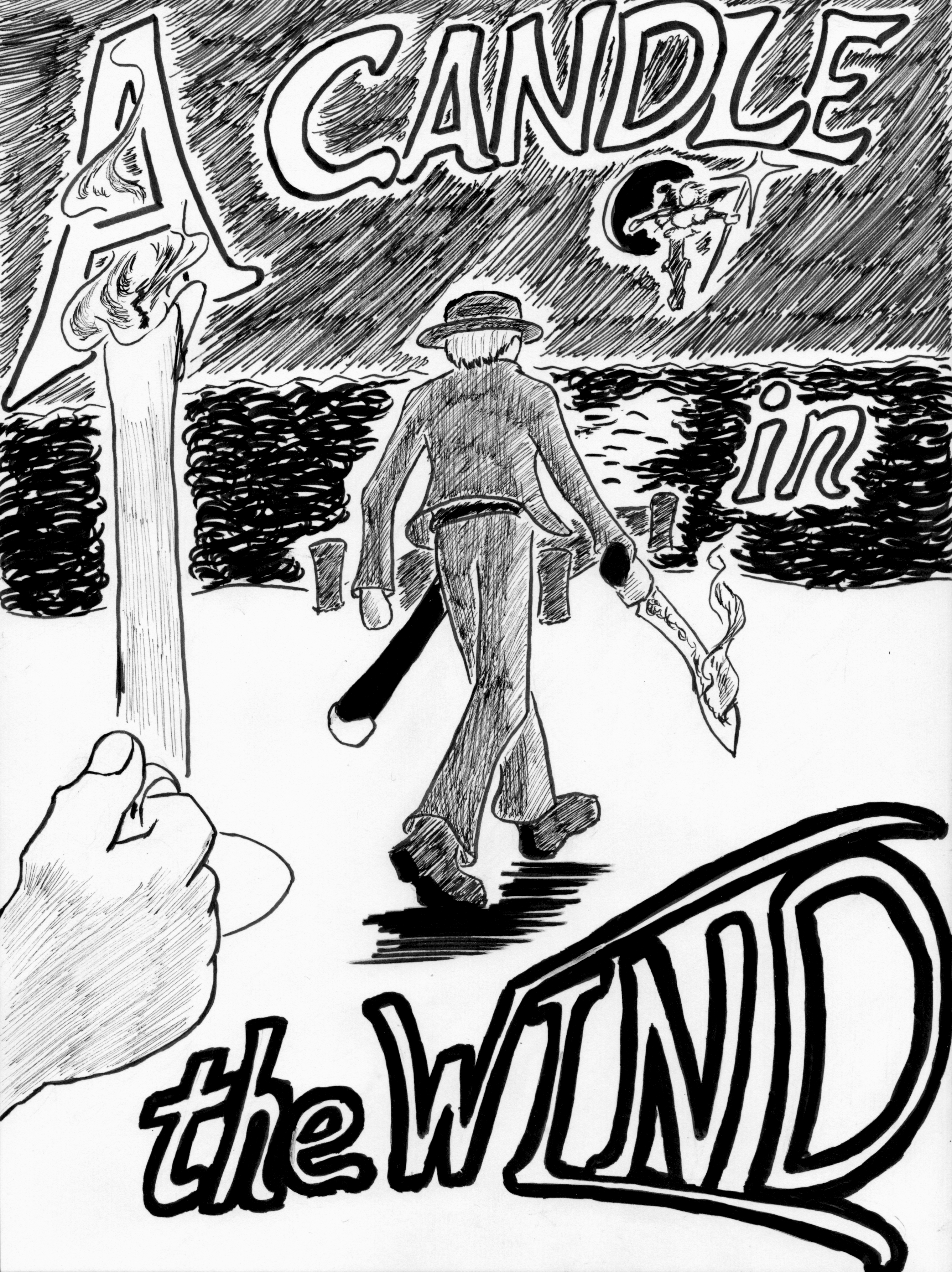
As the first rays of dawn hit the head of Jonathan Riker’s statue a cloud of dust swept over it born on a thunderous rush of wind. No change in weather was in the offing. However when the dust settled the only change that spoke to the source of the gust was a lone man picking his way through the graveyard. There was an odd quality to the man. It had little to do with his rumpled brown duster, heavy boots or even the unusual shirt wrapped around his torso. His face was unlined but his eyes were deep and hard. Unnatural streaks of silvery hair shot through his bangs and long ponytail but otherwise there was an unsettling, ageless quality to him.
The man stopped by at the Riker family crypt and nodded in greeting. Then he turned his attention to the unnatural eclipse locked in place over the bay. “My apologies, Jonathan,” the stranger said. “I kept telling myself I’d sort that one out eventually but others kept making demands on my time and I never got to devote my full attention to running him down. This never should’ve landed on your doorstep.”
With a twitch of one hand he moved the edge of his coat back and unlimbered his weapon. It was a long, gently curving sword with minimal hand guard and no mount to hold a sulfurite crystal. To the casual weapon enthusiast it might look like a Hodekkian tachi. Those familiar with such weapons could tell it was no such thing as soon as he drew it. A gleaming pattern like oil ran down the edge of the blade, nothing like a tachi’s hamon, and the hilt wasn’t wrapped in the diamond patter most Hodekki weapons favored. Still it gleamed brightly in the growing light of dawn.
The stranger casually threw the weapon over one shoulder as he studied the lighthouse, the bay, and the magic and crowd surrounding them both. “A fine place you’ve made here. I’ll step lightly. Someone kept old Heinrich from dragging your town off the face of the map and I’ll leave as much of their hard work in place as I can. Don’t worry about the cost. I’ll just take him back with me as payment. Unless he runs again. Either way, I guess we can call it even.”
He raised his sword to salute the founder of Riker’s Cove, then walked out of the graveyard at a sedate pace. As soon as the gate to that place was fully behind him he vanished from the human eye with a loud bang. A deep bootprint crushed into the dirt path was all he left behind him. Even if they had been looking that way, no one in the town watching what happened would have understood what they saw. From its vantage on the bluffs the statue of Jonathan Riker was better suited to the task.
Beyond that, its eyes of stone saw many things human eyes could not.
It clearly saw the stranger tear through town, barely more than a blur, once more pulling a wave of dust and debris in his wake. Sunlight glanced of his blade, reflecting in a dozen windows as he passed by. The force of his passage rattled doors in their frames and tore shingles from the roofs but none of the townsfolk at the docks heard him approach. Like the dust, the sound of his footsteps roiled along behind him.
Before he reached the docks the stranger slowed just a hair, leaping up the harbor master’s shack and using it as a platform to leap over the assembled crowds. In spite of his reduced speed the thunder following in his wake leveled the building and scattered the people like leaves. The candles they held were dropped or thrown aside yet didn’t blow out. In spite of the wall between their time and that of their creator the magic of the candles had linked themselves to Avery’s spell and now far more than simple combustion kept them lit.
As he flew through the air the stranger lifted his sword overhead in both hands, blade aglow with the force of daybreak. He landed only two steps from the edge of the lighthouse’s prison. The man rolled his momentum forward one step and struck straight down with his blade.
Heinrich von Nighburg’s bubble of warped time parted before it.
With a single flowing cut the moon prism split asunder and the stranger rolled back, letting the momentum carry him around and back into the wave of dust and thunder following in his wake. Once again he shifted his weight and looped his momentum forward again. The crackling wave of sound and air caught up the candle flames and the magic they contained as if it would drive the stranger’s sword forward again, this time with all the collective power of Riker’s Cove behind it. With a flick of the wrist, as simple yet delicate as skipping a stone, he sent that power upwards towards the malignant sky. The second wave cut away the malignancy there as easily as the first split the prism.
In the space of two, perhaps three heartbeats it was over. The sound and fury was past, the unnaturally long eclipse ended and a single, mangled body fell from the sky into the waves of the Cove once more.
To the people of the town it looked downright miraculous. One moment they were gathered, staring at the twisted sky, then there was a blinding flash and a thunderclap and they found themselves on the ground, looking up at a normal morning horizon, a total stranger standing in their midst with a satisfied look on his face. Satisfaction that quickly turned sour.
“Gotterdammerung,” he said, sheathing his weapon as he waded into the surf. “Why did he have to land in the ocean?”
Roy was just beginning to think he couldn’t hold the flame anymore when a sound like ripping cloth tore through the beacon chamber. The cacophony of voices from the sky paused, as if they all drew a breath at once. In that moment of quiet Roy thought he heard the echoes of Sam Jenkins laughing then dawn broke over the lighthouse in a thunderclap. A surge of power carried quiet thoughts of concern and hope from the shore, quickly overwhelmed by singular purpose.
Something shifted in the mindscape and the flame Roy was holding flared ten times as bright. Deep inside it, Johan’s sunstone flared up, then burst. The power swept away the candle flame, the sunstone and the last wisps of Avery’s control over the mindscape then shattered all the glass in the lighthouse reflectors for good measure. It would’ve been a scary sight if the six of them weren’t blinded by the sunstone flaring already.
When Roy could see again he looked around and saw nothing. The rest of the roof had been torn away and they had an unobstructed view of the early morning sunrise over Riker’s Cove. The sky over the waters was empty.
“Dust and ashes.” Roy dashed to the edge of the building and looked down but he didn’t see anything disturbing the waters of the bay.
“What happened?” Brandon asked, the bark of his yew retreating back into his body as he shifted back to a more normal appearance. “Did he escape with that thing?”
“I don’t think that was something that would just vanish,” Avery replied, still lying flat on his back. “Felt like the kind of creature that likes to let others know it’s around.”
“Doesn’t matter,” Roy snapped, hustling back to the stairs. “Whether his patron is here or not, I’m not letting that blackguard leave this town alive.”
Proud Elk was only a step behind him. “As always, Bright Coals, when it comes to hunting vile creatures you see the clearest.”
From the clattering on the stairs Roy could tell there were only two people behind him and he didn’t have to stop and look to know who they were. Avery and the Fairchilds were dependable enough souls but they’d never seen something like that before and it was the kind of experience that took some getting over the first time you did it. Besides, it was the three of them who owed Jonathan the most. The three of the them should finish it.
Roy’s first instinct was to head to the mirror and return to the manse, which seemed like the most likely place for von Nighburg to go after… whatever happened up there. But when they reached the bottom of the stairs they found the glass in it shattered just like the reflectors up above. A quick glance to Johan, a shake of the head, and Roy knew there was no way they were going to do anything with the mirror so he continued down to the base of the tower. Maybe the wizard was somewhere in the bay.
However as he reached the stairs to the ground floor Roy was greeted by two familiar voices speaking. One was Samson Riker. The other he hadn’t heard in a long, long time.
“Dangerous in here,” Riker was saying.
“Probably the most dangerous place left in town.” The other was speaking in a cheeky tone. “There’s no sign of Heinrich in the bay so if he’s anywhere it’s going to be in here.”
“Check again.”
Roy cleared this throat and approached the two men, politely declining Jenny’s offer to take her spot next to her father. “Nothing to see in here. Von Nighburg had some kind of a bolthole built on the other side of a mirror. The sheriff called it a shallowing. Problem is the mirror leading to it is shattered and near as we can tell no one’s getting through it.”
The stranger made an irritated noise and shoved his hands into the pockets of his brown duster. “Frustrating. Heinrich is pretty good at contingency plans but he’s never been so gifted at running away.”
Riker glanced at Roy and raised one eyebrow and tilted his head out towards the water. “You gonna check?”
“No. If he says von Nighburg ain’t out there then he’s not there.”
“You seem awfully confident about that,” Avery said, climbing down the stairs with tired, heavy footsteps, the Fairchilds right behind him. “I thought you said everyone else you asked to come was unavailable.”
“They were.” Roy gestured at the stranger. “This is the one we didn’t ask. Sheriff, Fairchilds, Mr. Riker, allow me to introduce you to the one the Sanna call The Strongest Man in the World.”
I’m wrapping up a project and getting ready for a couple of more, plus talking all about it in today’s writing vlog!
Weekly writing vlog is pretty short but I’ll be taking a week off so hopefully when I’m back in two weeks I’ll have a lot to share!
Weekly writing vlog brings a quick update on various topics but mostly the state of short stories.
From the title page Out of the Soylent Planet is utterly unrepentant about what it is. Robert Kroese has written a pretty fast moving and incredibly silly book about an intergalactic conman named Rex Nihilo and his long-suffering robot sidekick Sasha. It has lasguns. It has spaceships. It has lots and lots and lots of robots who are all forbidden from having any kind of original thoughts (Sasha included.) What it didn’t manage that well was laughs, at least not in my book.
Right off the bat I should note that humor is an extremely subjective topic and the fact that I didn’t find Kroese’s work funny doesn’t mean you’ll be equally unimpressed. I’ve heard several people say they thought it was hilarious. From a totally dispassionate point of view Kroese builds a number of jokes in very workmanlike fashion and executes on them well. That’s fine, but workmanlike humor kind of misses the point, at least in my opinion. Again, humor is hard to quantify.
All that said, I don’t intend to critique the humor in this review. I recommend reading a sample of one of the Rex Nihilo books and seeing if you laugh at it, since Kroese’s humor doesn’t change much in nature or tone over the course of the book. What you see is what you will get. You’ll probably get a better grasp of how much you’ll like his sense of humor firsthand rather than trying to see it through the lens of this review.
Instead, I’m going to recommend you avoid this book because the story and characters are very lackluster. I’m not a fan of negative reviews overall, mainly because poor quality media tends to fall into the same pitfalls over and over again. However, while I didn’t like Kroese’s humor and I thought his story had a lot of flaws, I can say it was original! In a way. Which is to say, I found its failures unique and refreshing in their own way.
As I said at the beginning, from the title onward Soylent Planet wears its idea on its sleeve. It is all about making fun of well known scifi ideas and properties. It begins with a chapter long sendup of Star Wars. The issue I have with it is that the Star Wars parody plays out along side the introduction of our characters rather than serving as the introduction to our characters. Rex and Sasha play no direct part in that parody they just watch it play out. It’s parody for the sake of parody, rather than a parody that also tells a story of its own. It’s more a distraction from the story than an enhancement for it and it had the side effect of making our protagonists less than the most interesting thing in the room.
If nothing else, this isn’t a running issue in the story. After this strange introductory chapter Rex and Sasha step up into center stage and their decisions do drive the story and are the major focus of the narrative, rather than being a sort of side show to a parody Kroese is running in parallel. However once Rex and Sasha are in the limelight we run into another problem. Rex is a character that borders on total incompetence who manages to stumble through things on luck. Again, this can work in a humorous story. The Pink Panther films comes to mind. The effectiveness of that is down to the quality of the humor in the story, which again is going to vary from reader to reader. I’ve already said all I have to say about that.
Sasha, on the other hand, is a robot who is forbidden to have original thoughts of her own. If she approaches such a thought, a safety mechanism reboots her. That’s an interesting idea, reminiscent of the narcoleptic character in the movie Rat Race, and seems like it should be the center of numerous gags. It’s not. Instead, it’s a plot device that allows Rex to escape the final danger he faces which is fine, in and of itself. I’m not saying that Kroese should have cut this plot device from the climax of the story, I think the two things could easily coexist. I just felt like neither character really had a central element that really held the story together.
Instead, Rex seems to bounce around from one scenario to another, spoofing on famous scifi ideas, and Sasha is dragged along in his wake. Both characters feel dragged by the plot, reacting rather than acting. Now, character agency is a tricky thing and I do think that passive or reactive characters are just as good as active ones, contrary to popular belief. But I like my reactive characters to have strong, well define core motivations that define their reactions. While Sasha is programmed to serve, that’s as close as either character gets to such a central motivation. I would’ve liked to see a stronger core to both characters to balance their passivity in this book.
What I can praise Kroese for is a good setup and payoff for the plot. He does a reasonable job of putting all the pieces in place for his climax before he gets there and he clearly enjoyed writing it. While many of the transitions in the story are clunky, the core idea is pretty polished. I want to enjoy this book. It’s just crammed full of things that make it hard for me. I wanted this story to have a point, to do something of its own with its characters and world. Kroese built it to spoof on scifi ideas and tropes instead. He executed on that idea pretty well in Soylent Planet. Whether you’ll enjoy that or not is a matter of taste.
An update on short stories and first thoughts on A Candle in the Wind.
I’ve written about my problems with the storytelling of Rian Johnson in the past. However after observing his career for some time, I’m beginning to believe that there’s a deeper thread running through his work that bears addressing. In the past, Johnson has stated he’d rather have half his audience love a film and half hate it than have a large majority simply like it. In fairness, he has succeeded in becoming quite the controversial director.
This position is merited. But I think the reason underlying that merited controversy is Johnson’s simple, undiluted laziness. On his own, I don’t think Johnson being a lazy director who somehow finds an audience is bad. Art and effort don’t have an entirely linear relationship and, once a certain degree of competence is achieved, even lazy creators can still create work of surprising artistic merit. This is true in every area of life and I don’t think art is an exception.
If Johnson was the only lazy director out there it might not be that big of an issue for movies as a whole although it would be disappointing. However we’re starting to see it with other creators as well. James Gunn and Taiko Waititi are also directors with a great deal of talent, in particular with a gift for striking visuals and excellent editing. As writers they have very little ambition.
Let me make my case using some examples from Johnson’s writing – and be warned there will be spoilers in here. In the movie Knives Out, Johnson builds his entire plot around a character, Marta Cabrera, who’s most notable characteristic is an is her inability to lie. Any time she lies she winds up vomiting. Marta is the caretaker for the aged Harlan Thrombey who winds up dying (indirectly) of an inappropriately administered medication. As his caretaker, Marta is implicated.
By the end of the story the genius detective Blanc has deduced the real killer and corners him into confessing using a gambit that hinges on… Marta lying. This is revealed when Marta barfs all over the killer after he confesses. All this happens in direct contradiction to all the previous instances where we see Marta vomit when she even tries to lie.
Now, I wouldn’t object to this as much if we’d seen Marta practice to overcome her difficulty. However there’s no set up like this at all, in fact it raises the possibility that Marta can lie and everything we’ve heard from her is actually a lie. We were supposed to be able to be confident in Marta’s integrity and the climax completely undercuts it to the point where I’m not sure her entire untruth allergy is a ploy on her part. It destroys Johnson’s narrative.
This happens again in Glass Onion, Johnson’s latest mystery film. A major central character, Andi, is revealed to be dead and the character who’s been called Andi up until the middle of the story turns out to be her twin sister Helen. This doesn’t add new dimension to any of the characters. It doesn’t cast any of their conversations in new lights, it doesn’t create tension since we don’t know Andi is an impostor and it doesn’t give rise to any clever gambits. A little more effort could have made this a twist that improved the story but instead it just undercuts our investment in what we thought we knew.
Finally, in The Last Jedi Johnson sets up the infamous hyperdrive kamikaze scene, where one ship rams another at near lightspeed in spite of the ways that contradicts everything else we’ve seen about the hyperdrive in the past including the previous installment in the franchise, Rogue One, where we see a ship at near lightspeed collide with another and get smashed to rubble without harming the other one. Give the hypderdrive kamikaze it’s due. It’s an impressive visual. It also shows a lack of care for the previous story and a lack of imagination for how he will get to his desired visual. There are may ways he could have achieved this. In fact in said previous film we see ships using ramming in ways suited to the Star Wars universe.
Johnson is supposed to be a genius artiste, setting up common tropes and then subverting them with his clever movie making. However, when he subverts he does it in the laziest way possible. You thought Marta couldn’t lie? Surprise! She can! You thought Andi was one person? Surprise! She was someone else! In fact, in Glass Onion the story is so bad that the characters themselves insult it as moronic. However, hanging a lampshade on your story’s lazily used tropes doesn’t make them okay. It just points out your laziness.
Waititi and Gunn are likewise both artists with their own visions that they seem intent on forcing into any narrative they produce and not making the least concessions to it. Gunn relies on character tropes to replace much of his character development. Waititi shoves jokes into his movies without trying to smooth the transition from narrative to joke or make the joke organically arise from the situation. It’s deeply frustrating, especially as these directors show so much talent in many other areas of their movie making.
Most of all it’s frustrating that people are so content with cheap entertainment. It is great to see people creating at their highest levels but when they only put their passion and effort into a very narrow band of what they make it shows incredible contempt for their creations and their audience. Hopefully one day we’ll all have more care for what we create and consume.
The power of story to uplift often necessitates we first confront the darkest parts of the world, whether the real world we live in or a world that only exists in fiction. Depicting the darkness of the world is very difficult. It’s difficult for a number of reasons. You have to learn about the darkness, which is decidedly unpleasant, you have to depict the darkness without running off your audience and you have to expose the darkness without reveling in it. Beyond that there’s one final problem.
There may be nothing to learn from passing through the darkness.
Last year I was told that if I really wanted to understand scifi fandom in general and the Science Fiction Writer’s of America specifically then I needed to read a book called The Last Closet: The Dark Side of Avalon by Moira Greyland. I had never been that interested in the SFWA and fandom has always struck me as a tad… obsessive. But I do enjoy scifi and I was given to understand Greyland had unique insights into what made some of the biggest scifi writers of the last generation tick. So I decided to check out the book by reading Amazon’s free sample.
Let me start at the end: I can’t recommend this book to anyone outside a very select group of people. Greyland has survived some of the darkest things I have ever heard. Her survival in and of itself would be a superhuman feat, the fact that she lives a wholesome life, creates beautiful music and has forgiven those who tormented her is truly, genuinely inspiring, a testament to the grace of God to redeem even the worst of circumstances. Many who have endured similar things say reading her book has helped them.
I believe this to be true, because I am in no place to contradict it. In fact, that testimony meshes well with what I’ve observed of human nature myself.
That said, I don’t know as The Last Closet has anything to offer anyone else who reads it. Those are my thoughts on the book broadly speaking and, before I delve into my reasoning deeper, let me give you a chance to jump off this ride here, dear reader. Greyland’s story is disturbing even removed by several layers of discussion. If you don’t wish to delve into very disturbing topics, now is the time to get off this ride.
Moira Greyland was the daughter of Martin Breen and Marion Zimmer Bradley. Breen was an early participant in scifi fandom, contributing to many fan magazines and appearing at many scifi conventions in the early years of these events, long before TV shows like Star Trek and Battlestar Galactica put the genre out for the general public. Bradley was an award winning fantasy writer – fantasy and science fiction have long been related genres and there was less of a barrier between them in the past – who published dozens of novels including The Mists of Avalon, which is her most famous work.
Breen was also a convicted child molester. His wife was aware of and covered up for his crimes, facts she testified to during Breen’s trial. If Greyland’s testimony is to be believed – and I see no reason it shouldn’t be – Bradley was also a child molester. Neither parent spared their own children their predations. The Last Closet is a complete accounting of their crimes, as far as Greyland can recall them and supported, as much as possible, from the public record.
To the extent I can praise the book, I find Greyland’s work in sourcing letters, articles and court transcripts to supplement her own narrative quite impressive. It speaks to her strong desire to be as fair as possible. I am also staggered by what reads as real, genuine pity and compassion that the author has for her subjects. Martin Breen and Marion Zimmer Bradley both suffered terrible childhoods and, as is so often the case, were themselves victims of the horrors they visited on others. These events doubtless warped their outlooks and poisoned their attitudes.
The prose of the book is very readable. In fact it feels very much like blog writing, a very folksy, easy to read kind of writing that blunts some of the force of the things it describes. Greyland does run a blog and her experience with this kind of accessible prose shows. She intermixes the factual narrative with pieces of poetry she has written over the years to help her process her trauma. These pieces are, frankly, terrifying. As someone who has never come close to the level of trauma Greyland has experienced, reading those verses felt a bit like walking over cracked ice, wondering if I was about to slip through into the trauma beneath.
As I said before, Greyland survived her childhood. Amazingly she even managed to live out her own dreams – she got married, had children and is a professional harpist with several albums of music available. She has forgiven her parents. Yet I cannot recommend anyone, outside her fellow abuse survivors, deliberately read her book.
Listen. The world is often a horrible, depraved place. Although it is rarer than it should be, people do survive the depravity of the world and bear witness to the goodness of God and the potential we all have to survive the worst circumstances. I have never doubted any of these things.
I wish that I could say Greyland’s story shocked me. Whether it is because I am cynical, jaded or just too aware of what my own sinful nature could do if unchecked, I have to say it did not. I always knew these things were happening somewhere. What it did do was sadden me and enrage me. Having read The Last Closet I now know a whole series of things about scifi conventions and the people who run them that only serves to stoke empty anger and grief. There is some consolation in knowing the victim has overcome these things.
However, I was not a victim of Greyland’s suffering. I have no one to forgive and only one lesson to take away from the story: Some things are beyond my control.
So I cannot recommend this book to most people. I wouldn’t even suggest reading the free sample – the story has that captivating quality of many horror stories that makes it difficult to look away once you’ve begun. It will leave you with very little deeper understanding of human nature, unless you are one of those who believes we are fundamentally good, and will leave a great deal of emotional baggage you’ve picked up quite vicariously. I’m almost certain that’s an unhealthy trade.
All that said, I also cannot suggest you avoid this book. In her introduction, Greyland states that she thinks one of the biggest benefits of her book is that it overcomes denial. It helped her make peace with what happened to her in part through her admitting it had happened. In the detailed recounting she stripped off some of the varnish she’d put over the ugliest memories. Abuse survivors also found it helped them admit the truth of their experiences.
One reason Breen and Bradley got away with their predatory behavior for so long was that so many people were in denial about it. I do not believe in widespread conspiracies to silence victims. I do believe that widespread abuse can be met with equally widespread denial that makes dealing with the abuse impossible. It is possible that The Last Closet can become a sword that helps people clear away denial that stands in their way. It may be that some will need to read it to convince themselves.
And some people will have to read it just so they know that the resource exists and how it can best be used.
So in the end, I find myself in a very strange situation. I can’t really recommend Greyland’s book but I also can’t say you won’t find a use for it if you do read it. So, for perhaps the second or third time in my years of blogging, I must simply place these facts about the book before you, dear reader, and leave them for you to make up your own mind.

