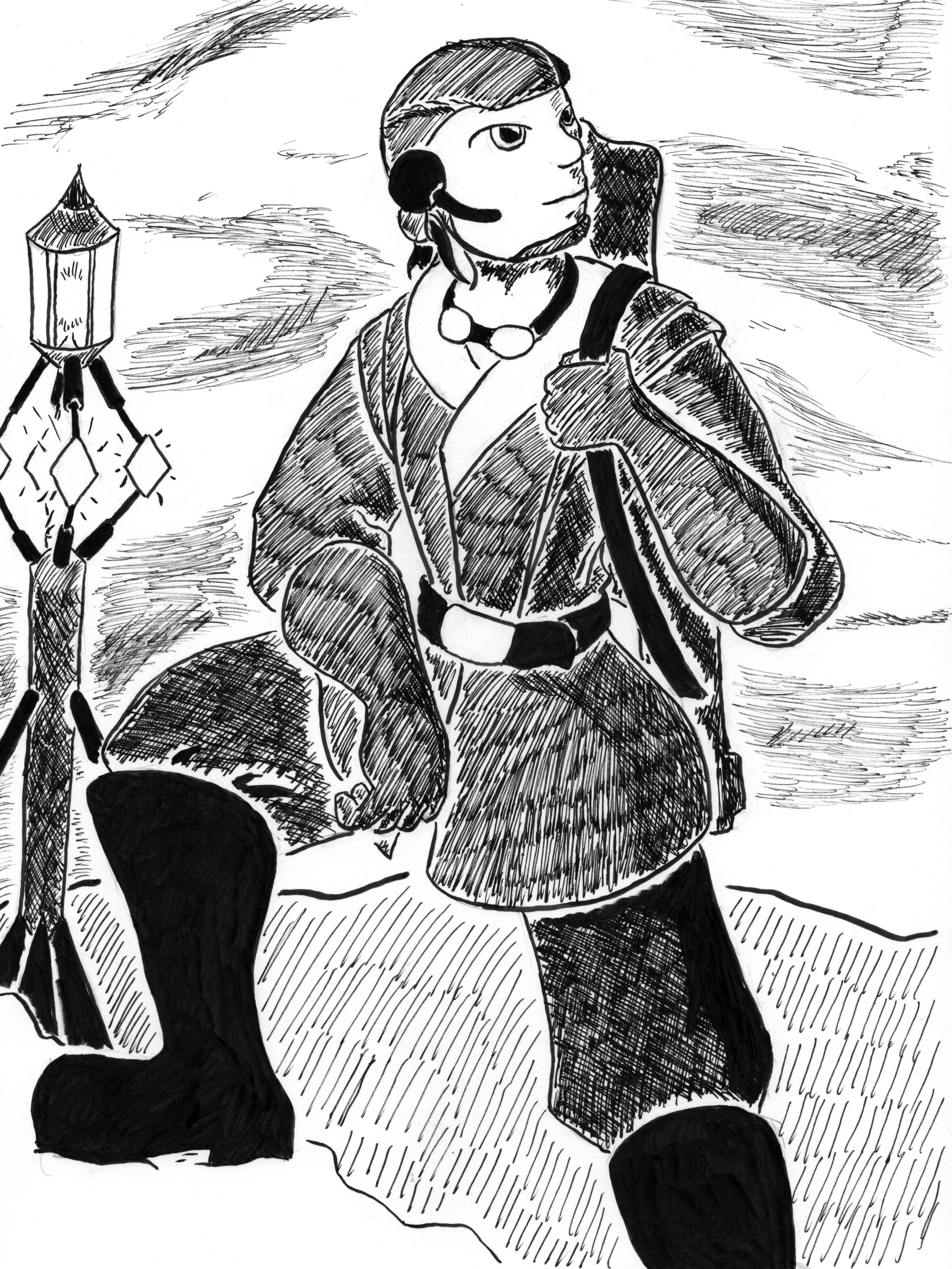
The Sidereal Saga – Cloudie

Previous Chapter

Dramatis Personae

Lloyd

“Hey, we got wounded down in the infirmary,” Lloyd said, hauling himself up onto the Skybreak‘s bridge as the ship rocked under them. “Try and keep us steady. If things are this rough while we’re still under the pressure domes you’re gonna shake this thing apart once we hit the atmo.”

“She’s a tough bird,” Lavanya replied through gritted teeth. “The Helium Seas are rougher than most atmosphere but at least we’ll be able to open up the engines instead of running them so low they’re borderline stalling. Problem is Ashland flight control says there’s a storm system brewing. They’ve locked down the pressure dome and are calling all outbound ships back to landing.”

“If your ship’s that tough we can turn sidereal and leave the dome that way,” Lloyd said, throwing himself down into the sensor station chair. “The pressure locks in the dome will save you stress on the hull from the sudden pressure change but they’re not required if you think the ship can take it.”

Lin’yi shot him a skeptical look from her spot at the copilot’s controls. “You mean the domes aren’t interdicted? That seems a little short sighted. What if the creatures that live out in the Seas get in that way?”

“The Jellies?” Lloyd shook his head. “They don’t have an etheric sense so there’s no way for them to get in except the pressure locks, which will kill them. Besides, there’s something like a dozen pressure domes on Ashland Prominence alone to say nothing of all the other settlements across the planet. Interdicting them all would be hugely expensive and choke off most etheric travel.”

“Why did no one tell me this?” Lavanya muttered. She grabbed the throttle, pushed it forward and Skybreak‘s engines roared to life. As she’d promised the ride smoothed out as the engines spun up and the sound of wind over the hull went from a soft hiss to a frantic drumbeat. “Count off the time to the dome, Carter.”

“Eighteen seconds.”

“The computer tells us we have to try to get into orbit and make a jump,” Lin’yi said, her hands flying across the ship’s controls. “But it won’t suggest a place for us to jump to. It said the best people to choose would be you or Mr. Hammer.”

“Me?” Carter looked shocked at that. “Why me? Ten seconds to the dome.”

“You have a low profile, not a lot of attention from reporters, not much communication across the etheric networks, that kind of thing. Apparently that makes it hard for the OMNI computers to predict your actions.” Lin’yi braced herself as the Skybreak spun into the sidereal. There was a whisper of motion as the ship slid through the empty realm then the terrestrial wiped back into place a second later. A hard jolt hit the hull as the dense atmosphere of Wireburn slapped into them.

“We should just head for orbit in the sidereal,” Lloyd muttered. “It’d be faster.”

“You’ve never piloted a jumpship, have you, Carter?” Lavanya asked, working her own set of controls desperately. “They aren’t like you. We can move around because a human’s etheric sense gives them a natural connection to the ether. The Skybreak doesn’t so she has to coast on momentum. The only form of propulsion we have in the sidereal is jumping, because not even Lin can afford a full fledged etheric turbine. Until yesterday I’d have said the ship didn’t have the computing power to run one, either.”

“Speaking of.” Lloyd tapped a few things on his console experimentally. “Why isn’t L-93 picking a planet at random for us to jump to? It’s not even talking now.”

“It says it’s calculating,” Lin’yi replied. “And when it was talking it said that none of its selection algorithms are truly random so OMNI could reverse engineer them from its code. You’re apparently the safest bet. I’ve got a star chart pulled up, do you have some place you want to go or would you rather point a finger at where we’re headed?”

Lloyd paused long enough to give her a skeptical look. Technically the woman was his employer and one of the five most beautiful woman he’d ever met but sometimes he felt like she ran her operation in a very casual fashion. “You know what? Jump us to the closest uninhabited system and we’ll recharge the reserves and perform a second jump from there.”

She shrugged and started programming the course into the navigational unit. “Let’s just hope they don’t have any backup waiting in the surrounding star systems.”

Some kind of alarm went off on Lloyd’s sensor readouts. The Skybreak was an interplanetary jumpship and had a lot more high powered, long range detectors than anything in the Wayfinder hangers so it took him a few seconds to work out exactly what the ship was seeing. Once he did a cold weight settled in his stomach. “We have a large object moving through the seas, coming in at nearly supersonic speeds,” he said. “How fast can this thing go in atmo?”

“Not hypsersonic,” Lavanya replied. “Not in this soup. How big an object are we talking?”

Lloyd craned his neck forward, trying to spot one of the Liquid Teeth’s titanic shadows in the ocher skies outside. “Kilometers wide. I have no idea how tall.”

“It is difficult to extrapolate based on available data but most strands of an I-Series outer matrix exceed lengths of one million kilometers,” L-93 announced, piping its voice in through the comm speakers. “This is not exactly how tall it is but the structure is toroidal in shape. The height of such a structure is dependent on your perspective.”

“Millions of kilometers.” Lavanya was starting to sound shell shocked. “Of course. Tell you what, 93, can you do anything to get us away from the hypersonic, planet sized torus?”

“Not with the resources on hand.”

“Great,” she muttered. “I guess we’ll just have to try and slip around one of the things.”

“The atmo’s going to be really rough around them,” Lloyd warned. “It’s not coming in at a direct angle, maybe you can get us around it. I’ll plot the computer’s projections on your heads up display.”

“Currently there is a 12% chance of evading I-6’s outer matrix without sustaining crippling damage to the Skybreak’s hull,” L-93 reported. “If you turn the ship sidereal for 112 seconds I can reinforce the hull by altering it’s molecular structure. That will raise the probability of a successful evasion to 16%. It will also deplete 62% of the ship’s etheric reserve.”

“We don’t have etheric turbines, 93,” Lavanya snarled, shifting from resignation to anger with shocking speed. “We’ll lose too much speed.”

Lloyd noticed a blip on the ship’s electromagnometer. With a flip of his wrist he spun the instrument all the way up to maximum sensitivity, pulled it out of its standard sweep and rescanned the area. Sure enough there was a small but regular pulse coming from just below them. “L-93, you specialize in making things, right? Can you fabricate anything?”

“So long as I have the correct base elements and a blueprint or design document with sufficient details. The ship will need to turn sidereal if the necessary etheric expenditure is large enough. Is there anything specific you would like?”

“A Meynard Technologies TR-16 Radio-to-Telepathy transmitter. Integrate it into the ship’s comms.” Both women in the cockpit with him gave him odd looks, which Lloyd ignored.

“Those are listed in the Wireburn Patent Library in sufficient detail for construction. Stand by. Fabrication will take 14 seconds.”

“Lloyd…” Lin’yi watched as a new panel wiped into the terrestrial from the sidereal. “What is that for?”

“I need to say hi to an old friend.” He reached out and hit the comm switch once the thing was finished. “That you, Cloudie? It’s Lloyd.”

For a long, uncomfortable moment there was no answer. Then the panel lit up with an incoming message. “Lloyd? It is me. I am glad to hear you are alive, the Wayfinder’s Guild listed you as missing when I arrived to ask about you yesterday morning. I have been waiting to find out how to best assist in the search. Are you inside a dome right now? The Seas are quite rough out here and I have heard reports that the Liquid Teeth are rising from the deep all over the planet.”

“I know.” For a brief moment Lloyd struggled with what to tell his friend. The Great Jellies barely had a concept of computers, much less artificial intelligence, and he didn’t have the time to try and explain any of it. “Listen, I don’t have time to explain why but I think the Teeth are looking for me. Or rather, that thing we found just before they started rising which I’ve still got hold of. I’m going to be running off planet soon, maybe they’ll go back down once I do. But I’ve got to get up to orbit before we can jump.”

“I don’t understand why any of that should be the case but I have noticed human begins have a very keen ability to get into trouble so I suppose it could be true. However I have never heard of the Teeth rising so far. Will you be able to make it?”

“Maybe.” Lloyd hesitated for a moment, realizing he was about to ask his friend to do something incredibly dangerous. “Listen, one of the Teeth is close by. We need to get around it but we’re in a jumpship, not nearly as optimized for the Seas as one of our skiffs. Do you think you could give us a hand?”

There was no delay in Cloudie’s answer. “Of course. Which ship is yours?”

With a couple of keystrokes he pulled up the Skybreak‘s schematics and transmitted them. He’d never used a telepathic transmitter for images before but MaynardTech claimed their devices could handle it the same as anything else. It seemed true because less than thirty seconds later a familiar bag of transparent protoplasm squirted up from the helium depths and hurried along beside them, it’s tentacles briefly running along the ship’s hull before it pulled a few dozen meters ahead.

“Are you piloting, Lloyd?” The Jelly asked.

“Negative. That’d be Ms. Brahman.”

“Hello, Ms. Brahman, I am Devours Clouds but you may call me Cloudie or DC if you prefer. If you follow behind me at this distance I believe I can safely guide your ship along the winds around the Liquid Teeth. Is that satisfactory?”

“Our chances of success are 32% with this guide,” L-93 added.

Lavanya pulled her goggles down around her neck and shot Lloyd a look. “Can that transmitter of yours show me where he’s going to fly or do I have to try and follow him purely by visuals?”

“Sorry, not even MaynardTech can do that.”

She huffed out a breath. “Cloudie, no offense but I’ve never even seen one of your kind before. I don’t know how you guys maneuver in this soup and I don’t know if the Skybreak can duplicate it. I’m not sure this is a good idea.”

“Beats the alternative,” Lloyd replied.

“We have less than two minutes before the outer matrix arrives,” L-93 said. “If you wish to reinforce the hull we will have to begin the procedure in 20 seconds. However using the time to fly test maneuvers with Devours Clouds may be more advantageous than a hull reinforcement.”

“Okay, Cloudie.” Lavanya tweaked a few controls and suddenly the Skybreak flipped itself upside down, waggled it’s stubby wings and fishtailed back and forth, zipping horizontally under the Great Jelly twice. “I got a few moves in me. Show me what you got.”

Cloudie responded by bunching up its tentacles and shooting straight up towards the upper atmosphere at an incredible rate. Lavanya cursed and flipped the ship right side up, stood it on its tail and punched the throttle. The ship’s intercom chimed and a woman’s voice yelled, “What the hell was that? There’s a wounded man down here!”

“Well strap him down,” Lin’yi snapped, “it’s only going to get rougher from here. We’re in for stormy weather.”

Cloudie zipped back and forth like a stone skipping across water, sometimes flying in graceful arcs, some times stopping and rebounding at odd angles, tentacles whipping about its central body in a dazzling display. Electrical energy crackled along its nerves, illuminating its transparent body, a testament to its effort. Lavanya worked the ship’s controls, sweat beading on her brow, as she craned her neck to keep the creature in sight. The Skybreak bucked, rattled and roared, engines straining and hull creaking. After a seeming eternity of that Cloudie announced, “Your moves are quite good Ms. Brahman. If you kept up with that you can ride the winds with me. The rest of this should be easy.”

Lloyd had total confidence in his friend but he felt like calling what followed easy was a bit misleading. The ship was still groaning and straining underfoot and Lavanya’s collar was soaking in sweat. But the ride was a little smoother and the sensor echo of the Liquid Teeth wasn’t getting any closer to the ship. Lin’yi leaned closer to him and whispered, “What are we doing? Is it working?”

“Yeah.” He leaned closer as well, ignoring a faint lilac scent that drifted past. “Jellies find what they call gaps in the wind, places where the weather is easier and gentler than the rest of the atmo. Apparently once you’re in one you can just ride the weather fronts, like surfing. You can’t wave something millions of kilometers long and several wide through atmo at hypersonic speeds without creating a massive weather front. As long as we can ride it then the Liquid Teeth can’t get closer to us.”

For a moment her attention fixed on him, like she was trying to find something to say, then her eyes flicked away to the sensor board. “Then why is the proximity alert going off?”

Lloyd jerked himself back to the station and sure enough the radar was warning about a second object moving through the churning atmosphere around I-6’s outer matrix. It wasn’t riding the wind like they were. In fact it looked almost like it was something that had broken off and was falling down towards them. Lloyd frowned and scanned for an ID beacon but didn’t find anything. So he ran a sensor profile recognition algorithm and said, “93, can you give us a hand with this?”

“Certainly.”

The moment the AI stepped in the algorithm went from twenty percent to complete. It couldn’t identify the ship with certainty but it did return three possible models of ship it could be. Lloyd blew out an breath and rocked back in his seat. Lin’yi leaned as close as she could given how rough the ship was flying. “What is it?”

“Not sure but all the possibilities are Kashron Yards Type M ships. You know what that means?”

Here eyes widened. “Black ops cruisers.”

He nodded. “Looks like they’re done trying to capture us. Now they’re going to blow us out of the sky.”

Schrodinger’s Book: Introduction and Chapter One

It’s hard to write a story about something that concerns you. Writing requires a degree of passion to play out, and for a lot of people – myself more so than most it would seem – concern is a thing that it’s hard to hold on to for any length of time. But, at the same time, writing is at its core the process of sorting out ideas and putting them into order. When something concerns me my kneejerk reaction is to analyze the problem, put it in order and try to figure out what bothers me and how we might fix that. Writing is a process tailor made to help you do that.

But writing a story is its own beast. Stories need conflict and when you are concerned with a problem conflict is probably baked into the cake. Stories also need characters, and when you’re concerned with a problem that can be more of a problem. They also need  setting, a world to take place in, and that becomes an even bigger hurdle. If your characters look too much like you, if your world looks too much like now, you come off extremely heavy handed and you can lose your audience very quickly. I’ve actually tinkered with this kind of story telling before and I’ll be the first to admit it came out pretty mediocre. So I tabled storytelling about issues I was concerned about.

Then, about a month and a half back, I heard someone pitch a story idea with a core concept that I thought was truly excellent. I didn’t like much about the plot points or execution but the core conceit was fascinating. I knew I had to steal the concept but I’d need some other kind of story to build around it.

Before I knew it, I was writing a story about something that concerned me. I’d sworn of this kind of writing for a while but I really, really wanted to do this story and I just couldn’t see a way to throw out the parts that were real life concerns of mine without weakening the narrative. So here I am again, writing a scifi story in the hopes that you’ll read it and enjoy, but also find something to mull over. I beg your indulgence.

A few house keeping things. Language evolves over time – this is known. However, every attempt to predict linguistic evolution that I have ever seen comes off as incredibly forced (I’m looking at you, scifi series that pulled a gender neutral pronoun out of an obscure far Eastern language for hackneyed political correctness points). Thus, while these characters come from some time in our future I will be using slang and obscenities of the present day as stand ins for whatever such language will be used in the future to make things feel more natural and less forced. Again, I beg your indulgence.

And yes, on the topic of language, I’ve chosen to do something I rarely do, and that is include a fair amount of coarse language. Long time readers may find this a surprise, given how rarely I’ve included such language in the past. For a number of reasons, ranging from verisimilitude to the demands of the story, I’ve chosen to break from form. One last time, I beg your indulgence.

And now, on with the show.


Chapter One – The Crash

Lang ran his fingers over the edges of the hole in the wall. It was big – a lot bigger than you’d expect given it was only a four seater that had come through it. He’d been expecting scorch marks but there weren’t any on the wall. The impact had crumpled most of the concrete inwards and strewn it all through the room inside, leaving smouldering rubble strewn on the ground below and inside the room, but what was left of the wall itself was free of carbon tracing. Except for what the smoke rising from within was leaving behind.

Not that there was much in the way of smoke. The rooms the drop pod had landed in were blessedly empty, there wasn’t even furniture or curtains on the windows, just some carpet that had caught fire under the braking thrust when the pod landed. Even the paint on the walls seemed to stubbornly resist burning.

“Anyone up there?” Dex called, his voice half disappearing beneath the sharp pang of the pod’s hull cooling.

“No. We’d have seen them by now if there was.” Of course, the streets outside the house were empty, too. Either drop pods from space landed in this neighborhood all the time or there wasn’t anyone within a five minute run to come see what happened. Either possibility was very worrying. He turned around and clambered down the side of the pod, the hull metal still warm to the touch after its rapid descent through atmosphere. Trace remnants of the shock gel he’d been submerged in until a moment ago sizzled against the hull but the insulated surface of his evac suit kept him from feeling anything.

“No one down here either,” Dex said as Lang clambered down the side of the pod using dents and loose plates as handholds, the magnetic surfaces in his boots helping his feet find purchase. “Priss got Grubber out of the pod but there wasn’t anything there to work on. He’s gone.”

“Hm.” Lang dropped off the ladder the last few feet and landed lightly. Grubber was the teams primary medic and it wasn’t going to get any easier without him. There was the brief pang of loss that went with losing a member of the unit but there would be time for that side of things later. For now, like any spacer downed in combat, first things came first. “What’s the status on the comm?”

“Fried. Priss thinks the primary array got fragged somewhere on our way down, over the Atlantic somewhere probably.” He jerked his thumb towards the pod’s open hatch, barely visible around his shoulder, where the sound of rummaging could be heard. “She’s pulling out the emergency supplies and the toolkits now.”

Lang stepped carefully around Grubber’s body, respectfully laid out beside the pod with a thermal blanket draped over top. “Were there any other pods in formation with us before we came down?”

“It was just us, last I saw,” Dex said. “There was at least one other pod with us until we hit the American seaboard but I think the same coastal guns that got our comm array got them too. But maybe they just went down somewhere farther north or in the ocean. You know how this shit goes.”

“Hm.” He didn’t, of course. No one knew how it went when a major ship broke up over a hostile planet, not unless he had a state of the art supercomputer and a network of traffic control satellites to rival Copernicus Prime. But he got what Dex was saying. “Then we don’t have any officers on site. The situation’s already looking up. I guess that makes you in charge.”

“Me?” Dex feigned shock. “Why me? You’re as much of a Corporal as I am. Got seniority, too, the LT gave you your stripe sixty seconds before I got mine.”

“Fine. Priss-”

“Not me!” She dropped the toolkits and emergency gear in a heap on the ground and clambered through the hatch. “Not only do you both have seniority on me, regs clearly say that, in the event that there’s a case of equal ranks in an emergency situation, command defaults to the officer or enlisted man with the least critical MOS. I’m comms, medical secondary.” She jerked a thumb at Dex. “He’s armory, sensors secondary. Those are gonna be pretty important in the next couple of days if we’re going to get in touch with fleet command and get off this rock.

“On the other hand.” She looked meaningfully from Lang to the wrecked drop pod. “We don’t have much for you to pilot or engineer thrusters on, flyboy.”

“Besides,” Dex added, “you were okay with taking charge when you were sending me out to check for people down here and Priss to check on Grubber. Almost made it look like you wanted the hot seat.”

“Give me the damn mission log,” Lang said with a sigh, cursing whatever fate had kept the LT from rearranging their drop pod assignments once they’d wound up with three people of the same grade in one four seater pod. “I want the two of you to assess what we can take off the pod in a couple of hours or so, in case we need to go. I’m going to poke my nose out the door and see if I can’t spot whatever welcoming committee they have waiting for us.”

“I’m not taking over if you get shot,” Dex called as he walked towards the building’s front door.


After a full perimeter check Lang decided he may have been wrong after all. There was no welcoming committee. There didn’t appear to be anyone in the neighborhood at all. Their pod had landed in a long line of townhouses, maybe a dozen units in all, but a quick glance in the window of the two next to the unit the pod hand landed on showed that they were just as abandoned looking as the one they’d crashed. And all the doors were sealed. He’d had to exit their landing site via window in the end, only to discover the locking mechanism bolted across the front door.

A notice on the front of the lock announced that the neighborhood was under evacuation orders and the population was ordered to report to the western Fort Worth processing center for resettlement. Dirt and dust caked the surface of the lock to the point where Lang had been forced to scrub it off to read the notice so it had been in place a long time. There were similar locks on every door he could see from the sidewalk in front of the townhouses.

Unease building at the back of his neck, Lang turned around and hefted himself back through the window into the house. “Dex?”

A quick clunk, then he poked his nose around the side of the pod. “Yeah?”

“You said this place was what – America?”

“Yeah, largest and most influential nation in this hemisphere at the time of the Departure. The rule was Do Not Fuck With Them. Pretty sure it was their orbital defenses that fragged us when we dropped inside lunar orbit. Hand me the nanosealer?” Lang came over and fished the requested tool out of Dex’s toolkit and handed it to him. He had part of the pod’s stabilizing thruster system pulled from its housing and started disconnecting it. “I think the part of the U.S. we’re in is called Texas. Why?”

“Hm.” Lang mulled it over for a second, more focused on the fact that Dex’s first move after Priss said there wouldn’t be any thruster work had been thruster work. Then he pushed the thought aside in favor of not answering Dex’s question. “Did America use the same dating system as Copernicus? At the time of Departure at least.”

Dex snorted. “Of course they did. The dating system was standard long before the first colonization efforts, Lang. Hell, the United States spearheaded the Triad project. Come on, Lang, I know you know that much or they wouldn’t have let you enlist.”

“With some of the guys who get in? You never know. Same goes for things like calendars. You know the Rodenberries have their own dating scheme, right?”

“Yeah, because they’re convinced they’re the best humanity has to offer, gotta do everything their own way.” The thruster came free with a pop and Dex dropped it in his toolkit. “This going anywhere?”

“Just trying to nail down some things. Looks like this neighborhood was evacuated a good forty years ago.”

“Evacuated?” Dex gave him a worried look. “Why?”

“The notice didn’t say. But all the buildings along here are locked up tight. I don’t think there’s anyone in twenty miles to come and look at what happened.” Lang held up the mission log. “I’m sure the LT would like to know about it if this ever gets back to him. If you’re thinking of juryrigging those to something besides our pod be sure to pull the timing computer too.”

“Will do.” The two men turned to their tasks and got to work.


“Shiiiiiiit.” Sean lowered his binoculars and handed them to Aubrey. “Definitely something burning out there a good half a mile to the north.”

“It could just be an electrical fire. I hear those happen up in Oklahoma City all the fucking time.” She took the binoculars and stuffed them in the pocket on his backpack. “They can burn forever. Some of the old buildings are just big piles of flammable shit.”

“It can happen, sure, but this neighborhood was built twelve years before the Evacuation and most of the buildings are printed concrete so there’s not that much in them to burn.” Sean turned from watching the trail of smoke roll into the sky. “And none of those fires started right after a fucking UFO flyover.”

“Then don’t just stand there!” Aubrey gave him a light push. “Get your ass moving so we can check it out!”

Next Chapter

Why Speculate?

Most of what I write falls under the genre of Science Fiction, but that’s a label I don’t really care for. You see, the term Science Fiction comes with a certain degree of bias built into it – it expects to be based on, you know, science. In fact, there’s a whole sub-genre called ‘hard’ Science Fiction that revels in providing the full scientific argument underpinning everything that happens, much to the detriment of the flow and pacing of the story they are presenting.

Apologists for hard Science Fiction insist that this is correct, because the whole point of Science Fiction is the science, not the fiction. We are, they tell us, in the age of science and it is the duty of conscientious authors to educate people about the science that will drive us into the New Age. Okay, maybe not all of them think that way, but the most vocal certainly seem to.

My biggest problem with Science Fiction is the Science. I’m not talking about the day to day observation, postulation, experimentation and conclusions of the laboratory. I do that kind of science in my day to day just like everyone else. I even try to be conscious of the process and direct it with my full faculties. I’m talking about Science, or, if you prefer, the Orthodoxy of Reason.

See, a lot of the big Science advocates insist that, with a little more time, they’ll have the numbers they need to make the world perfect and then, once all the people indoctrinated by Science Fiction and ready for the Coming Change fall into line, Science will usher in the Golden Age of Humanity and we can forget about all those pesky social ills, relational problems and personality disorders we have to deal with. This all sounds pretty good, to tell the truth.

My problem is, I observe history and note that people said those kinds of things in France and Russia while making sweeping changes to society. In France they even built statues to Reason, but what they wound up with was Napoleon. At least the Russians got Lenin, who was better looking and taller. I postulate that any new attempt in this direction is likely to end the same way.

Except this is America, so our guy will be even more hansom that those jokers.

Due to the immense human cost those last experiments in the bounty of human reason exacted, I’m loathe to accept a new one. No matter how appealing it might seem to have an Asimovian system like psychohistory in place, the past suggests that these kinds of things are pipe dreams.

So I’m not here to write science fiction. I don’t want to write about science, as fascinating as that subject can be. I want to write about people. One way to highlight what makes people people is to show them in vastly different settings and let how they are similar to us show through.

Sometimes those different settings will look something like our future. Sometimes they’ll look like what our world could have been like if something in our past changed. And sometimes they’ll look like a world that never existed. Officially, these kinds of stories would be considered science fiction, alternate history and fantasy.

But I prefer to use the term speculative fiction. It’s purpose is to show us different worlds, but it’s also to show us humanity, and only if the humanity rings true can we really call it a success. I hope that, as you read along with the story starting October 1st, you’ll find that I have managed to do just that, and that you’ll let me know what you think.