Author’s Obligations: Respect

“The New York Times arrives on your doorstep and shouts at you, ‘Are you a decent person? Are you a good citizen? Are you smart? Then you will read me.’ The Post has no such presuppositions.” 

– Tucker Carlson, on the difference between the New York Times and New York Post

There aren’t that many different things you can point to and say, “An author needs to do this.”  Writing is more an art than a science, so there’s definitely a lot more wiggle room for interpretation than in many other professions. Of course, obligations goes beyond getting training and studying the field. Qualifications is separate from obligations.

When I started writing these posts, I thought I could cover all the conceivable obligations of an author in one sitting. As it turns out, it took four. First, the author and the audience. Then, the author and the story. The first two were tied together with enrichment. The last… well, we’ll get to that in a second.

For the author, respect is assuming that the audience can read your story and be enriched by it.

Okay, so this sounds incredibly simplistic. And it is. It’s entirely possible that you will never have any difficulty fulfilling this obligation, particularly as a fiction author. For those of us who are on the bottom of the stack, and I’m guessing that’s most of you although if Stephen King is reading this I’d certainly love to hear from him, assuming that you need to do everything you can to get your reader’s attention and sell them on reading your story seems like a natural thing. After all, when you’re an unknown you can’t expect total strangers to invest in your book sight unseen. But in the publishing industry there is sometimes a subtle but strong undercurrent of condescension or outright superiority in tone and content.

The quote at the top of this post speaks to this attitude. On the one hand, The New York Times is a very old, well established newspaper. On the other hand, the fact that something is well established does not, in and of itself give it a stance of moral superiority. Neither does the fact that the editors are graduates of Ivy League colleges or the fact that they are trained journalists who are routinely given access to the highest levels of power in the nation and sometimes in the world. No matter how lofty your pedigree or connections, no matter how you think your studies and training have equipped you to observe and write, none of these things make your audience obligated to read what you have written. Your skill in turning a phrase or affecting people’s emotions does not make your work a necessary part of a healthy lifestyle. In short, you must earn the attention of your readership, you cannot demand it or worse, feel you are entitled to it.

Respect is showing your audience that you are approaching them as equals, as people who are able to read and understand what you have written, who don’t need their hands held through every point of the story or need to be beaten over the head to find the “correct” interpretation of characters or events. This doesn’t mean you throw things at your audience that you know they can’t deal with. No one expects eight year-olds to understand calculus, but a good mathematician doesn’t hold that against them. Likewise, you must accept your audience for what they are and speak to them where they are. That is respect.

Respect is also accepting that not every story is for every audience. This is a particularly egregious fault of the so-called ‘literary’ author, who feel that their stories must be written and read or something is fundamentally missing from society. The burden is on you, as an author, to write stories that speak to your audience where they are. It’s okay to have a clear cut idea of what you want your story to be about or what point you want it to make when you sit down to write it. That, after all, is the foundation of enrichment (more on that in a second), but if you’re not taking the steps to understand your audience and making it relevant to them you’re not showing respect.

Finally, while you can offer your audience anything you want as enrichment, you can show them any kind of work from the depressing but eye-opening 1984 to the exciting and mind sharpening adventures of Sherlock Holmes, but whether the audience takes away what you give them or not is up to them. You have to leave the decision of whether your story was worth their time in their hands – after all, you wouldn’t want a chef telling you how much you enjoyed your meal, would you? The work of an author is much the same. It may be a good and vital part of a reader’s life, but they’re also entitled to decide what they make of it. Authors have to respect that.

In short, you audience is there to receive solid, entertaining and meaningful stories from you. Your job is to write the best story you can and let them decide if it meets those criteria. When they know that you’ve done that, then that is respect.

Cool Things: The Philadelphia Story

I mentioned a while ago that I do love me some black and white movies. I’ve mentioned Casablanca before, and I figured that I might as well take advantage of this spot to mention a few others that you may not have heard of.

The Philadelphia Story stars Cary Grant, Katherine Hepburn and Jimmy Stewart, names you’ve hopefully heard of (and if you haven’t, this ain’t a half bad film to watch as a beginner’s primer to their work.) In modern times this movie would probably be considered a romantic comedy, but it has very little in common with the films put under that heading today. A brief synopsis of the story runs something like this:

C.K. Dexter Haven (Grant) and Tracy Samantha Lord (Hepburn), decidedly upper crust Americans with significant privacy issues, get married (not shown) and quickly get divorced again. Fast forward a bit.

Tracy is planning on getting married again, this time to George Kittredge (John Howard). The editor of a major tabloidesque magazine dispatches a reporter, Macaulay “Mike” Conner (Stewart), and photographer, Liz Imbrie (Ruth Hussey), to cover the wedding, armed with some juicy blackmail to get the family to play along. Dexter goes along, officially to provide an introduction to the family but unofficially with the hope of winning his ex-wife back. What results is a train wreck of conflicting objectives and personalities.

The Philadelphia Story is great for a plethora of reasons. It’s funny. Really funny, the kind of funny that is timeless in the way it relies on strong, believable and openly conflicting personalities. All of the stars, and the supporting cast, nail their parts, giving performances of a quality that many modern day stars seem to only manage once every four or five movies. But most importantly, the story manages to tackle issues without being in your face about it and without sacrificing the story.

Mike is a solid, proud working man. But at his heart he’s an artist. While he spends most of his time pounding out meaningless social drivel for a second rate gossip rag he once wrote a series of short stories that he published – and sold abysmally. (My sympathies, Mike.) Even so, he views himself as a member of the proletariat, solidly against the bourgeois in all forms. Problems arise when he finds himself attracted to Tracy Lord, very much not a member of the proletariat.

Tracy is a strong, confident woman with little patience for people who can’t match her own level of foresight and character – or so she seems to tell herself. In truth, she’s stand-offish and harsh. She has tossed Dexter for his drinking habit, which disgusted her, and she finds Mike’s insight and sharp wit a match for her own standards.

Dexter stands in the middle of the whirlwind. He still loves Tracy, despite her shrewish behavior towards him, and he hopes that some day she will learn that with high standards must come mercy, or she will wind up cutting herself off from humanity and end very, very alone. He never makes excuses for his bad behavior, but he’s dried out since his drinking days and can’t quite understand why he is still being punished for them. So, with grace and humor he has to gently rebuke Tracy’s excessive zeal, finagle some way to get the Lords out from under the blackmail threats with Mike’s help and hopefully walk away with the girl and a few new friends in the end.

The Philadelphia Story is a great story, well told, but more than anything it’s great for the way it shows the ways in which romance continues after a visit to the wedding alter. Thankfully not all relationships are as rocky as Dexter and Tracy’s. But, with this story in mind, it’s a little easier to believe that, with a little grace and a lot of dedication, even the rockiest can turn out fine in the end.

Heat Wave: Firestorm

Circuit

Echoes from the gunshots were still ringing in the elevator shaft as the Enchanter crumpled to the ground. One problem solved. Helix sprinted forward, but even though he was problem number two on my list of things to deal with, I wasn’t ready for him just yet. His turn wouldn’t come until Chainfall was finished.

As an officer of the law Helix had an obligation to check on the Enchanter before anything else, just one of many difficulties that he has to deal with which I do not. So, while he was doing a middling impression of the Good Samaritan I lowered the strength on my magnets just enough to let me slide down the elevator shaft. In a couple of seconds, maybe less, my feet touched the top of the elevator and I switched the magnets off entirely.

From the top of the elevator it was a simple matter to open the emergency hatch and drop down into the car, trailing the wires that still connected me to the building’s electrical grid. I knew that Project Sumter had established some sort of surveillance setup when they began watching the school building and the school itself probably had some cameras as part of the security. That would make it easier than I would like for them to figure out what part of the building I was moving through and how they might intercept me as I left.

So before I disconnected from the grid I charged up my capacitors for an EMP. With four separate magnets pulsing at once from the right position in the building I figured that I could knock out all the cameras that could see me as I made my exit. I took the half second the capacitors needed to charge to compose a text message to Grappler, telling her to start the van and come pick me up at the appropriate place, then disconnected the electrical hook-up and stepped out of the elevator.

Leaving the building from the roof was exit route six. The best entrance routes for the Project to use to reach the roof made two of the three stairways poor choices for my exit and for some reason it looked like this elevator had been moved, so I couldn’t necessarily count on empty elevator shafts as easy routes through the building anymore. I’d have to take the third set of stairs and exit the building through the service door on the west side of the building, which unfortunately would pass right under the windows in the block of offices where I’d left the church pastor a few minutes ago. But unless he was looking out the windows at the exact moment I left the building and someone was in a position to hear him yelling it wasn’t likely anyone would know I was out on the street in time to do anything before Grappler met me and we made good our exit.

So as soon as I was out of the elevator I sent the message to Grappler, telling her to pick me up on Diversy Street and do it fast. Then I took off down the halls of the school, headed towards the west stairway. About half way there, I was planning to set off the EMP and wipe the cameras on that side of the building.

I’d forgotten that some of the classrooms in the school let out into hallways on both sides. I certainly hadn’t expected to find anyone from the Project on the second floor, with their excellent response time I was certain they’d all be up on the roof with Helix, trying to sort out what was going on for at least another thirty seconds or so.

So when a woman in a crisp, professional suit that screamed government agent burst out of one of the classrooms, apparently using it as a short cut across the building, I was caught by surprise. From the brief glance I got of her face, she was too. We both tried to stop but it was clear a collision was inevitable. With an unthinking twitch of talent I switched my vest rig over to it’s taser mode and threw my hands up to block her.

It was a split second decision that didn’t take into account anything but the immediate situation. I only remembered that I’d prepped for an EMP as we slammed into each other, one of my hands grabbing her on the shoulder the other snatching her by the opposite wrist. There wasn’t time to try and keep the circuit from closing, the capacitors vented their stored potential in a heartbeat dumping far more current into her than is even remotely safe.

The woman made a muffled sound, barely even a groan, and crumpled to the ground. There was no time to check her. With a twinge of regret, I continued my headlong rush towards the stairs.

Helix

The gunshots took me completely by surprise and I still wasn’t sure what was happening when the person in the elevator dropped out of sight accompanied by the sound of the soles of boots being dragged along metal.

Without realizing it I’d run over to the Enchanter and flipped him on his back. He looked woozy but was still breathing. I was in the process of cuffing him when Jack and the rest of my team burst onto the roof. Jack was by my side instantly, yelling, “Why did you shut off your radio?”

On a scale of one to enraged Jack was hovering around seriously pissed. “There was a lot of noise coming that wouldn’t have done you any good,” I snapped, letting the Enchanter fall back down to the ground. “He’s been shot but he was wearing a vest so I think he’ll make it.”

“A vest?” Jack prodded the Enchanter’s chest with a couple of fingers, prompting him to groan.

“May be the only smart thing he’s done all night.”

“Who shot him?” Jack asked, glancing at the other three, who were giving the roof a careful look over.

“There was someone in the elevator shaft,” I said, quickly double checking my count. Yes, there were only three people on the roof. “Where’s Mossburger?”

“On the second floor,” Jack said. “He did say he noticed something off about the elevators but I didn’t catch what. He and Mona were going to reposition them in the building.”

A bad feeling settled in my gut and started playing hackie with my kidneys. It was a couple of steps over to the elevator shaft. I shouted, “FBI, put your hands in the air!” Then I peered over the edge of the doorframe. There wasn’t anything there but the emergency trapdoor in the top of the elevator car, sitting open. I glanced at Kesselman and waved him over. “Secure this waste of space,” I gestured at the Enchanter, then looked back at Jack. “I think we need to be downstairs.”

“Circuit?” Jack raised an eyebrow.

“Who else?” I called over my shoulder as I practically dove down the steps.

Two floors of steps isn’t a lot but after my climb and brief rooftop brawl I wasn’t at my freshest and by the time I reached the second floor my legs felt a little wobbly. The elevator door was closed when I stepped out into the hallway, but that was no surprise. There hadn’t been anyone visible in the car when I looked down and it’s not like there’s a whole lot of hiding places in a place like that. Circuit had already flown the coop.

Jack burst into the hallway a few seconds after I did, saying, “Herrera’s got the people on the ground moving to secure the building, but the local cops aren’t here yet and we’re short staffed. Surveillance people are watching the cameras but nothin yet.”

I ground my teeth for a moment and said, “Split up. You head that way,” I pointed off to the right, “I’ll take this way. If there’s no sign of him we head down to the first floor, we flush him, fine but don’t get too close.”

“No kidding,” Jack muttered. “Turn your headset back on.”

“Yes, dad.”

Once I was plugged back into the radio channel we parted ways, moving cautiously down the halls. That part of the second floor basically consisted of three long rows of classrooms, with the elevator at one end. From the elevator, the hall wrapped u-shaped around the middle row of classrooms, and if I recalled the blueprints right, those classrooms exited into the hallways on either side. If Circuit was trying to dodge us the fact that he could move freely from one hallway to the other was horribly inconvenient, but I didn’t expect he was planning on staying on this floor. On the other hand, if I needed Jack’s support he could just cut through a classroom and be right there.

Provided the classrooms were unlocked. I cursed and wished I had thought to check on that little detail at some point over the last few days. The halls were dark, and as I rounded the corner from the elevator and started down the long hall, with classroom doors on either side I planned to carefully check each door, to make sure there were no nasty surprises waiting for me. That idea went out the window when I saw a crumpled heap lying in the middle of the hallway.

I sucked in a breath and headed straight towards it, keeping an eye out to my sides as best I could moving at a fast walk. When I got there I realized it was Mona. I thumbed my radio and said, “Agent down, I repeat, agent down.” I quickly gave my position as I reached down and felt for a pulse. And froze, for just a second. “She doesn’t have a pulse. We need an EMT up here, now.”

At some point I’d gone from a normal speaking tone to yelling. “He’s up on the roof with the Enchanter,” Sanders said, “I’m sending him down now.”

Jack slid around the corner and came to a stop on the floor beside me. We quickly but gently flipped her onto her back and he started CPR. There was a surreal quality to it, just sitting there and watching. With startling clarity I saw Jack’s shoulders pumped up and down, I heard every creak and snap Mona’s ribs made under his weight. I felt grit from the floor between my fingers and the lingering hot spots where Mona’s suit was charred on her shoulder and arm. I was even aware of the subtle heat differences that marked people moving about on the stairs and on the roof, even moving across the street outside.

Across the street and away from the building, moving fast.

There weren’t any visible injuries on Mona’s body besides the burn marks, but somehow her heart had stopped. Like she had taken a large electrical shock. And I knew from who, and where he was.

I scrambled to my feet and crossed to the classroom that bordered on the street…

Circuit

There are some things you learn to recognize from experience, like the expression of exasperated patience you will see from many so-called civil servants. There are others that you’ve never encountered before but instantly recognize, like the sound of your nose breaking under a lucky punch. Then there are some things that you only recognize because you’ve wondered, over and over again in the back of your mind, exactly what they might be like. Here is a sound that falls into the third category:

Glass breaking, the roar of an overlarge blowtorch, the sound of a giant taking a deep breath and a funnel cloud reaching to touch the earth, all at once.

That was the sound that had been playing in the back of my mind, ever since my unfortunate brush with the agent back in the school building. As I hurriedly climbed over the low chain-link fence around the outside of the school property I thought I might have gotten away without hearing it at all. But it finally came as I dashed through the faltering rain, across Diversy Street towards the street corner where Grappler would pick me up.

I knew even before I looked back that Helix was coming for me. That’s how this game is played, after all – I do something he disapproves of, then run when he chases me. He’d just never gotten that close before.

There was a moment as I spun to look back at the building when the air itself seemed  to be pulling me back towards the building and Helix. I knew it was just the heat moving. In a way, heat itself is motion and when Helix had melted the window between himself and the outside the building no longer insulated the world around it from Helix’s heat sink. All the heat rushed towards it at once, dragging everything nearby in that direction at the same time.

But the mad rush slowed almost immediately as the available heat bled away, leaving ice forming on the ground and sleet replacing the rain. I felt my jaw drop open. I’d read that Helix was one of the most powerful heat sinks on record but I’d never really heard anything to suggest exactly what it meant.

Apparently, it meant he could wrap summer up into a ball, hold it in one hand and let winter fall from the skies.

For a second he just stared at me from the high ground, ignoring the hail, the wind and the last few shards of falling glass, letting the metal window frame and concrete wall slowly melt and drip down the building. Then he climbed up onto the window sill and jumped. I expected him to fall the two stories like a lead balloon but instead he pushed the intense heat in his hands down below his body, catching himself in the updraft and breaking his fall.

He landed lightly, incinerating the grass and hedges within two feet in the process, sending a rain of ashes floating upward in a bizarre counterpoint to the sleet falling all around him, and started forward. It wasn’t exactly a run but he wasn’t moving slowly either, and the way he melted the fence into slag without breaking stride told me his usual reluctance to cause property damage was on hiatus. He left footprints in the in the blacktop crossing the street.

I backpedaled a dozen steps, glancing over my shoulder to see if Grappler had arrived. She hadn’t. On the other hand, Helix hadn’t caught up with me until I was outside, and that gave me a decided advantage.

With a thought I sent a text from my phone, activating the heat sink countermeasures on the roof. A pair of powerful electromagnets kicked on, creating a large enough of a field to encompass a couple of city blocks and give me the reach to touch the bottom of the clouds overhead with my talent. The roiling masses of hot and cold air that heat sinks make work just like normal storm clouds, they cause wind, shed rain and, most importantly, they create some of the largest concentrations of static electricity in the world.

Helix may be one of the most powerful heat sinks in existence. He had definitely blown my expectations of his capabilities out of the water. But even if he had just done the best impression of human flight I’d ever seen, even if the earth under his feet was melting away and he held enough plasma in his hands to pass as an avenging angel, I still held the trump card.

Because if fire has always been the sword of the angels, then so is thunder the hammer of the gods.

I gave a Helix a touch of the hat, tugging it down over my eyes in the process, then traced a connection from him up to the clouds above based purely on the electric potentials involved. Then, with a snap of the fingers I closed the circuit.

Even with my eyes closed and and the hat brim shielding them the flash was still blinding. The thunderclap was worse, probably rattling windows in buildings several blocks away. Immediately after the lightning strike I felt the heat come rushing back, a moment of painful warmth followed by a more normal, if less humid, summer evening’s temperature. An eerie silence fell, or possibly I had managed to temporarily deafen myself. I pushed my hat back to its normal position and blinked the stars out of my eyes.

Helix had been knocked about a dozen feet sideways and lay sprawled on the ground. He was out of action but I could make out the gentle rise and fall of his chest that suggested he was still alive. For a second I wavered where I stood. A few minutes ago I had deliberately avoided confronting him on the roof because I felt, as I have always felt, that people with his character and training will be necessary to bring about the world I intend to create. Even if I never convinced him to see things my way he could still play a very valuable part in the events to come.

But not if I got caught before things could be set in motion. That chance run-in on the second floor had just changed the game. From the outside Helix probably looks like something of a loose cannon, the way he approaches and corrects problems in the most direct way possible can cause people a lot of worry. It’s also startlingly efficient. I’ve never known his methods to cross the line into overkill, they’ve always been just enough to stop me in my tracks.

I knew that if he’d gone on a rampage it could only be because I’d killed that woman. And that meant problems. Project Sumter would go to condition one. Every person in the country who knew about talents and had any kind of official standing would be out for my head. I could probably evade that kind of man hunt. But not if it was led by a man who had already had eight years to perfect the art of frustrating my plans. Regretfully, I drew my SIG and glanced around to make sure the coast was still clear.

It saved my life.

Barry’s desk was hurtling towards me, gracefully flipping itself end over end, side smashed from its impact with the window, drawers hanging open and dropping office supplies along behind it. The sight was so absurd I froze for a split second and nearly got my head taken off. I just barely managed to duck out of the way, cutting it so close my hat was snatched off my head by one of the dangling drawers.

The desk crashed to the ground ten feet away, slid a few more feet in a shower of sparks and came to a stop. Grappler’s van careened around the corner just beyond it, fishtailing badly on the ice. Helix forgotten, I sprinted towards it, sparing a glance back towards the school building as I ran.

I spotted a human shape leap out of a shattered window on the third floor covering far more distance in that one jump than was humanly possible, crashing to the ground in the middle of the street a few hundred feet away. In front of me, the van’s back door sprang open and Heavy Water leaned out, grabbed my left arm and hauled me into the still coasting van, yelling, “Go, go, go!”

There was a mad scramble as I got my feet under me and Heavy slammed the door closed behind me. We both grabbed for handholds to keep upright as the van picked up speed. Heavy wasn’t able to grab one before something hit the van and a large, desk-shaped dent appeared in one corner of the back, sending the vehicle fishtailing again.

Heavy cursed and tumbled to the ground, I clung to a crash bar in the van’s ceiling for dear life. I could hear Grappler in the front seat, muttering, “Come on baby, pick it up.”

The van surged forward at the same time a hand slammed into the van, from the side opposite where the desk hit us, tearing up from the back corner of the floor and closing on the hinge that held the door in place. The van rocked forward a bit, kicking off it’s rear wheels, then the engine clunked into high gear at the same instant I hit the door release, flinging the them open again. I should say door, the damage from the desk hitting us kept one side from opening and the other, now attached to the van by nothing but it’s top hinge, simply tore off. I pointed my SIG out the gaping hole it left and emptied the clip.

Since the armor plating was one of the van’s many nonstandard accessories there was little chance I would hurt the man who’d hit us, who was still holding our back door across his body like a shield. But it did keep him from following us. Heart pounding, I pulled the trigger until the slide locked back.

By then we were careening around a corner and, by some measure, safely away. The last thing I saw before High School 44 was out of sight was pastor Manuel Rodriguez tossing my van’s rear door away and turning back to check on Helix.

Heavy scrambled to his feet and wiped sweat from his face, spitting curses. “What the hell was that, Circuit?”

“The van stands out too much now,” I said absently, still trying to process what had just happened. “We need a new vehicle.”

“Circuit.” Heavy grabbed my shoulder and pulled me away from the back of the van, then spun me to look him in the eye. “What. Was. That.”
“I don’t know.” I shook my head mournfully. “A problem. Beyond that, I don’t know.”

Previous Chapter
Next Chapter
Fiction Index

Depth

Ah, depth. It’s one of the three dimensions, a measurement of how far from the visible surface an object extends. It’s also a measure of how seriously a person should be taken. And it’s one of the most important aspects of a story the author can consider, but one that’s rarely discussed. So what is depth, to the writer?

In terms of how you write stories, depth is actually a mix of the two.

The depth of your relationship with another person is the total of a lot of things. How long you’ve known them, how much you’ve learned about them in that time, how committed you are to understanding them, how well your personalities match and on and on. The deeper your relationship with that person, the more things you share with them. Most relationships begin with brief conversations or fun times. They grow to encompass shared efforts and rough patches, reminiscences of shared experiences or revelations of the past. Eventually, you have a deeply committed friendship or intimate romance.

But what happens if someone tries to skip all that build up and go straight to the commitment or intimacy? Well, usually you go out and get a restraining order, because that’s just creepy. The relationship doesn’t have the depth to handle it.

A relationship is a lot like a container. If it’s not deep enough to hold what you’re trying to put in it, the excess will spill out and cause a mess. That doesn’t necessarily mean legal injunctions, but hurt feelings, misunderstandings and, yes, outright creepiness can result, just to name a few possibilities. While the measuring and assessing of depth isn’t quite the same for storytelling, the basic principle is sound.

Back when I talked about enrichment, I mentioned this idea. If you try to put significant ideas and concepts into a story that lacks depth those ideas aren’t going to have anything to hold them, and you’ll come out as preachy, flat or just plain ol’ dumb. Your story needs to have a strong connection with your reader to carry your themes and the story itself, or you might as well just go and write an essay (Walden Two, I’m looking at you.)

Depth for your story is built in pretty much the same way you build depth in a relationship. Let the reader get to know your characters, listen to them talk, experience a few ups and downs and generally get comfortable with them. Then, and only then, are you ready to start hitting them with the hard stuff. Don’t start your story with the heavy background, start at a point that shows your characters at their best advantage. Don’t try and explain all the action at first, let your readers decide they want to know what’s going on by giving them hints to draw them in.

Of course, balancing what your readers are ready to know with giving them enough to make the story work is an art and not a science and you’re likely to wiff on it a lot before you get it down. There’s also no great writing exercise for creating depth in your stories, if there was you’d probably see it more in writing books or magazines. Verisimilitude is a similar concept, but only relates to making characters and situations seem believable.

Finding the touchstones that create deep and engrossing stories is a matter of a lifetime of reading. But you won’t be able to write deep stories just by reading. My suggestion is this: If you want to write a deep story, start by finding a story you found with particularly rich themes. Then read it again (I know, hard work, right?) Write down every moment where you feel you got a better understanding of a character or theme in the story. Then transform that into the outline for a story of your own. You may not ever write that story yourself, in fact, unless the story is fairly short or you have a lot of free time I wouldn’t recommend it at all, but just the process of building that new story in your head should give you a better grasp on what you like in a deep, enriching story.

Cool Things: Metropolys

Okay, board gamers! This one’s for you. Metropolys is a board game that serves as a strange blend of real estate management and creative bluffing. Each player takes the role of an urban developer and takes turns bidding on properties, attempting to acquire districts to build in that correspond to the goals they are given at the beginning of the game.

Of course, some districts have value in and of themselves and developing a large number of some types of districts carries bonuses as well. Since each player has two objectives that can score them points, figuring out who is doing what, and why is more than a little tricky. The game ends when one player has placed all of their buildings.

Metropolys can appeal to your gamersense in a couple of different ways. It has a strong psychological aspect in that it challenges you to figure out what your opponent is up to. The bidding plays into that, since each player has a limited number of high bids and using them early can leave you powerless to stop other players from snatching up properties in the later game.

I have also found few modern board games that encourage long term planning as well as Metropolys. Most games have a fair element of randomness to them, since that helps inexperienced players keep up and enjoy the game along with the skilled players. In Metropolys, that randomness comes from not knowing exactly what the other player needs to do to win and how they’ll respond to a given situation. But, by the same token, you know exactly what you need to do to win and with a little contingency planning it’s possible to plan and execute several rounds of intense bidding that leave you considerably ahead of other players, which gives great satisfaction and makes you feel something like a supervillain in the midst of a masterful heist. (But why would anyone want to feel like that, right?)

Visually Metropolys can seem kind of busy – the colors aren’t quite as distinct as they could have been, especially as regards lakes (which are an important part of some modes of gameplay) and rivers (which aren’t), and the little tokens that mark the values of some districts pose some logistical problems and add to setup time (but since they also add to gameplay value I’m not going  to complain too much). In short, there’s nothing special about the finishwork of the game. But don’t let that discourage you. Metropolys is a fun and fast game and, since the concept and gameplay is simple, it serves as a good game for families as well as parties. If board games are your thing it’s worth the time to check out.

Heat Wave: Fire and Rain

Helix

The driver was starting up the van while we strapped in, Sanders and Herrera keeping a running chatter going over the radio, tracking the new intruder and speculating on whether he was the Enchanter, when I felt the change. It was a sort of prickly feeling at the back of the neck, followed by the kind of vertigo most people will only get from roller coasters. I sat bolt upright and wiped muffin crumbs and frosting off my hands and onto my pants, then clipped my headset, dangling on my shoulder by the wire that attached it to the transmitter on my belt, back over my ear and chimed in. “This is Helix. A heat sink just went active. I repeat, we have an active heat sink, and it’s not me.” I took a second to confirm the general impression I’d gotten when the sink had opened up. “Temperature is draining towards your side of the building, Sanders.”

“Acknowledged. Do you have an idea of this guy’s reach or floor yet?”

“I’ve only seen him once before. Give me a second.” This was pretty tricky stuff Sanders wanted, in part because he was asking me to translate stuff that people like me will judge instinctively into the more concrete measurements of modern science.

Pretty much every heat sink I’d ever known, from my grandmother down to the four I’d met through research programs, agreed that using the talent looks, or feels, a lot like a holding a drain open. Just push the lever down and heat drains into your hand. But Dr. Barnaby Higgs, who teaches at the Rose-Hulman Institute of Technology in his free time and headed up most of those research programs, says the more appropriate analogy for what actually happens is what he calls the wet dishrag model. According to this model, the world is just a giant rag and heat is like water. When I create a heat sink it’s like I’m wringing all the heat out of the space around me and leaving a little puddle of high temperature somewhere next to me.

According to this model, how hot a heat sink we can make isn’t governed by how much heat we can ‘hold’. Instead, it’s dependent on how much water there is in the rag and how hard we can wring it out, or how hot the world around us is out and how cool we can make it. Dr. Higgs assures me this makes more sense than the drain analogy, and that there’s even solid mathematical models to back it up. Since the secrecy of his work makes peer review impossible I tend to take him with a grain of salt, but since they have to justify all the money they spend on his research the Project still uses his model when discussing heat sinks.

Except you can’t talk about wringing out dishrags over the radio in official government law enforcement operations, it’s embarrassing. So the term ‘reach’ is used to refer to how large an area a heat sink can alter the temperature of, and the term ‘floor’ to refer to how cold we can make it get in that area. Knowing these factors tells us important things like how much wind sheer surveillance helicopters can expect or how quickly a person can melt through several inches of concrete.

After several years of practice I’ve learned to judge ambient temperature to within five degrees and it was easy to see that the Enchanter had wrung just about as much heat as he could from the world around him by the way his heat sink trembled as I brushed my senses over it. I turned my senses outward and searched for the edge of the Enchanter’s heat sink, where the headlong rush of heat down the drain turned into the sedate meandering of normal convection.

After a moment of ballpark estimates I said, “I think we’re looking at a reach of two to three blocks and a floor somewhere around fifty degrees.”

“And with this the Enchanter beat out the guy with a quarter mile reach and bottoms out at the freezing point?”

“Power isn’t control, Sanders, and going heat sink vs heat sink has more in common with juggling than wrestling.” The van lurched around the corner of the school building and started to pick up speed.

The guy at the monitors sat up straight and looked back at us, straining against his seat belt. “He’s climbing up the side of the building, heading towards the roof. Looks like he’s using that same trick Helix did when he chased the Chameleon up the side of the-”

“Yes, we remember that one, thanks,” I said, probably a little sharper than I should have. Amplifier gave me a look like she wanted to ask, but knew it was probably a waste of time. “Herrera. Let me go up after the Enchanter, the outside of the building is damaged already and I can make better time that way than you can going up the stairs.”

“Dunno if that’s a good call,” Jack put in, leaning forward to give me a disapproving look. “We work in teams for a reason.”

“Good reasons,” I said quickly. “But all signs point to the Enchanter working alone. And he can’t hurt me with nothing but heat.”

Herrera gave me a sharp glance. “I thought there were limits to a heat sink’s ability to control the temperature of their personal space.”

“There are,” I said. “But for me, it’s hard to hit that limit without a blast furnace handy. I’m the stronger heat sink, so I doubt he’ll pose a threat on that front. And he’d have to be an idiot to carry a gun to an arson, so he’s not going to be armed.”

Watching Herrera come to a decision was actually pretty impressive. Her face remained totally impassive but I could almost see the various factors being weighed behind her eyes. Risk to me if I went, risk the Enchanter would get away if I tackled him without back-up, risk he would get away if we all went the slow route, risk the building could get burned down in any of the above situations. But once everything was considered she arrived at her decision instantly. “Okay. Go on up.”

“Thanks, boss.”

She nodded, but I caught a flicker of concern behind her usual composed façade. She thought it was the right choice, but that didn’t mean she liked it.

The van screeched to a halt outside the school building. Herrera gave a quick glance around the van, making sure everyone was ready to go, then yelled, “Everybody out!” Then, as a quick aside to Amplifier, “Except for you. Sorry, but you’ll need to stay here.”

“I get it, Teresa. Still a civilian.” Then, much to my surprise, she turned and gave me a quick kiss on the cheek. “Good luck.”

Being a master of witty dialog, I managed to get past my surprise and say, “Right.”

Then I piled out of the van along with everyone else, training dictating my movements as my brain kept working on figuring out what just happened. As my shoes slapped the pavement I finally managed to get my train of thought back onto the Enchanter. Who was on the roof. Of the school.

Jack thumped to the ground just behind me and gave me a light slap on the back, which was still enough to send me staggering a step or two given given the weight difference and how I wasn’t exactly paying attention.

“What was that?” He asked quietly.

“I don’t know,” I said, shaking my head to clear the last distractions from it. “And neither do you.”

“Duly noted.” Jack chuckled and gave me a shove towards the wall. “Get up there. We’ll be up the stairs ASAP.”

The van had stopped by a side door that, if I remembered correctly, would let the rest of the team directly into the gymnasium. The Enchanter’s point of ascent was about a hundred feet further down the building, but still much closer than the stairs were inside – Jack would have to lead the team through several hallways just to get to the main roof access. Fortunately, this was one of the parts of the building we had most anticipated the Enchanter targeting, and so we’d studied it the most. There wasn’t much chance of Jack getting lost on his way to the stairs.

What we hadn’t planned for was a rooftop scenario. The most vulnerable part of the school building was the chemistry labs, which were still outfitted with that wonderfully safe set up where natural gas is pumped in to provide unlimited use of the burners. The labs were on the first floor, right next to the gymnasium, so we had anticipated the Enchanter entering through the basement or just burning through the wall to gain entrance. Starting on the roof, with two floors of storage, offices and classrooms between himself and the gas lines, didn’t seem to make a whole lot of sense.

Still, when you’re chasing a criminal you can’t putter around trying to figure out why he’s going where he’s going. It’s best to keep your eyes and ears open and try not to run into trouble before you get your man.

So I pounded along the side of the building, draining my own share of heat from the surrounding air, taking advantage of that extra reach and lower floor Sanders had been ribbing me about a minute ago, and started melting my way up the side of the building the tune of the tortured creaking of strained concrete. It was cold enough that I could see my breath and the first rumblings of thunder signaled that rain was on its way. That’s a natural and expected side effect of what I do, but it was also the same as sending up flares telling the Enchanter that I was coming – there was no way I was going to be able to catch him by surprise.

As I hauled myself up the side of the building I took note of a few quick facts. The Enchanter was bigger than I was, from the distance between his handholds I guessed at least six inches taller than me, and something he’d been wearing, like the drawstring of a hoodie or an untied shoelace, had gotten caught in the molten concrete and stuck there when it cooled again, leaving the scorched ends dangling in the rising wind. It suggested that the Enchanter might be a bit careless. Even so, I never would have guessed just how careless.

Almost as soon as I stuck my head over the side of the roof I heard a popping sound, barely audible above the growing wind created by the clashing pressure and temperature zones the Enchanter and I were making. In spite of the noise I could still identify the sound instantly and was grateful for the wind, because the Enchanter was apparently one of those rare idiots who actually would bring a gun along to an arson. Cursing, I scrambled up over the edge of the roof and bolted to one side, doing my best to avoid bullets.

As I dashed across the roof I made a mental note to plan my next gun battle someplace with more cover. Preferably the kind that comes from snipers.

The roof of the school building was mostly flat, with a handful of those mysterious, cone-topped pipes stick up here and there, a couple of large, gray boxes with fans that I assumed had something to do with heating and cooling the building and the lights that ringed the perimeter of the roof. There were two entrances, a trap door that came up from a large maintenance closet half way across the building and the large service elevator, which was used to haul up any large pieces of equipment that might be needed for the heating/cooling plants, located about twenty feet beyond the Enchanter. Since safety regulations don’t let them put in an elevator without a stairway beside it I knew that was where I could expect Jack and the rest of my team from.

But I estimated they were at least a good sixty seconds away, possibly closer to two minutes, and that’s a long time to be stuck on a roof with a gun wielding arsonist. So I took cover behind the nearest box of heating equipment, which was almost as tall as I was, allowing the heat I was holding to trail out behind me as I ran. The zone of superheated air clashed with the nearly freezing world around it and made the wind even worse. A marksman with a decent rifle could probably have hit me through it, but doing it with a handgun was pretty much out of the question, even if you were a world class shooter, which I suspected the Enchanter was not. So I managed to get behind the squat metal structure without getting shot, although from the sound of things it wasn’t for want of trying on his part.

In my frantic trip across the roof I managed to notice two things. First, the Enchanter fired eight shots total. I wasn’t sure what kind of gun he was using but that’s getting close to the limit for most pistols. Second, it looked like he was kneeling on the roof, in the process of carving a huge circle, maybe about ten feet wide, out of the concrete. About an eighth of the circle was already cut, noxious black smoke coiling out as the insulation in the roof burned. For a second, I wasn’t quite sure what he was doing.

And then I got it. The chemistry labs might be the simplest part of the school to set on fire from the point of view of a normal arsonist, but the Enchanter wasn’t a normal arsonist. He was a heat sink who was playing arsonist to show off – his careful choice of targets and letters to the police and Circuit pointed to that. He didn’t want to set the building on fire in a mundane fashion, he was playing up his talent for all the world to see. Rather than just set the most flammable part of the building on fire, he was going to drop a flaming portion of the ceiling onto the wooden gym floor.

I risked a peek around the corner of the box. The Enchanter was about a quarter of the way done with his cut. It wasn’t going fast by any means and I was sure that my showing up and bleeding off some of his heat wasn’t helping any. But it still looked like he would be done before the rest of my team got up onto the roof. If we were going to actually prevent a major fire, I’d have to do something right away.

But with the Enchanter armed and the both of us being heat sinks the first thing I would have to do is find some way to get closer to him before I could do much. I was wearing a bulletproof vest and the wind and rain would help me a lot more than they would him, but even going up against a gun that was half empty those were long odds. I racked my brains, trying to think up some way to get closer to the Enchanter without getting shot.

The problem with talents is they’re really not as versatile as comics and movies would suggest. I could have created a wall of super-heated air but some part of it has to be connected to me and the larger the wall the less hot it is. Even if I could make a wall large enough to shield my whole body and hot enough to melt bullets I’d still get splattered with fast moving grains of lead once they passed through, which might even be more dangerous than just taking a bullet to the vest. By the same token, the fact that I can’t let a heat sink out of contact with my hands means I can heat air into plasma under the right circumstances, but I can’t throw it at anyone.

But there are a lot of things that rely on heat that most people don’t think of as being driven by heat. Standing in the middle of a fierce but highly local thunderstorm, it wasn’t very hard for me to think of one. I pushed my heat sink to the limits, letting the heat pour in from all directions and settle into a flat, pulsing disk between my hands. By the time I was done I was holding a glowing disk of plasma half again as big around as I was tall, but only a few millimeters wide, over my head.

I slipped one hand free of keeping the disk in shape just long enough to switch off my headset, then worked my way over to the edge of my metal box again. There was no way to keep the Enchanter from noticing all the extra heat pouring towards my location but that was fine. I wanted him to be watching. In a single motion I stepped out from behind the air plant and dropped into a crouch, then flipped the disk of plasma towards the Enchanter like I was tossing the world’s biggest pizza. As soon as I let go of the heat sink I ducked my head down and shoved my fingers into my ears.

The result was closer to a thunderclap than a flash-bang and, even though I knew what was coming and had time to cover my ears, they were still set ringing. When I looked up the Enchanter was swaying, probably only upright because he hadn’t been standing in the first place. His heat sink was slipping away and his gun hand was clamped to his head.

I jumped up out of my crouch and sprinted across the twenty or so feet between us in my best time. I don’t think either of us could hear much at the moment so I didn’t bother trying to be quiet but I did come at him from one side, grabbing his gun arm and giving it an expert twist. The weapon clattered out of his hand and I gave it a quick kick to put it out of play for the moment.

Unfortunately that distracted me just long enough for the Enchanter to throw his weight to the side and come down on top of me. Now I’m in pretty good shape and Kesselman, an ex-Airborne soldier, makes sure we can all handle ourselves if things get up close and personal, but the Enchanter had at six or seven inches and at least fifty pounds on me, and I wasn’t in a position to try supporting all that right that moment, so we both wound up taking a tumble onto the roof.

In the mad scramble that followed I managed to grab hold of one of the Enchanter’s legs and tried to wrench it into one of those crazy, debilitating joint locks that Kesselman is so fond of, but before I could get the right leverage one of the Enchanter’s arms smashed me on the side of the head and I lost my grip. He took the opportunity to leap to his feet while I spun back with the hit and came up in a crouch.

At this point he made his second unbelievably reckless move for the night. He stepped in and aimed a kick at my stomach. Nothing fancy, like you might expect from someone with some kind of training, just picked up his foot and stuck it forward with all his weight behind it, like he was planning to walk all over my stomach and keep going. It might have worked, too, if we’d been closer together or he hadn’t still been off balance. As it was, I managed to slip by the kick and slam one elbow down on his thigh.

As his weight came down on it the Enchanter staggered, his arms flailing, and I took the opportunity to grab one and fire another punch into the soft spot just below the arm pit. He gasped and threw a hay maker at my stomach. My vest took a little bit of the impact but stopping punches is not what it’s designed to do. And like I said before, the Enchanter was bigger than me by a fair margin. He didn’t lay me out flat, but I did loose my grip on him a second time, staggering back a step and getting my foot wedged in the groove he’d cut into the roof.

I pulled it free with a curse but lost a few precious seconds doing it and this time the Enchanter wasn’t foolhardy enough to stick around for more. While I was working free he turned and staggered towards the door to the stairs, winded and woozy but still going at a decent clip. I followed him as soon as my foot was free but wasn’t terribly worried that he would get away at that point. The rest of my team would be on the stairs already. Even if he saw them coming up and escaped onto one of the upper floors, there were only so many places he could go.

As I started after the Enchanter again I noticed something weird. The service elevator door was opening, which made no sense. You never take the elevator into a potentially volatile situation, it’s like a fish jumping straight into a barrel, my team should be coming from the stairs. The Enchanter was clearly just as surprised, he actually hesitated for a few seconds before continuing towards the stairs.

Even stranger than the elevator doors opening was the fact that there was no elevator behind them.

And the fact that, even though there was no elevator, there was still a person inside, one hand stretched towards the Enchanter…

——–

Circuit

Sometimes I wonder why Grappler keeps chiding me for doing my own legwork. It helps keep me young. On the other hand, when I find myself climbing up an elevator shaft, secured by nothing but a quartet of electromagnets strapped around my arms and built into my boots, sometimes I do wonder if I really am getting to be too old for that kind of thing. What seems so simple in theory is often much more tiring in practice.

As I reached the top of the elevator shaft I checked my connection to the building power supply for the dozenth time. I’d had to pull it up, hand over hand, from where it rested on top of the elevator down in the basement and I was pretty sure it had taken some knocks on the side of the shaft as I pulled it up. It was a sturdy piece of equipment and I wasn’t too worried but it would be embarrassing if it slipped out of its socket or shorted out in the middle of something and I wound up with no charge left to power any of my gadgets or keep me from falling to my death in this elevator shaft.

Worse, about half way up the shaft someone had called the elevators to the second floor. I wasn’t sure what had caused that, but it was going to make getting back out of the building much more challenging.

But I managed to make it to the top of the elevator shaft without significant mishap. Once there I drew my SIG, stretched out with my talent and triggered the elevator door. What I saw was really more than I could have reasonably hoped for.

A man, about five foot ten, wearing a hooded sweatshirt and jeans in spite of the heat and jogging with a slight limp was headed towards me – or more likely, towards the stairway door just beyond my position. About ten feet behind him, just barely visible at the far side of the elevator door, a shorter man in dark colored body armor was starting in pursuit.

It didn’t take a genius to know that I was looking at the Enchanter and Double Helix. The two most problematic people in my life at the moment.

First things first.

The most effective way to deal with a problem like the Enchanter is simple. Target the center of mass and fire two shots in rapid succession. So that is what I did.

Previous Chapter
Next Chapter
Fiction Index

Genrely Speaking: Space Opera

If you’ve already read my first post on genres you may have already realized that the genres I’m talking about are not what you’re going to find in your typical library or bookstore. That’s because those genres are incredibly broad and ill-defined. For example, both steampunk and space opera can usually be found under the science fiction genre (or worse, under the sci-fi/fantasy genre) but, as we’re about to see, they’re wildly different kinds of stories.

So, how do we know a space opera when we see one? What are the forms and stylistic hallmarks of this genre?

1. It takes place in the future, often the far future, when mankind has traveled to and settled large parts of the galaxy. There’s almost always some kind of an empire, although it’s not necessarily owned and operated by humanity, and alien races that just can’t get along with humanity. Don’t expect the aliens to be too, you know, alien though. They’re probably analogs human cultures, belief systems or even corporations, used to give the reader a degree of removal from whatever is about to be said about them.

2. The struggle is political or sometimes ideological. If there are physical or military aspects of the conflict it will be quite clear that they are subordinate to whatever the major, galaxy spanning conflict is. In other words, it’s called space opera for a reason. The stories are big, lavish and about a subtle as a brick. Space opera is about the big, world-shaking stuff, and while there can and often are subthemes of romance (or other personal storylines) that’s not where the emphasis lies.

3. Technology is a prop or eyecandy, a part of the culture as opposed to a driving force. This is no small part of what sets space opera apart from other major forms of science fiction. Where many kinds of sci-fi focus on technology and progress, space opera is more a morality tale in new clothing, trying to jolt us out of our preconceived notions and into thinking about the world in a new way.

Generally, when people think of sci-fi space opera is what they think of. (And by that I mean Star Wars.) While there’s more to sci-fi than that, it’s still the most prominent.

What are the weaknesses of space opera? It’s tendency to create caricatures of people or groups of people is definitely a strike against it. When it’s not tweaking details to get it’s point across there can be full-blown unfortunate implications. In the hands of the careless, space opera is a dangerous thing. Also, in the midst of all that epic, space-faring action the importance of the individual character and his decisions can be lost, and much of the impact of the story with it.

What are the strengths of space opera? Quite frankly, a lot of people, myself included, find it cool. The scope most space opera reaches, along with the high quality special effects and tendency to memorable, over the top characters makes for great reading or watching.

As an author, space opera also gives you one of the best chances you’ll ever have to do some large scale world and culture building. (I haven’t written about culture building yet, in part because I haven’t done much of it myself. There’s also not much about it out there, which is a shame.)

But most of all, space opera is a great opportunity for fun, and there’s surprisingly little of that in sci-fi. If you have a space opera series you really love, whether in print or on the silver screen, share it in the comments. I’d love add a new title or two to my sci-fi reading list.

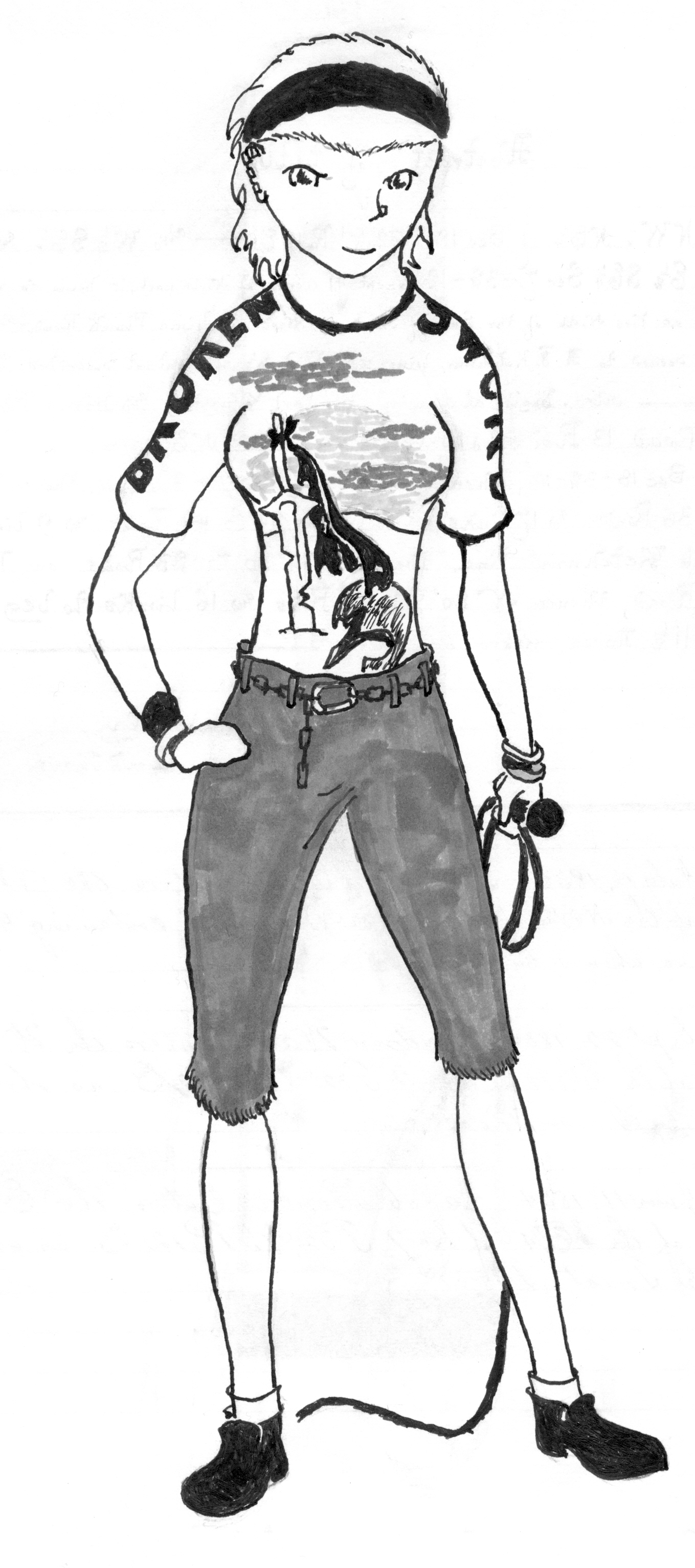
Original Art: Amplifier

I decided to be lazy* this week and post another page from my sketch book. This week’s subject: Amplifier, in her typical civilian dress (as opposed to her Biker Girl persona.)

amplifier0001

*for values of lazy that include doing things that are actually more time consuming than what I would usually be doing in this spot.

Heat Wave: Blown Fuses

Circuit

Rodriguez raised his eyebrows. “I have to admit, if you’re the independent justice seeking type you really aren’t doing a good job of representing yourself. You come off as very… hard edged.”

I laughed. “I thought you knew. We live in a world where one man’s justice is another man’s robbery. Justice is dead and we’re sitting on it’s gravestone. You’ll find that the world doesn’t know or care about justice.”

“You may find that kind of attitude fails to pay out.” He leaned back in his chair as far as he could while still keeping his hands on the desk. “Justice isn’t such a small thing as to fit in a person’s pocket, to be taken out whenever you need to check if something is right or wrong. It’s not a personal thing. It exists everywhere and is always the same. Justice measures us, not the other way around.”

“You know, I could almost like you under other circumstances.” I fished around in a belt pocket and pulled out a zip-tie, which I tossed on the desk. Then I stretched out a leg and tapped my foot against the exposed metal leg at one corner of the desk. “Why don’t you do us both a favor and make yourself good and secure.”

“Fine.” Rodriguez took the tie without protest and proceeded to firmly secure his wrist to the desk leg. While he worked on that I slipped around to the other side of the desk and checked the drawers. They were locked, as I suspected they might be, Barry apparently not wanting anyone to filch his office supplies while he was out. As I said, lazy not stupid. Bad as I felt about tying the pastor up, I didn’t want him letting himself out with a pair of scissors or something. The same line of thought led me to the wall to unplug Barry’s desk phone.

I straightened up and turned back to the desk to discover Rodriguez had pulled a small Bible out of his pocket and set it on the desk and was in the process of choosing a pen from the cup on the desk. He saw me staring at him, admittedly a little shocked at his incredible aplomb, and asked, “I don’t suppose you have any paper I could borrow? I haven’t worked much on this week’s sermon yet, and since I seem to have some time on my hands…”

“There really is more to you than meets the eye,” I said, shaking my head. “How did you even get in when the building was locked?”

“I borrowed a key from the groundskeeper. Someone from the church staff does this every year, so he’s used to the routine. Although this is something of a break from the normal.” Rodriguez shrugged. “I could say there’s more to you than meets the eye as well, but I suppose that goes without saying when a person is in disguise.”

That earned him a chuckle and I ducked into the first cubicle down the line and fished around for something to write on. As I did so, Rodriguez’ voice came drifting over the flimsy walls. “I have to wonder, if you’re not an arsonist and you’re not a vigilante of some sort, what are you?”

“Just a man here to advance his own goals.” I found a spiral bound notebook in the bottom drawer of the desk, which apparently belonged to someone less cautious than Barry was. I took it with me back out to the secretary’s desk. “I’m here to deal with a hindrance and once I’m done I’ll be gone. The fact that the hindrance happens to be a wanted arsonist is pure happenstance.”

“You sound suspiciously like a man trying to convince himself,” Rodriguez said, giving me an assessing gaze. “Are you here because of some kind of attachment to the building? Maybe a teacher you had growing up? Does one of your children attend here? In that case-”

“You are astoundingly naïve,” I said, slapping the notebook down on the desk and suppressing a wince as my shoulder twinged in protest. I leaned forward a bit and let Rodriguez get a good look at my eyes. What he saw there made him deflate a bit. “Try to understand that I see nothing here worth saving.

“Have you looked around this place lately, my friend?” I swept my arm through the air to indicate the entirety of the school. “It’s one of two things. A relic, a hopelessly outdated idea based on theories of education that haven’t held up, or it’s a blatant power grab by people who don’t loose a single moment’s sleep what their manipulations cost the next generation. To some people it’s one thing, to some the other, but neither one is good.”

I leaned down over the preacher and his books. “The only thing they teach here is complacency. Day after day the necessity of some system, any system is pounded into them and the teachers are there every step of the way to punish them if they’re the least bit different from their horrid little ideas of young people should be.” I jabbed a finger at his chest. “You’ve seen it, I’m sure. A quiet person is branded antisocial or depressed, an active person becomes ADHD, the best and brightest are pushed and pushed by their coaches or advanced coursework until they break, and on and on until the whole population is drugged into an exhausted stupor and fed whatever agenda their indoctrinater wants pushed. And when they leave they’re so dependent on the people telling them what to do they’re fit for nothing but corporate machines. Or worse, to be druggists and indoctrination agents themselves. This isn’t a place for youth. It’s a place for convicts.”

From Rodriguez’ uncomfortable expression, especially when I mentioned pushy coaches, I could tell that he knew what I was talking about. For a fleeting moment I wondered if he would agree to some sort of an arrangement that would let me stay in the building until the Enchanter was dealt with. Then he said, “That does happen, and much more than I like to admit. But that’s not the only system at work in these walls. Many people need these places, and we offer them a hope that reaches beyond the school walls.”

I sprang up from the desk in frustration. “Unbelievable. You’re supposed to be a righteous man, but you don’t even understand the first thing about righteousness, do you? You’re just as cowed by the glory of the establishment as everyone else.” I paced a few steps away then spun and jabbed my finger at the preacher in accusation. “Whatever happened to ‘teach your children my commands’? What about ‘make it your ambition to lead a quiet life, to work with your hands’?”

“You know the Bible,” he said, apparently a bit surprised by that. “But-”

“Of course I do,” I said, cutting him off with my gun hand. “And I know that it says ‘thou shalt not covet’. Not one of the rules they like to preach about, is it? Because that’s all they teach here. Be jealous. Want what everyone else has, but don’t worry, that’s the sacred virtue of fairness. And then they’re upset when people like me, who have had to work their entire lives to make a meaningful impact, don’t hand over what we’ve made meekly and quietly.”

The big man spread his hands in an infuriating ‘so what’ gesture. “Perhaps God has something even greater in mind for the meek.”

“Yes,” I said, dripping scorn. “Inherit the earth. We’ll see about that. Meanwhile, their priests stand behind their desks and preach the gospel of justice for the envious to thousands of children a year. This building cranks out more and more drones that will answer to the beck and call of their overlords so that their own jealousy can be assuaged. And you have the temerity to worship here. If you really followed this,” I banged one hand onto his Bible, “you’d be doing more than taking what scraps you can get after the future generation has been put through the meat grinder.”

“I know that not everything the schools do in the name of education is right, but no one can expect that.” Rodriguez offered a helpless shrug. “Do you really expect them to get it right for everyone?”

“I don’t. But a system is only useful when it benefits a majority, a large majority, of the people who go through it.” Once again I waved my hand to indicate the school, not as a building but as a calloused edifice to confinement and boredom. “This is fit for nothing more than ruination.”

“You can’t judge the whole world by just what you’ve experienced-”

“I know that!” I whirled and smashed my left hand into the flimsy cubicle wall behind me, ignoring the spike of pain that shot through my not quite healed fingers. The wall teetered for a moment but didn’t quite topple over. “I’ve done the research, I know what I’ve seen and I’ve watched the same thing happen too many times. Don’t preach to me, holy man. I’ve heard the gosple already, but there was nothing good about what was preached to me.” I turned back and glared at him over my mask. “I’ve seen it. And I’m going to end it – starting with the Enchanter. And I won’t stop until what we do for ourselves is a virtue again, and not a sign of disease.”

If there was one thing that has to be said, it’s that Rodriguez didn’t even blink. I was armed, masked and admittedly had wandered more than a little into monologuing territory while he was unarmed and tied to a desk. His refusal to so much as flinch was both impressive and annoying. Worse than his calm was the tinge of sadness underlying it. “You can’t fix it by playing the strongman. Say you do muscle your Enchanter out of the picture. Maybe you even make things a little better for a little while.” His free hand drifted over to rest on the Bible. “But unless you have something better to teach them, something to give them hope, you’ll just be another strong man in a long line.”

“As I said. We’ll see about that. I might have a surprise for you, down the line.” There might have been more to say after that, but before I could work it a tone in my ear warned me I had another incoming call. “Quite for a moment. Go ahead, Grappler.”

“Someone new on the south side of the building, Circuit. The Project looks like it’s starting to move in.”

“Understood. Start up the van and hold on standby until I-”

“Son of a-” Grappler’s voice faded into the background for a second and I heard a confused gabble of voices and a string of curses. “He’s climbing up the wall. I thought he was a heat sink, not a wall walker.”

“He’s cutting handholds into the wall,” I said, fishing around in my belt and pulling the connection for the elevator hookup free. “Not changing friction like you would. Get in position for retrieval on my signal. I’ll be on the roof.”

“Warming up the engine now.”

I hung up and headed back towards the door I’d originally entered through. The only elevator that went all the way up to the roof was that way. “Sorry to interrupt,” Rodriguez said as I got to the door. “But if there’s a chance of the building burning down do you think you could find it in your heart to let me loose?” He wiggled his zip-tied wrist for emphasis.

“There will be no burning today,” I said. “But there might be some shooting and definitely a lot of armed men running around. If you really want out, I’m sure you could drag that desk into a cubicle that has a pair of scissors handy. But if you want my advice, you’ll just shove it in front of the door and wait things out. You’ll be fine.”

I stepped out of the office, closed the door so Rodriguez couldn’t see where I was going and bolted down the hall. Although it didn’t register at the time, there was the the sound of something heavy bumping in the wall behind me as I sprinted away. But that would come later. For the moment, I had bigger problems to deal with.

Previous Chapter
Next Chapter
Fiction Index

Inspiration

Inspiration for writing comes from a host of places. Where you get your inspiration from will probably be as varied and unique as what you choose to write about. But it’s still important that you get out there and find your muse.

For the writer, inspiration is something that helps you find the right words to fit what you want to express. It’s not a crutch, you certainly shouldn’t need it every time you sit down to write. But knowing what helps the ideas flow can help you overcome those times when you sit down and confront the great white expanse of paper (or word processor) and try to come up with something worth sharing.

I don’t know most of you well enough to hazard a guess at what will best inspire you. So what I’m going to do is share a few things that really help when I’m trying to find the groove to write in.

1. Listen to music. This one is probably one of the most obvious and most talked about, so I ‘m going to get it out of the way first. Listening to music is a great way to get the ideas flowing, especially if it’s music that fits what you’re trying to write or just music that you love. If you can do both, that’s pure bonus.

2. Get moving. If you’re like most people, you probably sit down on your bum in a chair (or lay down on your stomach/back) and type/write while you’re composing. Getting up for a bit fora brief walk, cleaning off your desk (WARNING: this can set dangerous precedents) or just doing some jumping jacks by your desk can get the blood moving to the ol’ brain and help the ideas flow.

3. Eat something. Low blood sugar = low brain functions. Just don’t eat so much you get drowsy, that’s counter productive.

4. Read something. This is the intellectual equivalent of #3. Have something that will keep the ideas flowing with you when you write. If you’re writing part of your story that requires a great villain, keep Robert Greene’s The 48 Laws of Power handy and flip through it if you’re stuck. If humor’s what you need, you might keep Charles Schultz’s Peanuts or Bill Watterson’s Calvin and Hobbes on hand.

5. Talk it over.  Having a group of like-minded people who will go over ideas, share experiences and hack about new possibilities is a real boon to creative thought. If you can find a place to get that kind of input, take advantage of it.

6. Write something else. Now sometimes you just need to take a break and come back with a fresh perspective and new energy. But sometimes, in the act of writing something else you’ll write exactly what you need for the piece you were stuck on. Don’t worry about moving writing from one story or one piece to another. Usually it will be clear that what you’ve written fits better in one place than another, and if it’s not then at least you can go back to step #4.

Hopefully that’s enough to get you on your way to writing some good, solid stuff. As you scribble or type or touchscreen(?) away, pay attention to what your best ideas are and where they’re coming from. Once you get that discipline down, you’ll be able to pinpoint what your best sources of inspiration are, and then your ideas will never stop coming.