The Daedalus Incident

A “mashup” is where you take two things that seem totally unrelated and blend them into a seamless whole. The term doesn’t imply it but the blending has to seem natural to the point where the two things you’re working with almost look like they were always meant to go together. The term seems to have originated in contemporary music, where homages to previous musicians or blendings of styles seem much more common. But that doesn’t mean it can’t apply to other things.

The Daedalus Incident, by Michael J. Martinez is a great example. It takes fairly hard scifi and smashes it together with alternate history and low fantasy to get a story that is unique and charming.

We start on the venerable planet of Mars, where mining operations are interrupted by an unexpected and theoretically impossible earthquake. (Yes, technically it should be a marsquake but apparently that’s not a word.) As the multinational space command overseeing things there struggles to find a good explanation it quickly becomes apparent things are getting worse.

Meanwhile, Lt. Thomas Weatherby of the British Royal Navy is bound for Mercury. In the late 1700s. In a sailing ship equally at home on the sea or in the sky. And the story hasn’t even gotten weird yet.

The Daedalus Incident is everything you ever wanted if you’re into scifi with an X-Files twist. It’s got everything, from ancient alien astronauts to weird alchemy and beyond. The science here is pretty solid, to the extent it goes (and that may not be as far as you think) but more than that it takes pains to be believable enough to keep us from questioning it without demanding too much of us. There’s a very real element of believability to the nature of Weatherby’s ships – all the old-fashioned nautical terms are clearly well researched and consistent and the made up stuff is blended in seamlessly.

That said, if you’re one of those people who cannot stand, for whatever reason, anything that smacks of handwaving in your scifi this is not the story for you. (Honestly, I’m not sure how you can stand reading scifi at all.) Because frankly there’s a lot here that’s vulnerable to fridge logic and is liable to leave you with an upset stomach after you try and digest it. You’re better off leaving it on the shelf and admiring the pretty colors, because not everyone can handle that.

The plot here is suitably complex – there’s stuff going on in both narrative threads and a good pace and points of view are juggled to keep you interested in what happens next. Suspense is maintained quite well – I figured out who the mole in the ranks of the good guys was about half way through but I was still interested in how it would play out and there are enough other plot threads at work to keep you interested even if you figure it out, too.

All in all, this story is great fun and shows a creativity sadly lacking in a lot of politically or conspiracy oriented scifi these days. There’s a total of three books planned, the second of which is already out, and I plan to chase them all down. It’s probably worth your time, too.

Code Red (Part Two)

“Out of all the Euthanasia Wars, China’s was the worst.”

Herrigan stopped in the center of the amidships ballast pumping compartment to give Lauren a disbelieving look. “Euthanasia Wars? As in more than one?”

“Yes. That’s why there are two countries where the United States used to be. Several nations fought them as recently as ten years ago.” She gave Herrigan a little push aft before continuing. “But China’s was the worst.”

“Did they still have that stupid family planning policy with one kid each?” Herrigan asked, taking the hint and continuing on his way. “Even we never went that far and we had limited oxygen in the early days.”

“Yes, the one child policy still existed and yes, it was a big contributing factor to what made the war so vicious. The population was so heavily skewed towards young men at that point that, when the government started putting down the elderly, there were riots.” Lauren shrugged, although Herrigan couldn’t see it. “I guess they figured they weren’t going to put up with a society that didn’t care about whether population manipulation stiffed them out of a wife and wanted to kill them once they got too old.”

“No one saw this coming?”

“Some people think they didn’t, some think they had plans to deal with it that weren’t enough, and the possibilities go on.” Lauren paused a moment as they moved through a compartment with a few other crew in it. She didn’t want too many people hearing her story. It was common knowledge on the surface but that didn’t mean they liked talking about it. Once they were in the next compartment she continued. “Early on, while people were still picking sides, there was a mutiny on the nuclear submarine Guan Yu.”

“Nuclear powered or armed with nuclear weapons?” Herrigan asked.

“Both. It left port one day and no one heard from it for nearly two weeks. Then there was a string of massive detonations in or near the Aleutian Trench and-”

“Wait.” Herrigan tried to stop in the middle of the aft auxiliary electrical compartment but this time Lauren didn’t even let him come to a full stop before pushing him on. He didn’t let a little shoving keep him from his question though. “How can you have a nuclear winter caused by undersea detonations?”

“That trench is right along the tectonic plates. The detonations caused massive instabilities resulting in new volcanic eruptions and, in turn, warmer seas and much more violent storm seasons. To say nothing of the earthquakes and other problems.”

“The Big Shake was caused by this Guano ship? I remember that. I was six.” Herrigan tilted his head to one side. “But that was nearly forty years ago!”

“The most recent wars ended ten years ago, some of them have been over longer.” Another shrug he was in no position to see. “And some of this stuff has taken a long time to sort out.”

“And that was enough for an ice age?”

Lauren sighed and rushed through the next part. “Okay so some radical enviroterrorists released huge clouds of sun scattering nanoparticles into the upper atmosphere twenty years or so before that to try and combat global warming and the two may have stacked together to make undesirable results.”

“Like an ice age.”

“Yes.” She bit out the words. “Like an ice age. Now you know why your ship is illegal in most ports the world over. Can we please get my boss and work something out before he causes an international incident?”

“You realize we run on a small reactor. Can’t even melt down creditably, much less cause an explosion.”

“And you have no idea what the ice age has done to people. To civilization.” They were stopped outside a door marked “O.P.” that didn’t quite muffle the sound of shouting from inside. Lauren realized there was an edge in her own voice and did her best to reign it in. “People are going to be weirded out by this. Try to cut them a little slack.”

Herrigan gave her a strange look and said, “Right. Slack.” Then he grabbed the handle on the door, cranked it around to unlock it and pushed it open.

Chaos greeted them.

Bainbridge lay sprawled on the floor, he was soaking wet and covered with some kind of dull red lace or ribbon. An old man in a black jacket, the first of the color she’d seen, was yelling at him about meltdowns and responsible fissioning and qualifications all while shaking a stepladder at the harbormaster like some sort of geriatric lion tamer.

The captain, first mate and a third crewman faced off against the two harbor security men that Bainbridge had brought with him. The XO, Gwen, had pulled a knife from somewhere while both guards had drawn their ionizers. With a sudden twitch of panic Gwen wondered what would happen if they used the electrically based weapons in an environment as damp as Erin’s Dream. Especially with Bainbridge already sopping wet.

It was surprisingly easy to concentrate on the question since all shouting stopped as soon as the door banged open. Herrigan took advantage of the silence to say, in a surprisingly stern tone, “Put down your weapons, you two. You’re under arrest.”

The two security men looked at him in disbelief, something Lauren was sure was echoed on her own face, then one of them started to point his ionizer at Herrigan only to step back in surprise when a huge black blob appeared on his arm with a soft whuffing sound.

While Lauren had been distracted by what was going on in the compartment Herrigan had apparently drawn his own weapon, which was clearly not an ionizer, and was now carefully pelting the security men with whatever it was his gun fired. Whatever it was it crackled like popcorn and swelled up quickly, turning from a small black dot to a large sphere in just a second or two. The guard tried to bat it away only to wind up with his hand stuck to his sleeve.

Almost as fast as things had started it was over, with both security men tangled in a mess of black sticky foam, glued to themselves, the floor and sides of one tank and even each other. Neither one had their weapon pointed at anything important. Lauren cleared her throat and addressed them. “Why don’t you gentlemen go ahead and put the safety on your weapons? If they go off now there’s a good chance you’ll be the only ones hurt.”

“What’s that?” Bainbridge demanded, his tone not quite matched by his new reddish hairstyle. “Don’t be ridiculous, Lauren!”

“Mr. Bainbridge, we’re bordering on an international incident.”

He pulled a handful of red seaweed off his shoulder and tossed it aside, “The Living States of America won’t care if we impound an illegal nuclear vessel and arrest it’s crew.”

“No,” Lauren said, glancing at Herrigan. He nodded slightly and she said, “But the Alcatraz Pact might.”

“The what?” Bainbridge asked, going suddenly still and pale.

Lauren tried to remember if she’d ever seen him so disturbed. She didn’t think she had. “Former penal colony? They live under the ocean, around the Marianas Trench? Do you know something about this you’d like to share with the rest of the class?”

“There have been rumors…” The harbormaster glanced hurridly around the room, as if viewing it’s occupants in a new light. “I didn’t think the Marianas ghosts were real, though.”

The ship’s captain cleared his throat. “Deputy Cartwright? Could I have a moment?”

——–

“You told her about the Pact?”

“Just the name.” Herrigan glanced over at Lauren. At his insistence they’d moved the whole discussion back to the galley for the moment, in part because as soon as Bainbridge had remembered they were sitting next to an active and leaking nuclear reactor he’d gotten very, very nervous and edging close to some kind of breakdown. “Oscar, we’re running blind here and we’ve already made a lot of mistakes. We just didn’t know enough about the current situation up here to pass as surface men. It was better to tell her the truth than let her draw some kind of weird conclusions.”

Oscar looked skeptical but all he said was, “It’s your call to make. Just be ready to explain it when we get back. You cousin might not appreciate it, to say nothing of the Chief Zeke or any of the other Ward leaders.”

“I can handle Sam and he can handle the Chief Executive. The other Wards…” Herrigan shrugged helplessly. “We did start as a settlement of political dissidents. When have the Wards of Alcatraz ever agreed on anything?”

“Just remember that if the Warden ever calls you up to Alcatraz proper for an explanation. You’re deputized, sure, but I dunno if that was ever meant to cover something like this.” Duffy’s tone was light but his expression was grim. This was all new territory for everyone involved. “Let’s go talk to our friends, shall we?”

Bainbridge had put himself back together fairly well over the last ten minutes and he once again looked less like a frightened man and more like a self-satisfied official, albeit  a damp one. He harrumphed a bit as the other two men settled in across from him, breaking off a quite conversation with his assistant harbormaster. “Gentlemen, I think I have a better grasp on the situation now.”

“Excellent,” Duffy said with a quick and easy smile. “I hope that means we can set aside all this talk of impounding my ship.”

“Unfortunately, while I am convinced that you had no ill intent in bringing your ship and its…” The harbormaster hesitated for a moment. “Its dangerous power source here, that doesn’t mean I can just allow you to retain possession of it. It’s still my intention to impound Erin’s Dream until the government can decide exactly what to do with it.”

“Now wait a minute,” Herrigan said, holding up a hand. “Does the prohibition on nuclear power apply to warships as well? Because the Alcatraz Pact views all existing subs as part of its Reserve Navy as well – we just don’t have the resources to maintain a full Navy and a healthy construction fleet – so Erin’s Dream counts as a deep patrol sub in our books.”

“That’s preposterous! Little better than privateering.”

“There’s some similarities, sure,” Herrigan conceded. “But it’s not against international law as far as I know. ‘Course, our knowledge of surface law is out of date, hence our problem here…”

Bainbridge’s expression grew thunderous even as his voice grew quiet. “This ship is armed?”

“Maybe it is, maybe we have to install the right modules before we ship out.” Duffy spread his hands casually. “We’re not actually required to tell you, I believe.”

“Well think again-”

“Actually, sir, he’s right.” Lauren handed the harbormaster her tablet. “U.N Security Counsel approved it in 2033 in order to help deal with African and Indonesian pirate vessels, since good Navies were out of the price range of many countries involved. The laws are still on the books. And they’re right, warships can carry nuclear reactors.”

“There you have it.” Herrigan folded his arms over his chest and did his best to match Bainbridge’s grim expression, although he felt mildly ridiculous just having to argue about something as fundamental as keeping ahold of his livelihood. “Our ship is legal and safe. An attempt to impound it would be a blatant disregard of the rights of Marianas Trench Colony citizens. Our reactor is spinning down right now and will be ready for patching by the end of the day after tomorrow. Give us a little breathing room and we can be out of here in a week.”

“Marianas Trench Colony?” Bainbridge quirked an eyebrow. “Is that the official name for you fellows?”

“Not many people like it,” Duffy said. “Since all that’s really be done is scrubbing the word ‘Penal’ out. For all that it says pretty much the same thing most people like ‘Alcatraz’ better. Maybe because we picked it ourselves.”

The harbormaster braced himself against the table, as if to shove it away, but all he did was say, “Foreign warships are expected to declare themselves when they arrive in port, not sneak in and tie up with the civilian ship. Particularly not when we find they’re leaking radiation into my harbor. And-”

“My engines aren’t leaking nothing into your waters!” Old Phil bellowed from the other side of the galley where he and his grandson waited with the two security guards Bainbridge had brought along. He made as if to cross over to the other foursome’s table but the younger Phil restrained him. “You’ll be throwing-”

“You will all stop interrupting!” Bainbridge shouted. Herrigan bit his tongue and did his best to make the statement true. He was sure Duffy was doing the same beside him. After a moment’s quiet the harbormaster went on, his tone once again quiet and dangerous. “Furthermore the Alcatraz Pact has no relations at all with the government of Australia, the U.N. or any nation thereof. Correct me if I’m wrong.”

“No, you’re right on target there,” Herrigan said.

“So we could just as easily interpret your presence here, undeclared and possibly armed, as a declaration of war. Wouldn’t you agree?”

Duffy suddenly turned to one side and spat, a sure sign he was getting seriously angry. Lauren and Bainbridge started slightly at the sudden move and Bainbridge’s lip curled down in disgust but otherwise the silent tableau held. A part of Herrigan’s brain was already mulling over Eddie’s actual armament, the potential capabilities of the destroyers they’d spotted in port as they came in and whether the reactor could actually be patched when the ship wasn’t in port. If the harbormaster did decide to try and take possession of the ship was there really anything they could do to prevent it? Erin’s Dream wasn’t helpless but a daring escape under the nose of a working military port wasn’t exactly something she was designed for, either.

“Mr. Bainbridge.” The three men turned to Lauren as one. “Let me point out that the crew of the Erin’s Dream had just cause to suspect they wouldn’t be viewed in a friendly fashion. On top of that, they have still dealt with us in a fair fashion, to the extent they knew how, and haven’t threatened us in any way.”

“Except for attacking two security guards,” Bainbridge pointed out.

“In my defense,” Herrigan said, “Riot foam is proven nonlethal technology that came down with us from the surface. They were never in any danger.”

Lauren leaned in closer to the harbormaster, saying, “And they are a salvage vessel equipped with a nuclear reactor. If they wanted to be nasty I’m sure they have equally unexpected methods to do it with.”

Bainbridge mulled it over for a minute then finally said, “We would still have to notify the Commonwealth. I’ll admit I’m inclined to let you go, if for no other reason than to make sure rumors of nuclear reactors in private hands don’t get out. But I can’t just let you wander off without approval from Canberra.”

Herrigan and Duffy exchanged a look. The captain asked, “What do you think, Harry? You’re the closest thing to a government officer on board.”

“And don’t I know it.” He said it more to buy time to think than anything else. Ultimately there was no way for Erin’s Dream to escape New Darwin if the local authorities and the Australian Navy were determined to keep them there. Even a fully equipped war sub was meant to fight as much by stealth as power and, as much as he loved her, Herrigan knew he couldn’t count on his ship for even a quarter of the firepower of an Alcatraz tactical sub. At the moment their only leverage was having the harbormaster and assistant harbormaster on board and effectively in their power.

Announcing the existence of the Marianas Trench Colony to the Australian government just to get permission to leave port didn’t really appeal to him. But sometimes being smart meant knowing when to back down and see what happened. “We’ll want to keep working on repairs while we wait to hear.”

“Of course, Mr. Cartwright.” The harbormaster clearly liked that idea. “The sooner that reactor of yours is patched the better. How long do you think the patching process will take?”

“Two days to finish cooling the reactor,” Duffy said absently, “Maybe another day to patch it and three more days to spin it back up. About a week?”

Bainbridge raised his eyebrows. “That quickly?”

“If you banned nuclear power nearly forty years ago then you’ve fallen a fair bit behind the times.” Duffy shrugged. “Phil could explain the process better than I could, but I’m pretty sure he’ll back my numbers. Will we know if we can leave by then?”

“I’d expect to have the answer in three to four days, if not sooner,” Bainbridge said.

“Four days.” Herrigan leaned back and glanced down the narrow galley at Old Phil. “Can we be ready that fast?”

He nodded gravely. “If I have to break my heart to do it.”

“I expect to be leaving port in four days, Mr. Bainbridge.” Herrigan pushed himself up from the table and waved for the rest to gather up. “Now you two are probably very busy people so I’ll see you on your way.”

——–

To his surprise, Herrigan found himself out by the gangplank the very next afternoon, welcoming Lauren back to the ship. “I have to admit,” he said once the usual rituals were observed, “I wasn’t expecting you back quite so quickly.”

“No one was expecting an answer so soon,” she admitted. “But apparently someone in the Prime Minister’s office drafted a contingency plan for your reappearance about the same time the surface cut off contact with you and it only took a few hours of debate to settle on using it now.”

Herrigan absently rubbed his hand along his chin. “Really. After what, sixty years?”

“It may have been revised some.” She handed him a thick manila envelope. “The details are in there but the general gist of things is, they want you to take an ambassador down to you colony when you go home in order to facilitate opening friendly relations.”

He gently took the envelope out of Lauren’s hands and turned it over once or twice, as if that would somehow reveal that this was all a joke. “Who’s the ambassador?”

“We haven’t heard yet. I think that part is still being worked out.”

“Well.” Herrigan slipped the envelope into his back pocket and tried to think of what to say. He hadn’t really expected them to have a policy primed and ready. Hopefully he’d have at least another day to figure out what to do with an ambassador before one showed up on his doorstep.

“I need to be getting back to my work.”

“What’s that?” He jerked out of his thoughts and realized he’d been quiet for a minute or two while Lauren stood and waited. “Right. Sorry, didn’t mean to keep you. Thanks for letting us know the outcome so fast.”

“No problem.” She favored him with a very pretty smile. “Bainbridge is kind of chomping at the bit to get you out of his docks as soon as possible. Calm seas, Mr. Herrigan.”

“Wait.” She paused, turned halfway back towards the gangplank, her head cocked in an unspoken question. “I didn’t get a chance to ask yesterday. You didn’t seem to care much for us when you came on board but you still put in a good word with the harbormaster for us. Why?’

She thought for a moment, looking over the cluttered, kind of grubby deck of Erin’s Dream as if seeing it for the first time. Then she shrugged. “I suppose I just thought you should take second chances anywhere you can get them.”

Herrigan broke into a grin. “That you should, Lauren. That you should.”

Fiction Index
Part One

And Action!

At least half of all writing calls for an action sequence of some kind. We’re not just talking about a knock-down-drag-out slug fest here, anything from two kids chasing each other through the house to a particularly heated argument with fists banged on table tops and people pacing back and forth are opportunities for “action” sequences. With the right kind of writing a cross country race is not just a slog across back roads, it’s a gripping series of events that keeps the reader invested in what is happening to your characters.

If you’ve been to the movies on a regular basis in the last few years odds are you’ve seen a lot of action sequences so you already know that they have a lot of parts to them and can be done a lot of different ways. The construction of an action sequence is a big enough of a topic that I want to take two weeks to break it down, so this week we’re going to start with what an action sequence needs.

Action sequences all need a few basic building blocks:

  1. A character or thing that is taking action. You can’t have an action sequence based on a bunch of rocks baking in the summer sun. Ideally there will be a relatable character at the center of an action sequence, particularly if it’s early in the story, but compelling action sequences can also be built around an object or objects, like a coin being weighed and tossed about by the mechanisms inside a ridiculously complex vending machine. Or even better, a Rube Goldberg sequence that starts with that coin and ends with a bag of salted peanuts. While this sounds like a visual thing don’t underestimate how much a sequence of odd cause and effect events can interest readers, as well.
  2. A goal of some sort that everything will eventually lead to. Even if the whole point of the slip of paper making it’s way through 39 steps from the secretary who takes the message to it’s recipient is to introduce Luther Pendleton, Clockworker Supreme, when he picks it up out of his inbox, make sure all this action gets the readers somewhere. Action with no point comes across as frantic and quickly gets annoying.
  3. Things for the character (or thing) to react to. This usually comes in the form of an obstacle but can involve the character finding something unexpected and helpful, like a skateboard to use in the middle of a chase sequence. Remember, walking is an action. It doesn’t really become interesting until someone slips on a banana peel. Without something to react to, there’s no action.
  4. A sense of place. Where action takes place is as much a part of the action as what is going on. If you have any doubts about this I refer you to the clock tower sequence of The Great Mouse Detective. Your place doesn’t have to be quite thaaaat dramatic, but obviously you need something.
  5. A sense of timing. Just as with humor, in the action sequence timing is everything. You can’t just go from zero to hero in a couple of paragraphs or a few seconds of camerawork. Exactly how long is up to you but the ideal action sequence has something like fifteen to thirty ‘beats’ in it. (These are much like the beats in a beat outline, except each beat is a much smaller unit of time.) Like a plot as a whole your beats should ebb and surge, always building to the climax of your action scene.

On a very basic level, a plot is something happening. While it doesn’t necessarily follow that an action sequence, where more things happen than usual, equals more plot in a single scene it is true that people expect things to happen during a story. Unless, of course, your audience is the most elite of the literati, in which case things happening are probably actually a negative in your book. But for everyone else, a certain level of things happening is a must, and action sequences are a good way meet those expectations in a very attention getting fashion. Tune in next week and we’ll look at how to keep your audience invested in an action sequence.

Cool Things: Captain Phillips

Warning: Do not watch this movie if you do not deal well with stress.

While the packaging for Captain Phillips doesn’t have that warning anywhere on it, I really think it should. If you’re not sure who Captain Phillips is, or why a movie based on real events that happened to him should perk your interest, here’s a quick recap:

Richard Phillips was the captain of the Maersk Alabama when it was attacked by Somali pirates. He and his crew resisted as best they were equipped to and eventually got the pirates off their boat. But the pirates took Captain Phillips along with them as a hostage. It would take a Navy SEAL team to get him back.

The best genre to put Captain Phillips in would be thriller, but that does a huge disservice to the movie and the real man it’s based on. Perhaps the best way to think of it is a character study that runs over two and a half hours long. Or maybe it’s a meditation on the responsibilities that come with leadership. Or maybe it’s just a study of how good men stand up to hard times.

Phillips is not a particularly brave or exceptional man – and I say this in much the same way that Tolkien begins stories about hobbits by noting that they are not particularly brave or exceptional. Rich Phillips is a normal man with kids to worry about, a wife to worry with and a job where he’s spent many years working his way up to middle management. He’s a normal guy who’s job just so happens to involve moving cargo around the Horn of Africa.

I’m not going to dwell on the plot a whole lot, since it’s pretty much ripped straight from real events. It doesn’t have to be believable – it happened!

The cinematography, something I don’t usually dwell on in these segments, is ideal. It’s got that slightly jittery, almost homemade feel that reemphasizes to us that these are not your usual Hollywood glamourized characters.

Tom Hanks as Phillips gets to do something actors are almost never allowed to do – talk like a normal person. He hems and haws his way carefully and deliberately through his lines, not because he’s uncertain but because that’s exactly what fits a man who’s whole life has revolved around making haste slowly, so that the deliveries are made on time. There’s very little glamour in this movie. Frankly, it doesn’t need it.

Everything in this film is so realistic it’s scary. From the early laidback attitude of the crew to their later panicked intensity, the manic energy of the pirates that slowly builds into complete breakdown, we believe something about what we see that most movies can’t quite make us believe: That this happened somewhere, to someone. That something similar could easily happen to us.

So there’s a lot of nail chewing as the crew of Maersk Alabama struggles to keep the pirates off their boat with firehoses and flares, then sabotages them with broken glass and shorted out generators. But all this pales to the abduction of Captain Phillips and the eventual rescue at the hands of the US Navy.

There’s no way to explain the tension this movie builds. There’s no moment of frantic action, no clever twists of the plot. There’s just the integrity of Captain Phillips and our sense that, whatever happens, we’d like to have someone like him in our corner when our time comes. Like all films that focus on the heroism of a good man, the message is that we should strive to be that person, should the time come.

If you can manage to stand up to a couple of hours of pure tension, Captain Phillips will more than make itself worth your time.

Code Red (Part One)

Well here we are just two stories into the summer plans and we’re already off schedule. This story took me all of two and a half days to write so I figured it must be short – but when I went to post it I discovered it was about twice as long as what I would consider ideal post length. Looks like it’s perfect for a two part story!

——–

The position of chief technician on a Trenchman sub was a weird blend of chemical expert, mechanical engineer and botanist with a smattering of really weird expertise thrown in for flavor. They were very smart, very well respected people who the crew listened to as a matter of course, even when they didn’t personally like the technician in question. Captain Oscar Duffy had always gotten on fine with Old Phil, his chief tech, so when Phil called him off the bridge Duffy assumed it was important and made his way down the length of the Erin’s Dream to the rear Oxygen Processing compartment without protest.

“It’s turned red,” Phil said, as if that explained.

“I can see that,” Duffy said. He was, unfortunately, unenlightened by his chief tech’s explanation. “Unfortunately we’re not going to have a replacement on hand any time soon. The salvage bays are going to be mostly empty on our return run, though. Could we just load some extra air in tanks and use that to get us home? We could run part of the way on the surface.”

Old Phil gave him a disbelieving look. “You don’t know what this means, do you?”

“Assume I’m not entirely current on the nuance of every system on this ship.”

“Fine.” He rapped his knuckles sharply on the bulkhead just a foot from where the two men were standing. “You know what’s on the other side of this?”

“Oh.” Duffy felt himself turning pale. “That’s bad.”

“Yes, Captain, it certainly is. The pressure hull isn’t the only thing that’ll need fixing when we get to port.”

——–

Lauren Cochran looked up when Vern walked, or rather shuffled, into the assistant harbor master’s office. He wasn’t the type to intrude without cause, in fact he wasn’t the type to do anything at all to draw attention, so there was really only one possibility if he was crossing her threshold of his own volition. “Something the matter, Vern?”

Vern cleared his throat twice, an annoying but predictable sign of nervousness, and said, “Yes, ma’am. You know we’ve got a sub in port right now?”

“New Darwin’s always had a little Navy presence, Vern,” she said, fingers absently skimming over touchscreens as she tried to bring up the current listing of Royal Australian Navy ships in port. Was there an attack sub at dock just then? “Are they causing problems?”

“Not that I know of.” He fidgeted for a second. “Actually, I’m talking about a civilian sub?”

Flicked fingers sent the military berths away and she started flipping through the larger public listings. “A research sub or a salvage vehicle?”

“The latter.” He handed her the tablet he was holding and said, “The dock inspector found something you should see.”

Lauren grimaced as she took the tablet. It was clammy and sweaty and she did her best to surreptitiously wipe her hands dry as she woke up the device. “You could have just copied me the memory stick, you know.”

Vern shook his head vigorously. “You don’t want this running around the wifi, Lauren. Trust me.”

Erin’s Dream, huh,” she muttered, thumbing through the screens of data. She stopped when she reached the fourth. “Does the harbormaster know about this?”

“Not yet.” Vern looked down at his hands as if ashamed of the fact. “He was in a meeting with the deputy mayor when we noticed. He should be back in half an hour but…”

“You didn’t want this in the datastream. Okay, you made a good call.” She pushed herself up and out from behind her desk. “Have him meet me at Pier 42 as soon as he can.”

“Do you want security there?” Vern asked tentatively. “Or the police?”

“If it was going to be anyone I’d have the military there. But there’s still a chance this is a misunderstanding.”

“You think so?” Vern asked hopefully.

Lauren sighed. “No. Not really.”

——–

The cramped surface deck of Erin’s Dream was cluttered with equipment, parts and crew. With the sub at dock there wasn’t much call for the Waldos so Herrigan found himself doing his best to keep order among the chaos. “No, not the welding equipment. What if Graham needs that to patch the hull? Put it aft with the other stuff going back down into engineering storage.” He scowled around at the rest of the junk on the deck. He’d thought nothing could be as tough as keeping an underwater salvage op from tangling in it’s own power and communication cables but he didn’t even know what half this stuff was, much less whether they’d need it below decks in the next few weeks. “Keep the spare parts for the Waldos and Eddie separate. I don’t want to try seeing if a Waldo battery is compatible with our power supply system, you hear me? Don’t get them mixed up!”

“Hey, Harry?” Herrigan looked down from his vantage up on the conning tower to spot Tank, one of his salvage sub drivers, down on the main deck by the gangplank, waving for his attention. “Harry, some guys here to see you. One of ’em says he’s the harbormaster.”

“Coming!” He rattled down from the conning tower muttering curses. He’d chosen his salvage pilots for experience, since bad salvage pilots were almost entirely weeded out by their first two jobs. If you survived that long you were good. That was the way the job went. But that kind of competence didn’t always come with good manners, something people like harbormasters tended to appreciate.

It was pretty easy to tell with a glance which one the harbormaster was and, just as Herrigan had feared, he didn’t look happy at Tank’s offhand way of referred to him. The kind of man who came out to look at a salvage sub in a three piece suit most likely expected to be addressed with respect, too. There were maybe half a dozen people with the harbormaster too, a pretty large group just to pay a visit to a lowly salvage sub. To say nothing of how unusual a personal visit from the harbormaster was, period.

For the second time that month Herrigan was hearing damage control alarms. Problem was, this time they were entirely in his own mind and he wasn’t sure what kind of damage he was dealing with.

“Hi, I’m Herrigan Cartwright,” he said, holding out a hand to the harbormaster. “Welcome aboard the Erin’s Dream.”

“A pleasure, Mr. Cartwright,” the harbormaster said, giving the offered hand a quick shake, his tone making it clear they were just words. “This is a fine looking ship you have.”

Eddie’s got it where it counts…” Herrigan racked his brains quickly and, just as he was about to skip it remembered the name he’d heard during the ship’s initial inspection. “Mr. Bainbridge. What can I do for you today? Or are you perhaps a connoisseur of submersibles? Ours is a pretty unusual model.”

Bainbridge’s expression sharpened momentarily. “It is at that. We weren’t able to find anything like it in our records.”

Which was because Erin’s Dream had been build in Purgatory Ward’s shipyards at the bottom of the Marianas Trench, something the Australians weren’t supposed to know existed. Herrigan mentally kicked himself for that slip up, comparing submarine design and customization was a typical middle class topic of conversation for Trenchmen but he couldn’t expect others to share it. “She was a custom job, actually,” he answered, hoping it didn’t come off as lame as it sounded. “Would you like a tour?”

“Actually, I would. In a manner of speaking.” Bainbridge gestured behind him to a tall, careworn woman with gray streaks beginning to work through her black hair. “This is the assistant harbormaster, Lauren Cochran. We’ve come down here because there were some discrepancies in your registration we’d like to sort out. The two of us would like to take a look through your vessel if you don’t mind, Captain Cartwright.”

He flicked his gaze from the harbormaster to his assistant and back again. Best to buy time to work out a clearer picture of what was going on. “Actually, I’m not the captain. He’s below decks with our XO, getting a feel for some repairs that need doing.”

“You’re not the captain or the fist mate?” Lauren asked. “Then why did they call you over?”

“Because I am part owner. Captain Duffy and I each own half shares in the ship. So far as business decisions go I’m just as capable of making them as he is.” Herrigan offered her a casual shrug. “Tank must have figured this was about some of the repair supplies we’d requested.”

“Well, ‘Tank’ was close but not quite correct.” The harbormaster held up a flat device about the size of a notepad. “Our visit is related to the salvage you’re offering for sale. I notice you haven’t visited New Darwin before, so you might not be aware of some of the rules we have governing what kind of salvage we can and can’t take. We’ll need to inspect it, and do a second inspection of your vessel for possible illicit salvage.”

“Illicit salvage? That some kind of joke?” A glance between the two officials faces convinced him that no, it wasn’t. Herrigan sighed and waved to get Tank’s attention again. “Ring down to the galley and get Duffy up here, will you?”

“The galley?” Lauren asked.

“Yeah, like I said we’re doing some repairs down there. It’s a long story. I’d take you there but the place isn’t in any shape for company.”

“This is an inspection, Mr. Cartwright.” Bainbridge crossed his arms over his chest. “We’ll need to see all sections of the ship eventually.”

“All right,” Herrigan said, keeping a firm grip on his building annoyance. “We’ll go meet Duffy there. Then, since I’m sure we’re all busy people, I’ll take Mrs. Cochran to inspect our salvage holds and Duffy can give you the grand tour. Sound good?”

“Splendid,” Bainbridge replied. “Lead on.”

——–

The crew of Erin’s Dream was almost as strange as the ship itself. Almost everyone they passed in the corridors was wearing the same kind of slick, plastic shelled jacket that Herrrigan wore. Lauren hadn’t seen that many people on deck wearing them but that may just have been to keep cool. It quickly became apparent why they wore the jackets, temperatures belowdecks weren’t that bad but the humidity bordered on stifling. The jackets collected condensation and wicked it down to the floor quickly. She couldn’t tell what happened to the moisture after that, there certainly weren’t any puddles visible leading her to assume some kind of drainage system was at work.

The humidity was probably the driving force behind the almost total lack of hair on all of the men she’d seen. Most had just shaved their heads bald but some, like Herrigan, had enough fuzz on the top of their heads to be confused for a peach. The one woman she’d seen so far, the XO by all accounts, wore her hair short enough to be mistaken for a man most other places.

That might make things seem drab except the crew all seemed intent on wearing the brightest colors possible. Herrigan and at least half the crew had chosen a bright canary yellow for their waterproof jackets, most of the rest were an equally bright shade of blue. As nearly as Lauren could tell, the color didn’t correspond to job description in any way. While clothes tended to be loose cut and shapeless the crew seemed to favor crazy patterns on the fabric and, when mixed with tools sticking out of pockets,  bandanas on heads or broad leather belts, the whole crew had a vaguely piratical air.

Even Captain Duffy, who out of the whole crew wore the only gray waterproof jacket she’d seen and wore a button down shirt, accessorized with a bolo tie and iron gray hoop earrings.

Herrigan’s black trimmed, yellow clothes would have made him unremarkable in comparison to the rest of the crew except for the fact that he was armed.

Lauren caught sight of the weapons as he cranked open the pressure door leading into what he called the salvage bay. On the side of his belt he wore what looked like an ionizer with an unfamiliar control scheme. A knife handle stuck out from behind his back. She couldn’t tell more because as soon as she realized what they were he was pushing the door open and his jacket fell to cover them again.

“Tell me, Mrs. Cochran, what exactly is illicit salvage?” He asked, ushering her into a comparatively large compartment that, for all it’s size, was nearly crammed full with a set of six minisubs painted the bright sky blue she was starting to suspect was the signature color of Erin’s Dream.

Lauren cleared her throat, suddenly a little nervous. Herrigan Cartwright didn’t strike her as a particularly dangerous man, with no hair on his head his ears seemed comically prominent and the rest of him was a bit too gangly and awkward to be really threatening. If anything he looked kind of like a forty year old man who’d never outgrown his teenaged gawkiness. But an armed man was an armed man, and he might not like what he was about to hear.

“Australia has a law against salvaging any vessel that’s been on the ocean floor less than five years. Ships that do so can be barred from our ports and scrap companies that purchase such salvage can be fined.”

Herrigan’s brow furrowed. “Really? How can you tell? It’s not like they’re dated when you find them on the ocean floor, after all.”

“We have a process for that,” Lauren said, waving the tablet she’d brought with her and hoping Herrigan didn’t want any details she didn’t have. “It won’t take more than an hour to run the inspection, depending on how much scrap you have.”

“We only got the front hold half full before we had the mishap that brought us here,” Herrigan said, waving to their left. “There’s nothing in the aft hold right now, although you can have a look there if you want.”

“We can do that after.” He didn’t seem interested in what the tablet was supposed to be doing in all this and that was a relief. “Lead on.”

“You got it.” He threaded his way between the minisubs and the wall of the bay, taking a moment to stop and examine the manipulator arms on the vehicle as he went past. They passed a total of three minisubs and Herrigan stopped to look at each one.

“Can I ask what exactly it is you do?” Lauren said as he straightened up from inspecting the arms on the third sub. “You said you’re part owner of the ship but if that was all you are I think you’d be back at home, letting the crew do the earning for you.”

Herrigan laughed. “I’m not sure a crew like this would work for a guy like that. Still, since you asked, I’m the salvage team commander when we’re working on a wreck. The rest of the time I’m the deputy and assistant – well, chief cook now, I guess.” Lauren’s face twitched towards a scowl before she could catch herself and Herrigan caught it. “The food’s not that bad, honest.”

“I’m sure it’s not,” she said, absently rubbing at her wrist. “Deputy, you say? Are you a union man or something?”

“Or something,” he agreed, nodding vaguely. “But mostly, I cook.”

“I just don’t like the idea.”

“Of cooking?”

“Salvage.”

“Oh.” He was quiet for a moment as the finished crossing the bay. As he cranked the next pressure door open he asked, “Any particular reason?”

She mulled over what to tell him as he swung the door open and ushered her into the next compartment. The lights clicked on as he stepped in behind her. Finally, Lauren said, “My husband died at sea. I wasn’t… I didn’t really think anything about salvage before. But after… I have a hard time with the idea of total strangers pulling his ship apart around his body.”

Herrigan was quiet for a few minutes, leaving her with her thoughts and the sight of a dozen or so racks of neatly cut hull plates, crates of more complex parts like pumps or electrical boxes and who knew what else. Finally she gathered herself together and brought her tablet to life, pulled up the utility she needed and went to work.

“Ever heard of Erin McClain?” Herrigan asked after she’d been engrossed in looking over the salvage for a minute or two.

“No.” Lauren glanced up from her tablet. “Did she design this ship?”

“Not exactly, although it is named after her. She died a good five or six years before it was built.” Herrigan offered a casual shrug. “Kind of well known in shipbuilding circles. She was a big advocate of recycling. Said reusing what others left us furthered their legacy, rather than harming it. When Eddie was built I guess the christeners thought a salvage ship ought to be named after someone like that.”

“A nice sentiment, anyway.” Lauren went back to the salvage and tried not to think about where it came from or who it might have once belonged to. Or, for that matter, whether it was radioactive.

——–

“This is spare parts storage but most of that is up on deck right now. You’d be amazed how that kind of thing gets jumbled up over the years.” Duffy forced a smile. “Finding the patches and equipment to fix the hull breach you saw in the galley gave us a good excuse to sort it.”

“I was amazed to see a part of your ship look so… empty,” Bainbridge agreed, a hint of condescension in his voice.

“It’s a salvage sub,” Gwen said, ice in her voice colder than the Trench itself. “Space is at a premium.”

“Of course.” Bainbridge peered around at the empty shelves for a moment, boredom evident on his face. “Forgive me, Captain Duffy, but I’m beginning to suspect that this whole visit is a waste of everyone’s time. Maybe-”

“Captain?” Young Phil’s head poked through the pressure door at the other end of the compartment.

Duffy resisted the urge to try and shoo him away, after twenty minutes of the ship’s most boring features they’d almost gotten rid of the harbormaster. But shooing the young tech away now would look bad. “Yes, Phil?”

“Gramps wants you down in aft oxygen processing.” Old Phil and Young Phil were actually related, grandfather and grandson, and they had certain qualities in common. A tendency to ignore anyone that didn’t strike them as important was one of them and, given the fact that he didn’t even glance at Gwen or the harbormaster meant that whatever Old Phil wanted it was strictly Captain’s Business.

“I’m sorry, if you’d excuse me for a minute, my-”

“Captain, in case you’ve forgotten this is a total inspection,” Bainbridge said, immediately attentive. “We’ve started, we may as well finish. Let’s have a look at this oxygen processing compartment, shall we?”

“If you insist,” Duffy said, hiding a smile.  This might be to his advantage after all. It looked like the snappily dressed harbormaster just needed one more push to get him off the boat and oxygen processing would do nicely. “Right this way, gentleman.”

Their destination was several compartments aft and one deck down, requiring a little backtracking and a lot of edging past damp, sweaty crew. Once, when Graham came by leading a pair of crewmen carrying bags full of spoiled food from the ruined galley, he thought the harbormaster was about to bolt. But Bainbridge sucked in his stomach, smoothed down the front of his snazzy suit and let the three men by. A few moments later Duffy cranked open the pressure door into oxygen processing and let the harbormaster and his two men in first, sharing a smile with Gwen behind their backs.

“What is this?” Bainbridge exclaimed a moment later, a hand going over his mouth and nose in a vain attempt to combat the smell of compost and seawater. “Captain Duffy, why do you have a compartment full of seaweed?”

“It’s oxygen processing,” the Phils said in unison. The younger finished the thought, pushing into the compartment and trotting over to his grandfather. “We pump air through here and the seaweed breaks down the carbon dioxide into breathable oxygen and emergency food staples.”

Bainbridge looked around at the room in horror. The compartment was actually just a couple of narrow pathways through floor to ceiling water tanks crammed full of fernlike seaweed and clinging pillows of algae. “And this actually provides you with enough oxygen?”

“Well, this and the other two similar compartments throughout the ship handle about two thirds of our needs under normal circumstances,” Duffy said, pulling the pressure door closed behind him.

“Or they would if we could get that leak fixed,” Old Phil said, pulling an unhealthy reddish plant out of one of the tanks and tossing it into a bucket by his feet. Dozens of other dying plants already filled it to overflowing. “Captain if this keeps up we’re not going to be able to count on this compartment for more than half it’s usual output. The plants are dying off and it’ll take weeks, maybe months, for new splittings from the other compartments to get up to full size.”

“So we’ll take on some tanks of oxygen along with the other supplies. We’re already bankrupting ourselves on this run anyways.” Duffy shook his head ruefully. “We can handle running a little heavy in O2 reserves if we-”

A pinging noise from one of Bainbridge’s two men cut him off. The lackey, a big, tattooed guy with enough gut to suggest he spent more time in paperwork than honest work, pulled out one of the tablet computer gizmos that most of the dock workers seemed to carry and consulted it for a second. Then he said in alarm, “Harbormaster, this compartment is radioactive!”

“Well what do you think’s killing the seaweed?” Old Phil demanded. “Our reactor hasn’t cooled down enough to apply a patch yet.”

“It’s not dangerous to humans if we avoid long term exposure,” Young Phil added. “The seaweed is only affected because it’s been stuck next to the reactor for a week and a half.”

Bainbridge slowly turned to look at Duffy, sheer horror written across his features. “This ship is powered by a nuclear reactor?”

“Yes?” He hadn’t meant to be snide but Duffy’s answer still came out more like a question. The growing storm of emotions on the harbormaster’s face prompted the captain to add, “Is this going to be a problem?”

“Is it-” Bainbridge actually sputtered for a full five seconds, his men shifting nervously and exchanging glances as they waited for some cue on what to do. “This is an outrage, captain! Your ship will be impounded immediately! And you, Mr. Duffy, if that’s really your name, you will…”

At that point it looked like no more useful information was forthcoming. And really, after threatening to take his ship what more could there be to hear? Duffy looked at Gwen and said, “Tell Cartwright he needs to get up here. Now.”

——–

“Impound the ship?” Herrigan stared at the intercom in disbelief, as if doubting Gwen would somehow change what he was hearing. “Because of a reactor leak?”

“That’s what it sounds like. I – What?” The last bit was indistinct, not said into the pickup on the other end. There was a click and the speaker went dead.

Herrigan sighed and switched his own end of the conversation off. “Come on, Mrs. Cochran. Your boss is pitching a fit about our reactor.”

Lauren came out of the salvage stacks, her face noticeably paler. She could almost pass for a natural Trenchman. “Your what?”

“Our power plant has been leaking radiation since our accident. We’re planning to patch it tomorrow, once things cool a bit more.” Herrigan looked back through the door way as he waited for Lauren to catch up. She seemed oddly reluctant to get any closer. “I’m not irradiated or anything, it’s not a big leak. We can patch it, at least long enough to get it looked at by someone certified.”

“Who are you people?” She asked quietly. “And where are you from?”

“We’re salvagers,” Herrigan said, stepping back into the salvage bay slowly, wondering what he’d said that was wrong. “Our home port is Norfolk.”

“I thought that’s what your paperwork said.” She held her tablet between the two of them like it was a shield. “But no one calls it that anymore. Everyone calls it the Greater Chesapeake Port Authority, they have ever since the docks had to be moved out. And the Living States wouldn’t let a nuclear powered ship use that as home port.”

“The Living States?” The question was out before Herrigan could stop it.

“Who are you?” Laruen demanded, Herrigan’s confusion apparently making her bold.

He pulled in a lungfull of air and sighed. “Okay, fine. Game’s up. I’m Herrigan Cartwright, part owner and salvage commander of Erin’s Dream. And I’m a fully deputized constable of the Third Ward of the Alcatraz Pact, born and raised on the bottom of the Marianas Trench.”

Lauren stared at him in what he took to be an open invitation to continue. “We’ve been down there for almost ninety years, you know. It was a joint project, mostly Brazil and the US – you still got the US?” She nodded mutely. “That may not be good for us, then. Anyway, back then people were trying to combat global warming and decided to round up all the most committed skeptics and exile them some place where their ‘harmful practices’ couldn’t reach the world at large. And I think the sealed biosphere they were stuck in was supposed to help them see the errors of their ways, force them to adopt sustainable living and be less greedy or drive themselves to extinction. I’m not surprised you never heard of it, the project was kept hush-hush. At least to the public, other governments must have heard about it because we wound up getting people from just about everywhere except Australia – probably have your history to thank for that – and many of the later ones weren’t people exiled for views that didn’t match the political climate.”

Herrigan leaned against the doorframe and watched Lauren’s expression. He’d been hoping for a good mix of conflicting emotions – our at least outrage over his bad joke at the end – but all he was really getting was shock. Maybe a final push. “Funny how that worked out, given as how we finally get back up to the surface and, as near as we can tell, you’re stuck in the middle of an ice age with falling sea levels and everything. What caused that?”

Lauren finally looked him in the eye. “Nuclear winter.”

It was his turn to process things, and he took his time doing it. Then summed up his thoughts. “Huh.”

Fiction Index
Part Two
Stumbling Blocks

Writer’s block is widely viewed as the creative disaster and with good reason. When you sit down and. Just. Can’t. Write. It feels horrible. But rarely, in my experience, does the inability to write boil down to any one thing. Typically there’s a bunch of different things contributing to your inability to write and sometimes all you need to break the slump is to look at those things one at a time and determine if that’s your problem. By breaking things down writer’s block becomes a manageable problem. So here, in order of how often I find these things intruding in my writing, is a list of the typical building blocks of writer’s block and a suggestion on how you might deal with them.

  • Physical discomfort. Yeah, this is usually the biggest one for me. Sitting for a while results in cramps and sore muscles and getting up every so often to stretch, get the blood moving, ect, does wonders. Don’t discount hunger or thirst, either. While constant snacking while writing isn’t healthy, neither is starving yourself. A glass of water and a quick snack can do wonders to restore your concentration.
  • Stress. It’s an unfortunate truth that, while I enjoy doing theater or other such activities, juggling them all can often leave me too stressed or distracted to focus on writing. Now sometimes writing can serve as a bulwark between you and stress, allowing you to focus on something you enjoy while you recuperate for your next bout of stressful activity. But stress can build to the point where blocking it out for a time is not a healthy way of dealing with it. Sometimes you just need to slow down. Set writing aside and grab life with both hands for a while. Confronting the problem straight on, or slogging through a period of intense business with no distractions, is often the best way to get past this block. Constantly trying to write during times of high stress may make it harder to let go of the tension once the tough times are past, so it may be safer to just set writing aside for a while.
  • Lack of time (or sometimes laziness). This actually ties with stress in problems I have. Some stories need a lot of research, a lot of preparation and a lot of careful thought put into them. A case in point: If you’ve seen the Project Sumter Timeline you can see there are at least two major periods of time that are ripe for development. In fact, the story was originally supposed to focus on the Civil War, not the modern era. The early story ideas there just weren’t gelling because I didn’t know enough about the Western Theater of the Civil War to compile a good narrative. This situation is only nominally improved now. If a story needs more work than you’re putting into it and you don’t have the time maybe you need to simplify the story. Or maybe you need to shelve it and work on something else. Of course, if you do have the time, maybe you just need to focus more…
  • Convention. It’s very easy to get caught up in the idea that “this is how things should be”. For example, telepaths are almost always fearsome figures in paranormal fiction usually because they have ability to control people’s minds. How many stories can you do about that? How many different telepath characters can you create? But in Mindspace Investigations telepaths are feared more for their ability to directly manipulate the nervous system, knocking people unconscious with a touch or broadcasting pain so powerfully people keel over. The result is a  very different kind of telepath surrounded by different social dynamics and with different character quirks. Look over your story and make sure the tropes and conventions you’re using are empowering your story, not preventing it from going somewhere new and interesting. Because new and interesting is usually where stories need to go.
  • Original expectations. Sometimes you expect a story to go one way and it winds up somewhere else. Sometimes totally unexpected characters crop up in the background and start demanding attention. Under no circumstances can you let your original plot idea get in the way of where the story actually goes. Yes, make sure you stay on theme, but don’t be afraid of the extra work that comes with shifting focus to better suit the story you get rather than chasing the ghost of a story that may have never really existed.
  • Lack of ideas you like. Sometimes you can see stories places and just have no desire to follow up on them. Don’t force yourself. Instead grab a book, hit the movies or call up some friends and hang out and do something other than writing for a while. Give yourself a chance to recharge a little and soon enough your writer’s instincts will present you with something worthwhile. For me it usually takes fifteen minutes to an hour, but your mileage may vary.

Hopefully that helps you the next time you find yourself staring at a blank sheet of paper/word processor. Good luck!

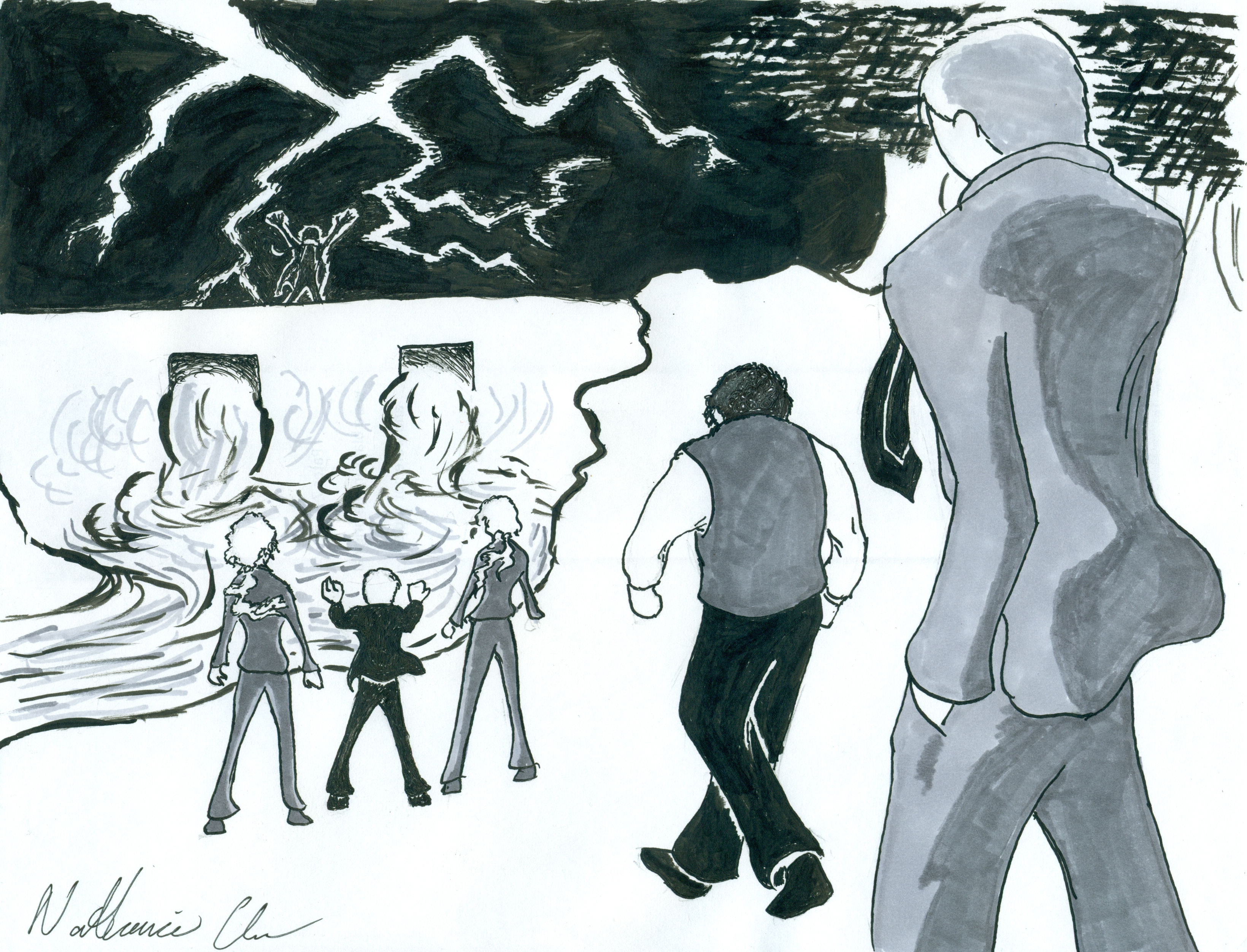
Original Art: Hydroelectric

Been playing around with the pen and ink again! This time around I employ the artist’s right to tinker with things to make a better picture – the astute viewer will note that the picture below is not remotely like anything that happens in Water Fall, although it’s meant to encapsulate the raid on Chainfall in a single image.

Hydroelectric0001

Circuit at top left. From left to right along the bottom we have Frostburn, Helix, Coldsnap, Samson and Massif.

I played around some more with the water and I’m more satisfied with it than I was when I did last time it came up. I still feel the white/black/gray balance is a bit off here and the “trees” in the top right don’t look quite right. Bob Ross made it look so easy…

But art is never perfect and that goes for the visuals as well as the written word.

Summer Plans

This summer the plan is to write stories.

Shocking, yes, but I hope not entirely unpalatable to the majority of my audience. Of course, you may want to know what kinds of stories, how long they’ll be and things like that. Worry not! I have actually put some thought into that and I have plan. Of course, I had a plan last summer and things wound up going awry more than once. Hopefully this time things will work out better.

The current plan calls four a total of seven short stories, one of which was posted last week in honor of Memorial Day. Memorial to a Saint was a Sumter short but only one of two that I’m planning for this summer. The second will come at the end of the other five and will in no way serve as a prelude to Thunder Clap. Seriously, it’s related in only the most tangential fashion.

That gives us five stories to spread across three other sets of narrative worlds. We’ll start next week by going back to the divided futures and seeing what the crew of Erin’s Dream is up to and what Port Darwin looks like in a hundred years. Then we’ll jump a couple of hundred years further into the future and see how of the most powerful families on Mars lives. In three weeks we’ll be back on Earth, visiting a group of the Weavers of the Heartlands that live right here in my home city of Fort Wayne. Finally we’ll abandon Earth as we know it entirely and tag along with Dmitri Dostoevsky on the business of empire for a couple of weeks before we jump back to Project Sumter’s neck of the woods. Of course, with all that world hopping going on there’s no telling where in time we might come down, so be prepared for anything.

With all that out of the way it will be time to start the third and final novel planned for this visit to Project Sumter’s timeline. Thunder Clap is the culmination of all the work I’ve been putting into Circuit and Helix over the past couple of years and I’m excited about it. Further, there’s not much I could say by way of introduction that wouldn’t steal from the story itself so I don’t plan to write an introduction so we’ll be swinging straight into the meat of things. By my count that means that, if everything goes as planned (ha!), the first chapter of Thunder Clap will come out some time in early August. I hope you’re looking forward to it. I know I am.

In the mean time, please enjoy the short stories and let me know what you think!

Genrely Speaking: Low Fantasy

Time to speak Genrely.  Low fantasy is, as you might expect, the polar opposite of high fantasy. Low fantasy plays around with many of the trappings of high fantasy but applies them to very different ends. The names of the genres kind of sum up the differences. While high fantasy focuses on the big ideas of the human condition low fantasy examines the minutia. Interestingly, it is possible to craft a story that mixes elements of high and low fantasy in one of the harder to quantify genres in existence (see Quintessence for one example).

So what is it that makes low fantasy what it is?

  1. An emphasis on characters who are not at all important in the scheme of things. The people who make up the central characters of a low fantasy story are not movers and shakers, not planning to overthrow governments and not wielders of forces that are out of the ordinary for their world. The scale of events and the people they focus on are, in some ways, much more normal than the typical fantasy stories.
  2. Focus on day to day activities. While this doesn’t exclude the kind of swashbuckling adventure that you’re accustomed to seeing in movies like The Lord of the Rings or reading about in The Chronicles of Narnia, the action in low fantasy ultimately has much less impact on the state of nations than the action in high fantasy. The genre simply assumes that there are people who do that kind of work for a living. There will always be tombs to rob, monsters to fight and evil wizards to put down. After a while it becomes kind of humdrum, and what does that mean for characters and societies?
  3. An abundance of magic. Magic in low fantasy tends to be commonplace. Not everyone knows how to use it but chances are everyone’s seen it a time or two. It tends to be of the sufficiently analyzed version, will come in all kinds in all kinds of shapes and sizes, might be tied in some way to a person’s ancestry or powerful artifacts, or follow any one of a dozen other rules, or just be available to anyone who takes the time to learn it. Its presence or absence in a situation is in no way significant.

What are the weaknesses of low fantasy? It tends to come off as the fantasy equivalent of status quo is god. The characters aren’t out for big purposes they are, at best, out to help a few people they know or just out for their own good. It can be hard to get invested in stories where nothing meaningful ever happens. Sure, the characters go out and have adventures but ten years later they’re sitting in the same bars, drinking and trying to figure out where their next big break will come from. I’m not saying stories about people in regular situations struggling with realistic problems are bad. But something about them cuts against the grain of a genre grouping that shares the same root with the word “fantastic” know what I mean?

What are the strengths of low fantasy? Low fantasy thrives on the way it proves ye olde maxim, the more things change the more they stay the same. We may not live in a world with flying carpets or travel between parallel earths but we can all appreciate the importance of paying the bills and keeping thieves and murderers off the streets – no matter how those crimes are accomplished.

At first glance low fantasy may look like an unappealing genre. Why add all the swords and sorcery if it’s ultimately incidental to the stories? Isn’t the author just being lazy, making sure they don’t have to research all the gritty little details of what they want to write about? Isn’t this a cop out?

The answer is, no. Low fantasy can act as a kind of insulation between the audience and the story. Some things may be uncomfortable when looked at in a way that hits close to home. By looking at these things through the perspective of the fantastic we can give the audience a degree of separation that makes these subjects easier to handle. Of course, by the same token the fantastic may turn off part of your audience as well. It’s important to know who you’re writing for, after all. What’s important is to take low fantasy on it’s own terms – stories of little people in big worlds. And after all, isn’t that what we all are?

Cool Things: Rear Window

Let me just say that I have a soft spot for Alfred Hitchcock. Not the crazy horror movies like Psycho or The Birds, but the masterful suspense films like To Catch a Thief, North by Northwest or The Man Who Knew Too Much. In fact, I seriously considered making this month “Alfred Hitchcock Movie Month” but there is such a thing as too much of a good thing. So to round out Classic Color Movie Month, here’s Rear Window.

Rear Window is part of the National Film Registry, a perennial favorite of the American Film Institute and well liked on sites like Rotten Tomatoes or Metacritic. What more can one man possibly add to the discussion?

Well, probably not a whole lot. Other than telling you that you really, really need to see this movie if you haven’t. But we’re going to try anyways.

At the center of Rear Window is photographer L.B. Jefferies (Jimmy Stewart). He’s recently broken his leg and spends his time in his cramped apartment confined to a wheelchair, watching the goings on in the courtyard outside his window and the buildings across the way. Equipped with a telephoto lens and a large supply of time on his hands, Jefferies alternates between contemplating the world below and trying to hold off the advances of his high society girlfriend, Lisa Freemont (Grace Kelly). A nurse, Stella (Thelma Ritter), provided by his insurance company also visits from time to time.

Things really go wild when one night, during a downpour, Jefferies hears a woman crying help. Among his neighbors there is a travelling salesman named Thorwald (Raymond Burr) who’s wife is a bedridden nag and who, after that one stormy night, Jeffries never sees again.

Jeffries soon begins to suspect that she’s been murdered. But if a man won’t stop at murdering his wife and cutting up the body to hide it, is there really any reason to think he’ll stop at anything else to get away with it?

It’s no surprise that Rear Window is considered one of Hitchcock’s greatest films. While the typical thriller starts at a breakneck pace and doesn’t let us off until it’s all said and done, Rear Window takes a very, very different approach. Things start mellow and almost relaxing and we get to know Jefferies and his friends. We’re most of the way through the first act before Mrs. Thorwald disappears. Even then, no one’s really sure what happened. And it’s not like someone would commit murder right there, in an apartment facing a courtyard where everyone has been sleeping with their windows open in an attempt to beat the heat.

Would they?

Perhaps the most brilliant part of the story is the fact that Jefferies is confined to his apartment. He really can’t leave to investigate, can’t talk to people other than those who come to his apartment to visit, can’t do much of anything that we, the viewers, can except talk to his friends and ask them for favors.  This creates a kind of empathy between audience and character, we’re alike in our powerlessness. We can only observe and hope things work out for the best. At the end, when Jefferies faces his reckoning, we almost feel like we should be there helping, because we feel we’ve been just as meddlesome as he has even though we ourselves have done nothing.

There’s more to Rear Window, of course. All the best stories are wheels within enigmas within mysteries of storytelling. Stewart is a brilliant actor and his costars match him in every respect. The cinematography is brilliant and the music is a nice touch. But, above everything else, the pacing of Rear Window, it’s incredibly slow but inexorable buildup to the climax, the way it feels at once relentless and light, inevitable yet somehow a little fun, is a lesson in pacing many modern film makers could draw on. A lot.

This is really a classic, not just for reasons of nostalgia but for it’s incredible construction and pacing. If you’ve never seen Rear Window, I think it’s time you went out and remedied that. Right now.