Cool Things: The Kingdom of Jackals

What do you get when you combine satire, comedy, steampunk-sci-fi and a grouchy old steamboat captain?

Why the Kingdom of Jackals, author Stephen Hunt’s crazy, tongue-in-cheek romp through adventure, human nature and Science! The Kingdom is a far cry from many steampunk stories in the themes it chooses to look at. While many steampunk stories are obsessed with Progress or Science!, Jackelian stories are a different beast. Don’t get me wrong, there’s plenty of steam powered robots, airships, scientific societies and more to tickle your neo-Victorian sensibilities, but they’re not the focus in Jackals. Rather, Hunt turns these things into subtle (or not so subtle) metaphors for modern culture.

Some struggles in human history are timeless, and by setting them in a place that never existed he manages to both show us the extreme forms of some historical and sociological themes and let us enjoy watching fun, engaging characters deal with them using gratuitous quantities of coal powered, pressure gauge studded, improbable technologies.

Jackals is full of weird but entertaining ideas. It’s the Republic with a King. The state religion is the Circlist Church, which worships reason and math and views the word “faith” as blasphemy. Groundquakes periodically send huge sections of the ground floating into the air unless worldsingers can calm the pressure in the tectonic plates. And that’s just day to day living, before the evil cults, chosen wielders of ancient, thinking weapons, lost civilizations, alien invasions and displaced nobility is taken into account.

As I said last Friday, Hunt makes excellent use of his characters in these novels. There’s nothing exactly like a main character in the series. Although some characters, such as Molly Templar and Jethro Daunt, are the focus of more than one book, the closest thing to a central character is actually Commodore Jared Black, the only character to make an appearance in all six novels to date. While never a central character in any of the stories he manages to be consistently among the most surprising, engaging, human and personable. Among the wild tales of aspiring authors, outlaws, famous detectives and belittled archaeologists, Jared manages to be the voice of the Everyman – and that while harboring some impressive secrets for himself.

Steampunk is many things to many people. It is commentary on the Victorian era, a time of unprecedented progress and struggle. It is a reflection on the relationship between knowledge, reason and the human soul. And it is a great excuse for huge quantities of gratuitous cogs, gears and pressure dials. If you want all that, with a healthy dose of thought provoking ideas for today, then the Kingdom of Jackals might be a place to think amount visiting…

Heat Wave: Slow Boil

Helix

You can tell a lot about a person by the way they organize a place. For example, anyone who wandered into Pritchard Mossburger’s new apartment would instantly realize that he had an organized mind. His new furniture, although a mismatched collection of second hand stuff, was still arranged symmetrically in one corner of the room, with a sofa at the center and two chairs flanking it. A long, low table ran down the side wall. It all looked like it had been organized by a T-square. However, before one could start thinking that he was an OCD neat freak you’d notice the cork board in the corner, already collecting newspaper clippings and printed blog articles that both dispelled that illusion and warned you that he might be mentally unstable in an entirely different direction.

All of that wouldn’t mean quite as much to you as the two big guys sprawling on his sofa or the even bigger guy who dwarfed the beaten up recliner he sat in on the right. Even if you never made it past Jack, Bergstrum and Kesselman to Herrera sitting in the other chair or me standing in the middle of the room and staring at them, you’d realize that Mossburger wasn’t your typical conspiracy obsessed genius with schizophrenic tendencies. That’s just one of the reasons we love him.

“Hey, Helix, you with us?” Bergstrum asked, waving his hand lazily across my field of vision. “Meeting’s going to start soon.”

“I hear you,” I mumbled, still staring at the couch he was sharing with Kesselman.

“What he’s trying to say is sit down,” Jack said, leaning forward and scratching his knee absently. “You’re making us all tired just looking at you. If there’s something so special about that couch you should have taken a closer look at it when we were helping the preacher fellow load his truck.”

I snapped my fingers. “That’s where I’ve seen it before.” A moment’s pause as something registered in the back of my mind. “We didn’t load a sofa on Rodriguez’s truck. I would definitely remember moving two sofas in one day.”

“It was on there already, I saw it in the back.” Jack snorted. “You need to work on your-”

“Situational awareness,” I said in unison with him. “I know, I know. You keep telling me that. Along with Sanders, Mona and occasionally Al Massif, Broadband and a bunch of other people I’ve already forgotten.”

“Maybe you’d remember them better if you were paying attention?” Kesselman ignored my scowl and hopped up to poked his head into the apartment’s cramped kitchenette. “Hey, Mossman, you don’t have feed us a four course meal!”

“Good, because I couldn’t make you one.” Mosburger came in carrying a pot of coffee and a pitcher of ice water in one hand and a tray of mugs in the other. “But I thought something to drink would be a step in the right direction. There’s sodas in the fridge, too.”

He put the dishes on the table and left them there as he and Kesselman retrieved a couple of chairs out of the kitchen. I stared at the coffee pot and ice water for a minute, feeling my fingers twitching in annoyance, then gave in and picked up to the ice water and moved it to the other end of the table.

Herrera watched me do it, an amused look on her face. “Something wrong, Helix?”

“It’s distracting. You have no idea how distracting thermodynamics can be.”

Jack laughed. “You think that’s bad? Leave a chunk of dry ice out sometime and watch him squirm.”

I gave him my darkest scowl. “I thought you were one of the good guys.”

“Sure I am.” He laughed again. “It’s not like it’s your secret weakness or something. You never notice these things when you’re focused on something, they just bother you when you’ve got nothing else on your mind.”

Herrera clapped her hands together and said, “In that case we might as well get started so Helix has something to think about besides coffee pot feng shui.”

Mosburger and I took seats in the kitchen chairs, which also looked like well worn second-hand furniture from somewhere, and settled in. We started by retreading over what I’d heard that morning. A break-in at the Project, relocation, a possible lead on the Firestarter. I turned Herrera’s books back over to her at that point and said, “While I’ll admit that these look like they could be the source of the Firestarter’s name for himself, and we should probably talk to Analysis about relabeling him as the Enchanter just for simplicity’s sake, I’m not sure that this really helps us in our primary goal, finding Circuit and throwing him in jail.”

“Except,” Mosburger held up a pile of paper that he had been skimming through, “that Circuit implied in his phone call last night that he was interested in the Firestarter. Or the Enchanter, or whatever you want to call him. He mentions it at least twice in this transcript, and I haven’t even finished it yet.”

“What are the odds it’s just some sort of red herring?” Bergstrum asked. “Circuit does that kind of overcomplicated psychological thing from time to time. Are we sure he wasn’t just trying to distract us from something else he’s up to? Has anyone followed up the theft that put Gearshift and his buddies on him in the first place?”

“Apparently he stole a grad student’s senior thesis project,” Mosburger said. “I’m a bit fuzzy on the details, I haven’t gotten the report on how Clark Movsesian managed to track Circuit from Texas back to his warehouse in the city, but I am fairly certain that it’s not directly related to the Firestarter. There’s no practical use for a miniature hydroelectric turbine around here.”

Jack leaned back in his chair and scratched at his chin absently. “I followed up the phone trace Forensics was running while Helix was chatting with Circuit last night. Unfortunately, I don’t think that’s going to help us any. It was either routed through a labyrinth that puts the Greeks to shame or somewhere along the line Circuit hacked things so he could make it look like the call was coming from wherever he wanted. Forensics says they traced it to the Island of Malta, San Antonio, LA and a couple of other places. It even showed as originating in the building at one point.”

Bergstrum sat up a bit straighter. “Could he have called while he was already inside?”

“Service is spotty through most of the building,” I said. “Shelob keeps it that way to help enforce the no outside networks policy.”

Jack got up and poured himself a cup of coffee. “Here’s what I don’t understand. Why did Circuit offer to cooperate with us if he was just planning to steal our files on the case and run off with them?”

I turned in my chair so I straddled the back and held out a hand. Jack handed me the coffee and filled another. Herrera waved for a cup too, so he wound up pouring a third. After a fortifying draught of caffeine I said, “Circuit’s the classic chess master. It’s unlikely he’d just ask us for information without planning what to do if we didn’t hand over what he wanted the easy way. What I don’t understand is how he knew where to go in the first place. The office is a secret government installation. It’s not like we’re listed in the yellow pages.”

“I asked Voorman if there were any leads on that.” Herrera paused to sip from her coffee and grimace, I wasn’t sure whether that because she didn’t like the drink or what she was about to say. “Apparently he’s put Agent Sanders on that inquiry, but the exact details, leads, sources, that kind of thing are all hush-hush so far. Officially so as not to compromise the investigation.”

Unofficially so as not to make Voorman or anyone else look bad. “As much as I’d like to follow that up, it’s out of our hands,” she said aloud, handing the much battered and worn books I’d just returned to her on to Mosburger. “Pritchard, take these in to Analysis as soon as you get the chance, see if that gives you getmen any insight into what the Enchanter is going to do next. I talked briefly to Agent Verger this morning, she’s agreed to keep us appraised of the Enchanter investigation in case that turns up something that points us back to Circuit. The rest of us will look into the warehouse Circuit was using, see if we can back-track it to him.”

“Join Project Sumter, see the world’s paperwork,” Jack muttered.

Herrera gave him a sympathetic look and waved a stack of papers she was pulling out of her messenger bag. “I understand where you’re coming from. This is my little piece of paperwork heaven, forms and regulations from one of the countless Federal departments I’ve never heard of that I apparently need to familiarize myself with.”

Jack leaned over a bit so he could see what Herrera was holding, then raised his eyebrows and exchanged a glance with Bergstrum and Kesselman. Either Herrera missed it or wasn’t curious, because she set them aside and kept digging around in her bag until she produced a spiral bound notebook and said, “I have a few leads I want to try and run down today, and I want to hear any ideas from you as well. But,” she gave me a slight smile. “Not all of us were supposed to be in the office today, back when we all expected to have an office to be in. So if they’d rather call it a day…”

I got up out of my chair, saying, “I think that’s my cue to leave. Will our new offices be ready for us by tomorrow?”

“I think so,” Herrera said as Mosburger picked up the papers she had set aside and started flipping through them.

“Then I’ll see you there,” I said, and started towards the door.

“You know, I had to go through this stuff on my first day,” Mosburger said, tapping one finger against the papers. “They make all the analysts muck through it once. If you can’t figure out it’s a prank in less than four hours they figure you’re second rate.”

“What?”

“The Department of NBH isn’t a real place,” he said. “There’s a lot of strange Federal offices out there, I know I dealt with some in my last job, but I don’t honestly think one of them deals in newbie hazing. Whoever put you on this stuff was probably just pulling your leg.”

I quietly latched the door behind me and quickly made my way down the hall to the elevator. Maybe letting Herrera think there was a massive pile of paperwork she needed to read through hadn’t been the nicest thing to do, but honestly, the woman needed to take things a little easier than she had been or she’d burn herself out. And the NBH stuff was pretty funny. If you knew it was a joke.

Or so I told myself. I didn’t have to tell myself much else because, before I could even call for the elevator, my phone rang. Since I was supposed to be out of the office it wasn’t surprising for my phone to go off. But I’d just been in the same room as most of the people who would normally call me on my day off, and I didn’t think Herrera was the type to call just to chew me out for playing a harmless joke on her.

As it turned out, I was right. The number wasn’t familiar to me at first but after a second I realized it was Aluchinskii Massif’s. I unlocked the touch screen and answered, pressing the call button for the elevator with my free hand. The door slid open as I spoke to Massif. We were done before it could close again, but rather than get on I hurried back down the hall and rapped on Mosburger’s door.

After a moment Kesselman opened it. If he was surprised to see me he didn’t show it and let me shove past him and back into the room without resistance. “I just heard from Agent Massif. The Enchanter hit a fire station downtown today. He says if we want to check out the scene now is the time.”

Herrera’s expression morphed from irritated to businesslike in a split second. It was a nifty trick and I needed to learn it one of these days. “How long ago was that?” She asked.

“Two hours or so, from the sound of it.”

“Does it matter?” Jack asked.

“Actually, no, I guess not.” She quickly shoved her papers back into her messenger bag. “Let’s move, people.”

Previous Chapter
Next Chapter
Fiction Index

Author’s Obligations: The Story

So every author needs to pay attention to their audience. What comes after that?

Well, for the fiction author, it’s the story. Most fiction authors start writing so they can share stories with their friends, or because they have a story they love so much they just have to tell it, or perhaps even just because they love stories so much they want to be part of making them. So with all this love and dedication to stories flying around, it might be useful to pause and say exactly what a story is. After all, if people start writing them for different reasons, they probably have different ideas of what the end product will look like.

According to Merriam-Webster’s, a story is an account of incidents or events, a statement regarding the facts pertinent to a situation in question or an anecdote, especially an amusing one. When talking about writing his famous poem “The Raven”, Edgar Allen Poe adds that it’s wise to consider what kind of emotional impact you want your readers to walk away with, as well. Many other authors have also said that they try to consider the ending of their stories before they begin. So, let’s say for the moment that a story is an account of a series of events intended to leave a specific impression on the reader when he is finished.

Now, you may quibble with that. There is lots of talk in writing circles about plot driven narratives versus character driven narratives. Maybe you think to yourself, “But I just want to have a good time and share it with others.” However, even in character driven stories things still need to happen in a certain order for your characters to make sense. Having fun is still an emotional response, even if “fun” isn’t something we normally consider an emotion.

So, what exactly is it that we owe to the story? What do we need to keep in mind as we write?

First, all stories have a natural arc to them. Beginning, middle, end. Whether you’re looking at the life of a single character or the events of a single day, all stories follow this basic pattern. There’s a lot of good stuff out there written on this topic, and I’m not going to rehash it all here. Suffice it to say, if your narrative doesn’t have a specific plot point where things start and another where they end, you’re probably in trouble.

Stories also want to be unique. They cannot have too much in common with other stories. Try not to be obviously recycling plot elements from other stories you have written, or successful stories written by other authors in the same genre. Also, and this is a much more common mistake, try to avoid using the same character over and over. Audiences (and publishers!) love continuity and returning faces. It gives them a sense of familiarity and stability as they wade into a new, unknown story. But, as the Wolverine Publicity phenomenon suggests, using a character too much can result in burnout or cynicism. Some of the best uses of recurring characters that I’ve seen come from the Kingdom of Jackels novels of Stephen Hunt and the Clockwork Century novels of Cherie Priest. In these series, the setting carries most of the work of continuity, while the characters show up to remind us that yes, they’re still alive and still being awesome.

Finally, it’s important to make sure that your story’s length and pay off are balanced. No one wants to read a seven hundred page book to find that the entire story built up to a single one line gag, but an hour long TV show can handle that kind of thing occasionally. (See, “The Trouble With Tribbles“.) Another example is Joe Abercrombie’s First Law trilogy. While well written and fast moving, and featuring believable, almost-lovable characters, after over fifteen hundred pages the trilogy ends with many of the major plot points unresolved and the fates of several characters left to the reader’s imaginations. Not exactly a satisfying end to a story. While life isn’t always satisfying, part of the point of fiction is to get around that. Since Abercrombie has written other books set in the same world, it’s possible that we’ll see some of these characters again. But I’m not sure he needed three books just to introduce us to his setting.

In the end, your obligation to the story is more about not getting caught up in your pet characters, scenarios or causes and making sure that the story speaks to the audience as clearly and effectively as possible. If you’re not doing that first, then you’re failing your story and your audience and you need to take a hard look at what you’re writing.

A Brief Primer on Magical Theory

Fantasy is a popular genre today. One of the most common aspects of fantasy stories is magic, but many people complain about magic because it doesn’t seem realistic. I applaud these people. The whole point of magic is to be not realistic. It is to be, you know, fantastic.

So, for those who don’t quite get it, or who want to write fantasy and were looking for some basic guidelines, here are some things to keep in mind when you’re working with magic.

1. Doing magic does not follow the laws of physics.

This should really go without saying, but most people just can’t get over the fact that the stuff they are seeing or reading about doesn’t seem to add up. How can a two pound house cat lift a four thousand pound car over it’s head even though it doesn’t have opposable thumbs? It’s magic, people. Stop worrying and enjoy the show. This is such a large stumbling block that most of the following rules are actually specific examples of this phenomenon.

2. Undoing magic also does not follow the laws of physics.

This is a corollary of rule #1. Even if it makes no sense that an enchanted amulet can stop a building destroying energy beam, or that the energy necessary to destroy a single magic sword of slightly greater than normal sharpness lights up the horizon brighter than your average city, that’s just the way things are.

3. Magic causes confusion.

Regardless of what kind of magic it is, good or bad, people always experience a moment of disorientation when they are subjected to it. Wizards become addlebrained old men so frequently because they spend so much time messing with it. Really, this isn’t surprising since magic totally defies all the rules of day to day living. So whenever someone has a spell cast on them, expect a moment of disorientation as they adjust to the addition of magical influence to their lives.

4. Magic treats inanimate objects as if they were thinking beings.

In short, magic makes the Pathetic Fallacy a reality. This is why magic items so frequently develop a mind of their own. And since magic is such a confusing, I-do-what-I-want kind of a force, you can expect most intelligent magic items to be real jerks.

5. Magical movement does not create inertia.

Regardless of how big or small, if you use magic to move objects, they won’t have any inertia. For example, if you throw a bunch of knives at someone with a telekinetic spell or are holding a kite aloft with magically conjured wind, and then another wizard undoes your spell, your items will waver for a moment in confusion (a combination of rules #3 and #4) and then fall to the ground, instead of continuing on their merry way until gravity catches up to them. This applies to all magically created phenomenon, so charging golems will drop straight to the ground without sliding a step further on their course, avalanches will come to an immediate rest no matter how precarious their position and, in extreme cases, objects will actually teleport themselves back to where they came from in the first place.

6. Magic that involves blood automatically protects the user from communicable diseases.

Seriously. If you are a horrendous, blood-sucking fiend your magical powers will prevent you from ever getting the flu or malaria or any other such stuff from any of your victims. Why these creatures don’t just start a blood bank and take a little off the top from each transfusion is beyond me.

7. Magical elements are not located on the periodic table.

Wizards are allowed to think of the world however they want. Just because fire, ice, poison, metal, grim and fluffy aren’t on the periodic table doesn’t mean they aren’t perfectly good magical elements.

8. The phrase “schools of magic” doesn’t refer to institutions. Nor do they have classrooms, scholarships or “school spirit”.

Schools of magic are how people think about magic, not boring buildings where you listen to boring lectures all day. Expect lots of exciting, potentially lethal hands on experiences to go along with your painstaking book learning when you join one of these. It’s also likely that you’ll spend more time proving yourself the better fluffymancer when you encounter others from the fluffy school of magic than you will striving to prove the superiority of fluffymancy over venomancy.

9. The more complex a magic spell, the sturdier or harder to disrupt it becomes.

This is why your basic light spell is always flickering out at the least opportune moment, even though all it involves is tapping a little crystal until it lights up, but a summoning ritual that involves candles, synchronized chanting, intricate diagrams drawn in chalk and constantly updated listings from the New York Stock Exchange never fails.

10. The cooler the thing you use to cast your spells, the cooler your magic.

For example, if you’re a plain ol’ wizard with a plain ol’ staff, you can expect that your coolest magic to be something like a fireball or a disintegrate ray. On the other hand, if you store your magic in playing cards, expect the ability to summon five story dragons or transform a normal mountaintop into the world’s newest caldera.

Of course, magic is much deeper and more complex than that, in fact it is deservedly thought of as a force beyond human understanding. Consider this a basic primer and remember the most important rule of magic there is: If you don’t know, you can just fudge it!

Heat Wave: Parallel Circuits

Circuit

“Children’s stories?” Heavy gave me a skeptical look as Grappler slid the laptop away from him so she could see the screen. “You want me to believe that the Enchanter is basing a campaign of arson all across the city on a series of children’s stories?”

“Not the whole thing, no,” I said, paying more attention to rewiring my vest rig with new, better insulated and more conductive wiring. I’ve done a lot of electrical work in my time, but doing it with one arm in a sling was proving a real challenge. “But Hangman tells me that the villain in the series also called himself the Enchanter. He took over a city using fire magic and denied it ever had a king. His propaganda people had the slogan, ‘There is no king, only an Enchanter. Death to pretenders.’ Sound familiar?”

“Sure. How does that help us deal with him?” Heavy asked skeptically.

“I’m not sure yet.” I did a quick check of all the connections and set the vest aside. “I’ve already asked Simeon to try and procure a copy of the books, hopefully that will give us more insight.”

Simeon nodded in acknowledgement and went on arranging the day’s newspapers on my desk as he said, “Unfortunately, the books only had a small printing and is something of a collector’s item. It will take a day or two for the set I’ve ordered to arrive.”

Grappler closed the laptop with a snort. “I know that you’re not supposed to ask pros for their secrets, but how did Hangman know about this? The Project boys, places you can pull a heist, that kind of thing makes sense for a info dealer to know. This, not so much.”

“Believe it or not, I thought of that.” I slid my laptop out from under Grappler’s fingers.

She fluttered them over her heart instead. “You? Thinking of something? Go on.”

“I’m afraid so. I even went so far as to ask. As it turns out, it was pure coincidence. Hangman apparently knew someone who had shared them with him when he was younger.” I fumbled the laptop open again and hooked it up to a wireless card, then began loading the custom drivers I’d written earlier. “He’s been monitoring the Project’s investigation into the Firestarter independently for the last week or so, at my request. The Enchanter angle apparently reminded him of the stories.”

“Which is fine, I guess,” Heavy said. “Except that I don’t see how reading these books helps us find the Enchanter.”

“When I talked to Helix he told me that the Enchanter had left them a pattern in the locations he set on fire.” I slid a copy of the Tribune over and skimmed the front page as I spoke, not really paying much to the headlines beyond watching for any new arson stories. There’s useful information everywhere, if you know how to look, and reporters are paid to be inquisitive. I might as well take advantage of the fact. “All patterns have to come from somewhere.”

“Yeah, but he was using their names and addresses as the basis, not something out of a storybook,” Grappler protested. “Why change now?”

“Because he has their attention. He knows, or at least he thinks, that they cracked his pattern and probably that they did it by bringing in someone smart, who will even now be tracking down who he is and what his motives are. He’s going to start dropping them hints, and if he’s named himself after a storybook villain he’s going to hint at that until someone figures it out. People like him have to advertise themselves. It’s part of their nature.”

“You’re the expert on that, so I’ll take your word for it,” Heavy said, swiveling his head so he could read the paper. After a moment he said, “Did you see this, boss?”

I looked over at that part of the paper. The headline that had Heavy’s attention read “Police Mocked in Serial Arson Case as Tempers Flare”. There wasn’t much there, just a short article chiding the city police and fire department, along with several man-on-the-street quotes to show that people wanted to know how their tax dollars were being spent to catch the man responsible. But at the end of the piece was an anonymous quote mentioning that the police had heard from directly from the arsonist. I glanced at the name of the author. “Anyone heard of this Grant Bennet before?”

“He’s a relatively new reporter,” Simeon answered. “Written for the Tribune for three years or so. The editorial staff has taken a liking to sending him after anything they want attacked in a way they can easily distance themselves from. He does seem to be well connected, though.”

All the good journalists are. But a little known journalist, new to the city and looking to make a name for himself? Potentially useful. “We need to reach out to him. See if he knows anything and if he might be persuaded to share it with us.”

Simeon took out a small notebook and scribbled in it for a moment. He asked, “Do you want to do that personally, or through channels?”

“It needs to be soon…” I thought for a moment. I like to do some things myself, and drawing new people into the fold is one of them, especially since the fiasco in Morocco. But I am also a limited resource. Still. “Other than optimizing the latest batch of transformers for the Chainfall site, there shouldn’t be anything more important than tracking the Enchanter this week.”

Simeon cleared his throat. “Actually, I heard from Mr. Davis while you were out yesterday. He said he hoped to have a preliminary test product for the mass produced hydroelectric system on Thursday. You have another engagement that day, so I made a tentative appointment on Friday.” Simeon folded his hands behind his back, looking very pleased with himself.

“Wait a minute.” I frowned. “I have something on Thursday?”

“Yes. On the other side of the partition.”

“Ah.” That meant my other, commonplace identity had a meeting or something similar that couldn’t be handled through teleconferencing. I wasn’t ready to give up that identity just yet, if for no other reason than it being a good fallback if I should ever need one. “It can’t be helped, then. When did Davis submit the production plans?”

“Yesterday, sir. Mr. Davis proposes that…” I tuned the rest of Simeon’s summary out. While in a lot of ways he behaves as a secretary or a butler, the fact is Simeon has an MBA and a couple of decades of business experience. If he thought it was worth my time to see what Davis had to show me, it was worth my time to see it. What bothered me was the timing.

It had been five days since the Enchanter’s last arson. He had never struck twice in a week and never gone more than sixteen days without a fire. By that math, Friday was the day we could begin expecting something from him.

On the other hand, he’d stumbled into Project Sumter’s boys during his last escapade and he had to know his pattern had been cracked. The fact that it had been cracked by someone else and the Project hadn’t known about it when they scheduled the visit to that location wasn’t really germane. The question was, would that change his timing? Did he have a plan ready to go as soon as he was discovered or had he not been expecting that? Or was he reeling in confusion after his run-in with Helix, surprised to find there was someone who could match his talent?

While I was fairly certain what kind of behavior we could expect from the Enchanter once he finally got his bearings, I didn’t think it likely that the Enchanter had actually thought this far ahead. Personally I found it more likely he was licking his wounds, and would lay low for longer than normal while he decided what to do next. But I wasn’t sure enough that I wanted to commit myself every day next week. Chasing the Enchanter was technically a side project, and Davis’ work the main goal, but I was becoming more and more loath to leave the matter alone. The man was dangerous, far more so to my long term goals than well intentioned but misguided people like Helix could ever be.

And that was enough to make the decision for me. “Meeting with Davis on Friday is fine,” I said. “But after that we’re going into high gear on this. The Enchanter is our number one priority. Grappler.” She sat up a bit straighter. “I want you to find this Grant Bennet person and talk to him. Try to work out if he knows more than we do, and if so what. Turn on the charm.”

She favored me with her best smile and said, “You know he won’t be able to resist. But next time, I want in on the big show, no leaving me out.”

That prompted a smile. “Don’t worry about that. It’s not like I can afford to sideline one third of the talents at my disposal when we’re going up against both Project Sumter and the Enchanter. Speaking of which, Heavy, I want you to get in touch with some of your old friends, anyone who might have heard about that human wall we ran into last night. If he turns up again, I want a better picture of what we’re dealing with.”

“I’ll run down some leads. But with that,” he pointed at my sling, “are you really going to be in any position to take on the Enchanter when he turns up again? And what if the Project comes along for the fun?”

I rubbed my arm and grimaced. Just talking about it caused psychosomatic itching, and I hadn’t even been in the sling a full day but if I wanted the arm to be useful in the future it had to rest now. “Honestly, I’m not in a good position to aid in arresting a criminal right now. And I don’t want to risk taking on a heat sink in something that doesn’t approach top form. So we’re not going to try and grab the Enchanter during his next arson, even if we can successfully predict where it will be.”

“We’re not?” Grappler asked, confusion evident on her face.

“No.” I leaned back in my chair and sighed. “We’re going to rest up and try to crack his patterns, compare our conclusions to his next attack and be ready for him the time after that. I’m not happy about it, but it’s the best move we have with our limited resources.”

Heavy leaned forward, looking concerned. “I’m not happy about messing with a guy who can boil water just by getting a little worked up, but if you want to catch him isn’t it better to do it quick? What if the Project catches him first?”

Then the Enchanter remains a potential problem, albeit a contained one. There hadn’t been any fatalities in his arsons so far, so a murder charge and the resulting death penalty case was out the window, meaning the Enchanter would always be around. I wanted the problem solved more permanently. Also, any likelihood of finding common ground with the members of Project Sumter would dwindle. I wasn’t optimistic about anyone spontaneously switching sides just because I had helped them catch a few criminals over the years, but when my time came I would need trained, experienced law enforcers and talents would be a nice plus. Overtures of good will now could go a long way in the future. But the Enchanter was not the only avenue for such overtures.

“If they catch him, then good for them,” I said. “Chainfall becomes our number one priority again.”

“Our position is unique,” Simeon said, a glint of excitement shining through his normally placid expression. “The Enchanter thinks that Project Sumter is what we represent, but we face no repercussions if we choose not to rise to his challenge. There is no one to punish us if we do not catch him before he strikes again, our funding cannot be cut and we cannot loose face with our superiors. Waiting to see what he will do costs us nothing but time and can gain us a lot.”

“Especially because it gives us time to prepare something special for our hot tempered friend.” I waved the hand with the sprained fingers in Simeon’s direction. “With this thing as it is, I’ll need help from you to get the plans drawn up and I want Davis to help us test it. Let him know we’ll be doing that as well on Friday.”

“Of course. How soon do you expect to need this surprise ready?”

That was a good question. While nothing about his activities had ever struck me as impulsive, I couldn’t get over the feeling that the Enchanter would move faster now that his game was getting more interesting. He would probably make himself known in less time, rather than more. Call it ten days from one fire to the next, no more.

In which case we would need to be ready sooner rather than later. “Ten days. In fact, we all need to have our share done by then, a week if you can swing it. The clock is ticking, people. Get to work.”

Previous Chapter
Next Chapter
Fiction Index

The Work

You can read all the books on writing you want, you can study the greats, you can join a writing group and talk the finer points of writing over and over again, but if you don’t keep your nose to the grindstone and actually write something, then you are not a writer. Let me stress this again. You must write something on a regular basis or you are not a writer.

A writer, after all, is a person who writes.

As I said in my first post on the author’s obligations, a writer writes for the purpose of sharing with others. This doesn’t mean that you have to share everything you write. Some drafts may need considerable work before they’re ready for the harsh light of criticism. Some may never be worth sharing at all. Writing for exercise and for fun is all part of being an author. But try to develop a tendency to write with an audience in mind.

Write when you’re in the mood to write. This is something you love, and whenever you can indulge your passion your skills will grow and so will your love of the art, so this is a win-win situation. It’s likely to result in your best work.

Write when you’re not in the mood. It’s very easy to make excuses for yourself and not write. There’s no solution to this other than to ignore those excuses and write anyway. Sure, you’ll probably use the delete key (or your eraser, if you’re of the analog persuasion) a lot at first, but with a running start you’ll be surprised what you can do if you just reach for it a little.

Write when you’re absolutely, positively in no shape to write. It will probably result in one of those passages that you never share with anyone, but sometimes buckling down and writing when you’re not emotionally or mentally prepared to write can result in something that surprises you and eventually finds a place somewhere.

In short, treat writing like your job. Hopefully a job you love, one that fills you with excitement and joy whenever you think of it, that allows you great freedom to creatively express yourself and one that shares those feelings with others, but still a job that brings with it the obligation to keep going, even when you don’t always want to.

Only when you begin to cultivate that mindset do you start to move away from the realm of dabbler and begin to be a writer.

Introducing Original Art!

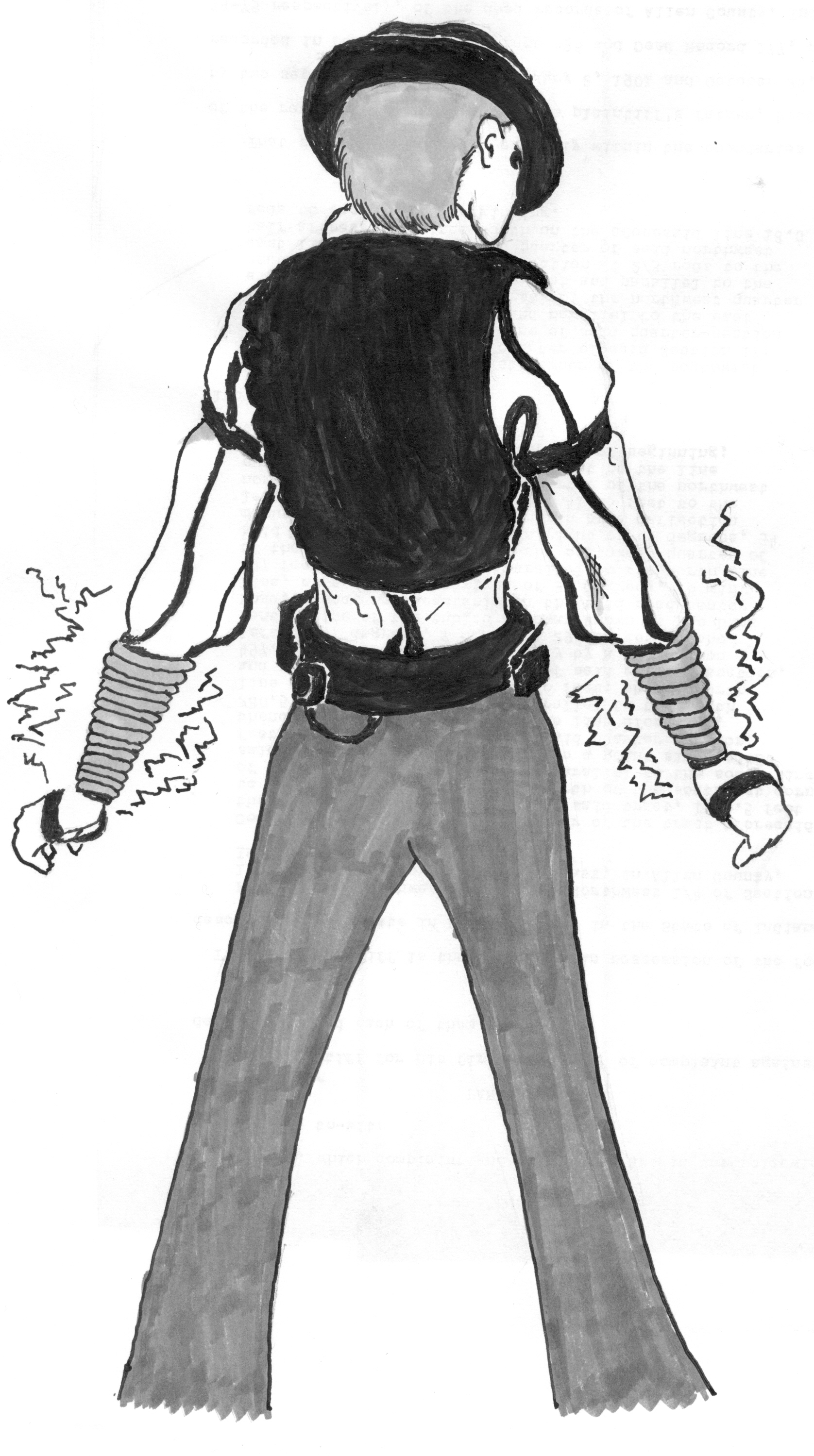
One of the things I do almost compulsively, aside from write, is doodle. Perhaps inevitably these two wind up intertwined, as I find myself doodling the characters characters I write about. I thought you might like to see some of these drawings, so I thought I put one of them up here every once in a while and see what you think.

So, if you’ve ever wondered what Circuit looks like when he gears up for some havoc it might ease your mind to know it’s something like this:

Circuit0001

Click for full size image.


Or maybe that’s no comfort at all.

See you Friday!

Heat Wave: Tempering

Helix

Amplifier chewed on her bottom lip, thinking. After a moment she got up out of her chair and paced away, taking a long pull on her bottle of water. Herrera shot me a concerned look, probably wondering why I’d laid it on so thick. Or maybe wondering how much of what I’d said was true. I had no doubt that she’d gotten a similar speech from someone when she signed up, and at least she had spent some time in the HSA, but the fact is, until you’ve actually been in the Project for a year or so you have no idea what the job is really like. But maybe that’s true of every job.

Herrera looked like she was on the verge of saying something but Amplifier beat her to the punch. “Which are you, Helix?” She ran her fingers casually along top of a small chest of drawers that was waiting for it’s second coat of varnish. “My grandma used to say that a person who tries to tell it like it is says more about themself than the way things are. Want to hear what I hear?”

“Sure, why not?” I folded my arms over my chest. “What’s your great insight into my inner workings?”

“One,” she held up a finger to signal the number, then leveled it so it pointed at me. “You love your job, or you wouldn’t put up with all the draw backs that come with it. You could have gone back to carpentry years ago, if that’s what you wanted.”

Amplifier strolled back over to where we were sitting and leaned her arms on the back of her chair. “Two, you’re a sweetheart trying to pretend you’re cynical and you’re bad at it. No one buys the shtick where you try and scare people off by pretending you’ve ruined yourself anymore, it’s overdone. I get that it’s a hard job, but people never got anywhere by running away from challenges. Besides, one of my best friends is a certified genius, and you know it or your people wouldn’t have tried to recruit him already. I think, between the two of us, we can come up with some ways to deal with the worst parts of the job.”

I raised my eyebrows a bit and said, “Anything else you managed to glean from all that?”

“Yeah.” She rested her chin on top of her arms and said, “You really think doing this job for as long as you have has ruined you somehow. Well, I’ve got a newsflash for you, I’m pretty sure every job you can possibly have does that. I worked in a fast food place for two years and it ruined my faith in humanity. I’ve been in a band for three years and it’s ruined my faith in art. I’m not sure you’re a worse person just because you job has ruined your faith in yourself or your talent. There’s plenty of people high on themselves already, anything that keeps you off of that has got to be a plus, right?”

“There’s a delicate balance somewhere in there, Amplifier, and I’m not sure you’re hitting it.”

She laughed and swung herself around the chair and back into the seat. “Well, not everything has to go one way. You mentioned going into research a minute ago. What’s that about?”

“Well there are a few people, most of them with letters after their name but no talents in the Sumter sense, although there are exceptions, who do research on exactly what talents do and how they might be related. For example,” I held up my water bottle and sloshed it back and forth. “What I did to cool this water down from room temperature to cold and refreshing is technically known as ‘cold spiking’ and it was once considered a separate talent from mine. About three decades ago some eggheads on the West Coast got a heat sink and cold spiker together and they managed to duplicate each other’s abilities on a small scale. Now they’re considered the same talent, but they work different sets of muscles, so to speak, so most people figure out how to do one early on and have a hard time working up to the same level of proficiency with the other. Most of that kind of info funnels back to the Project and helps the analysts and field agents out. In your case, there’s even more experiments being run, and if you just wanted to help out from time to time, I’m sure no one would say no…”

Herrera and I spent the next hour and a half explaining the many different possible things a person could do while working directly for the Project and as contractor. In the end Amplifier left not because we were done covering all the possibilities but because she had to get to class. I walked her to the door and was surprised to see that she hadn’t come on a motorcycle, or even a slovenly old junker but rather a sleek new hybrid station wagon. It didn’t do much for her image as a member of a garage band although it was probably pretty useful for hauling all their equipment around.

I shook my head and glanced around the parking lot. It was still early in the day so the only other car, besides mine, was the kind of rust bucket I would have expected from my other guest. I glanced at Herrera. “You two drive over separately?”

“What makes you think I didn’t just ride the subway?” Herrera asked with a raised eyebrow.

“People in our line of work don’t usually enter an enclosed space with a bunch of strangers unless it’s part of our job.” Since Herrera hadn’t made any move to leave I stepped back into the workshop and closed the door behind me. “Was there something else, besides the spontaneous recruiting talk?”

“As a matter of fact, there was.” Herrera strolled over to the chest of drawers Amplifier had been examining earlier and looked it over, as if she could figure out what Amplifier had been thinking while looking at it. “But before we talk about that, what was with that recruitment speech? Not the most encouraging thing I’ve ever heard.”

“Can I be honest?”

“I can’t imagine lying would help.” She shot me an evaluating look, softened with the ghost of a smile. “And I’ve gotten the impression you’re pretty bad at it.”

“You see right through me.” I scooped up the tabletop I’d been working on the night before and moved it to the side of the room, taking the moment to gather my thoughts. Once I had it leaned against the wall I did the same with myself and said, “It’s like this. I’ve had a few different oversight people in my time, but I’ve been with Bob Sanders the longest. We worked out a system for pretty much everything we could expect to do as talent and oversight, and we played to our strengths. For the most part, that means I was the bad cop. Now I gather that you may not like the idea, but the fact is it worked and it worked because we each knew what we were doing. I’m not Sanders’ biggest fan, but he knew what he was doing and he made sure the rest of us were on the same page.”

I held up two fingers. “Twice now you’ve taken us straight into important discussions with a valuable but potentially dangerous individual with little to no warning or time to plan our strategy and which way the conversation is to go. That was sloppy.” I jerked my thumb at my chest. “The first time was my fault. I’m the more experienced agent, I should have said something before we went in to talk to Amplifier yesterday. I definitely should have said something afterwards, and in fact I meant to bring it up tomorrow, because I didn’t think it would be relevant until then. It shouldn’t have been. But in the four days you’ve been my boss you’ve piled in a month’s worth of work.”

“You think I’m moving too fast?” She didn’t sound offended or curious, just a little sad. Not what I had been expecting.

“To use a handy analogy, if you don’t know what kind of wood you’re working with,” I rapped my knuckles against the tabletop, “you won’t know what the right tools for the job are. Or, measure once, cut twice. Or even-”

“All right,” she said, her faint smile coming back. “I get the idea. Two, megalomaniacal ass? Voorman wasn’t very happy with your cursing at a person of interest over the phone yesterday-”

“We monitor all phone calls as a quality assurance measure.”

Her smile twitched but didn’t grow, and she loose her train of thought either. “-and I’m not sure he’ll be any happier after hearing about that.”

“It can hardly be unprofessional to mention a term used on the Federal NBH Employment Termination form.”

Herrera’s expression wavered just a bit, the kind of look people get when they think you’re joking… but they’re not quite sure. “You’re kidding.”

“Look it up. It’s under section four, mental instabilities.” I stood up and started collecting the empty water bottles. “So. Something else besides the recruiting talk?”

Her fingers drifted down the left side if the chest of drawers. “How long have you been selling furniture?”

“I started selling independently instead of through a dealer about a year and a half before my pieces started showing up in Circuit’s instillations. That is what you’re wondering about, isn’t it?”

She turned to me and raised an eyebrow. “Actually, I was wondering how I missed the fact that your maker’s mark is half a strand of DNA when I saw it in Circuit’s warehouse.”

“Most people think it’s a spiral staircase.” I shrugged. “After all, as Amplifier said, carpentry isn’t very agentish. DNA isn’t very carpenterish, for that matter. I’m not sure how Circuit figured out I was making the stuff, but I’m guessing it had more to do with his hacking skills than the maker’s mark.”

“Has anyone ever followed that up?”

I spread my hands. “How are we supposed to do that? Put a tracer in each piece I sell? Even if we could afford the time and resources to do that and track them all, how are we supposed to tell which pieces Circuit’s bought? And what do we tell the judge when we ask for a warrant?”

“Point taken.” Herrera turned from the chest and folded her arms across her chest. “The Project headquarters was broken into last night.”

I paused, an empty water bottle halfway into the empty paint bucket I kept for recyclables. “What?”

“Someone got into the building, ruined a security camera, broke into the evidence room, tased three agents including Al Massif and stole all the evidence relating to the Firestarter case.” She picked up a messenger bag she had brought with her and fished out a sheet of printer paper. “There’s a video of the pair of them, from the security system of a restaurant down the street, but otherwise no indication of who it might be. Here’s a still frame.”

I snatched the sheet out of her hand and stared at it. It was just a blurry image of two men in street clothes jaywalking. The camera that took the video must have been forty feet away, making it pretty much useless for purposes of identifying who they might be. I looked back at Herrera. “That doesn’t tell us much, but I’m guessing we’re assuming this was Circuit and one of his people?”

“Not officially, but the evidence all points that way. He just expressed an interest in the Firestarter case a few hours before the break-in, and he strikes me as the type to be ready to take what he wants if no one will give it to him nicely.”

“You’re a good judge of character,” I said, trying not to grit my teeth. I try not to take my job personally, but some things really grate on you. “What’s our next move?”

“We move.” Herrera rubbed her arm absently like she felt a draft. “The location of headquarters has been compromised so the whole office is being packed up and moved to the auxiliary location.”

Which had been our primary location until three years ago. It was a decent facility, but farther out than our current location and missing some of the nicer bells and whistles, like a lead lined holding cell, that incorporated the state of the art in talent countermeasures. “Wonderful. I suppose we’ll have to wait a few days until we get settled before we get back to the case.”

“Excuse me?” She glanced over her shoulder as if checking to see if there was anyone else in the room. “Are you still talking to the woman who did a month’s worth of work in four days?” She looked back at me and smiled. “I’ve talked Mossman into putting us up this afternoon. We’re meeting at his place at three this- Helix!”

I jumped a bit then realized she was staring at my hand, which was still holding the sheet of paper she’d given me. Except it was now on fire. “Sorry! Sorry.” I quickly balled the sheet of paper up in my hands and began gently pressing the heat out of it. “That happens sometimes. Just FYI, you probably shouldn’t hand me anything flammable then tell me bad news.”

“Right.” Herrera watched wide eyed as I tossed what was left of the paper in the trash and dusted the ash off my hands. Then she slowly shook her head and said, “I guess hearing about it and seeing it in action are two different things after all.”

“I guess they are.”

“So. Mossburger’s place, three o’clock. You mind showing up on your day off?” She started rummaging through her messenger bag again.

“Normally, yes, but for Circuit I’ll make an exception.”

“Good. Now, you remember how I said I thought I had an idea about the Enchanter when we visited Circuit’s place yesterday?”

“Sure.” I nodded. “You said you needed to look into it.”

“Well, I did. It’s especially relevant after hearing that Circuit thinks the Enchanter and the Firestarter are the same person. I think I know what the source of the name is, and hopefully that will give us some insight into the Firestarter and, by extension, Circuit.” She pulled a pair of thin, well worn books out of her bag and started to hand them to me. Then she paused and gave me a skeptical look. “Are you safe with flammable objects yet?”

I put my hand over my heart. “I promise that they will not catch on fire.”

Apparently satisfied, she gave me the books and a moment to look them over. One was green, the other purple. They had charming watercolors on the front of fraying, well handled dust covers. One had a long rip along the back that had been taped together. They looked more appropriate to a library’s story circle than a criminal investigation. I looked back up at Herrera with a skeptical expression. “Children’s stories?”

Previous Chapter
Next Chapter
Fiction Index
Rereading

Let’s talk about rereading!

Wait a minute, you say. We just went over reading, didn’t we?

Of course in practice it’s probably a bad idea to reread something immediately after reading it. Also, it’s probably not worth your time to reread everything you read once. But really good writing, the kind of stuff that grabs you and runs, the kind that moves your heart and keeps your brain churning, that kind of stuff is worth reading more than once, particularly if you aspire to be a writer.

Rereading, particularly if you took notes or just wrote a rough sketch of your impressions after you read something the first time, is a great way for you to glean out the most important lessons from a book or story. I’m not talking about life lessons, although many stories have an Aesop or two built into them. I’m talking about the lessons that help you be more the writer you want to be.

Did you just read something that left you slack jawed and drooling, it was so amazing? Reread it. Now don’t shove your mouth closed, wipe your chin and go back to the top of the page, it’s best to finish the entire story or book before you reread something, but do make a little note for yourself and, a week or two later, come back and read that part again, maybe the whole chapter, or if it’s a short story just reread the whole thing.

You’re probably thinking to yourself, “But reading it again that quickly robs it of so much impact.”

Exactly. The problem with great writing is, the first time you read it, it sweeps you along so easily it looks effortless, when in fact the writing was probably very difficult. You need to slow down and really examine what made that passage speak to you. Was it word choice? What about those words struck you? Pacing and cadence? What rhythms and turns of phrase make it work? Is the scene the culmination of several preceding moments in the story? How does the author tie it all together for the audience?

Read for the story and the inspiration. Reread to appreciate the craftsmanship.

Another reason to reread is to see how a story speaks to you in a different stage of life. Truly great works appeal to people of all ages and backgrounds. In order to understand how they can do that it’s important to see them from as many perspectives as possible. While having a group of people that love stories and talking about them is a valuable resource in meeting that goal, so is carefully rereading stories that you loved when your life was different.

Has your impression of the book changed because you are older/married/(un)employed? Does the story still speak to you in the same way? In new ways? If the old spark is gone, can you think of ways the author might have kept it? You have changed, but if you’re a writer then writing is likely to be a lifetime obsession. Let your changing perspective teach you more about great writing.

If you’re anything like me you have shelves full of great books. Maybe there’s one or two you haven’t thought of in a while. Take them down and get reacquainted. Your old friends still have a lot to tell you, after all.

Cool Things: Potter’s Field

“There’s a cemetery on Hart Island at the western end of Long Island Sound. Unidentified corpses are buried here under plain stone markers at the rate of around 125 a week…” 

-Jordan Halpert, Potter’s Field 

Kind of chilling, isn’t it? In the city of New York, 125 people die nameless and friendless every week. That’s about 500 a month. 6,500 a year.

Who are they? How did they die? Does anyone really care about them?

I’m not sure how accurate that statistic is, but by opening his comic noir tour de force Potter’s Field with it, Mark Waid manages to ensure that he has our attention from minute one. After all, who want’s to die nameless and forgotten? The least dignity we could be offered is a tombstone with a name on it. Yet to the people of the Hart Island cemetery, the only indication of who they might be is a cold, impersonal number.

But there is a man. A man who hates that fact, who cannot stand to just walk away from those empty stones. So he walks the length and breadth of the city, piecing together the clues no one else has the time or the resources to find, and finding the names for these people and recording them in stone for all to see.

Like the people he serves, this man has no name to give to others, so they call him John Doe. To us, and to the people who help him, he is as much an enigma as the corpses he names. He seems to have no family, no friends, no history at all. And yet, there must be something that drives him to live alone, in abandoned buildings, eating canned food and sleeping on cots. Sometimes it’s hard to tell what the real mystery is – John or the people of in the potter’s field.

Or perhaps, as his name suggests, John Doe is just another one of the nameless dead who hasn’t given up on moving around just yet.

Potter’s Field is the polar opposite of the last Mark Waid titles I mentioned. Where Irredeemable and Incorruptible are quite possibly the greatest superhero titles ever written, Potter’s Field is a tribute to the mortal man. John’s not superhuman in anything but his ambition. He scrabbles about for clues, risks his life every time he crosses with the criminal underworld and very nearly becomes a real John Doe on more than one occasion.

But, as Greg Rucka says in his introduction to the first collection, he still shows us Waid’s favorite kind of struggle. That of a man who stands on the side of what’s Right , opposing what is Wrong. The fact that he does it without spandex, superpowers or a second thought from the press and public only makes him more of a hero, not less of one.

And it gives one new hope in the potential of funnybooks to tell stories. For that alone it’s worth your time. Pick up your copy now and maybe someday you’ll be able to show it to your children one day, and say, “This is one of the titles that started the revolution. This is what made comics a force in our culture.” And really, how cool is that?