Firespinner Chapter One – Malice in the Pines

The afternoon sun struck Roy’s eyes the moment he stepped off the Argentum Express.

“Dust and ashes,” he muttered, jamming his derby hat onto his head to block the light. “Mountain air will be the death of me.”

The metal monstrosity of the sky train shifted and creaked as its frame cooled. Roy did his best to ignore it. In the recesses of his mind he knew exactly how much magic had lifted the Express off the ground in Leondale, how many sulfurite crystals had exhausted their fire to push it over the mountains to the head of the Mi-Tzi river. He also knew exactly how much power now bled from the bottom of the train’s cars behind him in smoke and embers, wasted. The fire whispered in the back of his mind. Told him it would gather if he willed it, begged him for purpose, for form, swore if he only gave in to his desire, the fire would burn it into reality.

But Roy Harper’s thoughts were his own. The fire was welcome in them only when invited and he hadn’t travelled here to burn. He’d come to work.

Roy straightened his jacket and crossed the platform towards town. The station was a few hundred feet outside of Yellowstone, connected to the town by a gravel path winding alongside the shores a of wide lake that took up the northern half of the valley. From the air the water had looked like an alien eye, a ring of reddish brown oxide deposits around a bright cyan pool with unfathomable depths at the center. But from the path the lake itself was little more than a strip of bright, rippling liquid below a picturesque landscape with the town walls giving way to the rising ridges of the Yellowstone mountains. In spite of the clear day down below gathering clouds hid the upper peaks from view. For a moment Roy enjoyed the simple pleasures of the natural world.

“Hungry tree! Hungry tree!”

Roy’s head snapped around, scanning for danger. Deep in his gut he felt something was wrong, something beyond the obvious, which was a twenty foot pine tree that had lurched out of the tree line and was rapidly closing on the stream of passengers making their way to Yellowstone. The tree’s roots thumped and slithered over the ground like dozens of crazed snakes. Loose stones and uprooted grass flew behind it, kicked up by the fast moving appendages.

The crowd of passengers panicked.

Most of the crowd saw the tree and bolted for town. Yellowstone’s ten foot tall earthworks were enough to stop most trees and Leroy could see the guard patrols atop it to fend off anything the walls alone wouldn’t deter so heading for town was a sensible move. More foolhardy souls drew weapons and formed a ragged line between the tree and the rest of the crowd.

Roy saw the telltale flares of light as two spadroons and one sword cane ignited. The weapons were deadly enough, even in untrained hands, but only against human targets. Trees were another matter. They were too hard to cut or stab effectively, had no vitals to target and sap prevented their burning easily. If you really wanted to threaten them a heavy ax was the surest bet.

That, or a fire bordering on an inferno.

Roy glanced back at the train, a few dozen feet back, opened his mind and made the invitation. Every sulfurite crystal in the cars thrummed in response. Streams of fire burst from under the train, forming into a spiraling funnel until they merged into a single, serpentine torrent. Roy turned and dashed towards the tree, the fire trailing behind, eagerly responding to his thoughts of the winding river he’d flown over for the past several hours.

Ahead, the situation had gotten much worse. An arm in a gray sleeve stuck out from under a tangle of roots, a still burning cane sword lying on the ground a few feet away. One of the men with spadroons was trying to work his way around to the trapped man while the other was swinging frantically at the tree’s waving branches in an attempt to get its attention. Roy slowed and reevaluated his strategy. Flashburning the tree wasn’t an option now, in fact he’d pulled too much fire from the train to attack without hurting the trapped man.

A wave of the hand split the flames in half and Roy scattered what he didn’t need into the grass along the path. That would keep it going for a minute or two if he needed to come back for it. The man working around the side of the tree jumped away from the unexpected spray of flames. Seeing that, Roy tweaked the placement of the fires just enough to keep him separate from the tree. That gave him enough room to work. The rest of the fire got crushed down into a bead as small as Roy’s pinky joint that he wove through the flailing branches.

Touched against the trunk of the tree.

And let go.

The resulting explosion blew two of the lower branches off of the pine and sent it slowly toppling over. Through sheer force of will Roy shaped the explosion up and away from the trapped man and the effort left him winded. It wasn’t a simple matter for a downed tree to get upright again but it was possible and the pine immediately set about it, branches waving in erratic spasms that set the trunk undulating like a snake. Roy grabbed the grass fires back up, still advancing, and dumped the flame on the tree’s upper branches, spreading the pain out. Then one of the men still on their feet joined the effort, his spadroon tossing out angry gouts of fire in short, fat bursts.

But, while needles blackened and bark charred, the pine refused to burn.

Roy dashed past the downed man as the other spadroon wielder vented and sheathed his weapon, dragging the injured man out of the way. The pine’s roots dug into the ground and the massive tree nearly spasmed fully upright again. Fire wasn’t going to keep it down. For a moment Roy considered trying his bone bead necklace but decided that, given the circumstances, adding snow to the equation was counterproductive. So he finished pulling on his dueling gloves, the heavy leather supple and familiar in his hands, then drew his last card to play.

The dagger over his left hip came free with a soft rasp. Dead iron, cold wrought in the old style, forced into the shape of a weapon by naught but a hammer and human will.

Forged to kill magic in all it’s forms.

And life was the highest form of all.

Branches flailed wildly but Roy slipped past them and plunged the tip of the dagger down into the trunk of the tree with all his weight behind it. The tree bent almost double with a tortured groan, folding until up around the dagger like a book, then snapped straight, fast as a jumping spider. Its trunk smashed into Roy and sent him flying through the air. He didn’t remember landing.

As he lay staring up at the sky, feeling the waves of the lake lapping in his hair, he felt it again. Something about the tree was off. Or maybe it was just his ribs, which he felt throbbing with every heartbeat. Whatever the matter was, it would have to wait. He bolted back to his feet, viciously pushing his complaining ribs to the back of his mind, expecting to find the last two passengers at the mercy of the tree.

Instead he found the tree struggling to do anything with half its roots cut away. Two woodsmen were cleaving through its branches, their heavy bearded axes propelled in complex, lethal cutting patterns by gouts of fire blasting from the back of the ax heads. The gleaming bronze blades never stopped moving and, in the time it took Roy to stagger out of the lake and across the gravel path, the tree toppled to the ground a final time.

Twitched once.

And didn’t move again.

After a moment’s pause the woodsmen moved in and began hacking the tree to pieces, stripping the branches from the trunk with shocking speed. Roy swayed on his feet, caught his breath and wiped water out of his eyes. Turned out his hair was soaked. He took the handkerchief out of the breast pocket in his vest and ran it through his sopping locks then looked around for his hat. Found it in the grass beside the gravel pathway, dusted it off and put it back on. And went to talk to his employer.

“That you, Grunt?” He rasped out as he got close to the woodsmen.

The bigger of the two paused in hacking the tree to pieces just long enough to glance at Roy. “Up already, Harp? You need to learn to take it easy.”

Roy took a deep breath; quashed a wince as his ribs twinged extra hard. “Easy is for old men.”

A final swing of the ax cut the top third of the tree away. Ben Grunwald slung his weapon over his shoulder and grinned. “That’s what I’m trying to say, Harp.”

“Bite your tongue, kid.”

Grunt laughed and shouldered his ax. “You’re only a year older than me, Harp.”

Roy looked along the trunk and found his knife. One attempt was all it took to realize he couldn’t bend down and retrieve it.

Grunt’s companion reached down to grab it for him. “Gloves!” Grunt snapped. “That’s an iron dagger, Will. Put on gloves! Dust and ashes, man, look at the way it’s burned into the bark.”

Will hesitated, embarrassed. Roy resisted the urge to join in with Grunt. Yes, the the dagger had sapped the magic out of a two foot section of the trunk leaving it gray and lifeless but it was hard to pick the damage out of all the burns they’d left on the runaway plant.

The kid fished a pair of thick work gloves out of a pocket, yanked the implement free and handed it back to Roy with a sheepish look. He couldn’t have been more than half Roy’s age, probably somewhere around fourteen or fifteen, but even so he was big and strong, standing a full hand taller than Roy was. Most men were taller than Roy, of course, but that didn’t mean he wasn’t annoyed by it.

He snatched the dagger back from Will and put it back into its sheath then looked around for any further complications. Patches of fire still burned in the grass. A quick thought rounded all of them up into a small, angry red orb. Since it was a long walk back to the train and he couldn’t keep control of the flames over that long a distance Roy settled for channeling the remaining firepower into the sulfurite crystals in his cufflinks. They’d needed topping off after the long train ride anyways.

The three other passengers that fought with the tree looked like they were going to be okay, though the man in gray who got trapped under the pine’s roots had some nasty bruises and limped a bit. Then again, Roy was feeling much the same and he expected to make a full recovery. The rest of the passengers who’d run for it were out of sight, presumably safe inside Yellowstone’s earthworks.

“You some kind of wizard?” Will asked, watching Roy from the corner of his eyes.

Roy snorted. “Do I look like I’m coalstoking Dutch?”

Grunt laughed. “It’s the way you dress, Harp. The only people this far north who bother with those fancy suits of yours are the pompous types. ‘Course he thought you’re a wizard.” Grunt threw an arm over Roy’s shoulders and thumped him on the chest, which hurt but Roy ignored. It wasn’t as bad as the flannel of his bright red shirt scratching against Roy’s face. “But Harp’s just been touched by some druid nonsense, just like I was. Except it made me bigger and taller and it made him angry.”

“If I was as angry as all that you wouldn’t have that arm.” Roy shrugged Grunt’s arm off and straightened his suit. It was tailored but made of cotton and he didn’t think it was all that fancy.

“But what about…” Will waved his hands theatrically towards the scorch marks on the ground.

“Don’t worry about it,” Roy grumbled. “Grunt, you got some kind of druid or medicine man in town? That tree didn’t seem like it was running wild.”

Grunt glanced back towards town, where a larger party of woodsmen were coming out through the main gate to come meet them. Then he turned to his companion and gestured to the loose pile of wood that had once been a tree, still twitching but too small to move or think on its own anymore. “Will, lash up that lumber and help the boys get it back to town.”

The unspoken message came through loud and clear. Roy should ask again in private. “Am I the only one you invited to this little party?”

“The only one who said he was coming. We might see Van Der Klein or Cain, but they never said one way or another.”

“Klein ain’t coming. He just got married two months ago.”

Ben’s jaw dropped. “What?”

“Books tried to get ahold of you but you weren’t at your last three addresses.” Roy looked out at the scenic mountain peaks and the menacing forest line. “He didn’t know you put on the flannel and came up here to cut trees.”

“Ignis fatuus.” Grunt looked dejected. “Can’t believe I missed that.”

“Speaking of-” Roy began to reach into his jacket then gasped as pain shot through his side.

“Let’s get you back to town,” Grunt said. “The Woodsman’s Guild has someone to look at that for you.”

They started down the path to Yellowstone again. Roy managed to get the package out of his pocket after a moment. Thankfully it didn’t look damaged from the fight. “Books sent me your mail and asked me to bring it to you.”

Grunt took it with a grin. “He can’t stop with the sending things, can he? Natural born quartermaster. Seen him recently?”

“At the wedding.”

“Is he doing well?”

“He’s fatter than ever and still making money hand over fist.” Roy shook his head in disgust. “Who knew there was so much wealth in selling beans to the old continent.”

“Chocolate ain’t just any beans, Harp.”

“I suppose.” There was a gurgling, coughing noise then an enormous pillar of water shot up out of the lake. “Dust and ashes, what is that?”

“Yose’s Heartbeat,” Grunt said. “As the locals call it. It’s a geyser in the lake that erupts every morning, afternoon and witching hour.”

“Lovely.”

“Anyway, even if Cain doesn’t come-“

“Cain’s not coming.”

Grunt gave him an odd look. “Was he getting hitched, too?”

“There’s a price on his head. He’d be stupid to show his face around anyone from the unit.”

“A price…” Grunt sighed. “What’s he wanted for?”

“Killed a woman down in Winchester County.”

“So it finally came to that.” Grunt shook his head. “Well, you’re right, we probably won’t see him then.”

“We’d better not. If I see his worthless face I’ll cremate him myself.”

They walked in uncomfortable silence for a long moment. Then Grunt gathered himself and said, “Well, you were the only one who came but that’s all right. The Guild brought in a fixer and two of the local Sanna are pitching in. Five should be enough.”

“Let’s hope so.”

Grunt laughed. “You make it sound like you already know what the job is.”

Roy looked over his shoulder at the woodsmen gathering up the downed tree. He wasn’t an expert but he was fairly certain it was too small to be thinking and moving on its own in the first place. And even if it was big enough to move itself trees knew better than to stray too close to human habitation. There was no reason for it to get that close to Yellowstone unless it was ensorcelled. “I might have a guess or two at that…”

Next Chapter

(This story is also available to read on Royal Road! Find me publishing there under the name HorizonTalker)
World Building: Hexwood

At the core of the idea of a Weird Western is the desire to translate a specific period of time and its attendant cultural norms into something comprehensible to modern audiences. That’s a challenge all historical fiction faces but by switching in fantasy elements you can both simplify the process and slip in direct analogs to the present day. I find these kinds of mental challenges fun and engaging and I’ve written about my approach to world building before so I thought I would share a few takes from the Weird Western I’ve been working on. 

Hexwood: Dust and Ashes started as a germ of an idea three years ago. I knew I wanted to tell a story about a gold rush but, instead of gold, I wanted people digging for magic. The initial pieces of the world fell into place quickly. The geography had the shape of the world of the late 1800s and the story would be set in what we know as North America but with different political boundaries. The culture would be dependent on digging up magic rocks to continue functioning. On top of the usual dangers of the Old West the ecosystem would be rife with supernatural monsters and killer trees. And there would be flying trains. 

The flying trains were very important. 

As is typical when I am working on the early stages of a story I found old ideas, some abandoned, some that I had intended to use in other ways, some that I intend to use again in much the same way, all falling into place as I solidified my ideas. Many ideas I had got cut and set aside for another time. And, in time, I had a complete tale to tell and a world to tell it in. While I can’t get too deep into all the things added and cut I thought I’d share a bit of my thought process as I addressed these issues in the hopes it will entertain you, and perhaps help you build a world of your own. 

Here are how a few of the ideas in Hexwood developed. 

Sulfurite 

The world of Hexwood started with the idea of magic rocks. Well, truthfully it started with the name but the first element of the story I thought of was magic rocks. I liked the idea of miners delving deep for the essence of magic but, as I began to flesh out the idea, I quickly had to decide what kind of magic I wanted them to dig for. That was a bit of a problem. 

A lot of things went out the window immediately. It couldn’t be fairy tale magic, which is mostly about transformations, illusions and curses. Those things are too immaterial to dig out of the ground. It also couldn’t be things like the magic of stars or lightning or the deep oceans. The stars and storms aren’t things you can find underground and the ocean, while terrible and mysterious, has its magical qualities whether it is underground or not. That basically left the elements of earth and fire or the powers of the Underworld. 

The Underworld is overdone, so it went off the list. 

That left earth and fire. After some deliberation I chose fire, in part because I thought it would be interesting to experiment with a mythos similar to that of Dark Souls. I won’t delve too deep into those ideas because the idea of setting Hexwood in a world after an Age of Fire got scrapped very early but it did push me to the core idea of most magic in Hexwood, which was Fire itself. 

Yes, I decided early on that the simple act of something burning would be an expression of magic and when that magic was used on metals you would get a basic effect. Silver shape itself like a living creature, tin would push away from the source of heat, aluminum would counteract gravity, and so on. To make using magic in this way practical people stored the magic of fire in a special kind of rock called sulfurite. With the basics of what I came to call volcanic magic in place, and the name of my magic rocks decided, it was time to move on. How did I build a West to put them in? 

Dolmenfall 

In my mind the first hurdle to creating a world that paralleled the Old West was the influence of the American Civil War. While the Gold Rush started in 1849 and marks the start of the Old West in many reckonings most Westerns are set after the Civil War and incorporate the resulting changes to weapons, warfare and culture into their narratives. If I wanted to evoke the West properly there needed to be a similar defining event not too far in Hexwood’s past. 

I’m not sure where the idea for Dolmenfall originally came from but I do know what I was avoiding when I decided on it. My goal with Dolmenfall was to create a devastating internal conflict in Columbia (the nation where Hexwood is located) without referring to slavery or race. Far too much time is spent in culture today dwelling on these topics, I wanted something different and fresh. But in order to really evoke the same kind of tensions as the Civil War it needed to have elements that provoked strong distrust on both sides, as well as a clear potential for power imbalances that needed to be reckoned with but ultimately wasn’t until violence forced the issue. 

After some thought I decided that the theme of this conflict should be Old versus New. In many ways the Civil War was also a conflict of old and new ways, with slavery being one of humanity’s oldest institutions and America’s economic and cultural ideas of freedom still one of the newest ideas in culture and governance. But again, to avoid making this too on the nose, I chose to make it a conflict between old magic and new. Mark Pendleton, the protagonist of the story, worked best if he fought on the losing side and so he wound up a representative of old magic. 

Sulfurite is a lot like coal, it’s something you dig out of the ground that makes fire. Granted, sulfurite is rechargeable and basically functions as a battery that holds fire rather than electricity but the general principle is actually not that different than coal and thus I’d been thinking of volcanic magic as a very industrial flavor of magic. New, a little untrustworthy but very powerful. Thus it didn’t make sense for Mark to use volcanic magic, or at least not exclusively, so he had to use a different flavor of magic that was preindustrial and at least somewhat philosophically opposed to mechanization. When developing my main character I decided I wanted his magic to feel more ecclesiastical, so Mark got incense and a dowsing rod. I knew he’d need more than that but the later changes to Mark’s magic powers had more to do with his character than the world building, and with two plant based magics as a starting place – Mark specifically burns mandrake roots to use his central power and dowsing rods are wooden – I found myself thinking of him as a druid. That perfectly fit the bill for a system of old magic that would oppose a more “industrial” magic so I settled on the “Civil War” conflict in the setting being a conflict between druidic and volcanic magics rather than a war over economies and slavery. 

With druids in the mix my mind immediately went to Stonehenge. Now that monument predates known druidic traditions but what I really needed was something that would emphasize the Anglo nature of the druidic tradition and Stonehenge is a truly iconic English megalith. So I made stone circles like Stonehenge an integral part of the druidic tradition. Mark trained at one, called Moraine Henge, fought to protect it during the Columbian Civil War (not a name that stuck), and watched it destroyed when his side lost. The individual stone formations – dolmen – were smashed and the druidic tradition ended, at least for a time. The only thing left was to give the conflict a name – or better yet, two. The American Civil War actually has two names, after all (the other is the War of Northern Aggression, and yes some people still refer to it as such) and each illustrates how one side thought of the conflict. So in Hexwood you may hear some people refer to the Lakeshire War – a reference to where the war was fought, certainly, but also the people blamed for starting the conflict. Other people refer to the war by its outcome – Dolmenfall, a reference to the destruction of a treasured and irreplaceable cultural touchstone. 

Raging Skies, Burning Stone and Arthur Phoenixborn 

For the last five or six years the idea of doing something with the mythology of King Arthur has percolated in the back of my mind. Ideas ran from the Once and Future King returning to aid modern day Britain, as the legends promised, to a clash between the Knights of the Round Table and other equally legendary figures, such as Greek heroes or Taoist Immortals. Nothing ever came of any of those ideas. 

So when I was trying to ground Mark’s druidic traditions back into a larger cultural context King Arthur came to mind quite naturally. It took a little massaging but I managed to work disparate parts of various Arthurian story ideas I had tinkered with into a unified system and installed it as the mythical framework for the nation of Avalon, the England of Mark’s world, replacing the increasingly incongruous Dark Souls style mythos. It also let me establish a cultural throughline that would otherwise have been very difficult to explain. 

You see, the English cultural heritage that underpins American culture, including the Old West, is distinctly Christian in nature, trading on ideas about Kings submitting to laws, mercy as a component of justice, and the imperfect nature of man that only the Western Christian tradition has ever seriously tried to put into practice. What’s interesting about Arthur is that much of his mythos seems to be an attempt to assimilate those Christian ideas into the culture of the old Angles, with Arthur himself serving as a clear Messianic figure. 

My original intent with importing Arthur into the world of Hexwood was just to give the nation of Avalon a suitably mystical feeling origin. But once I realized I needed to ground the philosophies of Avalon and Columbia in something substantial in order for them to ring true Avalon’s First and Forever King started to take on more significance. He died and came back, gaining the title of Pheonixborn (replacing our Arthur’s title of Pendragon, which sounded too much like Pendleton for me to use). He united the druids and founded the Knights of the Stone Circle to place their powers at the service of the people, rather than the other way around. And he picked up two guardian deities, the Lord in Raging Skies and Lady in Burning Stone, to emphasize the idea that even the King himself should submit to authority, law and other abstract truths in order to build a stronger nation. While I wouldn’t go so far as to call it a coherent religion it does go a long way to fleshing out the philosophical underpinnings of the world outside the town of Hexwood, where Mark and his friends live. 

And there you have it. These were the first three major steps in fleshing out a world around my simply story about magic rocks. It barely scratches the surface of all the different things I tinkered with while building Hexwood‘s world and I’m sure more things will be added and subtracted in the days to come. But hopefully you enjoyed this little glance into the process and how just one idea can quickly spiral out into many layers of complexity if you just think about it for a bit. 

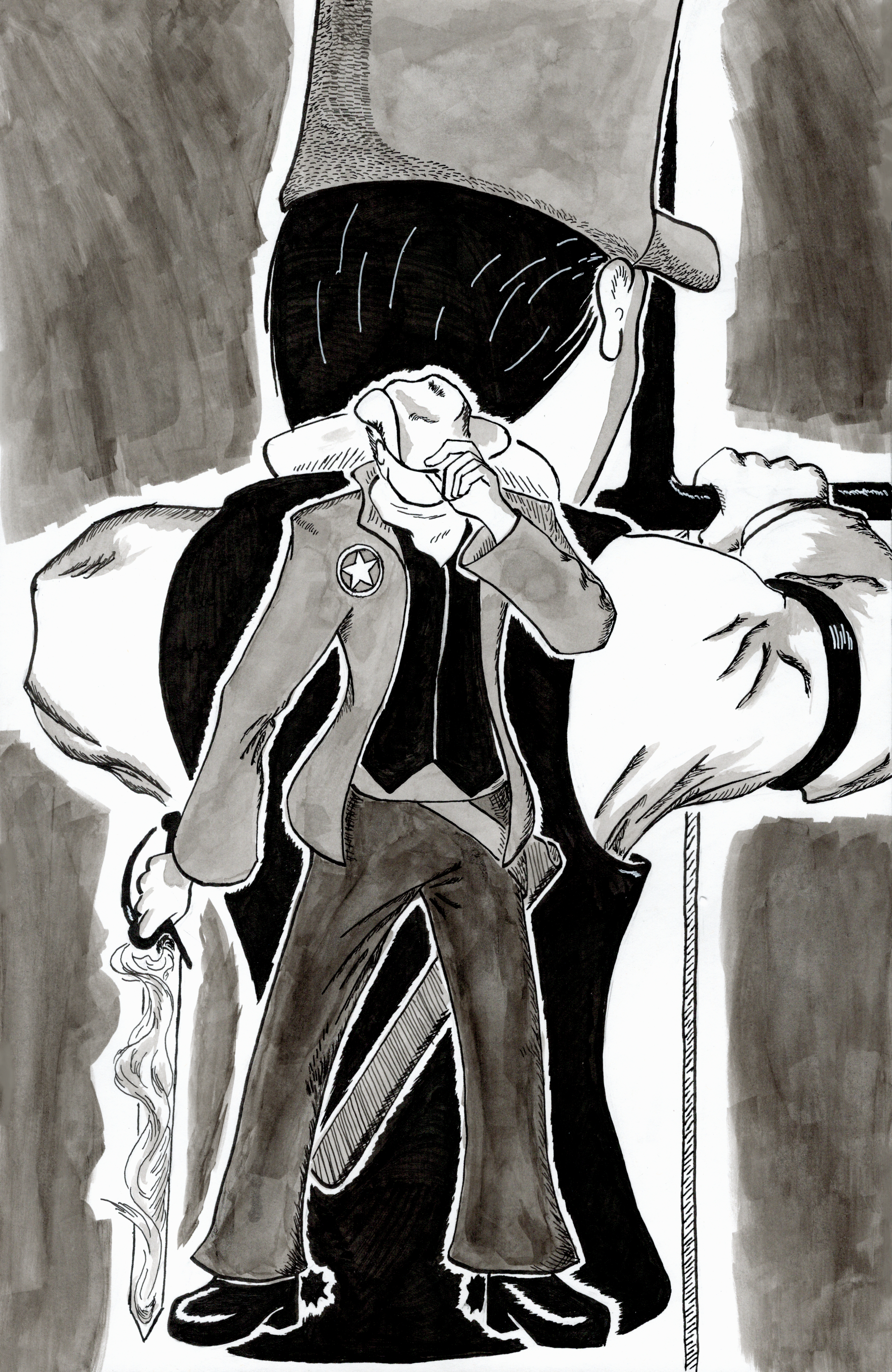
What? You wanted to read a story in that world? Well, Hexwood is a comic, you see. It’s not quite done with production although I can share the cover art with you here: 

But I don’t plan on publishing the script here. Still. Maybe we can work something out. Come back next week. You may be pleasantly surprised. 

Genrely Speaking: Weird Western

Boy oh boy we have not done this in a while. Long time readers know that genres are a thing that fascinate me, they are at once an attempt to codify stories and make discussing them easier and, at the same time, somewhat arbitrary groupings that carry different connotations among different people. For whatever reason the standards, exceptions and idiosyncrasies of genre classification entice me to think about stories through new lenses as I try and narrow down exactly what defines a story and its thematic content. Now all genres are broad categories and they tend to spawn a bunch of subgenres that narrow the scope to an extent, which for the purpose of Genrely Speaking are counted as regular genres rather than some beast of their own. A subgenre is almost narrow enough to be a useful tool for analysis rather than just a section in the library. 

That is, when it’s not just two genres pasted one on top of the other. 

Enter: The Weird Western. 

As the name implies this genre is built on a base of the Western. It has all the open horizons, independent lives and harsh consequences as that genre but it layers something… extra on top of that. That extra usually comes in the form of some kind of Space Opera or Low Fantasy (or, on rare occasions, some other Fantasy genre). On the one hand a Space Western can serve as a look at technology or social trends when they’re boiled down to just one or a handful of people surviving in harsh places. On the other a Fantasy Western takes many of the superstitions and traditions of the West and makes them real, living forces that the protagonists have to deal with on a daily basis. 

Given the many facets this broad genre can take I’m going to confine “weird western” to the realm of the second half of the blend, the Western with Low Fantasy, and refer to the first half as a Space Western. Note that this doesn’t rule out the Weird Space Western for the truly ambitious writer (see: Jack Irons, the Steel Cowboy.) Given this context, what are the pillars of the Weird Western? 

  1. Personification of the forces of change. This can take many forms, from clashes between Native American and European figures of myth to the personifications of railways directing expansion west to some kind of magical disaster driving people across the plains, some form of the supernatural will be involved in humanity’s move westward. This is true even if the Weird Western is set in some fictional world with no historical ties to the United States. One interpretation of this theme that I found particularly interesting was Cherie Priest’s Clockwork Century, where zombies started slowly overrunning the West in a metaphor for the creeping dehumanization of mechanization. 
  2. Magic as a treasure to acquire. The West was a place where people grabbed for a great many things. Land, water, livestock, transportation and precious metals to name a few. While all of those things still hold value in most Weird Westerns most of the players in the story are more interested in magic, which serves as a stand in that simplifies and streamlines the many different conflicts of a traditional Western into something a modern audience can easily understand. As modern culture has moved away from the kinds of work that defined the Old West fights over pasture or farm land and the relentless expansion of the railways have lost some of their immediate impact. Many Americans today don’t even own their own property, much less property that they use to sustain themselves. They are more used to wealth and prosperity in the abstract, in terms of bank balance, investment and the like. Magic in a Weird Western typically serves as an analogy to these more familiar landmarks of prosperity and survival and frames the characters’ desires in a format modern readers instantly resonate with. 
  3. A focus on outsiders. While the Western has always had its love for characters from ‘outside’ communities, from the traveling gunfighter to the displaced veteran, they still tend to focus heavily on specific communities. High Noon, Shane and Tombstone all feature very, very local stories with mostly local casts adding maybe one or two outsiders to provide prospective or an audience vantage point. This makes the narrative a bit more grounded and lends the tale an air of believability (roving gunslingers were by far the exception in the West, after all). In Weird Westerns outsiders are often a much bigger part of the narrative, with large numbers of them roving the West in search of the things that make them powerful and effective. Or, on the flip side, the story may feature people who have been displaced from a quiet town or camp and forced into bigger, more mystical environments that they must then learn to survive in. This lends the Weird Western Genre a tendency to build casts of hunter gatherers, rather than farmers or miners. If not balanced properly it can undercut the Western feel of a story (see the novel A Few Souls More for an example of this). 

What are the weaknesses of the Weird Western? It combines two genres that have a limited appeal. The most popular flavors of fantasy are some kind of Modern or Urban Fantasy and High or Epic Fantasy while Western is a genre few people pay much attention to at all. The tropes and archetypes that define the genre just aren’t as immediate and appealing to most people as they used to be. 

The genre also runs a serious risk of doing too much to really excel at any one thing. Most Weird Westerns try to blend a magic system or two with building a realistic supernatural West, strong characters, historical events and real world cultures. They also need a good plot, the ability to write dialog that is at once snappy and somewhat archaic and a sense of the bittersweet nature of a vanishing frontier. The author needs to do all of these things while balancing them so neither half of the Weird/West balance overwhelms the other. It’s a hard genre to do well and not a lot of people will be excited even if you execute perfectly. 

What are the strengths of the Weird Western? Like many forms of fantasy it gives us the ability to examine difficult questions at a bit of a remove. But more than that, when done right it taps into a section of myth that is powerful and currently quite fresh and new to the modern mind. The West is also one of the best settings to juxtapose modern knowledge and understanding with the conflicts of might and right, civilization and nature. Many of the conflicts we face today are the same as were fought in the West, and with the supernatural to personify the clashing forces there’s much you can say quickly and easily in the Weird West. 

The biggest struggle in the Weird West is building a world that will hold both the supernatural and mundane human portions of the narrative. The West was a very specific place and time, as I’ve mentioned before, and you have to be careful how you introduce anything new to it if you wish to keep the defining elements of the Western present. It’s fun, for sure, but also a tricky challenge. There may be something to talk about there. Hm… maybe we’ll take a crack at that next week. 

Fantasy is Inescapable

One of the most common complaints a modern fantasist hears about his or her work is that fantasy stories are so incredibly trivial. By the same token every modern fantasist has written some kind of rebuttal to this notion. George MacDonald, C.S. Lewis, J.R.R. Tolkien, each took up the standard in turn. Other authors, from bestsellers like George R.R. Martin and Stephen King to lesser known talents like Bill Willingham and Larry Correia, have donned the mantel and defended the fantastical in turn. While I’ve looked at the question of why we love fantasy myself, years ago, I’ve never thought about how to defend the fantastical tale if I had to justify its existence. 

Even now I’m not sure why people question fantasy. We’re surrounded by things that evoke wonder every day. Sunrise and sunset, birth and death, history and nature, all hint at deeper truths that underpin the world as we know it. Humanity’s response to these deep truths has always been the fantastic. From the earliest days of recorded civilization we have had a very sophisticated and story driven way of grappling with the portions of the world beyond our comprehension. 

From the beginning of recorded history the fantastic has come and gone in the stories we read. Gilgamesh fought and befriended Enkidu, the wild man, and together they slew the Bull of Heaven. Then Enkidu died and his death drove Gilgamesh to seek immortality. In a nutshell we see the contest of man versus nature, the cost of building a civilization and how it drives men to memorialize these sacrifices in the fabric of their culture. A sociologist or anthropologist could discuss these concepts in terms of numbers, pressures or psychological drives and add a great deal to the overall picture. But in a single fantasy the basic concepts are expounded on and laid bare to the casual listener in a way no other kind of discussion can. 

The English language is no stranger to fantastic stories either. From the early days of King Arthur’s legends to the plays of Shakespeare, fantastic characters have given voice to such abstract forces as the legitimacy of rulers, the forces of nature and the human drive for vengeance. Edgar Allen Poe transformed the influence of a hostile and overprotective father into a garden of poison that would slowly kill or warp those who lived in it. George MacDonald transformed the battle between good and evil in the human heart into the slow, horrific distortion of the human body. All of these were serious stories for sober minded men attempting to understand the world as it is. They left their marks, great and small, in our own understanding of the world. But all pale before the king. 

The most influential novel in the English language is undoubtedly Charles Dickens’ A Christmas Carol. It’s been parodied or homaged in every long running TV show or, in the old days, radio play. It’s been adapted to stage and film more than any other story in the Western canon. Everyone from Sir Patrick Stewart to the Muppets has taken a crack at it. And on a very fundamental level, A Christmas Carol is a fantasy. 

Ebenezer Scrooge is surrounded by ghosts. These specters embody any and every idea about the human condition you could want – greed, generosity, family, loneliness, regret, past, present, future, death, redemption and second chances. All of these things have faces and voices – or a lack thereof – that makes their impact on Scrooge felt with greater strength than millions of pages of academic prattle about these concepts ever could. In fact, millions of pages of thoughts on A Christmas Carol undoubtedly exist, but none of it comes close to equaling the thing itself. 

And this is a truth paralleled in Dickens’ tale itself. Scrooge understands all the fundamentals of Christmas from the first word of the book. But that simple understanding is insufficient. Ebeneezer understands Christmas but he cannot live it until he meets with it. And he hasn’t met Christmas in such a long time that it will take something fantastic – or, in the book’s own words, wondrous – to effect that meeting. This is why the first words of the book remind us of a simple fact: Marley was dead, to begin with. And later on Dickens reiterates this theme with the following words: 

“There is no doubt that Marley was dead. This must be distinctly understood, or nothing wonderful can come of the story I am going to relate.” 

The meeting of Scrooge and Marley, seven years after Marley’s death, was a wonder that opened the door for Christmas to meet Scrooge as well. And it was this meeting that would turn the grasping, clutching covetous old sinner into a man who could live Christmas all the year round. A transformation easy to miss in the mundane world but obvious  to all when it speaks to us through fantasy. 

A Christmas Carol is one of the first stories I can clearly remember my mother reading to me. It was the first play I saw live on the stage. And, perhaps because of this, I have never once had an issue with abstract ideas like generosity or regret wearing a human face and speaking its own mind. Add in a lot of reading of myth in high school and I’ve always assumed fantasy is an integral part of human culture. We need to hear the voices of progress and nature, heroism and despair, judgement and redemption. We need these things to be more than abstracts, we need them to walk among us and talk to us before we can truly come to grips with them, as Ebeneezer Scrooge did. If giving voice to those concepts, if giving them the power to make their will known, somehow classifies my stories as fantasies then that is what they must be. That is how humans are best equipped to hear them and that is how I want to tell them. 

The Loss of Western Symbolism

So remember when I talked about the use of goblins as a metaphor for human frailty? Well I’ve been thinking a lot about modern failures to make effective use of traditional symbolism and I’ve reached an almost inevitable conclusion – many Western symbols have been undermined to the point where they are entirely useless as storytelling tools. Yes, a lot my thoughts of late have been returning to various themes and my essays will be reflecting this. So let’s talk about symbolism. 

Symbols are the bedrock of communication. Words are essentially symbols for abstract concepts. On a lower level, even letters are symbols for individual sounds. We string three letters together to write ‘cat’. Those symbols tell us to think of a specific series of sounds which in turn we connect to the concept of a domesticated animal that humans adopted for the purpose of shedding fur on all of our black clothing. Language is essentially symbolic. Imagine if I were to write a sentence where short grinder hammerhead portal normalize traffic wrangle. Nothing would make sense, right? I can’t just use a word and change the meaning it symbolizes to something else, that would strip all attempts at communication of meaning and purpose. 

Our larger scale cultural symbols are just as important and just as vital to cultural coherence as words are to coherent communication. So I’ve been thinking about them and mulling them over and asking myself – are we even trying to communicate the core of these symbols anymore? Or is one of the reasons our culture seems unable to cohere any longer because we’ve abandoned the language that’s supposed to be holding them together? 

As with many big questions of this nature I have few answers. But there are two interesting data points to look at: Monsters and Relics. Let’s break them down, shall we? 

Monsters 

I already talked some about the nature of monsters in fiction when I talked about Goblin Slayer but let’s look a little deeper. Beginning with the Greeks monsters were seen as symbols of the ills of the human condition. In fact, many monsters were a result of human misbehavior if not actual humans transformed for evil actions. As examples Arachne was transformed for her pride and Medusa for lust and adultery (and public fornication). 

Moving forward into medieval times we see interesting stories like Saint George and the Dragon, where a country is poisoned by the influence of an evil creature that is devouring their children. George captures and executes the beast and the country is converted to Christianity. It’s an interesting inversion of the Fisher King, where the ills of a country are personified rather than its health. But the material point is that the recovery of the land is tied to a new moral system, symbolized in George’s battle with the Dragon. 

A wonderful modern take on this symbolic application is George (not a dragon slayer) MacDonald’s The Princess and Curdie, where a simple miner boy finds he has to fight an entire royal court that is slowly transforming into an army of monsters. Again, the transformation into monsters is driven by failings of character. 

But in modern tales there’s a strong resistance to allowing monsters to fill this symbolic purpose. Part of this comes from the creative desire to do something new, and rather than carve out new expressions of a symbolic theme many creators have chosen to just look at the symbols in a new light. Unfortunately that new light is almost entirely a literalistic one. Rather than look at monsters as metaphors almost all modern fantasies and fables try to grapple with monsters as stand-alone creatures that must be complete in and of themselves. 

Consider The Dragon Prince. The whole premise of this show is that there is an entire nation of exotic and fabled creatures brimming with magic and culture, and humans are locked in a struggle with them. There’s nothing wrong with that premise. But the story constantly invokes the symbology of dragons, complete with their hording, their vengefulness, their pride and their destructive temperament. And instead of overcoming them, the characters simply decide they must live with the dragons. 

And there’s a life lesson there, for sure. You will meet people like this, and you will have to live with them. But what this take on the symbolism of monsters misses is that, while classic monsters cannot exist without humanity, neither can humanity exist without monsters. 

The pat, easy answer of The Dragon Prince is that our difficulties are primarily external. They stem from misunderstandings or an unwillingness to compromise, not from flaws of character we must grapple with and overcome. But this kind of simplistic externalizing of internal struggles is far and away the norm these days, robbing a powerful symbol of its cultural impact. 

Relics 

This isn’t really the best word for what I’m getting at, as a ‘relic’ generally refers an item of some kind of great cultural or spiritual significance whereas here I mainly refer to items that take the measure of a man. Again, in early myths we see relics as measures time and again. The most common measure these relics took was the worthiness of a ruler. That’s seen in early forms in things such as the Golden Fleece but probably most significantly in the swords of King Arthur. Both the Sword in the Stone and Excalibur (when they aren’t the same sword, your legend may vary) are weapons that only worthy men can acquire. This was kind of a theme in the British Isles, as the Dyrnwyn was another, lesser known British sword that supposedly burst into a flaming weapon in the hands of a worthy man. Additional British relics include a whetstone that would only give sharp weapons to brave men, a coat that only fit the brave, and a mantle that only reached the ground on a woman who had honored her marriage vows. 

We see this theme in legends of the Norse as well. Modern culture brings to mind Mjolnir, the hammer of Thor, which only the thunder god was supposedly strong enough to lift – but in the ancient legends the weapon wasn’t limited in that way. In fact, it was stolen more than once. But Sigmund the Volsung also acquired a magic sword which only he could only pull free. The sword is as much a curse to Sigmund as a blessing but does serve as a mark of his exceptional nature as acknowledged by Odin. 

Of course the relic as measure of a man is a symbol we see in modern fiction as well. Even in the very recent examples of the MCU it’s everywhere. Not only is there the modern interpretation of Mjolnir but there’s Captain America’s shield, an item he receives in acknowledgement of his status as America’s greatest soldier and can only use effectively because of his skill and intelligence, and even Iron Man’s armor, which he wields by virtue of his scientific brilliance and character (such as it is). 

However, even the relic is beginning to fall from grace. In the MCU, Mjolnir was destroyed and Thor had to learn to do without it. In the Hard Magic novel series there are relics which serve to keep magic safe and usable but, eventually, are destroyed in favor of making magic more accessible. In fact, in many urban fantasy series relics that take the measure of their user get subverted into items that restrain their owner, a kind of shackle that keeps their owners on a preset path. In other cases they’re simply powerless items used to prop up shams or pretenders. 

Where the transformation of the monster is a somewhat understandable outgrowth of a more literal minded culture and the creative mind’s constant striving for new takes on old stories, the subversion of the relic strikes me as more an outgrowth of the dreaded postmodernism. A weapon like Excalibur cannot actually measure a person’s worthiness to rule so it has to be a prop intended to make people appear worthy to rule. The loss we suffer from this kind of perspective is pronounced. 

One of the things a relic as a symbol for worthiness can easily illustrate is why we must be cautious with those who are entrusted with power. All the British relics that measure worthiness inflict consequences on those who attempt to use them but are unworthy. Consider the cook pot – brave men can eat from it but cowards will starve. So be brave! Keep yourself and your community fed! Relics create an immediate sense of what the stakes are for having or not having the qualities they measure. Subverting them as a symbol for virtue internalizes something that should be external – if what we need comes from within ourselves or is just an idea we project onto the item to justify ourselves then, in almost paradoxical fashion, the consequences of falling short of that standard are no long our fault but the fault of our circumstances. Cowardice isn’t what led us to starve, there simply wasn’t a brave person here to get food and share it with us. Or perhaps we were just caught up in how society told us we should eat instead of considering new ways of thinking about meals (like food poisoning!) 

There are a lot of reasons to want to tweak things like symbolism in your storytelling. But every time this is done it’s like assigning a new meaning to a word. The more it’s done, the more overworn the word or symbol becomes and the harder it is to clearly convey the other concepts the word addresses. That’s a loss for communication, and it really needs to stop. Our symbolic language is part of our culture, part of how we share ideas, and if we lose it then art and culture become that much harder to propagate.

Five Betrayals of Alita’s Character in the Battle Angle Movie

A couple of years ago I wrote a breakdown on the failures of the movie Alita: Battle Angle to properly translate the villain of Yukito Kishiro’s manga (Gunmn in the Japanese, Battle Angle Alita for us English speakers). For a while I considered doing a full breakdown of that adaptation and all the many ways it failed but ultimately I didn’t want to spend any more money or time on a film that fell so short of what I wanted. So I forgot about it. 

Then they decided to rerelease the film in theaters.  

This could be a last ditch attempt to salvage the theater industry by pumping old films back into them. I know many fans of Alita hope this will lead to a sequel. What these people need to understand is that, even if they get a sequel, they will not get what they want. The Alita film does not understand the characters of its source material and it cannot develop them effectively. While Alita and her friends were not horribly betrayed like Nova was I don’t really believe James Cameron can effectively develop the story – this is the man who wrote Avatar after all. Beyond that, I don’t think he wants to develop the story of Alita, I think he is using the visuals Kishiro developed to try and tell his own story that, as I said before, is trite and overplayed these days. If my breakdown of Nova didn’t convince you of that, or you just don’t want to go back and read that post, here are five ways Cameron betrayed the heroine’s character in his film. 

  1. Movie Alita fails to learn. While manga Alita is not a genius like Nova or Ido she does learn and grow from the things she experiences. In fact she quickly picks up on Nova’s headgames and does her best to work around them. She rarely succeeds, as Nova is a truly formidable villain, but she does learn and grow. Movie Alita doesn’t seem to learn her enemies’ gambits at all. In fact, even though Vector’s deal to send Hugo to Zalem proves to be a flat out lie she immediately turns around and trusts that Motorball champions get to go to Zalem, even though this promise ultimately comes from the exact same place. Zalem itself. It makes her look incredibly stupid and shows that she’s not at all the same character as Kishiro’s heroine. 
  2. Movie Alita shows no compassion to her enemies. From the end of her encounter with Makaku, manga Alita showed the ability to form an understanding of her enemies and shows a deep sense of compassion for their circumstances and how they reached the place they did. She still defeats them but rarely does she fail to acknowledge their humanity. There are a few instances where Alita completely dismisses her opponents and just fights them senselessly and when she does it’s a moral failing on her part. Instead it is her acts of compassion, not her acts of violence, that have the biggest impact on the world and ultimately defeat Nova. Movie Alita never shows this connection with or sympathy for the evil people she must dispatch. She is far less humane than she should be. Worse, she executes Vector in cold blood when he poses no threat to her at all. This deprives Vector of his opportunity to grow and transform into a major pillar of society future as Kishiro’s Vector did. In spite of the many failures of the movie elsewhere Vector’s murder is what ultimately convinced me Cameron didn’t understand Alita. 
  3. Movie Alita cannot face the lessons of Motorball. The unfortunate truth is, by transforming Motorball into just another obstacle between Alita and Nova, the movie abandons the lesson Motorball teaches manga Alita. In the manga Motorball was one of the lowest points in Alita’s life. After losing Hugo she dives into Motorball so she can find a way to indulge her violent impulses without running into trouble. Except ultimately Alita does run in to trouble, and leaves the sport after a resounding defeat at the hands of Emperor Jashugan. She’s warned by her former teammate that she’s bad for the sport because she never came there for Motorball but just because she was seeking selfish fulfillment and that makes it impossible for her to be a true Motorball player. This rebuke was a decisive moment where Alita began to overcome her selfish impulses. Add in the low likelihood that Jashugan will decisively defeat Alita if he’s a barrier between movie Alita and Nova, thus depriving her of an insurmountable obstacle, there’s little chance movie Alita will get any of the value Motorball brought to manga Alita. 
  4. Movie Alita will never face her karma. In the manga Alita’s intervention between Zapan and Hugo was fundamentally unjust. Manga Zapan went looking for the spine thief by posing as a victim and trying to capture Hugo when Hugo tried to steal his spine. Manga Hugo never changed direction and thus earned his comeuppance from Zapan. Tearing Zapan’s face off was a grave injustice driven by Alita’s selfish blindness to Hugo’s evil actions. When Zapan and Alita fought again later on Alita was forced to face all the destruction her selfishness caused to both Zapan and her community. By allowing movie Hugo to turn over a new leaf and turning Zapan into a disgruntled rival who hunted Hugo as a sideways way to get back at Alita, the movie incarnation of Alita will not grow through facing the consequences of a significant selfish action. 

WARNING – SPOILERS FOR THE BATTLE ANGLE ALITA MANGA 

  1. Movie Alita cannot accept the Secret of Zalem. It’s a significant manga plot point that Zalem removes the biological brain of its citizens and replaces them with solid state computer chips. Zalemites are not told this substitution takes place. In typical cyberpunk fashion, once they learn this fact most Zalemites suffer mental breakdowns as they grapple with their sense of self and what this substitution might mean about what they are. Many Earth bound humans are also repulsed by this fact. There are three characters utterly unphased by this revelation – Lou (unimportant to this analysis), Alita and Nova. Nova’s sense of ego overrides any sense of humanity in the traditional sense, he’s far too monstrous to bother with the physical pieces that make up bodies, even his own, he’s lost in the intellectual challenges he wants to tackle. Conversely by the time Alita learns the secret of Zalem she’s developed such a sense of compassion for others that she treasures humanity no matter what physical parts make it up. Without the final secret of Zalem to bring out this part of her character Alita cannot reach the zenith of her character or show her ultimate contrast with her villain. And the hard reality is, movie Zalem does not use brain chips. Nova, Ido and the rest all have normal meat brains. How do I know this? Because we see Chiren after she’s been broken down for parts by Vector and her brain is clearly visible. Chiren is supposedly from Zalem. Thus brain chips are definitely off the table and with them the Secret of Zalem. 

SPOILERS END HERE 

Now I know, it’s possible to have two stories start in the same place and end in completely different places. Keep a hero the same and change the villain and you can still tell a compelling story, just with your hero growing in different and new ways. And I suppose that means an Alita sequel could be a decent film, even if it’s got nothing to do with Kishiro’s tale. But my core premise has and always will be, that Alita: Battle Angel should have been a retelling of Yukito Kishiro’s classic cyberpunk manga. Not Susan Collins’ dystopian YA novels. Not Cameron’s Avatar with cyborgs instead of blue people. But the latter two are closer to what we got. As far as I’m concerned Cameron can keep it. 

Martian Scriptures – Post Script

We’ve reached the end of yet another tale! Thank you once more to everyone who read this story as it was publishing, you were a great encouragement to me. Thank you also to everyone reading this long after the fact! I hope you’ve enjoyed this look into the Triad Worlds. Unlike Schrodinger’s Book, I wasn’t as interested in diving into immediate culture and trends with Martian Scriptures as I was in looking at stories that frame our lives and how they influence us on the daily. As is usually the case I feel I hit that theme with varying degrees of success but overall I’m pleased with the outcome. I hope you are as well.

Outside of this brief post there will be no content update this week. Next week I plan to take a break from fiction for a month or so to write a few essays on fiction and the writing process (more the former than the latter) and as usual I understand if you wish to pass on them. Sometimes I feel they mean more to me than anyone else. But, as essays help me sort out my own thoughts, I continue to work in that space so I can write more effectively overall.

If fiction is what you come here for then don’t despair! I intend to be back with a new and very different kind of work come December so dust of your Trilby and get ready to head out to the Columbian West. Intrigued? You only have a few weeks to wait! Until next week.

Martian Scriptures Chapter Twenty Five – Life After Silence

Previous Chapter

“How many people are down there?” The Admiral asked. “A thousand? Two?” 

“Four thousand and sixty eight,” Craig said. He’d read the number in so many reports over the last hour that he didn’t even have to check. “All locked in some kind of medically induced coma, kept healthy by Terran medical nanotechnology. We’re working on figuring out how to revive them right now but it’s been slow going.” 

“Well we might be able to help you there.” Carrington manipulated something off screen for a second. “We do have a few files on their medinano that Langley and Hu brought back from their time on Earth, plus a few samples taken from the Terrans on hand that we’ve done some preliminary studies on. But we also think the Shutdown process could be hard on the people it effects, particularly mentally, with time in Shutdown as an aggravating factor.” 

“The longer they sleep, the worse they fare.” 

“Exactly.” 

The admiral returned his attention to Craig. “And that is completely ignoring the other difficulty this discovery poses.” 

“The Borealis dome can’t support five to six thousand people,” Craig said. “I know. There was a solution proposed by our head of Martian Operations.” 

“I saw it.” There was a hint of malice in Carrington’s smile. “Your boy there is going to ruin his own career with this kind of freewheeling initiative. Or he would if we were back in the Triad Worlds. I’m rather glad you brought him with you. Taking building materials from the derelict parts of Earth is a novel thought and one I am considering. Given the significance of that step, and the inevitable increasing tensions it will provoke, I’ll be consulting with the senior captains of the Newtonian and Gallilean groups but, before that, I’d like to hear your opinion.” 

Craig paused for a moment. He’d expected that question and mostly had his answer. But the answer cut so hard against who he was he still hesitated to say it. “Sir, I don’t see as we have any choice. We’re already entangled with the Martian population and we know Earth doesn’t like either of us. And the Martians waited so long for someone with the time and resources to lend them a hand, it seems cruel to demand they keep waiting. We could send a message drone back to the Triad Worlds, they might even answer us right away. But, even with the time it would save not having to drop below superluminal to do fleet position checks, we’d still wait a year to hear from them. I’m not sure Bottletown will hold together that long, now that they know the truth about their colony.” 

Carrington sighed. “I tend to agree. We’ll still inform the Triad Worlds and Rodenberry, of course, but I don’t think there will be any objection in the fleet proper to your proposed course of action. I suspect that by this time next week we’ll be formally at war with Earth, God help us.” 

“Perhaps,” Craig mused, “UNIGOV will hold to their pacifist principles.” 

“Don’t count on it, Captain” Carrington said. “Don’t count on it.” 


Volk looked around the Vault in momentary confusion. He’d never entered through the Sunbottle side of the underground bay and it looked quite different from the entrance along the edge of the dome. Most of the wall was occupied by large pieces of equipment he couldn’t attache to a purpose, some part of the old yet shockingly advanced Earth tech that kept most of the population of Bottletown in Shutdown and awaiting revival. In the first few days since finding the Vault the Stewart‘s top medical and engineering officers had swarmed the Vault, examining equipment, taking measurements and dumping code. Now the Fleet’s best and brightest minds were collaborating to try and crack it, to figure out some way to revive the people of Mars. 

By the same token many Malacandrans had rushed down to the Vault, looking desperately to see if it was true, and all the people who had left them in Silence were still close at hand. They’d transformed the aisles and stacks of pods. Now there were ribbons, piles of books or mementos stacked by the pods where long Silenced relatives lay sleeping. Portable display boards were stuck to the ends of aisles listing the hundreds of people stacked there and, in the few places where the sleepers had expired of age in spite of the wonders of Terran medical nanotech, black clothes covered the pods in a symbol of respect. 

Taken together, it made Volk feel very out of place. In five years of Naval service he’d traveled to two dozen worlds never intended for human life and put his very own boots on seventy percent of them. But walking through the Vault felt more like trespassing than surveying those places ever had. 

A soft tune echoed down the aisles and drew him away from the entryway, as if the Vault had changed from mausoleum to enchanted grotto and now fairies were tempting him further in. Volk shook his head and got his head in the present. He’d been too stressed with the whole “Martian Operations” thing the past few days. It’d been nothing but scheduling trips to and from the Stewart or facilitating meetings between the ship’s Senior Staff and the Elders of Bottletown. The culture shocks of men and women in the thirties and forties, still striving to reach their professional peaks, dealing with eighteen and nineteen year olds who were used to being the final say on everything in the entire world posed a steep challenge. Volk was looking forward to getting all that sorted and returning to his normal role as leader of a five man survey team. 

But there was a lot to sort before he could get there. 

He found the source of the tune at the far end of the Vault, near the other entry. Aubrey was there, examining Naomi’s Shutdown pod and consulting with the AI readout she’d set on the ground next to here. She looked out of place, like a sunflower in the middle of a cave, and the Malacandran girl leaning against the next rack of pods in the row and humming lent the whole scene an ephemeral air. He exchanged a glance with the girl – Gemma, if he was remembering her name right – and stepped over to Aubrey. “Everything going all right?” 

“No.” She sighed and shut the readout down. “A couple of emergency medical training classes did not prepare me for this. We got some of the medical data from… from Earth, and it says you can revive people from Shutdown without special measures for about a week. But that applies to modern medical nanotech, not this ancient stuff. Your doctor is taking precautions in case there are complications in reviving her but I’m not sure they’re going to be enough.” 

“Hey, take it easy,” he said, putting a reassuring hand on her shoulder. “Like you said, you’re not a doctor you’re a traffic controller. No one’s going to blame you if this doesn’t work. We all just do what we can.” 

“Easy to say when what you can do is fall out of the sky like a rock with all the parts the town needs to pull through.” Aubrey shook her head. “Sometimes I think I should have stayed on Earth.” 

“Really?” 

“I don’t know. There’s so much wrong there and I barely understand what’s right here and I’m not even sure that made sense.” She pressed a hand to her forehead. “I thought if I came up here to space and looked around I could understand more about what we did wrong down there and help fix it. Turns out I can’t even help with this one little thing.” 

Volk laughed and gestured back at the Vault full of sleeping people “I’d hardly call reviving all these people a little thing.” 

“You’re missing the point.” 

“Aubrey, I don’t know what all is wrong on Earth. The Admiral is keeping those details to himself and that’s his right. But I do know we wouldn’t have any idea what Earth is like or any of those medical records from Earth if you hadn’t helped out Martin when he was stuck down there. And look!” He gestured back to Naomi’s pod, decorated  with a half a dozen drawings from her kids, ready to greet her when she awoke. “There’s a lady who’s boys are missing her that’s going to see them again tonight, all because you lent a helping hand. That’s plenty to be proud of for a week’s work. Take a day off, think about what to do next after you’ve had a break.” 

“Okay.” She rubbed her hands over her eyes and blew out a breath. “That sounds like a good idea. Like a great idea. So what is there to do for fun around here, Gemma?” 

She laughed. “Fun? I guess you could sing with the choir, that’s what I usually do. Or talk to the Elders. They spend a lot of time just talking, I dunno about what. We got some old games on the central computer network.” 

“It’s a colony, they’ve only got so much leisure time to start with,” Volk said with a chuckle. He leaned back against the pod behind him only to feel his hand bump against something. A stack of three books slid off the pod and landed in a jumble on the floor. He stooped to pick them up, thinking they must be of recent manufacture. He hadn’t seen that many books around Bottletown before. Looking closer he realized there was a red book, a green book and a gray book, each about the size of the old paperback format. 

His landmark oriented surveyor’s brain flashed back through his trip from the entrance and realized he’d passed at least four stacks of identical books on his way. He flipped them around to read the titles. Out of the Silent Planet. Perelandra. That Hideous Strength. “Where did these come from?” 

“Damian came down and left them for his father. For when he wakes up.” Gemma pointed towards the pod they’d been resting on. “He told me once he loved talking about Ransom’s notes – the first book, I guess – with his father. Solomon Drake was a petitioner, too, and I guess listening to his dad talk about the story of Dr. Ransom was a big part of why Damian followed in his footsteps. So he’s probably really excited to talk to his dad about the rest of Dr. Ransom’s life. I heard he read the other two books the very first day he got them.” 

Volk stacked them back on top of the pod, ambivalent. “Well,” he finally said. “I hope they enjoy them.” 

“You don’t sound fully convinced,” Aubrey said. 

He shrugged. “This may sound odd but until I was twelve I thought James T. Kirk was a real person who really saved the galaxy from disasters. I didn’t realize how much of what he did would actually cause disasters, or that no person was really as brave, insightful or persuasive as Kirk. My dad is a true believer, convinced we’re always just days away from that perfect kind of society. But once I saw all the flaws in the details – people who didn’t ever live by the perfect standards, standards that contradicted and the like – I couldn’t look at it like he did anymore. We haven’t really been on good terms since I told him that. I’m not sure we’re doing anyone favors here.” 

She put a hand on his arm and rubbed it soothingly. “Listen, I don’t know much about this Rodenberry person you worship–” 

“We don’t exactly worship him.” 

“Whatever. I don’t know about him any more than I know about Priss’s Catholics or Dr. Ransom so I can’t speak to what you do or don’t believe. But I can tell you this. UNIGOV lied to us about their perfect society and hid all those flaws in the details from us.” She turned him around and looked him in the eye. “If you hide the truth you’re no different than they are. Gemma and her people survived on top of a faulty nuclear reactor for a century and a half, they can make it through this, too.” 

Volk smiled. “You know, I think you’re right.” 

“Me too!” Gemma chimed in. 

That got an actual laugh from him. “Fine, fine. But believe it or not that’s not why I came down here to find you.” 

“No?” Aubrey laughed. “So what brought you here.” 

“The Admiral is asking you to come back to the Sea of Tranquility,” Volk said, some of his good humor leaving him. He’d hoped to get to know Aubrey better but the harsh reality of Naval life had its say in all things. “He didn’t say exactly what it was about, just that you needed to know Steven had agreed to cooperate.” 

“I… wasn’t expecting that.” She visibly gathered herself and nodded. “When we finish Naomi’s revival operation I’ll be ready to go.” 

“Wouldn’t dream of taking you away before it,” Volk said. “Check in with me afterwards and we’ll arrange your transfer back to the Stewart. I understand one of the Newtonian ships will be coming to pick you up the day after tomorrow. It’s been a pleasure working with you.” 

He started back towards the Sunbottle entrance but stopped when he heard Aubrey’s voice. “Volk?” 

“Yes?” He turned halfway and looked back. “Something wrong?” 

Aubrey was staring at the stack of books now. “Are you staying here? On planet?” 

“That’s the plan. I am the head of Martian Operations, after all.” 

“Do me a favor?” 

He shrugged. “Sure. What is it?” 

Her fingers rested on top of the red book. “Find out why it was different.” When she saw Volk’s blank look she added, “The outcome. Mars and Earth both have societies based on stories with little to no truth in them. So why were they so different? Why did Earth reject something new and a little frightening, in spite of all our supposed history telling how we were kind, welcoming and courageous? Why did Mars accept people so far outside what they were used to when their story is all about the consequences of distrust and cruelty? If we can’t work it out UNIGOV is going to keep Earth a silent planet, no matter what the Ransom books say.” 

Volk nodded. “I understand your question, although I’m not sure I’ll ever be able to answer it. Better men than me have spent lifetimes trying. But we’ll do our best.” 

And as he walked out of the Vault, as all the details of responsibilities and tasks swarmed in around him once more, Volk admitted he’d made an impossible promise. Rodenberry thought space was the final frontier, that humanity must surpass itself before it could challenge the stars. In truth, Volk thought it was quite the opposite. Life as a department head, however brief, had convinced him that the intricacies of the human experience were far deeper and more difficult than anything he’d experienced on new planets. Either way, it was never boring out there. 


Pak looked up when Gemma returned to the watch tower. Alyssa had left an hour before, leaving the bottler team reconnecting the secondary boards to the power system unsupervised, which led to one conclusion. “I take it they finished reviving Naomi?” 

“Yup. Her family and Alyssa’s practically threw a party right there in the Vault! It was something.” Gemma sat down in the chair next to his. “Then Volk hustled Aubrey away, she’s going back to Earth for something or another.” 

“I’m sorry to hear that,” Pak said, entering a final command sequence and looking at her while he waited for the last code to compile. “You two seemed like you got to be good friends.” 

Gemma waved a hand. “Sort of? I thought the way Volk followed her around sometimes was cute. I feel kind of bad for him, with her going so far away.” 

“Oh.” He hadn’t gotten that impression at all. “Well, we have a bit of a wait before anyone else is revived but I guess I can deal with it. Anyone you’re excited to see again? I know my sister and I have been talking about what to show our parents when they wake up.” 

Gemma made a very noncommittal noise. “I annoyed my dad a lot before he went into Silence,” she said. “Mom ran interference but I think I gave them a lot of headaches. I don’t know what to say to them when I see them again.” 

“Don’t talk about the past,” Pak suggested. “Talk about the future. What do you want to do with them now?” 

Gemma looked up at the watch tower’s ceiling for a moment. “I want to go to Earth.” 

The urge to smile tugged at the corner of his lips. “I’m sure that’s not something they’ll expect.” A pinging noise told him his code was done and he turned back around to look at his handywork. “Perfect.” 

“What are you doing?” Gemma asked, coming to look over his shoulder. 

“Testing out some new equipment and software the Rodenberries gave us.” He pointed to a simple display of Malacandran orbital space, complete with a bright green dot representing the Stewart. “We can monitor incoming flights now. See?” 

“Oh… Not bad, head watcher. Not bad.” 

She was getting cheeky for a watcher in her first cent. But then, maybe that wasn’t so bad. Things around Bottletown were changing, almost entirely for the better. Perhaps the watch tower would be less of a dead end job in the future, and head watchers would need a more personable touch. Time would tell. The board sounded a clear tone as a small blue dot departed the Stewart, one of their landers coming in with some new batch of people, equipment or mix of both, to push Bottletown a little further on their way. Maybe soon they’d reclaim all of Borealis. But for the moment, at least the space they watched was far less silent. 

Martian Scriptures Chapter Twenty Four – Final Resting Place

Previous Chapter

Volk popped the vent and let the impact gel drain out into the container underneath. The quiet gurgling nooise had an odd mournful sound to it, as if the lander already understood it was destined to be broken down and recycled. With the lander’s power plant offloaded and running the colony dome and valuable cargo unloaded and awaiting installation the lander was bereft of purpose and scattered over half a square kilometer of Martian soil so Captain Gyle had finally ordered it tossed into the nanofacturies planetside and broken down into its base components. If the Stewart really needed a sixth Tigris class lander they could always rebuild it in their more advanced facilities shipside. But right now no one was missing it. 

A banging noise came from inside the main hull section, followed by a frustrated growl and the distinct sound of a nanosealer hitting a bulkhead at throwing speed. “Shit.” 

A smile tugged at the corner of Volk’s mouth. So someone was kind of missing it. He climbed up the canted hull and slid into the lander’s main hatch, adjusting his balance in an effort to stay upright on a floor canted about twenty degrees off level. “Got that flight recorder yet, Langley?” 

“No.” Volk found the nanosealer sitting in the lowest corner in the room and picked it up. “I forgot how damn hard it is to get these things out on purpose.” 

“Removing them wasn’t part of your training on Somme class landers?” 

Langley’s head appeared in the doorway to the cockpit. “Under the circumstances, if we crashed one of those we were expected to sterilize the crash site and go to ground. I have experience with that but I suspect you wouldn’t appreciate it, much less the Borealis folks.” 

“You blew up your escape pod when you landed on Earth?” 

“Yup.” He disappeared back into the cockpit, his voice echoing through the empty compartments of the ship. “And my Somme when it went down, although that had a much bigger boom.” 

Volk made his way towards the cockpit, stepping carefully in the slimy remains of the impact gel. “This may be an indelicate question to ask but how many ships have you crashed?” 

“Four.” He’d pulled the entire side of the central computer compartment off and was trying to balance it on the pilot’s chair but it wasn’t cooperating. He sighed and just tossed it in the corner. “We’re recycling everything anyway.” 

“Isn’t that kind of a lot of ships to crash?” 

“In my defense one of them was an actual waterborn thing and I was six.” He dug into the guts of the computer, pushing racks of purpose built processors and general purpose storage drives out of the way. “The other two involved getting shot by hostile parties before the crashing part took over and this one was calculated and deliberate-” 

“Sure.” 

“-so I’m confident my flight privileges are in no danger.” 

Volk handed Langley the nanosealer when he waved a hand for it. “Well, I do plan on putting in a good word for you though I’m not sure how much difference it will make in your command structure. You did get us down with everything of note intact and no casualties.” 

“That’s a first,” he muttered. 

Not a subject he felt a need to dig into. “So if you want…” 

Langley came out with the flight recorder in hand. “Yes?” 

“I’m trying to say, you don’t have to stay here and work cleanup. We’ve got a second lander on landing orbit now, stuffed with all kinds of engineers to sort all this out. And I was under the impression you were here to keep an eye on Miss Vance.” 

“Well you’re wrong. I’m here as her security blanket. She gets nervous very easily and is away from everything she’s ever known, plus a lot of the assumptions she’s always held about humanity got seriously shaken about a week ago. She wanted a familiar face to come along with her to Mars.” Langley shrugged and tossed the flight recorder into the seat beside him and scrambled to his feet. “That was me. But she took to you folks and the Bottletowners like a fish to water, like I kinda suspected she would. She keeps running off places without telling me. Frankly, I think it’s healthy for her and I’ve taken a strict hands off policy about it for the time being.” 

“So she’s more Starfleet’s speed than the Klingon’s?” 

He laughed. “More or less.” 

Volk took the flight recorder and started working his way out of the cockpit. “So how did you get exposed to the Great Man’s work, if I may ask? I know our recordings came from the original colony records but I was under the impression not many people put a lot of weight behind his work most places.” 

“In general we don’t. Until a few years ago I knew only the stereotypical stuff about Rodeberry’s work – he was overly idealistic and had notions about human nature which don’t really bear out. Everyone knows it’s more nuanced than that but few people dig in to his stories to get an idea of how. So after I was shot down over Minerva I got rotated back to Copernicus and went on leave for a bit. Wound up taking a bunch of correspondence courses to brush up some skills and I signed up to audit an introductory course on the ‘Great Man’ from the Naval Academy in New San Francisco along with everything else. And the thing that stuck out to me most was the guest lecturer who came in to talk about the Klingons.” 

Volk smiled. “Professor Pachelli.” 

“You know him?” 

“He’d just started teaching STC 201 when I took it,” Volk said. “That’s ‘Introduction to Rodenberry’s Antagonists,’ if you were wondering. Fluent in Klingon and mean as vinegar, he had definite ideas about what the best aspects of the Great Man’s work are. Let me guess. When he was guest lecturer he gave the ‘Five Insights into the Klingon Mind’ talk.” 

“That’s the one. I got interested in Klingons, their stories were fun and I thought the idea of them as antagonists was clever. The honor code let Kirk and Spock outmaneuver them without always resorting to violence. But also another indication that Rodenberry was writing without considering human nature. No one sticks to their guns to that extent, and having the bad guys do it instead of the good guys isn’t great messaging either.” Volk hopped down onto the ground and Langley followed a moment later. He glanced around the empty field the lander sat in and dropped his volume to a quiet but still conversational level. “Still, I’ve been thinking about Klingons a lot the last couple of days.” 

“Oh?” Volk looked around as well but couldn’t find anything noteworthy. “Why is that?” 

Sins of the Father.” 

“You’ll have to refresh my memory.” 

“Worf’s father is censured by the Klingon government and, after investigating, Worf chooses not to tell the truth in order to protect the reputation of a powerful Klingon. In doing this he prevents a possible civil war but is dishonored for his father’s supposed actions. Worf believes trading the truth for lives is the honorable choice.” Langley held his hands out and tilted them like he was a scale, weighing justice. “But then the Klingon ruler dies and the powerful Klingon Worf protected fights a civil war to take power. And the war is worse, because he had more time to gather allies from inside and outside of Klingon space, than it would have been if Worf just disgraced him. In the end, Worf made the wrong decision.” 

This was ringing some bells somewhere in the recesses of Volk’s memory. He’d always enjoyed the later stories, from the Deep Space Nine incarnation, more and many of the details from the era Langley referred to were spotty. “Yes, I remember that story, somewhat. What’s significant about it?” 

Langley sighed. “Never mind. Just make sure you tell the Malacandrans the truth. They deserve to know that the story they’re living in is over, Fyodorovich. Tell them who C.S. Lewis is. Show them the other books he wrote and let them know the Silent Planet talks to them again. The truth will out, one way or another, and any fallout from that will be worse later. Not better.” 

Then he took the flight recorder out of Volk’s hands and walked off towards the Old Borealis basecamp. Volk glanced at his empty hands with a start. “Hey!” 

“I need a copy of that descent telemetry,” he said, “or no one will ever believe I pulled it off!” 

Volk shook his head and followed after, still not sure what he made of the man. 


Pak watched as Elder Alyssa and the rest of his guests worked their way along the outside of the dome. While blueprints and programming for custom built vacuum suits was one of the many blessings the Rodenberries had given them over the past few days a form fitted suit you were unfamiliar with was almost as cumbersome as a poor fitting one and it was slow going for most of them. With the exceptions of Volk and his silent shadow. Pak was now convinced Spacer First Class Shen was actually some kind of personal watcher that Volk’s superiors had tasked with keeping him out of trouble because she’d refused to leave him alone since he’d crashed his ship in the cornfields three days ago. 

Out of the Malacandrans who’d come out with him only Gemma had any kind of time logged in suits so the rest of them, from the Eldest down to petitioner Drake, stumbled over every hillock and flailed against every gust of wind. They still got where they were going inside of a quarter hour. “We saw this doorway when we first arrived,” Volk said when he saw where Pak had stopped. “But it didn’t look operable. Now power readings, anyway.” 

“It doesn’t need power,” Pak said, taking the hatch by the handle and lifting it completely off its hinges and setting it aside. Without the added gravity inside the dome it was an easy enough thing to accomplish. “It hasn’t worked that way in more cents than I can count.” 

Volk just stared at the door for a minute. “I don’t know why we didn’t think of that.” 

“In my experience,” Alyssa said, “overthinking things is Rodenberry way.” 

“Speaking of doing things the hard way…” Pak turned and tried to pick the Thulcandran woman out from the crowd. With everyone in vac suits it was hard to do. “There’s an entrance at the bottom of the reactor, right? Why aren’t we using that?” 

“We don’t have the passcodes to open the door,” the Eldest said. “And we can’t be sure the door isn’t boobytrapped.” 

“What’s a boobytrap?” Alyssa asked. 

“Nothing good,” Volk said. “Let’s go down and see what this place is all about.” 

The stairs down were caked with red dust. Most of the lights were dark but they’d anticipated that and Volk passed out four portable lanterns and they picked their way down with appropriate reverence. “Why do you think your Founders closed this part of the dome off?” The Thulcandran woman asked. “The plans don’t show anything interesting down here.” 

“We don’t have any idea,” the Eldest said. “We just know they didn’t want it reopened until we’d made peace with Thulcandra.” 

“That’s why you’re here, Aubrey,” Volk said. 

“I always wanted to be a living loophole.” But she didn’t seem too put out at the idea. 

At the bottom of the stairway there was a locked hatch. The lights fucntion for the twenty or so feet leading up to the landing and this entrance had power. A key pad at the center of the hatch suggested how people gained entrance. Eldest Nobari pushed his way to the front of the line. “Naomi told me the combination before she passed,” he said. “It’s part of the oral tradition.” 

“What happens when you open the door?” Volk asked. 

“Those instructions come once we enter the next chamber,” Nobari replied. “But I don’t think anything dangerous. Naomi said it was our last, best chance to see peace with Thulcandra but she didn’t know anything more than that.” 

He put the code in and the hatch clunked. The Eldest was reaching to open it when Volk gently pulled him back from the entrance. “Shen? If you would.” 

The small woman wormed her way to the place Nobari had been standing, taking her weapon in her hands and nodding to Volk. He reached out and opened the hatch. 

The room inside was dark but as soon as the hatch opened completely old lighting systems snapped to life, marching across the chamber in an ever expanding circle of illumination. At first Pak was listening for the instructions that would tell them what happened next. But he lost track of that notion as he began to realize how big a room he was looking at. It was nearly thirty feet from floor to ceiling but he couldn’t tell how far it went in any given direction because it was full, floor to ceiling, with racks of pods. He wasn’t sure what was in the pods but they were about ten feet long and three feet high. After a moment Pak realized with a start that they were the exact size of a Glass Coffin. 

“The floor, sir,” Shen said, gesturing to an illuminated strip running down the center of the aisles. Most of the lights were white but a blue strip led off to the left. “I think It’s telling us where to go.” 

“I agree. Aubrey what do you- hey!” Volk pulled her hands away from her helmet. “Keep that on until we know what’s going on here.” 

“It’s a Vault,” she said, voice wooden. “Schrodinger’s Vault.” 

“What’s that mean?” Pak asked. 

Shen knelt by one of the pods, down at the point where the blue lights ended. “Wait, Naomi is in here. What the hell is this?” 

“She’s gone into Shutdown,” Aubery said. “They all have. Your Founders put everyone into Shutdown in the hopes that they’d get revived once Earth broke its silence and contacted you again. None of your elders are dead, just waiting for us to break the Silence…” 

Chapter Twenty Three – Long Way Down

Previous Chapter

“You’re crazy!” Cates said. 

At the same time Alyssa said, “I don’t like the sounds of this plan, Dex.” 

“We skim down in a single orbit, use the atmosphere as brakes during the nadir of the first stage of the loop then bounce up a bit and repeat. We’ll lose about half the hull on our belly but we’ll be down in twenty five minutes, tops.” Langley jerked a thumb at himself. “At least, if I’m flying. Clearly your guy doesn’t have the chops for this.” 

Volk gave the Copernican pilot his best officer’s stare. “Langley, if this is just some overwrought way to make Ensign Cates feel inferior it’s in poor taste.” 

“Lieutenant,” he replied, “I did almost this exact landing pattern over Earth less than a week ago in a far less robust or maneuverable craft and on that run everyone who was alive before impact with the ground was just as alive after.” 

“A weird way to say it,” Volk countered. 

“One of us in the pod died during the orbital bombardment on the way down,” Langley said, matter of fact. “There’s no ground based barrage to worry about here.” 

“Mars has a lot less atmo than Earth,” Cates said. “You can’t count on it to brake as hard at any point during descent.” 

“Martian gravity is a lot lighter, too, and the thinner atmosphere is an upside since otherwise we’d burn up, you ain’t got the armor on these things to make a really fast landing in standard atmo.” He spread his hands. “Come on, LT, what do you say?” 

“Lieutenant,” Cates snapped, “we don’t have the thrust to land safely even with a landing profile configured for maximum air resistance.” 

“I wasn’t kidding when I said crash the ship.” 

“We’re not all that has to survive the landing,” Alyssa put in. “This is all kind of pointless if the reactor parts don’t survive.” 

“That cargo hold is the sturdiest part of the ship, if we flood it with impact gel it’ll be fine.” Langley jammed his hands under his arms and clamped them down tight, clearly anxious to be doing something. “We can do this but if we’re going to try it we need to start down soon.” 

“No, this is stupid.” Cates waved towards the back of the ship. “What about the reactor? You heard what they said, we need that to power the dome some other way or we can’t–” 

Volk grabbed Cates by the collar of his evac suit and dragged him out of his chair. “Thank you, Ensign, that’s enough. Sergeant Langley, take the conn please. Everyone else take a seat and ready for vacuum. And Alyssa, let the colony know they’re going to have to open both sides of their airlock long enough for us to get through. We can’t go in the normal way.” 

To his credit Cates didn’t press the point once the decision was made he just scrambled into different chair and started strapping in. Langley took his place and set to work, changing the lander’s angle of descent sharply and hitting the acceleration thrusters hard. Since his hands were full Volk took his helmet and fitted it in place for him. Alyssa and Cates followed suit. The ship’s comms crackled and Captain Gyle’s voice came over. “Lieutenant Fyodorovich, explain the change to your landing profile.” 

He waited just long enough to pull his own helmet on and transfer communications over before answering. “Fyodorovich here, Captain. Have you been briefed on the new situation planetside?” 

“The failing reactor? The report just came through. We’ve got Commander Deveneaux working on it. Does this have a bearing on your vector?” 

There was a horrible moment where Volk tried to decide if he should acknowledge the potential pun or not. Discretion was the better part of valor. “Yes, sir. Sergeant Langley thinks we can get down fast enough to prevent a catastrophic failure if we make a powered emergency landing.” 

“Very interesting,” Gyle said. “Mr. Fyodorovich we don’t have the time to make a replacement for the parts you’re carrying if they’re destroyed on landing.” 

“Understood, sir. But we think we can land this safely. What are the odds we find a way to keep the reactor intact long enough to make a conventional landing before it irradiates half the dome?” 

There was a long moment of silence on the other side of the comm. Volk hoped the Captain made up his mind before they were too deep in the gravity well to turn back. Finally Gyle came back long enough to say, “Good luck, Lieutenant.” 

Volk reached across the board and triggered the manual override to flood the cabin with impact gel. As the clear, noneuclidean liquid filled the chamber Langley got set up in the glove box that would let him manipulate the lander’s controls without having to fight the liquid’s temperamental viscosity. “Ladies and gentleman,” he said, “thank you for flying Drop Ship Transportation, we hope you will enjoy today’s crash for the rest of your lives. We’d like to take this opportunity to remind you that it is a good day to die.” 

“Oh, shit,” Volk muttered. “He thinks he’s a Klingon.” 

“Q’plah, motherfuckers!” 


“They want us to what?” Pak threw the old wiring aside and moved out of the way so his crew could keep working on the servo replacement. 

“You have to open both sides of the airlock,” Harriet said. “They’re coming in very, very fast and Volk says the lander will punch through the internal door one way or another so he’d like us to get it open if we can.” 

“That’s not possible,” Pak said, trying to keep from yelling into his comm. He didn’t want to deafen the woman. “There’s safeties to keep us from opening both halves of the door.” 

“Can’t you override the safety?” 

“The programming language isn’t one we have a manual for…” Pak looked around for a loose board. “But I can try to do something.” 

“Well if you can’t figure it out get your team away from that hatch in eighteen minutes because by that point you’ll be in the line of fire.” 

“Great. Great, thanks.” He signed off the comm and looked around. “Gemma! You’re in charge here, finish up these replacements and clear the scene in ten minutes, got it?” 

“Ten minutes!” She pulled herself out of a servo hatch and stared at him. “How am I supposed to do that? And what are you doing?” 

“Just get it done!” He sprinted off towards the closest network node he could tap in to. 


The worst part about an emergency landing was the waiting. There was nothing quite so terrifying as sitting in a chair, looking out a viewport and watching the air around your ship slowly superheat from the friction of your passage, knowing you were bound for a sudden, sharp stop sometime in the near future. Except maybe sitting in a chair with no viewport. Volk caught a quiet whimper come over the open comm circuit he’d established among the four passengers in the lander. 

“Everything okay, Mrs. Pracht?” 

“Sick stomach,” she said. 

“Ah. Well, if you do lose anything your helmet has an automatic suction system that should deal with it. Let me know if it doesn’t.” 

“This happens a lot?” 

“More than we like to admit.” 

“Crosswinds moving north-northwest,” Cates said, cutting in to the channel. “Brace for it.” 

“In this atmo it’ll be a walk in the park,” Langley said, his hands working the controls frantically. 

And to Volk’s surprise the jolt a few seconds later was pretty negligible. “Damn,” Cates muttered. “How did you do that?” 

“Practice. Panic about crosswinds once we’re halfway down, kid. Until then, try and relax.” 

Langley had probably meant it as much for Alyssa as for Cates but, if so, it was lost on her. She was starting to huff a bit in her helmet and Volk was getting worried. Spacers went through a lot of training to acclimate to the stress of being in a vacuum suit, to say nothing of space flight and emergency situations. “Calm down, Alyssa,” he said. “Only fifteen minutes to go.” 

“Is it supposed to be this warm?” She asked. 

Volk glanced out the viewport and watched the air glow brighter and brighter. “No. Not really.” 


Where the exterior door and its servos had deteriorated quite a bit the network hub was still in surprisingly good shape. Pak managed to get it open and connect it to his board in under a minute. After that he got so wrapped up in trying to get access he never noticed Harriet coming up behind him. He nearly jumped out of his skin when her hand touched his shoulder. “What?!” 

“Sorry…” She huffed, panting and sweaty. “Got… lost. Thought you were… at the hatch.” 

He tried to slow his heart down. “No, I had to come here to get in the network. What did you need?” She just held out the small, comm sized box the spacers seemed to use as their all-purpose computing solution. After a moment’s hesitation Pak took it and said, “Hello?” 

“Is this the person in charge of reprogramming the hatch systems?” A voice asked. 

“That’s me.” 

“I’m told no one down there has any significant experience with this kind of thing.” 

Pak grimaced. “True enough. Is it too much to hope you have a solution ready to go?” 

“We’re going to do everything we can to help you.” Which he noticed was not a direct answer to his question. “Now, we’re going to be working in ENDEMIC, the English language version of ColSystems’ Dome Engineering Management Information Codec, which is a very simple and robust programming language from that era.” 

“I’m glad someone here is an expert on it.” 

“I’m just reading from the first page of the manual, kid. We’re not trying anything fancy, just pasting a new command bypass over existing code so hopefully it won’t take us too long to sort it out. Now you need to get system access.” 

“I’m working on that.” 

“There’s a back door you can use by bringing up the file directory…” 


“We’re crossing a warm air pocket in twenty seconds.” For all the animosity previously Cates seemed to function as Langley’s copilot just fine. “Shorter to skirt it to the north.” 

“We’re going too fast to cut around it neatly like that. We’ll just ride the turbulence.” 

Alyssa whimpered, the only noise she’d made for the past three or four minutes. “Easy,” Volk said. “We’re more than halfway down.” 

“We can’t just fly through it, we’ll hit the updraft and bounce like a bad penny!” 

“You have pennies on Rodenberry? I thought the Federation was beyond money.” Even Langley’s barbs had lost their playful edge and sounded more like a straining man trying to distract himself. 

“Steady, Langley,” Volk said. “Banter isn’t necessary if its distracting you.” 

“Gotta rag on someone, LT,” he shot back, “or I wind up doing it to myself. That’s even more distracting.” 

“By all means, rag on me then,” Cates said. “Just don’t smash this thing on the ground.” 

Another nervous sound from Alyssa. Then they hit the turbulence and engine two burst in to flames. 


“Try compiling it again.” 

Pak hit the right key on his board. “Same error message. Maybe we’re going about this all wrong, Mr. Deveneaux. What if, instead of creating a new opening subroutine, we tried just disengaging the safeties on the servoes for the inner door and cranked it open by hand.” 

“That’s going to be very slow to open and reseal, Pak,” the stranger on the comms said. “I don’t know if that’s adviseable.” 

“We have eight minutes left. I think It’s or only option to get this done before your ship crashes straight through the hatch and we can’t reseal it at all.” 

“Fair point. Okay, Pak, try the following commands…” 


Volk finally got the fire in engine two out. “You have full thrust on the starboard side again, Mr. Langley.” 

“Peachy.” The lander’s engines roared back to maximum, a new and somewhat ominous whine added to the mix. “We are twenty seconds away from the dome, people. If you’re the praying type, now is the time.” 

A quick glance at Alyssa told Volk she’d taken Langley’s advice some time ago. Assuming she hadn’t passed out. The woman had many admirable qualities but a love of flying wasn’t among them, unfortunately. He ran through a mental list of things he needed to do before crashing the lander and he could only think of one thing left to do. “Mr. Cates, stand by to release the braking parachute on Mr. Langley’s command.” 

“Wait, this ship has a parachute?” 

What?!” Volk and Cates demanded in unison. 

“Langley to Borealis, confirm entry hatch is open!” 


Pak clung to the side of the manual servo release, doing his best to resist the rushing tide of air trying to rip him out onto the surface of Mars. “This is Pak Teng Won at Hatch Five, hatch is open.” 

“Then hang on to something, we’re coming through and it isn’t going to be pretty.” 

“Already hanging on, thanks.” 

But his words were lost in the deafening howl that rose up, swallowing even the roar of the wind, as a flying craft the size of a house tore through the hatch. A wave of scalding air bore through the hatch with it, momentarily reversing the flow of wind through the hatch and almost knocking Pak to the ground with the suddenness of the reversal. As soon as he had his feet again Pak hit the automated controls for the outer hatch, sealing the dome again in a matter of seconds. But he didn’t pay attention to that because the ship smashed to the ground with a horrifying grinding, hissing noise. 

Half an acre of Martian corn flashfried into ash under the superheated hull or got ripped up in a tidal wave of dirt and plants that scattered everywhere in front of the sliding extraMartian object. For a moment he didn’t think it would stop before it hit a building but then a colorful black and gold object exploded from the back of the ship and expanded into a parachute that looked like it was half the size of the Sunbottle. It billowed under the force of the air for a moment then tore in half down the middle but that was enough to stop the ship before it even crossed the clear space between the fields and Old Borealis. Pak heaved a sigh of relief. Then realized that even though the ship hadn’t hit anything that was no guarantee anyone was alive in that thing. 

He’d covered half the distance to the ship when hatch popped open on the top of the ship and a suited man dragged himself out, a weird slime dripping from his whole body. He looked unsteady but that didn’t stop him from ripping his helmet off and throwing it down hard enough that it bounced five times before rolling to a stop. “Perfect landing, Cates. Let’s see you do that next time.” 

Pak let his headlong dash slow to a walk. Ramone had sent bottlers with hookup cables to loop the lander in. The parts on the ship would let them fix the Sunbottle. All four passengers on the lander had crawled out and looked like they were okay. 

Gemma came up by him, looking equally shellshocked by the craziness that had come and gone in the last half hour, and asked, “So, are we done?” 

Pak took a deep breath and let it out. Laughed. And said, “Yeah, I think the disaster is averted. For today.” He slapped her on the back. “Good work.” 

She turned bright red for some reason. “Uh, yeah. Thanks.” 

Pak put it out of his mind and went to see if they needed any help unloading the lander.