Water Fall: Breaking the Levy

Three Days After the Michigan Avenue Proclamation 

Circuit

After all the prep, the pursuit and the press, I’d finally achieved a lifelong dream: Exposing the existence of unusual talents to the world at large. Naturally, once we’d shaken off pursuit I decided to repair to my evil villain’s lair and plot my next diabolical move. Also, since the place had been under construction for nearly a year and I hadn’t visited in three weeks, there were a lot of things to check up on. Being a conscientious evil mastermind I immediately set out to bring myself up to date in a fashion most likely to be unpleasant for all involved. Which is to say, I scheduled a meeting.

There were no donuts involved.

And, since it was my meeting, I dispensed with an agenda and skipped straight to the questions. “Status of the maglev relays?”

Davis waved his hand over the northern section of the map of the Chainfall site we were gathered around. “The last quadrant has the system fully installed and connected, but the reserves aren’t charged yet. You can only expect fifteen to twenty minutes of use right now. We won’t have the full hour and a half of reserves until tomorrow afternoon.”

I nodded. “That’s acceptable. What about the Empion grenades and their launchers?”

“They’re all up and running,” Wallace said, rapping his knuckles on the table and sending pens and pencils jumping. “You have full coverage of the base and we’ve done a couple of test detonations. We don’t know how well they handle, since the maglev system works best in your hands, but the basic principles are sound.”

“That leads us to the ground situation.” I glanced at Heavy and Grappler. “How prepared are we?”

Heavy laughed. “You know us, boss. We got flypaper and glue out everywhere you want it and a couple of places you didn’t think of. But the guys you got here? They ain’t pros. Not like the Army, not like the cops. When the hammer comes down, they’re only gonna buy you so much time.”

“Not to worry,” I said with a half smile. “Chainfall isn’t a permanent site, it’s just a temporary production facility.”

“Which raises the question,” Davis said, “of what, exactly, you need that would require you invest almost fifteen million dollars of time, effort and material in building this site.”

“Only fifteen million?” Hangman asked, glancing at Davis.

“You save a lot when you don’t need permits, zoning adjustments, board of health and safety inspections and the architect does the work free of charge,” Wallace said.

“The answer,” I said, a bit louder than the byplay going on, “is this.”

I took a small stretch of bronze colored wire out of a box that sat on one side of the table and set it on top of the map. It was about the thickness of the wide rice noodles you find in Chinese cooking, coiled into the rough shape of an electromagnet. For a moment the rest studied it, as if there was some great significance hidden in its coils. Which there was, although I could tell from their expressions they didn’t know what it was.

Finally Wallace said, “We’re making copper wire?”

“Not copper,” I said. “Cuprate-perovskite ceramic wire.”

Davis made a sound somewhere between a whimper and a squeal of glee and snatched the coil up to inspect it more closely. “A high temperature superconductor. And you made this here?”

“For a quarter the cost buying it on the open market, to say nothing of the cost of buying it through the black market. Assuming there was even enough of the stuff in the world to meet our needs.” I folded my arms over my chest and turned my smile up to full strength. “Worth those fifteen millions to you, Davis?”

Hangman waved her hand a bit to catch our attention then asked, “Excuse me if I scroll back a bit, but, what’s so special about this cupping ceramics?”

“It’s cuprate-perovskite ceramic, and when-”

Letting Davis try and explain would take all day so I jumped in and intercepted before he could work up too much of a head of steam. “Let’s just call them CPCs and say the short answer is, they can function as superconductors without having to be frozen all the way down to near absolute zero.”

Her eyebrows shot up in surprise. “Room temperature superconductors?”

“Liquid nitrogen baths are still required,” I said. “The phrase ‘high temperature’ is extremely relative in this case.”

“Ah. I see.”

“But if we’re going to finalize the Thunderclap array,” I continued, “Davis is going to require a great deal of CPC electromagnetic coils. We’ve known that for more than five years, thus the necessity of adding the Chainfall operation to our long term strategy.”

“The what?” Heavy asked, sounding a little confused.

I glanced at my senior engineer, who was still studying the coil with something approaching reverence. “Mr. Davis? Would you care to explain the purpose behind that invaluable piece of wire you’re holding?”

“I would be delighted,” he said, slowly lifting the coil up until it was at his eye level and rotating it for the whole table to see. A few of the other hands in the ops room glanced over from their monitors to see what there was to see but, for the most part, the people Simeon had found to staff Chainfall were maintaining a professional interesting in their equipment. Just as well. Davis, oblivious to the interest or apathy of his surroundings, went on. “A superconductor has a number of unique properties but, from the moment I was hired, Circuit and I have only been interested in the way they can hold current for a near infinite length of time.”

“You mean it’s like a battery that never runs out?” Grappler asked, sounding interested in the conversation for the first time.

“More like a flashlight that doesn’t actually use any electricity,” Davis said. “It took a year of research to determine the best way to exploit that. It all ultimately hinges on the fact that electricity and magnetism are the same thing.”

“Right,” Heavy said, nodding. “Even I get that much. With a the maghand the boss can reach out and flip switches or mess with power lines he’s not touching. Why’s the superconductingness of the magnet make a difference?”

“Because the nature of a superconductor is such that a fusebox like Circuit can tweak the resistance just enough to get slightly different shapes of magnetic fields.” Davis quickly but gently set the electromagnet coil back down on the table while continuing to talk and motion with his other hand. “Before you ask, that means one electromagnet, cooled to superconductivity and attached to the right computer equipment, can do triple duty, serving as a ‘maghand’, as you call it, a maglev relay and a lightning funnel all at once. Put enough of them in a city and a fusebox at the center and you know what you get?”

“Anything you want,” I said. “This is the age of information, and CPC superconductors are the secret to exploiting it. Hijacking any security system, manipulating traffic flow, shorting out substations and using the resulting current both offensively and defensively via the lighting funnel effect, it’s all possible once we have the tech in place. And that’s just scratching the surface.”

“Which is swell and all,” Hangman said, “but kind of raises the question, where are you going to install this Thunderclap array? I know you have property holdings all over the nation but a magnet that size isn’t going to cover a whole city block. Will it?”

“One of the bright sides of using superconductors is that they use so little current to keep running, so even a small coil like this will make a bigger magnetic field than you might think.” I picked up the wire and tucked it back into it’s box. “But that was just a test product. The real things will be several times bigger and should cover at least a half a dozen city blocks.”

“Again,” Hangman countered, “You don’t have the real estate to make that practical. What are you going to do with all-”

“Hangman, my dear, you underestimate Simeon’s ability to play the great game.” I pulled two sheets of paper, folded into thirds, from my jacket’s inner pocket and slid them across the table to Wallace. “Three years ago I left the country in order to set up a financial network in southern Europe and northern Africa. The incredible mineral resources of Africa, in particular, were of interest to me as a place to acquire the raw material to build the Thunderclap array, but Germany and Spain both served as conduits to funnel money back through dummy corporations and silent partners, some of whom aren’t even aware of what they’re investing in. When you run it all together we have more than enough access to turn not one but three cities into test sites for Thunderclap.”

“Always good to have options,” Wallace said, picking up the papers and flipping them open. “But I assume you already have your heart set on one?”

I nodded in confirmation. “The others serve to distract Project Sumter and, as you say, provide us with fallback sites if the first implementation doesn’t go well.”

As he read the first sheet of paper Wallace’s eyebrows rose until the practically touched his hairline, which takes some doing when it’s receded that far. “You’re setting this up in your own back yard?”

“Talented people exist in the public eye now,” I said, holding up half a dozen newspapers from across the country with front page stories on the subject. After my initial interview revealing our existence it sounded like most publications had more than one person in their local community volunteering to give an interview of their own, complete with demonstrations and, in one case, a fanciful costume to protect their identity and cause unfortunate misconceptions. All in all, it was about as expected. “Sooner or later, and I suspect it will be sooner, Project Sumter is going to put itself forward and try and assert control. But they’ll lack credibility and trust from the public, most secretive government branches do. After they flail about for a while, we can step in and pick up the pieces. And what better place to do it than right under the nose of one of their biggest offices? Plus, the fact that we’re operating in the same city we chose to reveal ourselves in will emphasize that we’re confident and in control.”

Glances passed back and forth around the table, and I saw one or two skeptical expressions warming to cautious enthusiasm. Heavy actually laughed and said, “Ballsy, boss. I like it.”

I offered a slight bow from the waist, then said, “Any other questions?”

And of course Davis had one. “How long?”

“Before we’re ready to use the array? Maybe a year. Six months if all goes smoothly.”

“Not what I was asking.” He leaned forward and gave me a hard look. “I just remembered that the method we devised for manufacturing cupra – excuse me, CPC materials involved the direct involvement of a fusebox. You were supposed to hire three for the occasion.”

Grappler saw where this was going quickly. “But one of them got arrested in that arms sting that went down while the rest of us were out around the country. So now we got two.” She glanced at me. “Unless you’re filling in?”

Wallace shook his head. “Not a good idea. A lot of our defenses only work at top efficiency if there’s a fusebox at the controls. For example, the maglev system can only throw an Empion grenade straight up, if we want to actually get a target in range of it’s pulse we’re going to have to be able to move it horizontally as well as vertically, and for that we need Circuit. And it’s less likely to work if he’s exhausted after spending a bunch of time fabricating electromagnets.”

Davis scowled. “I said in the past that making too much of your stuff dependent on your talent-”

“Relax, people,” I said, making a hushing gesture. “We’ll just have to make some concessions to the timetable. I had originally hoped to have things done in five or six days with our three other fuseboxes working around the clock. As it is, we’re probably looking at a week to ten days. Hangman? How long until we’re likely to be spotted?”

She spared me an arch glance, then turned her attention back to her laptop. “The next satellite overflight will be in one hour and sixteen minutes. I don’t know how many passes it will take for them to actually notice that dam you’re building outside, but I’m guessing it won’t be that many. The whole country’s probably on alert at this point.”

“Every second counts,” I said, running numbers in my head. “Wallace, that means you should be able to grab the first batch of finished CPC coils and head back to the city with them before anyone is paying attention. Use the Chinatown safehouse and start building the array based on the blueprints I gave you. There’s a list of preliminary locations to install them at as well. See Simeon before you leave, he’ll provide you with documentation on what kinds of cover stories to use.”

“Just as a helpful reminder, I did live in town for several years,” Wallace said. “There’s a chance someone’s going to know who I am. Might raise questions.”

“An acceptable risk, at this point. Anyone have a point they’d like to raise, now is the time.” I glanced around the table but no one looked like they had anything to add. “In that case, get settled and stay sharp. It all comes down to how the other side reacts now.”

Fiction Index
Previous Chapter
Next Chapter 
Vox Protagonist

We’ve talked about voice before, in an abstract sense, but today let’s take a look at one very specific aspect of it – personage. Or, in other words, what person your story is written in. What they are, strengths and weaknesses and why you might choose a specific viewpoint for a story are all things to consider.

So a quick overview of the three ‘persons’, or viewpoints, of storytelling. A first person story is told from the viewpoint of a person who actually takes part in the story. The narrator is a character, refers to his or herself as “I” and tells what he or she saw and heard from other people, or learned from inanimate sources or just plain guessed from thin air.

First person narrators are not always the most trustworthy of people. We can only know what they know.

A second person narrative is a story told about what you are doing. The author seeks to put you in the shoes of a character in the story, tells you what you’ve done and why you might have done it, and generally comes of as really stilted or stylized unless you’re really careful with it.

A third person narrative just talks about what’s going on. The person telling the story, if there can really be said to be a ‘person’ telling this story, plays no part in events and only reports what is going on. They may report just the events experienced by, and thoughts of, a handful of main characters (first person limited) or report all details going on in a scene and/or the narrative at large (first person omniscient).

Hopefully you already know what these viewpoints  are or that’s enough for you to go on. If not, there’s a more detailed breakdown of these viewpoints here.

Now, why would you want to use a particular viewpoint?

Well, let’s start by dealing with the elephant in the room. If you’re going to use a second person viewpoint, the odds are you’re writing a Choose Your Own Adventure book or Half Asleep In Frog Pajamas. And someone’s already done one of those two options, so that leaves you with the adventure books.

Really, second person is a very limited voice, I haven’t seen it used effectively in serious storytelling before – excepting the frog pajamas – and I wouldn’t recommend your trying to crack the code now. Second person is a very effective way of communicating suggestions or instructions but there’s not been many really good uses of it in fiction. Feel free to disagree, but this author doesn’t think that will change any time soon.

First person, on the other hand, is incredibly flexible. First person stories are engaging, conversational and very interesting. They let the personality of the narrator come through very strongly, although this is a double edged sword because if your narrator is too disagreeable or just plain boring your readers could wind up disliking an otherwise serviceable story. First person stories also allow for a lot of narrative tricks on the part of the author. A first person narrator cannot (or at least should not) tell the audience anything the character doesn’t know. This lets the author build suspense by keeping information from the reader in a totally acceptable, believable way.

A story written in the first person makes the most out of its medium when it sticks with strong characters, fast moving plots and carefully controlled suspense. On the other hand, while a first person story can have more than one narrator, it has to be careful not to go overboard. Any more than two or possible three viewpoints to juggle and it might be better to go with something else.

A third person limited viewpoint lets the author spread his focus more without sacrificing the limited information of a first person voice. You can think of a third person limited narrator as someone who heard a bunch of stories from a group of people and wove their individual stories into a coherent whole. He’s still limited to knowing what the characters knew and thought, what they heard and said, but by smoothing over inconsistencies in their viewpoints and, more importantly, by toning down the personalities so they are less in your face, the third person narrator lets us focus more on what’s happening in the big picture.

The third person limited voice lets us hear a larger story in a more complete way without drowning us in a schizophrenia of different personalities and viewpoints. When written in a particularly Lemony style the narrator can even maintain a personality of its own.

Eventually a story reaches a scale where the audience cannot learn everything they need to know just by relying on a few voices. Then third person omniscient steps in. By the time you’re dealing with a third person omniscient narrator, facts, events and plot structure is starting to supersede the individual thoughts and characters in the story. While it’s still important that these characters be strong and interesting, you use this voice when their interestingness is secondary to the interesting nature of what is going on around them.

First person stories are very popular today for their experiential nature. They suck you in and drag you along like an enthusiastic friend dying to tell you all about the awesome thing that happened to them yesterday. It’s a particularly effective tool for engaging the short attention spans of some people in this day and age. (ASIDE: These people exist in all age groups, so that’s not a dig at the YA crowd. Although YA writers in particular seem to love first person narratives.) On the other hand, the personality of the narrator can become a distraction from the story at large.

Third person stories give the author more distance, making exposition easier to work into the story, but they can also be a crutch for much the same reasons. If you wind up telling more than you’re showing in your stories you may want to switch to writing in the first person for a while, just to hone your showing chops a little more.

Ultimately, the viewpoint you choose for your story should reflect the scale and nature of your story and your strengths as an author. You should probably experiment with all three (and by this I really mean first person and third person limited or omniscient since I can’t recommend second person under any known circumstances) for each story you attempt. Don’t get locked into thinking that a YA story has to be told in first person simply because so many successful young adult series use that viewpoint. Harry Potter is written entirely in third person, after all.

Most importantly, choose a viewpoint that lets you have the most fun. Because if you’re not enjoying your writing, your audience won’t be either.

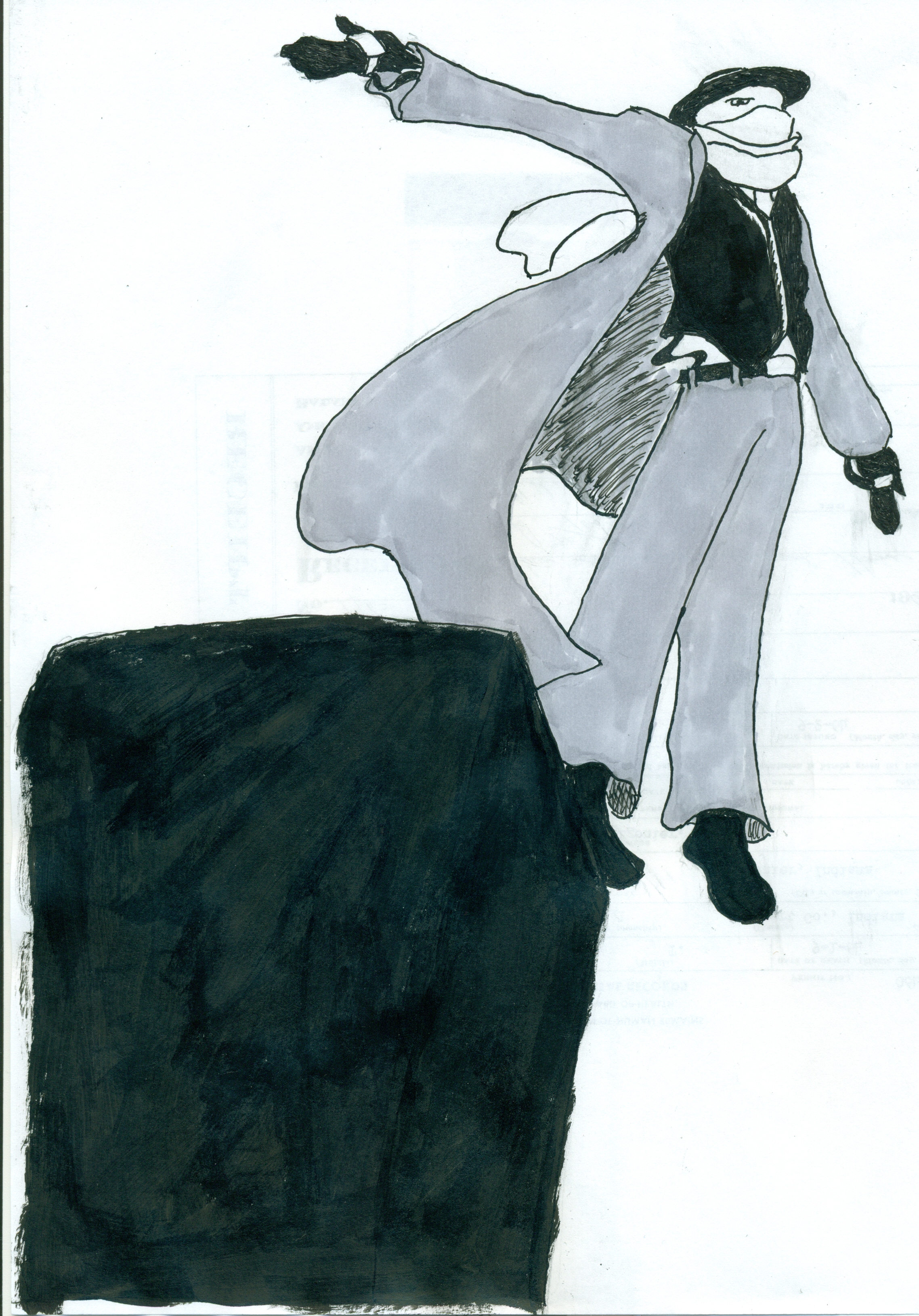
Original Art: Circuit Over Michigan Avenue

Time for another display of original art! If you’ve been following Water Fall at all you know that the Michigan Avenue Proclamation is a major plot point. If you’ve ever wondered what that looked like, wonder no longer, for the answer is here!

michiganavenue

The composition here isn’t everything I wanted it to be. The black/gray/white ratios aren’t everything I could want. I painted the concrete display case black hoping that would make the image pop better but, in the end, it’s not all I hoped. I thought about adding some tone to the background, but I was worried that would muddy the image more. Still, here it is, hope you enjoy.

Water Fall: Running Deep

Two Days After the Michigan Avenue Proclamation

Helix

It’s not something I normally go on too much about, but my boss is incredibly hot. And I don’t mean that in the sense that I would normally mean it – she’s attractive, not a great deal warmer than the environment around her. She’s got classic high cheekbones, a deft hand with makeup and a figure that could launch the siege of a large building, if not a small city. I mention this because, when I got back to the office late the next morning, it was surrounded by reporters.

I don’t think I have to say that this isn’t business as normal.

Getting out of my car I could hear them all talking and shouting at someone. I glanced over at Jack, who was climbing out of his truck a dozen parking spots away, and tilted my head. We hadn’t coordinated our arrival but that was the only thing about our entering the building that went uncoordinated. With a series of quick hand signals, half out of the book and half from a long history of working together, and Jack set off to trail blaze while I hung back to support if anything went wrong. Jack always trail blazes in crowds, in part because he’s so much bigger and more intimidating but also because he has this odd idea that I’ll take the term trailblazing too literally for anyone’s good.

So as I trailed along about twenty feet behind Jack I got a great view of him coming around the side of the building towards the doors. The moment when he spotted the crowd was truly priceless. His expression went from suspicion, since anything out of the ordinary is suspicious, to surprise, when he realized we were surrounded by reporters, to profound embarrassment, since being noticed by the public is the opposite of what we are technically supposed to do.

Someone had posted a pair of armed guards outside, which explained why the reporters were outside, and keeping a good ten feet away from the doors instead of swarming over the reception area just inside. I thought I recognized one of them as the leader of Al Massif’s tactical team. Jack peered over the crowed, clearly weighing the odds of getting through the press of press cleanly, spotted the guards and decided to make a go of it.

Not that any of the reporters paid much attention to Jack. Teresa had arrived at some earlier time and they were all clustered around her since, as I’ve said already, she’s pretty much the most eye catching thing around. Don’t ever let anyone convince you that doesn’t make a difference in how the news gets told. I decided that, given the situation, sticking closely to the normal routine of following Jack and clearing out anyone who tailed him wasn’t going to be needed and I should probably back up Teresa instead.

One thing that you have to develop in this line of work is your ability to be rude. Dealing with members of the public is a lot easier when you can keep them at arm’s length and reporters won’t take you seriously unless you spend the first five minutes trying to brush them off. Teresa comes from a background in Homeland Security so I’m sure she’d had Basic Rudeness 101 but in the few months I’ve worked with her I’ve noticed she really doesn’t rely on it much. While this probably ingratiates her to the regular people we meet, and it’s probably something we were all going to use more in the future, at the moment courtesy was just getting her mobbed by reporters who didn’t know it was time to back off.

Among the few upsides of being unusually short is the ability to sneak up on people, especially when they’re focused on someone taller than you. I got a satisfying jump out of most of the reporters when I stepped into their midst, took Teresa by the elbow and said, “Excuse me, ladies and gentlemen.” Rudeness is different from being unprofessional, after all. “Agent Herrera and I are needed inside.” I steered her towards the door and, since there is an element of fair trade in these kinds of things, kept talking as I walked. “We’re not currently cleared to say much, as I’m sure you’ve already learned. There will probably be a statement released by the Senate’s Oversight Committee on Talented Individuals within the next day or two. Contact the office of Senator Brahms Dawson, of Wisconsin, if you want more details.”

The best part about talking to reporters is they all shut up while you’re doing it, so my statement bought just enough silence to hear a repressed snort of laughter from Teresa when I set the press on Dawson’s office. It was definitely the kind of game two people could play and, as the talented field agent with seniority in the Midwest, I suspected that I’d be in for reciprocal treatment, but in the mean time I was enjoying the mental picture of Brahms Dawson being ambushed by reporters demanding a statement at every turn.

There were at least twenty or thirty reporters out front of the office that morning and, being fairly short and content free, what I had to say didn’t get us all the way in the doors. Teresa knew better than to contradict me in front of the public so she waited until the barrage of follow-up questions was cut off by the door sliding closed behind us before she asked, “Are you sure that was something you should be saying?”

“It was factual and nothing they wouldn’t know in another day or so. It also keeps them from paying too much attention to us so we might be able to move with a little more freedom, if they’re camped out front with satellite vans and cameras it’s just one more way for Circuit to try and spy on us.” Another thought occurred to me. “And in a way, it’s a good chance for the Senator.”

Teresa glanced down at me as she started up the stairs to the second floor. “In what way?”

“Think about it,” I said, gesturing back at the press that crowded around outside. “They’re going to be all over this story. In fact, they already are. When they hear about the kind of information manipulation we’ve actively engaged in over the past fifty years they’ll skip straight past asking questions and go straight to demanding blood. The one shot the Committee has at saving their skins is if they can say their piece before anyone else.”

“Haven’t seen today’s paper yet, have you?” She asked, pulling a pile of newssheet out from under one arm.

Since it was the kind of question you can answer by doing something I decided not to say anything and just take the copy of the Tribune she was offering. The front page was dedicated to the attack on Michigan Avenue. In addition to a factual account of what went on and a man on the street interview with store managers and owners talking about what the economic impact of the attack might be there was a short article below the fold. Written by the paper’s sports writer, it claimed to be an interview with the man who masterminded the attack. I only had to read a few paragraphs to decide that it wasn’t someone trying to grab credit. Only Circuit could sound so self-satisfied, even in print.

I handed the newspaper back to Teresa. “Okay, so he’s a step ahead of us there, too. At least it’s just the local paper.”

“You talking about Circuit’s latest publicity stunt?” Cheryl was coming down the hall from the other direction, a stack of printer paper in one hand. “Because it’s not just the Tribune.”

I groaned. “Please tell me you’re joking.”

“Nope.” She waved the papers she was holding back and forth. “There’s three different articles that we know of so far. These are printouts from the Indianapolis Star and the Atlanta Journal-Constitution. All your getmen are cleared to see them, along with oversight agents and anyone else you think needs to look them over.”

I gave her a blank stare.

“Right.” She sighed. “I guess information security isn’t such a big deal this time, is it?”

Teresa gently took the printouts from her. “The game’s changed, Cheryl. We’re all still working out the rules.”

“Yeah, well…” She threw her hands up. “In the mean time, I have to make sure we write down everything that happens on the way. So try and snag this guy before the paperwork backlog gets too severe, okay?”

“Will do,” I said over my shoulder, pushing through the door and onto the floor.

Our offices have never been the bustling, frantic command center you tend to see shown on TV. For one thing, we’ve never had the budget for that kind of staff. For another, we’re always short on field agents so they tend to wind up out in the field, instead of in the office most of the time. As far as I’m concerned, there’s nothing wrong with that. But it does mean that the floor is usually a lot of empty desks with one or two people filling out paperwork scattered about. Today there were no desks because the floor map was in use, but practically every available place to stand that didn’t put you on top of some part of the continental U.S. was occupied by qualified field agents.

“Busy day,” Teresa observed.

“Kind of surprising,” I said, trying to find Jack without resorting to standing on tiptoes. “The last time we went to Condition One we got out new assignments in the field.”

“Michael sent out notice that everyone should report here last night, while we were in the field.” I glanced up. Agent Samson, the only other guy in the room even close to Jack’s size, had somehow managed to sneak up on me in the crowd. He glanced at the printouts Teresa was holding and raised an eyebrow. “Good news, I hope?”

“We could use some, but this isn’t it,” I said, plucking the printouts from Teresa’s hand and passing them up to Samson. “What do you make of that?”

He made a rumbling noise in the back of his throat as he skimmed the printouts for a second, then sighed. “I saw the article in the Tribune this morning. I’m surprised he managed to reach this far in one day, but otherwise there’s nothing that surprising here.”

“What surprises me is that you’re here.” I folded my arms and gave him an appraising look. “Shouldn’t you still be on the disappearance of Dawson’s daughter?”

“We’re at Condition One,” Samson pointed out. “Why wouldn’t I be working this case?”

“Because you’re not a certified field agent anymore?” I suggested. “You’re not up on current procedure, you don’t have a tactical support team and, since we’re going to need Voorman here to handle PR as much as possible he’s not going to be able to be in the field with you full time anymore, so you don’t really have oversight, either.”

“Bob Sanders has been studying up on what I can do,” Samson said, matching my posture if not quite the level of hostility. “He actually served as oversight for me during the Michigan Avenue cleanup. Taxmen have traditionally moved without conventional tactical support, which I’m sure you know, and a lot of existing procedure is now a moot point. Helix, I’ve gotten the impression you don’t care much for me since you realized I was a talent. Part of it is probably because I didn’t slap Circuit down when I had a chance.”

I glanced down and away. “I don’t blame you for Mona’s death any more than I blame anyone who was there that night except Circuit. But you’ve been gone for over ten years just so you could preach in a run down school building. We could have used your help.”

“Yes, I figured it might be something like that.” Samson fidgeted for a moment, the sighed. “Look, Helix, when I joined Project Sumter there weren’t nearly as many problems on the scale of Open Circuit or even the Breeders that you found Coldsnap and Frostburn with. Most of my work consisted of showing up when we interacted with foreign talents to make it clear we had muscle or convincing talented people to lie about what they were, or else. I worked with the Project for six years and only had one case even close to the scale of what you’ve dealt with in the past.”

“So work on the problems with the system!” I threw my hands in the air. “I didn’t like the lying any more than you did, but I’ve been working to change things, at least when I had the time.”

He nodded approvingly. “I know. Even when I wasn’t active, Voorman passed on the occasional word about the kinds of reforms you’ve been stumping for. I’m particularly glad you managed to convince Project Sumter to share proven self control methods with the parents of younger children with dangerous talents. But,” he said, holding up a finger, “that’s something only you could have done. Between your grandparents and all those tricky cases you handled, you had a level of credibility and influence a former gangbanger who was once accused of manslaughter could ever hope to have.”

Next to me, Teresa made a surprised sound. “A gang? You?”

“MS-13,” he confirmed with a nod. “God prepares each man for his work. My history with them, and my experience here at Project Sumter, made me well equipped to deal with teens struggling with gangs, drugs or unusual abilities, or all three at once. But I couldn’t really help them find peace here. Project Sumter prioritizes the public over the individual. And Heaven knows the public needs it. But individual people need something, too, and the people of God exist to bring it to them. For a long time serving as a pastor was the best way to use my all my talents and experiences to do that.”

Ever since I could remember I’d thought of Project Sumter as the best existing method for dealing with the problems talented people presented in a democratic society. Hearing Samson say there was a better way to deal with things didn’t make me feel any better about him but I could grudgingly admit I saw his point. I wasn’t going to just then without prompting, but I could have if I’d been pressed. But I was getting uncomfortable with the direction of the conversation and we were starting to get a lot of attention from the other agents in the crowed around us, so instead I pushed us back to the original topic. “So you’re not on the Daswson case anymore?”

“Has anyone ever really considered them different cases?” Teresa asked.

“Not anyone on my team,” Samson replied. “Movsesian is at least eighty percent sure that her disappearance is related to Circuit and the only other possibility he considers likely is that she’s hiding out over a disagreement with her family.”

“She’s never gotten on that well with her dad,” Teresa said, “but I don’t think she’d drop out of sight for more than a month just because they were arguing about something.”

“And no one in her family remembers anything that could have made her that upset.” The big man shrugged his shoulders eloquently. “We’re not left with many possibilities beyond Circuit’s involvement. It’s surprising that he hasn’t tried to use Elizabeth Dawson as leverage yet, but that day may be coming in the near future. I don’t agree with Senator Dawson any more than you do, Helix, but he doesn’t deserve to have his daughter held over his head like that. And helping families who have lost track of difficult or estranged children is one of the things I do best.”

“But Circuit is way beyond anything you’ve dealt with before,” Teresa said, a note of understanding entering into her voice. “So you’re continuing to work the case on the Project’s terms.”

“And who knows?” Samson said. “Perhaps I first came to the Project in preparation for such a time as this. I just wish we knew more about how Circuit abducted her and what her current situation might be. The girl disappeared so flawlessly he might as well have made an elephant disappear right before our eyes.”

I blinked once. “Misdirection.”

“I’m sorry?” Teresa gave me a blank look, which was echoed by Samson.

“Circuit loves misdirection. Every job he’s pulled, whatever we thought his objective was turned out to be misdirection to keep us away from what he really wanted.” I turned to stare out across the map of the country, my gaze drawn to the Midwest where almost constant status updates were being projected onto the floor.

Samson moved to follow my line of sight, as if that might give him a clue what I was talking about. “Are you saying he abducted a senator’s daughter to keep us distracted?”

“I’m saying…” I pulled my eyes away from the map and looked over at Teresa. “Why would he announce he’s planning to take over the country?”

“Well, he needed publicity to help him gather-” Teresa broke off and stared at me blankly for a moment. “Are you saying taking over the country is a smoke screen for something else?”

“What could he possibly want?” Samson asked, incredulous. “World domination? Please don’t tell me people actually think that way.”

“No.” I looked back out at the map, Samson’s words of a moment ago ringing in my mind. For such a time as this. Because in the age of electronic security, the Internet and cell phones, was there ever a better time for a man with the ability to sense and alter electricity to make his mark? “He doesn’t want to rule the world. He wants to save it.”

Fiction Index
Previous Chapter
Next Chapter

Genrely Speaking: The Amateur Detective

Welcome back to Genrely Speaking, where we talk about the genres of fiction and what they mean when they’re mentioned here at Nate Chen Publications. Genres are a slipper thing, as much based on the whims of whoever is doing the classifying as any specific criteria. That also means that creating a new genre is almost as simple as saying, “this is a genre,” and then mentioning it as much as possible. If it catches on, great, if not, that’s no real loss.

Today we’re going to invent a genre.

You won’t really find much if you Google amateur detective stories, other than to find that sometimes the protagonists of detective stories are amateurs and not professionals. And in the very broad, general sense that’s true. But if you read the Gernely Speaking post on detective stories you’ll find that, when we use that term here, we’re talking about stories where the main character is a detective to the bone. A story with a protagonist who’s never solved a crime before is not what those stories want. Besides, amateur detective stories have their own standards that must be met.

What standards, exactly? Well by now you know that’s what we’re here to talk about.

  1. An amateur detective is not normally a detective, but has attributes that will prove useful in solving a mystery. Amateur detective stories are still detective stories in the end, there’s going to be some kind of mystery that needs unravelling and our protagonist is going to be leading the charge. As such, he needs to be equipped to handle the problem but not with years of experience and savvy, but rather a set of skills that will give him a unique and fresh perspective. One classic example is Miss Marple, the matronly old lady who stars in a number of Agatha Christie stories, solves problems using logic and an incredibly shrewd insight into human nature honed after years of being a benevolent busybody. Another example would be Ellis Peter’s Brother Cadfael, who is a monk who serves as apothecary to his cloister and the nearby village. As a soldier and man of learning in the dreary middle ages, Cadfael is well equipped to solve murders and has a sense of right and wrong that burdens him to do so.

  2. The amateur detective usually stumbles into his mystery by accident. Where as the protagonists in police procedurals and detective stories will often be sought out or called into an investigation, amateur detectives tend to just get swept up in the course of events. They’re in the wrong place at the wrong time, or they know someone who was, or they just have a friend who tends to fall into bad company – there’s as many excuses as there are stars in the sky, really. But, while the hero can, and perhaps should, be a man of upstanding moral character he is not, by nature, a person who seeks out and challenges injustice on a regular basis.

  3. The amateur detective survives by cunning and occasionally luck, but not skill. This doesn’t refer to how the protagonist solves his mystery but rather how he deals with the frequently manifold dangers solving a crime will present him with. Since amateur detectives aren’t used to dealing with criminals they probably hasn’t been put in significant physical danger at any point in their lives. There are possible exceptions, of course, but for the most part amateur detectives will have to get out of tight scrapes using something other than skilled gunplay or fisticuffs. In fact this wild improvisation is frequently part of their appeal to the audience.

What are the weaknesses of the amateur detective story? Unlike other detective stories you can’t write a series of amateur detective stories – at some point the protagonist’s amateurish characteristics will stop being appealing and start making them look kind of lame. Thus most of these stories have a one-and-done kind of a feel. There’s nothing wrong with that from the writing perspective but it may make your audience and/or publisher less willing to invest the time into the story – long running mystery series are some of the biggest money makers out there, they’re popular with people and thus with publishers. But people really want them to go on, not come to a stop.

And for the writer the biggest pitfall is letting too much hinge on happenstance. Your protagonist is already (most of the time) involved in the story at least partly by coincidence, and will probably need some measure of luck to survive a scrape at some point. If you let your protagonist skate by on nothing but luck your plot starts to look a little bit thin. On the other hand, take fate completely out of the equation and your protagonist may wind up looking a little too much like Batman to be believable.

What are the strengths of an amateur detective story? The biggest is simply that the protagonist is much more relatable than most in the mystery genre. Let’s face it, the average reader is not Sherlock Holmes, nor does he understand the chemical or biological sciences of an experienced CSI tech. She might get the basics of the psychology behind interviewing witnesses and tricking or forcing information out of them but there’s a good chance readers won’t be entirely comfortable with those things.

Neither will an amateur detective. This isn’t what they do, after all. As an outsider to the game of crime and punishment they are just like us. This is part of the genre’s great appeal. While everyone wants to see justice done when we are offended; few people want to actually get their hands dirty doing it. Finding the truth of a situation is often unpleasant and makes you a lot of enemies. But the amateur detective is driven by something greater than their personal comfort or satisfaction, and that is often the only thing that sets them apart from us. They can be more than a little inspiring to find, and make us want to be a little more like them. That alone makes them worth our time.

Cool Things: The Mark of Zorro

Okay, that is not actually the plot of The Mark of Zorro but from the moment they meet each other on screen you know it’s what must happen. The razor sharp intensity of Basil Rathbone as Captain Esteban and Tyrone Power as the verbose, lacksidasical Don Diego Vega could not be more at odds with one another. We see the steel under Diego’s façade  for a moment during their first meeting but the shrewd don is quick to hide his dislike for Esteban and his partner in crime, the Alcalde, or governor, Luis Quintero. Instead of public displays against the powers that be, Diego adopts the persona of El Zorro, or The Fox, and becomes one of the first superheroes to grace the silver screen.

While not equipped with superpowers in the traditional sense, or even the advantages of masked geniuses like Batman, Zorro quickly strikes fear into the heart of the corrupt officials of California and, in doing so, rode into the minds of the American people. Zorro is charming, skilled and mysterious and, while things look bleak for a time, he never looses.

You may have noticed that this post begins with a spoiler. But, if you’re at all familiar with swashbuckling films or you’re paying any attention at all to the incredible tension between these two characters you’ll quickly realize that the battle between Power’s Zorro and Rathbone’s Esteban is more than a plot point. It’s an inevitable law of nature. The two must clash, and it will be a battle for the ages.

In fact, more than anything else, it’s the power of these two actors that makes the movie something more than basic swashbuckling fare. Power depicts Zorro with such panache, such flair, such incredible ease of attitude and motion that you can’t help but believe this dashing rogue is really the most shrewd plotter and deadly swordsman in all of California. Rathbone’s signature glare, supreme self-confidence and air of constant readiness is a brilliant contrast. It feels almost as if the two start their duel from their first meeting, only escalating to actual steel when verbal barbs and crafty schemes fail to get them what they want.

Oh, there are other brilliant moments in the movie. At any moment with Zorro or Esteban on the screen, they dominate it. When they share a scene we cannot tell where to look. There literally isn’t room for both of them there, and sooner or later one of them will have to go. For a study in well crafted rivalry there really is no film better than this one (although there might be some just as  good.)

The greatest tribute to any black and white film is to say it’s still worth watching today. For most swashbucklers, even some only a decade or two old, this isn’t the case. The acting tends to be mediocre, the action dated.

It’s true that the sword battles in The Mark of Zorro could be shot better, with better cinematography or special effects. But in terms of actual sword work these two actors are peerless and they demonstrate their skill with little of the flare or embellishment you see in action movies today – there’s nothing here but pulse pounding action.

The acting, as you’ve hopefully already gathered, is incredible.

The plot is timeless. We’ve all heard this story a million times before, but we don’t care because it’s such a fundamental tale. Sure, it’s not the greatest script, but sometimes it doesn’t have to be.

The Mark of Zorro. Watch it. You won’t be disappointed.

Water Fall: Still Waters

The Day After the Michigan Avenue Proclamation 

Circuit

“This is not an exclusive interview, you understand,” I said, settling into the chair across from Terrance Martin.

“Exclusive?” Martin laughed bitterly as he shook his head and plunked his phone down between us hard enough to make me wonder if he’d need a new one. Then he slid his own chair a bit close to the table and adjusted his bulk so it sat more comfortably. “I’ve never heard of anyone blackmailing a reporter into interviewing him. Why should any other part of the interview be normal?”

“An excellent attitude to take, Mr. Martin.” I took my hat off and set it on the table beside me in an effort to be polite, although the scarf that hid my face would have to stay. Beside me Heavy Water took a chair of his own. We’d both dressed down a bit for this meeting, he went with a simple hoodie and jeans, with the hood up and a turtleneck with the neck unrolled and pulled up to hide most of his face. In addition to my scarf, I was wearing a beige overcoat and knee high waterproof boots that would conceal everything I was wearing underneath.

“I don’t know who you people are, but you look ridiculous,” he added, sitting back in his chair and glancing around the echoing lobby of the Circle Centre. There weren’t a lot of people there, by shopping mall standards, but there were still enough to create a lot of background noise. “But not as ridiculous as meeting here. I’m going to have a hard time hearing you on the recording.”

“I’m sure this interview will be memorable enough that you won’t need to consult your notes too closely.” I smiled, even though he couldn’t see it. “We’re making history, after all.”

“I’m a sports writer,” he said skeptically. “The only history I write happens on the playing field.”

“I’m well aware of your specialty,” I said with a smile. “But we did choose you for a reason and, trust me, once word of other events comes out your editor will want a part of this.”

Martin gave Heavy a skeptical look. “This guy okay?”

If he’d been expecting some kind of ethnic sympathy from Heavy he was in for a disappointment. Any shared experiences they had as African Americans were more than overwritten by hidden talent, criminal background and blood relation to a serial killer. Heavy just grunted and said, “You’d be surprised. We have something to show you.”

With that much preamble and no more, Heavy picked up Martin’s cup of coffee, popped the lid off and reached in. A second later he quickly dumped a shiny, viscous blob of steaming coffee out on the table where it trembled a bit like the world’s most bitter tasting blob of jelly. Martin jerked back with a yelp, perhaps to avoid getting scalded, then leaned back in for a closer look.

Heavy let the coffee sit there for a moment then reached out and flicked the blob with a single finger, returning the liquid to normal viscosity. It burst almost like a bubble sending coffee rushing out in all directions and causing the reporter to jerk back again, cursing this time. I grabbed some napkins and casually dropped them on the brown mess on the table, then said, “Pretty little trick, don’t you think?”

The reporter glared at Heavy. “What did you do?”

“I altered the viscosity of your coffee until it was closer to glue than caffeine,” Heavy said with a shrug. “Then I put it back to normal. Splash.”

“You…” Martin’s face scrunched up, probably reviewing high school physics that he hadn’t had to use in decades. “How is that possible?”

“Modern science tells us what’s happening, but not the mechanism by which it is accomplished. Another example.” I held my hand out palm up over the table. With a flex of my fingers I sent electricity arcing through my fingers like it was a miniature Jacob’s Ladder. It was a modification, or actually the original incarnation of, my taser rig. It wasn’t really much more than a parlor trick but in this case that was exactly what I wanted. “What you are seeing is called an unusual talent.”

He switched his attention from the sparks crawling down my hand back to me. “Seriously?”

“That’s the official term.” I snapped the current off and closed my hand. “We chose to talk to you, in part, because you’re used to seeing people with exceptional abilities.”

“Whoa. Hold up.” Martin leaned back and put his hands between us like he was trying to push me away. “There’s a huge difference between being a good athlete and having…” He gestured at my hand. “Some kind of superpowers.”

“Not a superpower,” I said quickly. “An unusual talent. We can do one thing you can’t. We’re not comic book characters. We’re real people, just like you.”

Our interviewer gave us a skeptical look. “Who hide your faces and blackmail people like you’re cut-rate villains.”

“Look, we can go back and for over this all day our you can listen to his point,” Heavy said, leaning forward just enough to make it clear he wasn’t making a request. “This isn’t about us having a couple of sweet tricks up our sleeves, it’s about equality.”

“Really?” He still looked and sounded skeptical. “How so? Your friend looks pretty well off to me.”

“Money isn’t the central issue.” I drummed my fingers on the tabletop for a second. Heavy had jumped ahead in our script but, given the direction things had been going, that was actually a good choice. Best to stick with him and catch the rest later. “Have you ever heard of people like us before? I mean outside of Greek myth or movies something like that.”

“No…” Martin said slowly. “But there are good reasons for you people to stay hidden, right?”

“Such as?”

“Well, wouldn’t you be worried about getting outed?”

“Worried about what?” I asked, keeping my tone casual. “Persecution by others? Do you realize how difficult it is for us to stay hidden?”

The reporter’s brow furrowed. “I don’t follow.”

“Think about it.” I rested an elbow on the table, careful to avoid the mess Heavy had made, and leaned in, lowering my voice and prompting Martin to match my posture to hear better. “Life isn’t like fiction. We don’t magically develop our talents in adolescence. It’s much less like athletic ability and much more like perfect pitch in that respect. Ninety nine percent of the time there’s no way to keep family members or close friends from knowing. Then there’s the shrewd folks who notice their friends always have something weird happening around them. And that doesn’t even begin to take into account the cops who have one to many strange things happen to them, the conspiracy theorists who are in the right place at the right time-”

“Wait, wait, wait.” Martin waved his had to cut me off. “Exactly how many people know about you talented folks?”

“The official government estimates, made during the 2000 Census, are that about 1 in 25 people are either talented themselves, or know someone who is. Don’t ask how they reached that conclusion, the math is kind of complicated.”

“Right. I don’t care anyways.” He shook his head. “What I want to know is, how do you guys even stay secret?”

“Ah. Well.” I leaned back in my chair and stared at the ceiling. That wasn’t in the script, but it was a good question. “It’s actually a combination of two things. Most fiction would have you believe that people pass off anything they see and don’t understand as hallucinations or something similar, they simply won’t believe anything that doesn’t fit with their way of looking at the world.”

“I notice that you don’t seem worried about that,” Martin said.

“Because it’s just not true. People want there to be fantastic abilities, that’s why there’s a million stories about people who have them – well, that and the fact we’re real and there’s at least a cultural memory of our existence.” I glanced down at the reporter and gave him the hardest look I could manage. It’s actually quite good even when you can only see half my face, I know because I practice with a mirror from time to time. “People keep the secret out of fear.”

“Fear of what?” Martin asked incredulously. “You have crazy superpowers, what’s there to be afraid of?”

“Don’t get it wrong,” Heavy said. “We can mess with a couple of laws of nature, sure, but that doesn’t mean we’re invincible. I’ve been laid up for months after getting shot. Maybe there’s one or two guys who can bounce bullets out there but, as far as I know, that’s all they can do. There’s plenty to be afraid of.”

I drummed my fingers to grab and keep Martin’s attention. “What you don’t seem to understand is, most of us don’t know just how common talented people are. So even if one of us should see some sign that another person might have a talent of their own we keep quiet. And if your son could juggle electricity and you met another man who you saw doing the same, would you approach him? What would you say when he asked you how you realized what he could do? What if he saw your son as some kind of rival?”

“I get the picture.” He gave us a meaningful look. “Not everyone with your talents is a nice person.”

“Funny, coming from you. But it’s much worse than that.” I leaned forward again and said in a softer tone, “The government doesn’t want people to know about us.  That’s the other thing that keeps us secret. We can’t use our talents for our own profit, in fact we’re not supposed to use them at all unless we’re employed by the government. We’re hounded when we do, and we can even go to jail. They’re careful to keep it all neat and kosher looking, but the real purpose is to make sure we never become known to the general public.”

Martin frowned. “I’m guessing they don’t want to cause a panic or riots or hate crimes or something like that?”

“That’s the idea,” Heavy said. “But tell me, has that ever worked? In this country or anywhere else?”

I picked up the line of thought smoothly, glad to be back to something resembling our script. “A fundamental part of our identity is being repressed right now. Significant contributions we could be making with our unique abilities are being prevented, or kept strictly in the hands of the government, supposedly for our own safety. But who does it really benefit? Project Sumter, the government’s organization for controlling talents, has the monopoly on talents who are well educated on what they can do and how they can do it safely. They use it to conduct surveillance and enforce laws in ways no one else can match.”

“One out of ten of known talents dies in accidents resulting because they don’t understand what they can do,” Heavy added. “By keeping that information to themselves The Man makes himself partly responsible for those deaths.”

Martin’s eyes widened slightly, then his skeptical expression was back in force. “Okay, that does sound bad. But any numbers you produce to support that are going to be a case of your word versus the government’s. And what do you think running a story in a newspaper is going to do about it? The Indianapolis Star isn’t even a big paper.”

“It wouldn’t be that big a help, if that’s all we did,” I said with a shrug. “You’ve seen the kind of long term differences movements that were all protest and no plan have made. Fortunately, we have something of a little more substance. We’ve already proclaimed our intention not to suffer second class citizenship in silence any longer. Now we’re beginning to act. What we need is to reach out to likeminded people, get in touch with them. A little activist journalism could go a long way in that regard.”

Marin nodded. “I could see that. Okay, what do you want to say to our readers about your intentions?”

“For now, just that we want equality, no different than anyone else in America. We’re willing to do what we need to in order to get it. You can call me Open Circuit, that was given to me by the government but it’s a name I’m not afraid to use as I stand up to them. I’m the nominal leader of our movement right now. There will be further demonstrations of what we can do with our unique talents and how we can use them to address our national problems in the coming weeks. In the mean time, we need other talents to come out of hiding and normal people to start demanding answers from the government.”

“What about this Project Sumter that you say manages your people?”

“Very hush hush,” I said, spreading my hands. “I don’t know all that much about it, other than that it is a government agency and it answers to a Senate committee chaired by Senator Brahms Dawson of Wisconsin.”

A grin broke out on Martin’s face. “Oh, really?”

“Someone to talk to when you start fact checking,” I said, letting a smile creep into my voice.

“That it is.” He reached out to pick up his phone then hesitated. “Anything else you’d like to add?”

“Not right now.” I raised an eyebrow. “Do you think your editor will want to run the story?”

“He might be persuaded,” Martin said, picking up his phone and tapping at the screen for a moment. He hesitated as he started to put it a way and gave me a nervous look. “Does it make a difference about that other thing?”

I placed a USB stick on the table between us. “This is the only existing copy of the security camera footage. It’s all yours. No repercussions even if your editor doesn’t run the story. But I don’t think that will be his decision.”

“You’re probably right,” Martin said, scooping up the stick and tucking it away. “If you want another interview just call me. I’m pretty sure we can work something out easier next time.”

“A pleasure,” I said. But Martin was already hurrying off, dialing frantically on his phone.

——–

“Was that really the only copy of the camera film?” Heavy asked, tossing his hoodie onto the bathroom sink and rolling down his shirt collar.

“It was,” I said, winding my scarf up carefully and setting it next to my coat and hat. In half an hour some enterprising soul would be pawning them or perhaps just adding them to their personal wardrobe. They no longer served any purpose for the two of us. “It was a hit and run, Heavy. Martin was well past the statute of limitations on those and, even if he wasn’t, it was a drug dealer he killed.”

“A sixteen year old drug dealer,” Heavy pointed out.

“Granted. But the chances of his being prosecuted would be small, particularly based on footage from a low quality, unmanned security camera on a warehouse that just happens to be owned by a wanted fugitive.” I unhooked the Jacob’s Ladder glove I was wearing and tucked it into the pocket of a light windbreaker I’d stuffed into the pocket of my long coat, then rolled down the sleeve of my shirt.

Heavy wasn’t planning on wearing a jacket. Between his beat-up turtleneck and my ratty flannel shirt and windbreaker we now looked like a couple of worn out blue collar workers getting off of third shift and heading home for the day. Except instead of looking tired, Heavy looked mad. “It’s not right. Kids like him get out there, slinging drugs on corners because they got nothing else.”

“I know it, Heavy.” I shrugged into the windbreaker and left the front open. “Society owed that boy something better and what it gave him was the front bumper of Terrance Martin’s car. And he didn’t even have the guts to stay there until someone could come and take the kid’s body away. Trust me, just because the world’s forgotten that kid doesn’t mean I have. We can’t afford to discredit him right now, but once Martin’s usefulness is over we’ll be in a position to do something about that.”

“You’re gonna use him and loose him, huh?”

I sighed. “That’s the world we live in, Heavy.”

“At least you’re trying for the right thing.” He shoved his hands in his pockets and slumped his shoulders, starting to look more like the exhausted, overworked manual laborers we were supposed to be. “I guess you can’t let it get to you.”

“And yet it still does,” I muttered under my breath, heading towards the restroom door. “But one day we’ll change that. One day very soon…”

Fiction Index
Previous Chapter
Next Chapter

Graveyarding

 I think I’ve mentioned once or twice the practice of sticking various story elements in my “graveyard” once I determine I’m not going to do anything more with them, at least in the form they were in originally. What sends a story to the graveyard varies, anything from writer’s block to needing extensive research to confirm details can result in this treatment. I’ve even had ideas for good scenes that just don’t fit anywhere and reluctantly found myself sending them to the graveyard. This is where many of the short stories I write come from.

And that brings me to the subject of today’s post: Graveyard management. The first thing to recognize is, when you find something that doesn’t work, killing it doesn’t mean it’s gone for good. You’re a writer, not a surgeon. You are constrained only by your imagination and vocabulary in the language of your choice. If you set something aside it’s only gone for good if you can’t remember it. So it’s less important to fret about cutting ideas you like and much more important to take solid steps to insure you remember those ideas.

So why call a file of unused stories a graveyard?

Mainly because they’re rarely going to come back as you remember them. That particular idea may be dead but you can use it as the foundation of something new, or weave multiple story ideas together creating a veritable Frankenstein’s Creature of a story. With cut and paste, we have the technology to lay the ground work for such a thing quickly. You can make it better, faster, stronger… you get the idea.

Project Sumter itself is one such creation. The characters take their cues from an old set of short stories I worked on, where Circuit was just a megalomaniac fronting a global network of technologically savvy insurrectionists, Lethal Injection was his mentor, not his first victim, and Helix was an intelligence agent who knew something was going on but had no idea what. Superpowers were something the story was supposed to explicitly reject.

Obviously, that didn’t work out.

Project Sumter, as I said a couple of weeks ago, was supposed to focus on the American Civil War. It was only when I started trying to work out all  the possible interactions of Corporal Sumter and his Confederate rivals into the existing timeline of the Civil War that I began to appreciate exactly how complicated a those stories would be. So the early phases of Project Sumter went to the graveyard.

There they bumped into the old technothriller stories and sat for a few months, stewing. The results are still playing out, but hopefully they’re enjoyable.

And that’s the beauty of the graveyard. If you properly maintain it, glancing over it every so often so that the ideas in it stay fresh, you will eventually find a home for all those stray thoughts, fun characters and snappy dialog. You don’t have to call it a graveyard, of course, you could call it the pot, the top shelf, the cutting floor, whatever you want. But if you’re going to be a writer it’s important to conserve your most important resource – the writing you’ve done. So whatever you do, don’t ever let any of it slip through your fingers!

Cool(?) Things: The 48 Laws of Power

Here in the US we’re starting to boot up our presidential election cycle, a two year political circus we endure after a very brief two year vacation. It’s about this time in the four year cycle that I revisit a book that has been very influential in my thinking and writing, Robert Greene’s The 48 Laws of Power. While not exactly ‘cool’ in the sense that it makes you go ‘wow’ or inspires you to shove it into the hands of random people on the street, this book is still a must read for anyone who intends to live in a theoretically free and democratic society like a constitutional republic.

The 48 Laws is nonfiction and, like most nonfiction, it’s pretty much what it says on the tin. Greene opens his book with an introduction to power, why people seek it and why they keep it, and offers some basic warnings to the casual reader. This is not a book of right and wrong, not a thing of moral imperatives, but a book of things people have done in the past and that have resulted in those people amassing or keeping hold of power. It then plunges into each of the 48 laws, each with a short chapter on how the law has been proven, both by people who obeyed it and prospered and those who disobeyed it and suffered, and how the law might be implemented practically. Each chapter is packed with amusing anecdotes, cautionary tales and useful memory devices. The book ends with a bibliography of sources, in case you want to delve deeper into examples of any of the laws of power you’ve just studied. The book doesn’t need to be read in any particular order, and could just serve as a handy guidebook on manipulating people.

If you’re into that kind of thing.

Greene doesn’t waste any space in The 48 Laws. Each law is quickly explained and it’s implications explored thoroughly but succinctly. A powerful person will only spend as much time as is necessary on a thing, after all. For all that, it’s very informative and engrossing. The pages are populated by historical figures, well known and obscure, who’s cunning and wisdom has ensured that they find and stand in places of power. It’s much like entering an exclusive club and finding it full of witty, gregarious people who are willing to tell you anything you want to know. They probably realize that if you can understand what they’re telling you, you’d have figured it out on your own. So why not share? They’re not around for you to bother any more.

Why read The 48 Laws of Power? For starters, it’s a great villain’s guidebook. Both Circuit and Senator Brahms Dawson, the primary antagonists in my Project Sumter stories, use gambits or adopt policies that are derived from reading this book. Of course, Helix and others also demonstrate some of the laws but they rarely do so deliberately.

There’s also a goldmine of human psychology here. You don’t have to actively seek to amass power to glean lessons about how your mind and the minds of others works and benefit from them. And, of course, as you may already realize from reading this blog, I don’t think power in itself is a bad thing. Getting power for it’s own sake will undoubtedly make one a villain and advancing the wrong causes with your power can easily do more harm than good. But simply because you’re armed with the strategies and techniques of power doesn’t make you a bad person.

And that brings me to why I’m recommending this book at this time. Politicians are all about power and manipulation. They use the laws of power frequently and shamelessly. Reading Greene’s book will ready you for those techniques and equip you to see past them and analyze what lies behind the power. Is it selfishness? An unworthy cause? A worthy one? These are things worth knowing. And once you know, well, that’s half the battle.

And that’s very cool, indeed.

Water Fall: Outpouring

Four Hours After the Michigan Avenue Proclamation

Massif

Helix finally showed his face again about twenty minutes later, coming in at the head of a procession that included Agents Herrera and Mossburger, Cheryl O’Hara and, to my astonishment, Lincoln He. Helix ignored me, yelling, “Darryl! Voorman! We need to talk!”

Hush and HiRes peeled away and went over to join their boss in the following discussion. As they did Dominic gave a strangled yelp.

“What’s wrong?” I demanded, setting my feet a little more firmly on instinct.

“You can’t see that?” He demanded, then apparently realized how silly a question that was. “They disappeared!”

“That’s normal procedure,” Coldsnap said.

“One of HiRes’ handier tricks,” Frostburn added. “Thanks to Hush they can’t be overheard and HiRes makes sure they can’t be seen or have their lips read.”

I squinted in the general direction they’d gone a moment before. The amorphous blobs of movement that indicated people shifting on their feet or passing documents back and forth were still there, although I didn’t see anything solid looking at the center of the calm zones Helix and Hush created. Weird.

I decided to keep the fact that whatever HiRes was doing wasn’t entirely effective against my talent to myself. “I’m not sure that’s really necessary,” I told Frostburn, “considering Voorman basically told us what Helix was up to half an hour ago.”

“But procedure is procedure,” she answered. “Sometimes it’s an end unto itself.”

I knew all about that but before I could explain how little I thought of it Lincoln tapped me on the shoulder. “I found Hangman,” he said, handing me a very dated looking laptop. “But I don’t know how helpful to your investigation that’s going to be.”

“Sound ominous,” I said, taking the laptop and squinting at the screen. “What am I looking at?”

“A video file uploaded by Hangman a few hours ago.” Lincoln pointed at a line of pure gibberish at the bottom of the screen, half capital letters and half random symbols or punctuation. “It looks like he scheduled this to go live about half an hour after they hit Michigan Avenue.”

I glanced at him. “How do you know about that? It shouldn’t be in the press yet and you’ve been in the Records department for the last month.”

“Just a couple of days, really,” he said absently, poking the laptop’s touchpad. “And I know about Michigan Avenue and that that’s the correlation because your friend Helix mentioned it when Cheryl showed it to him.”

The screen refreshed and the video file started playing automatically. I could make out a man dressed in a fedora, scarf and suit on the screen. He was probably talking but the volume on the computer’s speaker was turned down so low I couldn’t make anything out. “There’s a lot of junk there about overthrowing the current system and creating a more equitable arrangement for everyone,” Lincoln said, still tinkering with the laptop’s controls, “but the really interesting part is this here, at the bottom. The guy talking here-”

“That’s Circuit,” I said, still trying to process what I was seeing. “Hangman’s working with Circuit. He’s not been captured or killed by him.”

“That’s the read Helix and his analyst got, too,” Lincoln said, using that even tone people like to use when they’re explaining to someone who’s particularly slow.

“But why?” I asked, a little confused. “Circuit is already an information warfare specialist.”

“Because he’s trying to broaden his reach,” Mossman said, looking over my other shoulder with Auburn in tow. “That video is basically a recruitment speech. But prospective recruits need a way to contact him, right? That’s what this is all about.” He pointed at the same lines of text Lincoln had earlier. “These lines of code alter slightly each time the page is refreshed, depending on how many page views the video has and the local time of the terminal that’s loading the video. There’s probably more but that’s all we’ve gotten so far. We’re hoping it’s a code that tells people how to contact him.”

“Has the added benefit of screening the intelligence of prospective applicants, too,” Lincoln added.

Auburn plucked absently at her lip for a moment, then refreshed the page again. “Page views with a specific ISP,” she said, pointing at a specific part of the code. “See?”

“I didn’t think of that,” Lincoln said. “How many routers in this building?”

I handed him the laptop. “I’m not sure, but I do know this is way over my head. You people work on this, I’m going to find Bob Sanders.”

Mossburger glanced up at me. “Why?”

“Because he’s got the best contacts with the FBI in this office, and it sounds like we’re going to need them in the near future. Let me know if you find out something concrete.”

——–

Helix

“And those are the Senator’s terms,” I said, finishing my pitch to Darryl.

He nodded. “I suppose that’s the best I could have hoped for, at least for now.” I saw a fraction of the stress that had turned my one-time friend into an old man before his time bleed away. “I appreciate this, Helix.” I glanced meaningfully to my right, where Teresa was doing her best to look inconspicuous. Darryl caught my drift immediately. “And thank you, Agent Herrera. I doubt Senator Dawson would have run late to a meeting if it was just Helix calling.”

“It pays to be connected, sometimes,” she said with the hint of a smile. “Although, really, I think the Secret Service could have arranged for some of his time easily enough.”

“And really, Darryl,” I said, quirking an eyebrow. “You’re a bodyguard now?”

“The exact function of our team is… fluid at the moment.” He laughed softly. “They’ve never tried to used talented individuals as part of their approach to what they do. The Secret Service covers a lot of bases and not all talents work well in all their capacities. Just finding and recruiting the right people has been a challenge. And we’re creating an operational doctrine from the ground up.”

“But still involved in finding criminals,” Teresa noted.

The brief flicker of humor vanished. “Only Circuit, and only because he claims he’s aiming to overthrow the country. Attacks on the person of the President, the Judiciary or the Mint could all accomplish those aims.”

“Even so, when it comes to unusual talents, oversight is Sumter’s job,” I said.

“Oversight indeed,” he replied grimly.

I winced. “You know how it is, Darryl. We’ll get him, and if you want a piece of that it has to be with us.”

Darryl nodded. “Honestly, I never wanted it any other way.”

“For now, work with Mossman and the other analysts,” Teresa said, nodding back to the small huddle that had formed around Lincoln He and his laptop. “Try and get some idea of where to look for Circuit next.”

“Gladly.” Darryl started over towards the small group, cane tapping along the floor.

Voorman, who had been uncharacteristically quiet and still for the duration of the conversation, gave us a weak smile and said, “Not bad work, you two. You just got back in town today, am I right?”

I glanced at my watch. “Technically speaking, yesterday. But yes, that’s right.”

“In that case, go to home, both of you. Get some rest, I’ll be in touch with you, Agent Herrera, and let you know what the schedule is. I think there’s going to wind up being briefings every four hours, but a lot will depend on what the head office decides. Not your problem right now. I’ll be in touch.” He turned and wandered back out onto the floor, studying the updated status reports along the southeast coast.

Teresa watched him for a moment, then said, “Go on home. I’ll call you and let you know what the plan is as soon as I hear it.”

I glanced at Voorman, who was talking to Lincoln and hadn’t heard, then back again only to find Teresa had already left. I figured she wasn’t planning on heading home soon so I decided to follow her and, sure enough, she headed to her office and picked up a stack of reports. I leaned against the door frame and asked, “Are you okay?”

She glanced up, looking a little surprised to see me. “I’m sorry?”

“Look, I know the Senator has been a big help to you over the years, and you know there’s no love lost between the two of us. So,” I held up a hand. “Don’t take this the wrong way. But if I’d been through what you have, and I heard him say what he just said, I’d be upset.”

“I don’t think that’s any of your business, Helix,” she said, slowly setting the report aside.

“Teresa, when you know a Senator you don’t get much privacy.” I took one of the empty chairs in front of her desk, turned it around and straddled it. “Look, this isn’t a great time for this conversation, but I don’t think there’s ever going to be one and we need your A game here. The Senator just said there’s no free rides just because someone’s grieving and you can’t tell me your father’s death didn’t have anything to do with your decision to go into law enforcement, or to join Project Sumter.”

She glanced down and away. “Of course they did.”

“Of course.” It was an answer that said absolutely nothing that I didn’t already know. Looks like I’d have to push a little harder. “You said you know a lot about survivor’s guilt.”

“So?” A defiant expression this time, looking me right in the eye.

Step lightly, Double Helix, I thought. Now is not the time to make her mad. “So, I’m self-aware enough to understand where my guilt comes from. People like Darryl and I, it’s our job to find and stop people like Circuit. We shouldn’t have lost Mona at that school on Diversy, there’s probably a dozen things we could have done to prevent it.” I took a deep breath, reminding myself to stay on task. “Yes, I feel guilty about it. But what do you have to feel guilty about?”

Teresa’s eyes narrowed. “Helix, when was the last time you legitimately felt like you were in danger?”

“When Grandpa Wake got so made he accidentally ripped a tire off the tractor with his bare hands,” I answered promptly, smiling slightly at the memory. “I was twelve and had just gone joyriding…” I let the thought trail off. Teresa was looking at me with that blank, I-don’t-get-it kind of expression people get when I talk about my mom’s parents.

“Okay,” she said slowly. “Let me ask a different question. Was there ever a time when you didn’t feel like your talent was enough to keep you safe?”

I thought about it for a moment. “Once, when I got stranded in a freak snowstorm in Montana. There wasn’t enough ambient heat in the atmosphere to use in a meaningful way.”

Teresa nodded and leaned back in her chair. “I remember reading about that. You were still new at the time, yes?”

“Yeah. I didn’t have a solid migration schedule set up for the winter, since I couldn’t go to the Southern region and the West Coast already had two active heat sinks at the time.” I matched her relaxed posture and asked, “Is that important?”

“How did it make you feel?”

I hadn’t expected this to be my therapy session, but I figured it would be worthwhile to play along. “It wasn’t the greatest feeling, that’s for sure. But nothing happened in the end. I was really just there to interview a newly discovered talent, there wasn’t anything sinister about it.”

“But for a little while you had an idea of what the life of a normal woman is like.” She gripped the arms of her chair tightly, her gaze somewhere far away. “Empowering women is a major concern for so many people today because we’re typically physically less capable than men. Worse, we’re often singled out as the targets of people like Lethal Injection.”

There was a whole world of preconceptions there but I had a feeling they didn’t have anything to do with what Teresa was really trying to say. “Except Lethal Injection didn’t kill you, he killed your father.”

“The police say he got there just after I left for school and it might have been a kidnapping attempt gone wrong.” She shuddered slightly. “His other two cases looked much the same, from what I’ve read.”

“You think your father died instead of you.” That sure explained a lot. Teresa had never struck me as the vengeful type. Of course, Darryl never had either, but even he was showing some signs of hopefully regaining perspective with time. It had been years since Teresa’s father died and she knew that his killer was dead. Batman style revenge-on-all-criminals makes for a decent comic but there are few people in real life who have the kind of emotional stamina to carry a grudge that long, the Man From Gettysburg being a notable example.

And he was probably mentally disturbed beforehand.

But guilt? That was something that never really went away. I reached across the desk and gently took Teresa by the hands, pulled her forward so her forearms were resting on the desk and put my hands over hers. By doing so I engaged multiple senses at once, ensuring that her entire attention was on me, a technique for better engaging emotionally distraught people that we learn early in our field training. I sternly told myself that better communication was the only reason I was doing it.

“Teresa, I don’t think I’ve ever met a father worth his salt who would have been upset to die in place of his children. But that’s not what happened.” Teresa hesitated as I added the last bit and I took it as an opportunity to push on. “Lethal Injection killed more than just the three people who made the news. We think he was responsible for seven or eight murders. All middle aged men, two of them who didn’t have any daughters at all.”

Her brow furrowed slightly. “Then why… Serial killers always have a specific kind of victim they target. Why middle aged men?”

I could think of several possible answers to that, all sarcastic and probably not that useful under the circumstances. “They were all single fathers, Teresa. Most of them lost their wives or partners to an accident or some kind of illness, although I think in one case she just walked out. But they all decided to keep their kids and raise them themselves, rather than turning them over to relatives. That was the only similarity we found among them. Ethnicity, place of origin, economic background, education, there were no commonalities in those factors. You loved your dad, I take it?”

 “Yes.” Immediate and firm. “He wasn’t always as… involved as mom was before the accident, but he was always there. Even when he was still hurting from her death he took time for me.”

“We got similar statements from just about everyone child we talked to during the course of the investigation,” I said, grimacing at the memory. Even years afterwards I still felt a twinge of anger at a man who would single out a child’s last living parent and kill them. “They all had kids. They were all trying to do their best by them. We never got Lethal Injection for questioning, since he died resisting arrest, but we’re pretty sure that’s why he targeted them. There weren’t any other similarities.”

Teresa stared at me, her expression a mix of wonder and disgust. “That’s horrible.”

“More importantly.” I looked her directly in the eye for a moment and spoke each word slowly. “It means your father died because he chose to do the right thing. It wasn’t your fault. The only one to blame is a madman, and he’s dead.” I let go of her hands and leaned back, taking a deep breath and letting it out slowly. “I don’t know what Circuit wants to do, I don’t think he chose to kill Mona, it probably wasn’t intentional at all. But she was trying to do the right thing and now she’s dead. Darryl deserves the right to look Circuit in the eye and demand justice as much as you and all the other children of Lethal Injection’s victims.”

Teresa nodded. “And to do that we all need to pull our weight.”

“That’s right.” I gave a rueful smile. “Can you guess what step one of that is?”

“Getting some rest,” she said, matching my smile and raising a tired laugh. “I can take a hint, Helix.”

“Glad to hear it,” I said, dragging myself up off of my chair. “But I’m not hinting, I’m dragging. Come on.”

I took her by the arm and hauled her out of her chair. She went along with a groan but let me push her out of the office and into the hallway. She made it out of the building under her own power, smiling and occasionally shaking her head and chuckling under her breath. Outside the sky was dark, the streets were bathed in shadows from the street lamps and Circuit cast his own shadow over the future. But I could tell that, for Teresa Herrera, the darkness that had driven her to Project Sumter was finally starting to break.

It was a start. But the real work was yet to come.

Fiction Index
Previous Chapter
Next Chapter