Genrely Speaking: High Fantasy

Welcome to Genrely Speaking! Today we’re going to tackle the genre of high fantasy, a kind of story about the conflict of good and evil, the nature of humanity and formidable legions of heavy cavalry making glorious charges to save the day. Or, at least, that’s what most people think of when they think of high fantasy, probably because they’ve seen the movie versions of Tolkien’s Lord of the Rings trilogy. And in a way, they’re not wrong. The Downfall of The Lord of the Rings and the Return of the King is the definitive example of high fantasy. Tolkien codified many of the things which embody the genre today. It’s true, he based his stories on many of the epic myths he studied and taught as a professor, but stories like Beowulf don’t actually meet all the modern criteria of high fantasy. Strange, but true.

So what are the characteristics of high fantasy? I’m glad you asked!

  1. A world distinct from our own, usually existing in some kind of idealized Middle Ages, with it’s own history, geography, customs and very often peoples. There can be no cheating here. There can’t be connections between our modern world and the world of the story, or really our world at any point. The fantasy world must stand on its own, and any similarities between the two superficial at best. This first and biggest criteria is what keeps the old bardic tales from counting as high fantasy – they all supposedly happen at least in part somewhere in the world as we know it. It also rules out a lot of modern day fantasy such as The Chronicles of Narnia, which contain fully realized fantasy worlds that are visited by people from our own.

  2. An emphasis on the motivations of the character to enter into conflict, usually to protect something or achieve a moral purpose, such as redeem the family name or atone for some crime. This is what rules out a lot of “swords and sorcery” tales from the genre. High fantasy is not about mercenary warriors seeking to amass fortune or wizards delving into lost secrets so they can amass more and more power. It’s about the efforts of people to achieve something they perceive to be a noble end (whether it proves to be noble or not is part of the journey) and in doing so putting the things they value to the test. Most sources will tell you that these two things are the standards by which high fantasy is judged. However, for the purposes of this blog (which is why Genrely Speaking exists, after all) I add one other requirement, as sort of an extension of this one.

  3. The depiction of magic and the supernatural as rare, and outside the scope of everyday life. The purpose of high fantasy is to sketch the conflicts between light and dark in epic proportions. That’s easily undermined if the conflict comes down to who has the most magic mojo. At the end of the day, Sauron wasn’t defeated on the fields of Rohan, or at the walls of Gondor or the gates of Mordor. It wasn’t even because Frodo was willing to go, or Sam turned out to be a determinator made of iron. He was defeated because, decades before, Bilbo had compassion on Gollum and spared his life. Of course, without all those other people working to stall Sauron and divert his attention, it’s unlikely Frodo and Sam could have made the trip to Mount Doom. But without the compassion of Bilbo, none of the rest would have mattered. It was the unforeseen consequences of Gollum standing in the shadow of the volcano with Sam and Frodo that ultimately made Sauron’s defeat possible. In the end, that is the kind of thing that sets high fantasy apart from the rest.

What are the weaknesses of high fantasy? With all the crazy epic plots, focus on the fate of the world and themes of good and evil, it’s very easy to loose track of the individual human characters that are caught up in the whirlwind. Since no experience is really meaningful to us unless we can relate to it, that means the impact of high fantasy can be significantly weakened if not done well.

Note that this doesn’t mean there can’t be nonhuman characters in high fantasy in order for it to resonate with us. Hobbits strongly appeal to the human desire for safety and comfort, things just about everybody wants. They’re relatable, in fact much more so than some of the technically human characters, like Aragorn (how many here are born to be kings?) The importance is to keep these relatable characters in the spotlight as much as possible, while still keeping events moving as well.

What are the strengths of high fantasy? The ability to look at ugly things about ourselves from a safe vantage point. The veneer of a fantastic setting makes it easier for us to look head on at the kinds of evil that high fantasy tries to portray. While it’s very easy for the evil to become totally remote because of the fantastic skin put over it, the best writers remember to keep pointing out the potential for evil that exists in the best of us. Saruman the White and Denethor, Steward of Gondor are both excellent examples of Tolkien reminding the readers that the enemies were not orcs – it was evil. Sure, Sauron and the orcs were handy personifications of it, but the selfish cruelty they represented can easily show up everywhere.

High fantasy is a troubled genre. In many ways Tolkien, as it’s codifier, casts a shadow that people have had a hard time overcoming. Elves, dwarves and rings are all fantasy tropes that are deeply rooted in the audience’s mind. However it also has great potential as a storytelling medium, potential that is at least partly untapped. It’s worth an occasional read, at least to see where the genre is at. What works do you think embody the genre best?

Original Art: Solomon ben Gideon

As I do every so often, I come to you today to share a little piece of art from my very own pen. Today we feature Solomon ben Gideon of Terra Eternal. (He’s from this story.)

Mons0001

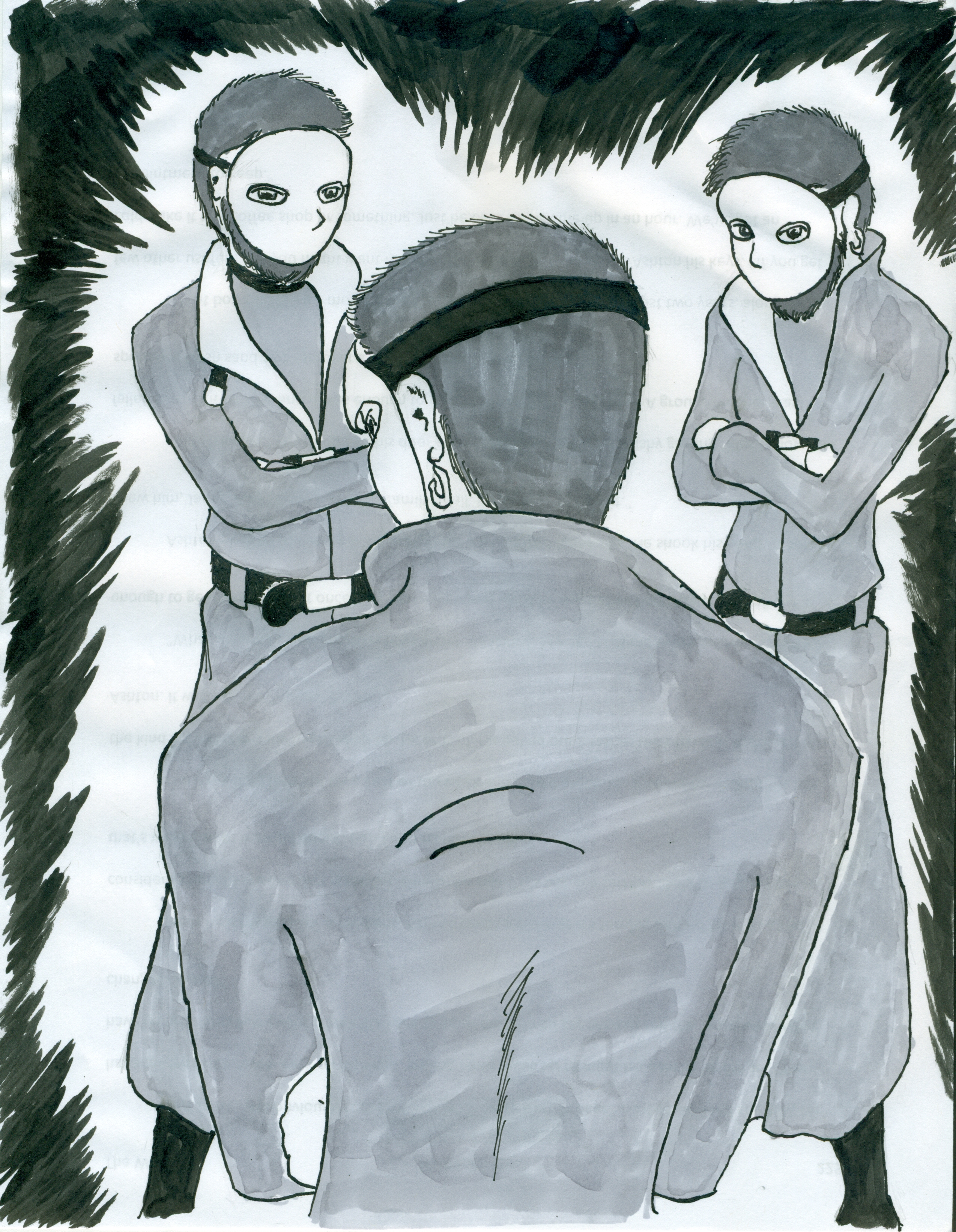
Now if you’ve read The Doyen and the Dragon you know what’s going on here – Mons is a Soul of One, a group of the same person from parallel worlds trained to work in tandem.  That’s why there’s three of him in this picture! Of course, he didn’t wear a mask in that story. The mask is saved for when they’re in public places, not out on the side of mountains. Souls of One tend to cause a stir when they show up in heavily populated areas. The masks at least mark them as official people – although in some ways that’s just as unsettling…

Anyway! As always, click the image if you want to see it larger, and remember to enjoy!


Water Fall: Cold Greetings

Six weeks, Five days before the Michigan Avenue Proclamation

Helix

We never did go to Condition One.

By all rights the fact that Circuit had killed Mona should have brought the full resources of Project Sumter to bear on the task of finding him and locking him in a fully insulated, nonmagnetic cell lit by candles. At least, such was my first instinct, and probably that of every other field agent we had.

But the reality is never so clear cut. There was just too much going in the nation and the world to take all of our resources and throw them at a single problem. That didn’t mean finding Circuit wasn’t a priority. And for the Midwest Branch, the place where things had gone bad, it was priority one. We didn’t pull every talent we had off their assignments and send them after Circuit. For example, Pastor Manuel Rodriguez, also known as Agent Samson, was looking for Senator Dawson’s daughter, a case we believed was related, but officially had nothing to do with Circuit.

But the other fourteen talents working out of the Midwest office were all called in and given a summary of Circuit’s recent activities, his know goals including those he stated when he contacted us directly a few weeks ago and those we’ve inferred from his activities, and all leads pertaining to his whereabouts, which was a very short list. Then we were all given assignments and sent back out.

Teresa and I, and Massif and Verger, pretty much kept doing the things we’d already been working on. We’d juggled this case back and forth for a few weeks already and the meeting would probably have been a complete waste of time for us if we hadn’t been the ones doing most of the presenting. Everyone else got assigned lower priority legwork to spend time on between other duties.With that thrilling morning out of the way I headed back to my desk to grab some lunch and start putting together a priority list for the various real estate dealers and developers we needed to interview.

Trouble was waiting for me.

It came in the form of two tall, cool blondes who were sitting on my desk and chatting animatedly. Their backs were to me as I approached across the floor so I slapped the presentation notes I was carrying down on my desk to get their attention. They turned inwards and glared back at me, asking in unison, “Yes?”

I ignored their eerily similar faces and said, “Hello, Frostburn. Hello, Coldsnap. Get off my desk.”

The twins looked at each other and shared a secretive smile. Frostburn, the older of the two, said, “He never changes, does he?”

“Every once and a while he gets another gray hair,” Coldsnap said. They looked back at me. “Hello, Helix.”

I crossed my arms and glared at them, which was not as easy as it had been when I was taller than they were. “You two aren’t even cleared to be in here. Thought you’d have headed home after the funeral.”

The girls finally got off my desk and faced me, their matching charcoal slacks and professional blouses making them look a good deal like actual members of the office staff, much like Cheryl O’Hara, our acting Records chief. I could also see that they had guest passes clipped on, like we give out to Senators and their staff on the rare occasions when they come for a visit. Coldsnap folded her arms across her chest, Frostburn rested her palms on the edge of my desk.

I’d known these girls for nearly a decade, ever since I talked Darryl into getting them placed with my grandparents after we rescued them from some sort of demented, Neo-Nazi breeding program. They were digging their heels in, getting ready for an argument. A part of me really, really wished they’d waited until after I got lunch. I slipped into my chair and did my best not to tap my fingers impatiently. “Okay, I get it. This is a big deal. What’s going on? I’m still trying to convince people you’re a trustworthy-”

“It’s not about a job,” Frostburn said, shaking her head.

“We’ve got a job now,” Coldsnap added, running it along just behind her sister’s sentence so it felt like they were talking as a unit, rather than separate people. “And not one in fashion retail, anymore.”

“I thought you liked that job,” I said, raising my eyebrows. It hadn’t really challenged them, but at least they knew the trends and didn’t find it boring. They’d wanted to do more, but their history created even more difficulties with the Oversight Committee than mine did. “Never mind. If it’s not about a job, why are you here?”

“Darryl,” Frostburn said, tilting her chin up and triggering a rapid fire cascaded of talk I knew all to well.

Coldsnap picked up the train of thought immediately. “He needs to do something, anything to keep his mind occupied.”

“There’s only one case of any importance right now, and we both know it,” Frostburn added. “The guy who killed his wife.”

“Hey, now,” I said, trying to stop them before they built up a head of steam. “You’re not supposed to-”

“Besides, Darryl probably isn’t going to want to work anything else,” Coldsnap said, running right over me. I should have known better than to try and interrupt them – if I’d known them as well as I do now when they got their codenames I’d have pushed to lump them together as Avalanche. “He wants to get Circuit.”

“Ask him to be on your team,” Frostburn finished. “He needs it.”

I looked at the two of them for a moment, trying to figure out their angle. They’d known Darryl just as long as they’d known me but we’d both been careful not to talk too much about our work when we’d seen them, which admittedly wasn’t that often in  the last few years. For that matter, even my grandparents, Sergeant Wake and Clear Skies, had shown a little more care in what they told them after the mess my joining the Project had turned into.

So how had they known about Circuit? “You two got a job.” I swiveled in my chair a little as I thought it over, looking at each one out of the corner of my eye. “Who gave you a job?”

They exchanged a guilty glance I’d seen a hundred times before.

“Does it matter?” Coldsnap asked, pouting a little.

“Yes.” I wasn’t buying, even if Coldsnap was really good at selling it.

Frostburn sighed. “You’re not cleared to know that.”

“I’m not cleared to know that.” I stared at first one, then the other until they broke eye contact. “Me. I have clearance up to Top Secret. There are something like a hundred and fifty codewords I’m cleared to pull from Records – including yours – and I’m not cleared to know who your employer is?”

They flinched and Coldsnap nodded. I realized my voice had risen and pulled it down to a more normal level. “Well, after seventy five years dealing talents ourselves I suppose we’re overdue for another government agency sticking it’s fingers in the pie.”

Coldsnap goggled at me. “You missed the fact that my sister had a crush on you for three years but you figured that out five minutes?”

Frostburn’s pale skin lit up like a flare and she slapped her sister’s arm so hard heads turned. “You were not-”

“And now they’re going to try and poach Darryl off of us by offering him a job where he can chase Open Circuit.” I opted to steer well clear of that other can of worms Coldsnap had just opened. “I’m guessing you’re coming here to tell me about this is not part of the recruiting plan?”

“No,” Frostburn mumbled, no longer making eye contact.

“We’re here to prove our group has a different perspective on how to deal with talented problems,” Coldsnap said, rubbing her arm. “To Darryl, not any of your agents. We’re not poaching actual talents. We kind of need experienced supervisors more than talents right now, and Darryl certainly qualifies. But honestly, Frostburn and I would rather Darryl stay here where someone like you, with a level head-” I heard a muffled laugh from the direction of Massif’s desk but we all ignored it, “-and plenty of experience, was with him rather than our team, which is new and… untested.”

“Makes sense.” I sighed and shoved my chair back from the desk, crashing into Bergstrum’s a second later. Sometimes there’s not as much room as I’d like out on the floor. “That was a good thought, girls. I appreciate knowing what you’ve just told me.”

Coldsnap perked up a bit. “Then you’ll do-”

“No.” Shocked them both for the second time in ten minutes, a personal best. “It’s not my decision, it’s Project policy. It’s good sense. And it’s for the best. I’m not pushing against this one. If some other branch of the Government wants to give him a job I’ll do what I can to keep him here. We certainly wouldn’t be the same without him. But that’s all I can do, girls. Sorry.”

A final look passed between them, another one I recognized well. They’d decided to give up on it. “If that’s the way you feel, Helix.” Frostburn put a hand on her sister’s shoulder and pulled her away. “But if you have to mention that there’s a new game in town…”

“I’ve been keeping secrets longer than you two have been alive. Don’t tell me how to do my job.” I spread my hands. “No one asks how I learn these things anymore, anyways.”

The door to the room swung open and an unfamiliar man with dark brown hair and the mother of all scowls on his face came in, a talent known as Lightning Cage following just a step behind. I smiled a little and said, “Tell Grandma and Grandpa hello for me when you get home.”

They nodded gratefully and started across the room to meet up with Cage and his sourfaced companion. They probably weren’t going home, but that was the kind of thing I was going to have to pretend I didn’t know, at least for a little bit.

“Friends of yours?” Massif asked, sliding his chair down a couple of desks to come to a rest behind Teresa’s.

“Old friends of the family,” I said.

He nodded. “Your talent?”

“Something similar.” The twins were cold spikes. While I pushed down and created places where heat could pool, spikes push upwards and heat flows out of the area, creating incredibly cold temperatures. Project Sumter had originally considered them separate abilities but it had been proven that people could do both. Most just had a natural inclination to one or the other. I knew that Massif could see some sign of what I did with his unusual vision, it made sense that he’d see something from Frostburn and Coldsnap, too.

He grunted and looked after the twins as they left. “Trying to get them a job?”

“Why, you interested in them?” I asked, drumming my fingers absently. “Professionally or personally? Neither one has had a date since Grandpa tore the tires straight off-”

“Neither one,” Massif said quickly. “Just curious if that was why I’ve still got your last trainee.”

“Oh.” Come to think of it, Amplifier had been assigned to Massif, hadn’t she? “How’s that going?”

He shrugged. “She’s a handful. But in a lot of ways it’s better than field work, so I guess I shouldn’t complain. I’m taking her out to meet with some people in the community tomorrow.”

“Well, if you need any advice with her field stress test…”

“I’m not a natural sadist like you,” Massif said. “But I’ll figure something out. The Watch is trolling for good incidents for me. What about you? They’re enough like you I assume you’ve got a fabulous idea for their stress test already picked out.”

I glanced over to where the twins were chatting with Cage and whoever the dour looking fellow was with him. They really were a lot different from when we’d first found them in a house with the corpse of a man they’d accidentally turned into an ice sculpture. Even if they could be cleared to work with the Project, they’d probably be required to undergo a “real” stress test to measure how much they’d changed. Frankly, that didn’t seem fair. “They’ve had all the testing they need for one lifetime.”

“They pass or fail?” Massif asked.

I shrugged. “Depends on who you ask.”

——–

Massif

I was still thinking about Helix and his strange friends the next day when Harriet and I picked up Amplifier and headed out towards Chinatown. The field stress test is something of a rite of passage and Helix is famous for being tough on the people he runs through it. Of the eleven talents who’ve had the unique pleasure of entering the Project with Helix as their sponsor, ten had to undergo the stress test more than once. Four had to go through it three or more times.

I got it the second time around and frankly I have no idea how anyone finds the courage for a third try.

But it looked like I was going to be sponsoring talent for Amplifier through all the really tricky portions of her application to Project Sumter and that meant, among other things, representing her to the Senate Oversight Committee, vetting her first oversight agent and putting her through a field stress test of my own design, with the decision over whether she passed or failed ultimately falling to me. Helix had been really dodgy about whether he planned to take back over and do the rest the day before, so I was guessing it was all on me. I’d done it once before, but I’ll admit that Amplifier brought a whole different dynamic to things.

“So you actually know a kung fu master?” She asked, doing her best to lean forward and make eye contact from the back seat.

“Not gung fu,” I said. “Wushu. Gung fu is like excellence, or a level of accomplishment. That’s why the old, badly translated movies would give you phrases like, ‘You don’t have enough gung fu.’ They were literally saying, ‘You’re not accomplished enough to take me on.'”

“Whatever.” She shook her head in frustration. “You know a wushu master, then.”

“Giancarlo He-sifu, to be exact,” I said. “He spotted me when I was eight and realized I had a talent. It took him a while to convince my parents studying wushu would help me with the problems that talent gave me, but I wound up learning from him eventually.”

“Giancarlo He?” I could hear disbelief in every syllable. “What kind of a code name is that?”

“It’s not,” Harriet said, whipping the car through traffic with dizzying speed. Even if the Project said she was getting too old for field work I don’t think most drivers in town would agree with them. “To the best of our knowledge, Giancarlo He is not a talent. He can just recognize them when he sees them.”

“What?” Amplifier held her hands up in a horrible imitation of a wushu stance. “Because he has mystic training?”

“That’s entirely possible,” Harriet said with a shrug. “Look at Chinese myths and culture. Superhuman people have been a part of their lore since before the Roman Empire was pulling itself up by the Greeks. Of course there’s going to be more awareness of talents built into their culture, not all those legends can pure fairy tale. And talents like Al’s both lend themselves to martial arts and require unique work arounds for people who want to survive fighting them. Wushu is a combat sport now, but it comes from a long and fairly mystical fighting tradition where talented individuals would be viewed as natural born prodigies and respected, not freaks to be feared. So of course wushu masters can spot talents.”

“That’s not to say there aren’t talents in the He family,” I added. “In fact, I think there’s a couple. But talents are weird – even the most common ones can skip whole generations sometimes. There’s nothing solid proving they’re actually genetic, and not dependent on some sort of weird environmental factor.”

“The evidence is split,” Harriet said. “Helix gets his code name because he comes from a long running family of talents. But the talent on his grandfather’s side only turned up ever other generation, while his grandmother’s side sometimes produced two or three talents a generation. When they married, their kids had no talents, then Helix popped up with his maternal grandmother’s ability. No sign of talent on the father’s side of the family. At the same time, we’ve found a pair of identical twins with the exact same talent, right down to how well they can use it. It’s strange.”

“Maybe the twins just encountered something weird at the same time?” Amplifier asked.

“No.” Harriet shook her head. “These twins were weird. A talented pedigree, just like Helix, and they were kept separate until their talents became clear at the age of six. A lot of questionable stuff went on there, but it’s a powerful argument for talents from genetics. I think it would settle things in most people’s minds if it weren’t for all the contrary cases.”

I glanced at Harriet but she was just a blur, like usual. I was wondering if that thought had been prompted by the twins who visited Helix yesterday, and if they were the same pair. But it didn’t seem like the best time to ask. “Anyway. The point is, you can’t just look at someone’s parents and guess if they’re a talent, any more than you can guess if they’re good at math.”

“It’s a clue but not confirmation,” Amp said.

“Exactly.” Harriet parked the car and we piled out. “There’s a lot of rules in the Project that protect talents, almost as many as there are to protect other people from them. One of the ones for the protection of talents says we can’t investigate people who we think have talents, only public incidents where we think a talent was used.”

“That sounds fair,” Amp replied.

“So if you really don’t want the Project to open a file on you all you have to do is avoid using your talent in public,” I said, leading the way into a small import shop and absently smoothing my shirt as I crossed the threshold, just like I’d been doing since I’d been eight. “But people like He-sifu will still find you, whether because of their training or family or whatever. And some of them act as a support network, helping curious people get answers about their talents without endangering themselves or others, getting new talents up to speed on the rules and generally keeping us all in touch with each other.”

“Little groups like the ones you started in are common enough,” Harriet said. “But knowing Mr. He and the people he can introduce you to will help you a lot more in the long run, if you plan to do this job for any length of time.”

Amplifier smiled, becoming insufferably cute. “I’ll just have to turn on the charm, then.”

“You’ll have an easier time of it than me,” I muttered.

“What’s that?”

“Is that one of my ungrateful students?” The voice came, rich and strong, from the stairs at the back of the store. The old, wooden planks creaked as Sifu made his way down them, saying, “It’s high time you came to see me again. It’s the least you could do, since you will never be bothered to pass on my teachings.”

I heaved a sigh and bowed properly from the waist. “Hello, Sifu.”

Sifu came to a stop at the bottom of the stairs. Although he only came up to my collarbone now he still felt like he towered over the whole room. Every movement screamed control and dignity, and his physique made him look much younger than his fifty years. Even with my shortsightedness I still felt like I could see him as clear as day, standing with one arm behind his back and his other hand poised to lecture. “Well. Little Mountain. You have come with more questions I suppose. Not to ask me for students, so you can finally do your duty to your sifu?”

“Just questions, Sifu.”

He studied me for a moment and then turned and started back up the stairs. “Come along then. Let me make the world clearer for you again, Little Mountain.”

Fiction Index
Previous Chapter
Next Chapter

Writing Men: An Introduction

A lot of people think that men are a simple topic. When Dave Barry wrote a book on the subject he made jokes about how no one thought he’d be able to get a whole book’s worth of material out of it. Even a lot of men share in this attitude. Sports, sex and video games are pretty much all they are shown to care about – unless power and money take the place of sports and games.

Now part of this might be because of the prevalence of sitcoms on TV, which have a tendency to reduce people to easily sketched caricatures. Dramatic television and books are a little more balanced, but even then outside the central characters there is a tendency to create men who are fairly one dimensional.

It’s true, in many ways men are simpler than women. We take a lot of pride and a lot of flack for that. However, there’s an assumption that simple because we’re dealing with one thing at a time we’re single dimensional. There’s a line to walk in properly depicting men and a skilled writer needs to learn what it is.

But, while there’s a large and growing body of study into women in literature as writers and characters, little or no study has been put into men. Some might say that’s because men are already so prevalent in stories, so isn’t it time for women to have the spotlight? But that assumes that all the portrayals of men are accurate and depict the thoughts and characters of men with all their good and bad points. That’s not a good assumption to make any more than it would be to make such an assumption about the depictions of women.

I am in no way an expert on writing or men, although I am one and that makes me better suited to speak on writing men than, say, on writing women. So what I propose is take a look on some things that I think you should keep in mind when writing for men. There’s a comic strip that runs in the local newspaper called Between Friends, a comic about  the friendship between a trio of forty-something women . My mother was surprised to find that I read and love it. But there’s nothing that’s given me more insight into women than reading a comic strip that’s written by them, for them. While the entertainment value might not be as high, hopefully in exploring what writing men means we will develop a better idea of what writing men entails for all of us. This isn’t going to be a regular even, to the extent that Genrely Speaking is, but it’s an idea that’s caught in my mind and I want to explore it with you some.

If you are a male writer, please chime in with things that you think I might have missed. If you’re a non-male writer, and something doesn’t sound right to you, by all means hash it out in the comments. It’s not possible to have a definitive set of guidelines to writing for men, but hopefully we can get a clearer picture over time.

Cool Things: The Piano Guys

I don’t talk about music much here, mainly because I rarely go out and find new stuff to listen to. I’m a classically trained musician, but I have eclectic tastes. While there are songs on the radio that I like, it’s usually on a case by case basis. There aren’t any groups I’m really fond of, at least not playing on the radio.

While The Piano Guys don’t get much radio time, they do have a very popular YouTube channel and make some of the most interesting classical music you’ve heard in a long time (assuming you’ve heard any at all.) Some might hesitate to call it “classical” but I’m not one of them. Certainly the instruments and the core of the music they draw from is classical, but like all the best artists they give the material a twist all their own.

The Piano Guys specialize in mashups, which means that they take two different (usually wildly different) pieces of music and blend them into a seamless whole. While this is a trademark of rap and techno music, where taking “samples” has long been a way of life, it’s not something that happens much with classical music, unless classical pieces are being sampled for one of the two music styles I mentioned before.

However, by taking famous classical pieces and infusing them with the rhythms of modern music, and blending the melodies, The Piano Guys prove that, even with all the cultural buzz that we’ve attached to our musical superstars these days, at it’s core music is still music, and capable of speaking to people regardless of their age or the instrument it’s played on. Michael Jackson and Mozart may not sound like a natural combination, but when Michael Meets Mozart plays you start to wonder if they were actually meant to be.

The Piano Guys isn’t just for people who love classical music. The pop music they blend in still retains all the great sound and soul that made them great songs on the radio (you can even get versions that are done with spoken lyrics.) The videos that get made to go along with the music are also well worth the checking out. Cello Wars and Rockabelle’s Cannon are two I particularly like, although I may be biased as a cellist myself.

All in all, with plenty of music available for free on YouTube and a couple of very cheap albums available through most online music retailers, The Piano Guys are at least worth checking out if you’re looking for a new take on classical music, pop music, or just mashups in general. But don’t blame me if you loose an afternoon browsing their channel. I’ll warn you now – they are addictive. If you’re not careful you may find yourself with a new favorite on you playlist.

Water Fall: Shaky Evidence

Six Weeks, Six Days before the Michigan Avenue Proclamation 

Helix

Once you dragged him out of his body armor and slapped him in a refrigerated holding room, he didn’t look like much. His codename was The Enchanter and he was a serial arsonist, believed to be responsible for six different fires, plus one more attempted, and we had technically been chasing him when Mona Templeton had gotten killed by Open Circuit. For this reason alone I was not exactly thrilled to find myself dealing with him again.

Unlike the first time we’d done this kind of thing together, I’d worked out a system for this interrogation with my boss. Senior Special Agent Teresa Herrera was about as aggressive an interrogator as I’d ever met, provided she hadn’t taken a liking to her subject, and once we had a routine worked out things went beautifully. I mostly looked intimidating and reminded him that, since we were both heat sinks, there wasn’t much he could do with what little ambient heat was in the room before I’d shut him down. Every once in a while I pressed him extra hard when I thought he wasn’t being entirely honest. Teresa did most of the work requiring patience or credibility.

Of course since the room we were in was about forty degrees Fahrenheit, and she had to wear a heavy jacket and gloves since we were basically just sitting around in it four a few hours, she couldn’t use one of her greatest assets. It’s true that thinking she was just a decorative girl to distract hardened criminals would be a mistake, but since it’s not a bad one to foster in said criminals it’s nice to be able to do that with maximum force. But even if we had gotten The Enchanter to maximum distraction and pressed him with a dozen expert interrogators I don’t think we could have gotten much farther than we had.

He just didn’t seem to know very much.

“Okay, let’s start over again,” Teresa said, standing up from her chair and pacing to the door of the room and back again. Even dressed against the cold she had to be getting stiff and a little chilly. Unlike we heat sinks, she couldn’t force the temperature of the immediate surroundings to stay at a steady, comfortable temperature and, although I was doing what I could to keep things at an even seventy five degrees in a larger area than normal, I was loosing ground steadily. It was already down to something closer to fifty five and sliding fast.

“You decided to commit a string of arsons in order to stick it to us,” she said when she got back to the table. “We are- how did you put it?”

“A symptom of the way The Man seeks to oppress anyone who’s a threat to their system.” The first time The Enchanter had said it he’d practically sprayed spit all over the table. He’d dwindled through angry yelling, snarling and had finally arrived at weary resignation. This is just one of the reasons we rake people over the coals so often, it wears them down until they can’t even remember their prepared lies and the truth slips out by accident.

“So you set a series of fires using your talent in place of normal chemical accelerants.” Teresa placed one gloved finger on an open folder sitting on the table and carefully turned the page. She’d practiced the maneuver for ten minutes beforehand just so she could do it without fumbling. “You thought this would attract our attention.”

“It did, didn’t it?” He sat up a little. “Your spies must be busy, keeping tabs on all the police and fire departments like that.”

“Believe it or not, they cooperate with us voluntarily,” I said, letting a tinge of amusement into my tone. I always think it’s funny when people assume we’re all-knowing and I knew he’d assume I was just gloating. The Enchanter was many things, but he wasn’t very bright. “We are the good guys, after all.”

“You’re a bunch of oppressors, dead set on stopping progress!” A little of the old fire was coming back as he warmed to his subject. “Worse, you’re a turn coat! You’re one of us, man. They’re stomping us down because they can’t let the little man have any power. We got to do something, make a change!”

If he had enough energy to go on another rant he had enough energy to keep lying. I glanced at Teresa and she gave the barest nod, so I goaded him a little more. “So you decided to cause a couple of million dollars of property damage and the death of a firefighter-”

“That was an accident!” He slammed his hands on the table and jumped out of his chair, forcing me to stand up too, in case he was planning on starting something. “He didn’t die in the fire, he fell when he was poking around the building afterwards. It sucks, sure, but that was part of his job, and not my fault.”

I leaned across the table, keeping my voice level with effort, and said, “There wouldn’t have been a burnt out building to investigate if you hadn’t torched it in the first place. That’s involuntary manslaughter, except we charge people with that when doing something legal. You weren’t. So maybe you get criminally negligent manslaughter, instead.”

“Have a seat, gentlemen,” Teresa said. “There’s no need for posturing.”

“Posturing?” The Enchanter asked, incredulous. “I’m the one you’re trying to paint as a villain. Don’t you remember having me shot just before I was arrested?”

I laughed, startling him, and sat back in my chair, leaning back and studying him with interest. “Now that was a true villain at work. Open Circuit. What was your beef with him, exactly?”

“I dunno what you’re talking about.” The Enchanter folded his arms across his chest and slumped in his chair.

“Let’s put it another way.” Teresa leaned in a bit with a sympathetic expression, like she was used to my confusing suspects all the time. “How did you know that there was any Project Sumter out there in the first place?”

“Oh, that all?” He waved it off. “Of course the man’s got some kind of invisible hand to keep us down, am I right? But after the first time I figured I’d better get some idea of how you worked. So I got in touch with some people.”

This time, Teresa threw me a look. While she’d mastered turning pages in gloves note taking was still my responsibility. We were being recorded, but Records is notoriously fickle about letting the recordings out into the wild once they’re in storage, so it’s best to take precautions. Information security is a much bigger deal for us than the average police station. So I made a couple of scribbles on my notepad.

“What people?” Teresa asked.

He laughed. “You think you’ve got a good handle on things don’t you? Well there’s lots of people out there who know about you and aren’t afraid to talk. They told me the important stuff. Who you guys are. Basics of not attracting too much attention when you don’t want it. The glass cannon rule. That’s one you broke.”

I grimaced. The glass cannon rule was a sort of rule of thumb most of us live by. It says that since all but a few talents were just as fragile as normal people we should refrain from using our powers to kill each other. Like most unwritten rules, participation is strictly voluntary, which is just one reason I don’t like it. Another was the stupid name, but that was thanks to the Analysis department, who get to name just about everything and has a mixed record at choosing good ones. Just look at me. But mostly, I feel living by it makes a lot of us more careless than we might otherwise be.

And technically Circuit hadn’t broken it, if you were wondering. Using a gun is fair, even if using talent is not.

“Which first time was that?” I glanced through my own files. “The arson back in late June?”

The Enchanter gave me an incredulous look. “What, you don’t remember?”

“Believe it or not, I have other things to do with my time-”

“A lot happens in our line of work,” Teresa said, cutting me off. “We might not have realized that a particular even was associated with you. That happens a lot, especially with talents that don’t have an open file yet.”

“Even the all-seeing eye has blind spots, huh?” He snorted.

“Oh, we could leave it out of your file if you prefer,” I said. “It’ll probably get assigned to one of the other heat sinks that have surfaced in the last month or two.”

“What?” The Enchanter sat up straighter. Ever since we learned he was sending notes before his arsons I’d pegged him as vain enough to want credit for what he did. It was nice to know I was right.

“Records likes that, you know,” Teresa added, seeing where I was going. “The small stuff can get credited to anyone, so long as it winds up somewhere eventually. It’s one of the prices we pay for a functioning bureaucracy.”

“It was a bank job,” The Enchanter said with pride. “It was supposed to be easy in, easy out. Because there’s no door on earth that can stop someone like us.”

He motioned first to me, then to himself. I just rolled my eyes and he took it as an invitation to continue. “Problem was, I never could get close. There was always someone there, you know, watching it. Hangman warned me it was being watched already, but it was crazy. You were there round the clock. Finally you call me and give me the riot act. Hangman tells me it was probably you guys. How did you get my number, anyway?”

“Classified,” I said, writing down the name he’d just mentioned. I wasn’t familiar with the name Hangman, so I’d have to ask an expert to see who it might be. We’d have to check the timing, but I was pretty sure there was a bank job that had Circuit’s fingerprints on it in that time frame somewhere. The man really does not like to share.

Teresa asked a few more questions before wrapping things up, but there wasn’t anything more of value to be had. We were heading back up to our desks when she asked, “How often do they know that much about the Project before we find them?”

“That much?” I thought about it. “I don’t think I’ve ever met anyone who knew much about Project Sumter without ever meeting us before. But The Enchanter basically just knew we existed, had some basic rules and are willing to enforce them. I’d say about one out of three talents we find know that much.”

“Really?” Teresa frowned. “How does the word get out? I can’t imagine they just stop in a coffee shop and get the latest gossip.”

“Actually, that might not be that far off.” I held up my notes. “He mentioned someone called Hangman.”

“Familiar name?”

“Never heard it before. But.” I held up a finger. “There are people out there who have seen things, and know enough to give new talents survival tips. Many of them don’t even have talents themselves, although like this Hangman they tend to work with codenames. They’re parents, siblings, spouses or really good friends with talents, or they’ve done a lot of research after witnessing something they shouldn’t.”

She looked a little alarmed at that. “How many people like that are there?”

“Well, we can’t require them to register or anything, so it’s really our best guess. But maybe as much as five percent of the population could fall into the category of aware, but untalented.” I shrugged. “They don’t go around talking when they shouldn’t, so we ignore them. It’s not like we could track them all even if we did have the authority to do something like that.”

“I suppose.” She absently fanned her jacket, sweating now that she was out of The Enchanter’s refrigerated cell. “How do we track down this…”

“Hangman.”

“This Hangman?”

“We don’t. I’ve never really been good at maintaining contacts in the talent community outside of work.” That earned me a bemused smile. “But we do have someone on staff who’s got his finger on the pulse. I’ll kick it over to him, and we can focus on something else.”

“Good.” She took her jacket and gloves off and tossed them into the chair by her desk. “In that case, let me get the real estate records for those buildings we’re investigating. We need to get them broken into chunks before assignments at the meeting tomorrow.”

“Oh goody,” I said, doing my best to ensure my lack of enthusiasm was obvious. “While you’re doing that, I guess I’d better leave him a note.”

“Who is in charge of keeping an eye on the talent community, anyway?”

It was my turn to smile. “Funny you should put it that way…”

——–

Massif

The evidence room is usually one of the neatest rooms in the office but since we’d just moved into this building a couple of weeks ago things hadn’t been sorted out all the way yet. And there had been a major incident not that long ago, so between getting the old stuff filed away and the new stuff logged in and cataloged, the boys down there had been pretty overworked.

Still, with all the random boxes on the floor and the desks, plus the bulky gizmos Circuit had left behind at various places in the last couple weeks and the large pieces of heat warped debris that had been pulled out of the area around the school where he’d gone toe to toe with Helix, it felt a bit like picking our way through a war zone. I passed a chunk of asphalt the size of a small table leaning against the wall. Running my fingers absently along it I could feel the ragged edge left behind by the power saw they’d used to cut it out of the road, but the road’s surface was smooth and rippled like glass. Near the center I felt fabric, stopped and leaned in for a closer look. “Is this somebody’s shoe?”

“Helix’s, yes. Hello Harriet, Agent Massif.” The voice sounded like Michael Voorman, our Senior Special Liaison. I looked about until I caught sight of a short, round fuzzy blur that could only be the man himself. No one else in the Project fidgets as much. He shuffles his feet around so much sometimes it looks almost like he’s dancing. Not that I payed that much attention to it at that moment, because he was standing next to-

“Hello Michael, how have you-”

“Senspec,” I said, sliding quickly forward, no longer caring what kind of crap was on the floor so long as none of it wound up under my feet. “Who is that?”

Voorman glanced over his shoulder, up at the strange vortex of movement that had been squashed into human form. I really can’t describe what he looked like, except to say that he seemed to pulse with pent up energy. It washed out most of his features, all I could really tell was that he was big, maybe even taller than I was, and built even wider. Something about it set my teeth on edge and nothing would have made me happier than tossing him into the special lead-lined cell where we kept the really weird stuff.

Unfortunately, Voorman burst that bubble right away. “This is Agent Samson. I’m sorry, I forgot. The Shenandoah papers suggest your two talents really don’t work well together.”

I came to a stop about four or five steps away, watching the anomaly called Samson warily. Shenandoah was the first vector shift on record, a West Point grad who fought in the Confederate Army of Tennessee, and after the war spent a fair part of his remaining years studying his own talent. His journals were the foundation for most of what we know about my talent. I’d never heard anything about people like this, though. “This is Agent Samson.”

Voorman didn’t seem to notice my repeating it. “He’s been assigned to the Dawson disappearance. But before that, we need to hand this over to someone. Harriet, I’d like you and Agent Massif to take point on it. It’s suited to your team more than anyone else we have available right now.”

“What is it?” Harriet asked, walking over and gingerly taking a seat on a big box. She was getting too old for field work, in fact she was less than six months from mandatory retirement from the field, and it was starting to show in more and more ways. Almost without thinking I slipped between her and Samson.

He knelt down by something on the ground covered by a tarp and, with a twitch of the wrist, yanked the cover away to reveal a sheet of metal that had been bent and twisted like a soda can. “I pulled this off the back of a van belonging to Open Circuit.” Samson picked it up with one hand and turned it so one edge faced towards me. “What do you make of this?”

I glanced at Harriet, who motioned me down. On closer inspection I could tell that I was looking at the rear door of a van, so Samson hadn’t been kidding about where he’d gotten it. The hand he was holding the door with glowed an unsettling white, a steady vector supporting the door’s weight in some way that didn’t really make sense. The frame of the door had split open from the force that had ripped it off the back of the vehicle and there was something inside the paneling that didn’t look right.

I ran a few fingers along the edge of it, feeling the cool, hard surface. “What is this?” I murmured. “Iron plating?”

“Basically,” Samson said. His voice was deep and surprisingly resonate, like a teacher or a politician. He set the door down and pried the crack in the frame a little wider, pointing at something inside. “See that in there?”

“No.”

“Agent Massif’s talent causes a very serious case of nearsightedness,” Harriet said, leaning on my shoulder to get a look as well. “For that matter, my eyes aren’t what they were either. What is it?”

“It’s a serial number,” Voorman said. “It matches a set of armor plates stolen from the Army several years ago.”

“Armor plates?” I looked over at Voorman. “This van was armored like a tank?”

Samson shrugged, setting off a gut-wrenching shift in vectors in the process. The man was a walking mass of momentum just waiting to go somewhere, and it made me nervous. “More like a Humvee, I think. But either way, it’s like no other van on earth.”

“So what does that have to do with us?” I asked. “It’s true that I’m about as sturdy as a tank, too, but I don’t see how that helps.”

“Here’s the thing: The van itself never turned up. That means Circuit still has it, and will probably be trying to fix it.” He rotated the door ninety degrees and pointed to the edge again. “But he’ll have  to find someone who understands damage like that.”

I ran my fingers along the side of the door once more. The edge had a hand print in it. Or more accurately, half a hand print. The other half was probably in the door frame of the van in question. “In other words, he doesn’t just need an auto shop. He needs a talented auto shop.”

“Or at least an auto shop that has dealt with a lot of talents in the past.” Harriet stood up with a grunt. “Fuseboxes could have a lot of problems with cars, I imagine. I’m sure oracles and visionaries could have problems, too. There might even be a specialty market for modifications that make it easier for talents to use cars.”

“I could see that.” Harriet and I chuckled, although the silence from Voorman and Samson suggested they didn’t get it. The way movement affects my vision makes it impossible for me to drive, so my boss gets to chauffeur me pretty much everywhere. It would take more than just custom glasses, or a windshield even, to fix my problems. But it was an interesting thought. I looked over at Voorman. “I suppose you’re saying you want us to check in with my contacts in the community at large, see if we can turn up a place that might do this kind of work?”

“Exactly.” Samson stood up and smoothed the front of his pants. “That should put you a step closer to figuring out where Circuit went after he fled Diversy Street.”

“Why would he keep the van?” I wondered, running my fingers along the surface of the armor plate absently. “Even if he gets it fixed he can’t have a bunch of doors like this just sitting around.”

“If the rest of the van is armored like this it would still be a really nice thing to have around,” Harriet pointed out.

“And he could have a bunch of doors like this just sitting around,” Samson said. “The stockpile that was stolen was enough to fully armor a dozen vehicles of that size, give or take.”

“I see. In that case he might have a mechanic already lined up where he keeps the parts. We’ll want to get our hands on those, too.” I got up and gave him a hard look. “So what’s the catch?”

Samson pulled back a bit. “I beg your pardon?”

“He’s saying, what do you want from us?” Harriet said. “You could have just filed a memo if you wanted to bring this to our attention. The only reason to show it to us yourselves is to ask us for something in return. Presumably off the record.”

“Guilty,” Voorman said with a shrug. He slid around the side of the door and came over to her. “While Elizabeth Dawson’s disappearance is creating headlines right now, and that’s good from the angle of a standard missing persons case, it does make our lives somewhat more difficult. We can’t meddle with this investigation in the same way we do with others. It simply isn’t going to fly. There’s too much scrutiny on the case.”

“No surprise there,” I said. “Pretty young daughter of a powerful man goes missing? It’s sure to be a media circus.”

“We need you to be looking for a connection between Circuit and the Dawson disappearance at the same time you’re running down everything else.” Samson dug into a pocket and pulled out a pair of business cards, handing one to me and one to Harriet. I squinted at mine, more than a little weirded out. Handing out something that had your real name on it, not a codename, just wasn’t done. Samson was a strange agent in more ways than one.

“Anything you find out, pass back to us,” he said, apparently not noticing my discomfort. Or unable to tell it from all the other discomfort he was causing.

“Especially if you can locate the van,” Voorman added. “We want to look for any signs that it was used to abduct Miss Dawson, in addition to being used in the Diversy Street escape.”

“Why aren’t there more agents working this, Michael?” Harriet asked. “It’s been years since you’ve been in the field. Even if you and Sam worked together before, it doesn’t seem like a good bet to leave it to just the two of you.”

“With the level of attention on the case, we don’t want more,” Samson said. “And I’ve been retired for years, giving the Project an added layer of protection of some reporter does start prying into me. We already have a cover story worked out.”

I tucked his business card into my pocket. “Does it have anything to do with your being a priest?”

“Pastor,” he said, the correction sounding like it came from rote practice. “And yes, it does.”

“Okay, Sam,” Harriet said. “I guess you got yourselves a couple more eyes.”

“I’ll try to get a meeting with the people I know in the community,” I said. “But I can’t guarantee I’ll find anything before the meeting tomorrow.”

“If it makes things work out faster, you have permission to skip it,” Voorman said.

I chuckled. “If I pull a stunt like that Helix will be ticked.”
He snorted. “Double Helix will just have to deal.”

Fiction Index
Previous Chapter
Next Chapter

The Great Moving Update!

Hi! Just posting a reminder that there aren’t going to be any more regular updates this week, since I’m moving across town. Hope that’s not a disappointment.

If it is, then rejoice! We are on schedule to have the usual Monday update next week. The moving process will not disrupt Water Fall’s progression any. I look forward to seeing you on Monday. Now if you’ll excuse me, I must return to what the Aeslin Mice would refer to as The Sacred Ritual of Packing All the Crap.

Water Fall: Solid Grounding

Six weeks, six days before the Michigan Avenue Proclamation 

Massif

Amplifier looked tired.

Not that there was anything surprising about that. Our physical conditioning tests aren’t meant to be easy and, unless a person was a physical fitness nut or a member of the armed forces before joining with the Project, there’s a good chance they’re going to find them challenging. So far, the Midwest’s newest recruit was showing pretty good marks on them, nothing out of the common way but enough to qualify for field training, if that’s what she wanted.

What was surprising was that I could see it. Thanks to my unique powers of vision, or lack thereof, the cues I use to judge a person’s mood are almost entirely nonvisual. Sure, you can get a general idea of how a person’s feeling by their posture, but most of the nuance is supposed to be in the face or other such subtle cues, which are totally lost on a person as nearsighted as I usually am.

Playing orientation facilitator, or whatever HR calls the people who train newbies these days, for Amplifier had been an education for me. While I didn’t have much of as standard to judge by I guessed she had what most people would call an open and expressive face, because just about every change of mood registered there. It matched the rest of her personality, from which I guessed hiding her thoughts or moods had never been a necessity in her childhood. I was thinking only child, reasonably wealthy family, but that’s not the kind of thing you talk about with people who’s personal history gets redacted by the U.S. government.

Regardless of how privileged her upbringing had been, it hadn’t kept her from building up enough stamina to complete a one mile run in a weighted vest and belt, designed to simulate the kind of gear we might carry into the field, in just under seven minutes. Not spectacular but enough to show promise, especially since it was the last in a string of exercises for the day. She sprawled out on her back by the track in the gym while I made some sloppily written notes on her evaluation sheet. “You can take off the gear if you want.”

“Thank goodness,” she said, sitting up with a grunt. Then she proceeded to strip the vest off and throw it as far as she could which, considering it weight about twelve pounds, wasn’t as far as you might expect.

I tried not to stare. One thing I never understood when I was younger was why my friends would say a girl was hot. I knew they saw something about her, but I was never sure what. Amp was proving to be an education in that respect, too. Like the fun in getting “hot and sweaty” never made any sense to me before.

“So,” she said, straightening her tank top as I tried not to notice. “What comes next?”

I grabbed onto the chance for innocent conversation. “Actually, nothing. You’re done for the day. For once, there’s not even any paperwork we need you to go over, I think Harriet got all of it from you before we started today.”

“That’s it?” She sounded incredulous. “What, isn’t the exhausting exercise supposed to be the prelude to some kind of crazy basic combat training?”

I laughed at that, not because it sounded preposterous but because I had assumed the same thing when I went through the process. “If my goal was to teach you wushu, yeah. But my sifu would have my head if I tried that, and besides it’s not part of the Project’s curriculum. We have employee safety standards we have to keep to.”

“Ah, right. Those pesky standards.” Amp glanced around, then back at me. “Then again, there’s no one here right now… I know I wouldn’t tell anyone if you wanted to hand out a few free pointers.”

“I dunno…” When I was seven I started studying wushu. My sifu, or teacher, assured my parents it would be a big help in dealing with the weird abilities I had and he was right, which was one of the only reasons I stuck with it for the first few years. The work is hard and the instructors are harder. But when I actually joined Project Sumter I discovered that being too far ahead of the game can actually get you as much trouble as being too far behind. My hand to hand instructors didn’t really like having to deal with me, and I really didn’t want to relearn a bunch of basics that didn’t mesh well with my natural talents. There was tension for a while.

“What, you think I can’t handle it?” Amp asked, breaking into my thoughts.

Everyone knows the answer to that question is always no. So I shrugged and said, “If you want. But take it easy, you really don’t look like you’re used to this kind of thing. Even if you feel fine now, I can bet you won’t later.”

“I hear you.” Amplifier followed me over to the exercise mats. “So where do we start?”

“We start with me reminding you of one very, very important thing.” I turned my body slightly so that the left side faced her. “Project Sumter does not exist to deal with ordinary people. While there are many exceptionally smart or skilled individuals in the world, what falls under our purview are people with abilities that aren’t fully documented or understood, and that allow them to behave in ways that defy sense. Kick me.”

She blinked once. “Excuse me?”

I hadn’t expected to have to say it twice. “Kick me. Any way you want.”

To her credit, Amplifier resisted the urge to hit below the belt. Instead she just picked up one leg and jammed her foot as hard as she could into my side, hitting me just above where the kidneys are. I could see the blow coming, a dull white point of focused motion, then it connected and Amp fell over backward. I quickly moved over and reached down to help her up but she waved me off, scrambling to her feet with a grunt.

“Okay,” I said, getting back to my feet as well. “What happened?”

“Shouldn’t that be my line?” Amp asked, indignant. “I have no idea!”

“Start thinking about it,” I said, brushing lightly at a make-believe bit of dust on her shoulder. With my other hand I tapped my jaw. “Now punch me.”

She gave me a look I couldn’t quite read, but from the way she punched me, getting a good windup and putting all her weight behind it, she was probably pretty mad. Either way it was a really good punch and when it connected she nearly knocked herself over again, this time spinning to one side and yanking the shoulder my hand was on away. She kept her feet only by hopping to one side a few feet and flailing her arms for balance.

“How did you do that?” She demanded.

“Tell me what you think I did and I’ll tell you if I did it or not.”

Now Amp couldn’t keep the disbelief out of her tone. “That’s stupid.”

“No.” I folded one arm behind my back and pointed one finger upward, mimicking a pose I’d seen my sifu use countless times before, I think because it was one of the few body language cues I could pick up on at first. “This is the most important part of defending yourself against other talents. There are sixty two different kinds of talents in the Project records. Some of them are very similar to each other, and learning to tell them apart is the difference between using an effective countermeasure and getting caught flat footed. Worse, if you confront an unfamiliar talent you’re going to have to be able to accurately describe it to someone else if you want to get more information on it. Learning to pay attention to the smallest details, even when the big picture makes no sense, is the most important skill a Sumter field agent can have. Now, tell me what you think I did.”

“It felt like you punched me,” she said, rubbing her shoulder. “Even though you didn’t wind up. Or move at all. It felt like you punched me in the shoulder at the same time I hit you.”

I nodded. “Not bad. That’s almost exactly what happened, and anyone familiar with vector shifts would guess that was my talent as soon as you described it. And they’d be right.”

“Vector shifts?”

“Right. It’s the ability to perceive momentum in the objects around you, and move it from one solid object you’re touching to another.” A skeptical silence met that explanation so tried a different approach. “Have you ever played pool?”

“Sure.” A shrug. “I’m not any good at it, but…”

“Have you ever seen a setup where two pool balls are touching, and a player hits one with the cue ball so that the ball it’s touching moves but the ball that was struck stays in place?” I demonstrated with my hands, holding one in place while the other illustrated the cue ball striking and the third ball flying off.

“Yeah, I’ve seen that.”

“I work on the same principle. I take momentum from one solid object.” I gestured towards her feet. “And transfer it into another.” I tapped the mat we were standing on with one foot.

Amplifier just stared at me for a minute. “You’re serious.”

“You’ve just seen me do it twice.”

“But…” She looked around in confusion, as if she expected to find a hidden camera somewhere. “Wouldn’t that mean you’re pretty much invincible?”

“Not exactly. None of us talents are, although some come closer than others.” I took a closer look at her. While they hadn’t been big hits, she had just been knocked around a bit and that after an hour or two of pretty strenuous exercise. She wasn’t fidgeting around as much as she usually did and she looked kind of deflated. So I started for the edge of the mat, talking over my shoulder. “Now it’s time for lesson number two. Most people with talents spend a lot of time thinking about how they can use them, but not a lot thinking about what kind of countermeasures people could take against them. It’s something you need to start thinking about, if you haven’t already. Based on what I’ve told you, what do you think is the best way to deal with a vector shift?”

There was a moment’s quiet as Amp thought the question over, trailing along behind me. She didn’t say anything at all until she’d gone and collected the vest she tossed aside earlier and slung it over one arm. “I guess, from the sound of things, the most straightforward thing to do would be to keep your feet off the ground. Or on something fragile, like maybe a wood floor.”

“It’s very hard to get a vector shift in the air if he doesn’t want to be there,” I said. “But you’re on the right track with the idea of bad footing. Gravel isn’t great for me, either.”

“Right, but that’s not exactly something I can count on.” She tilted her head to one side and studied me. “You said you can move momentum from one solid object to another. What would happen if I sprayed you with a fire hose?”

“It would depend on whether I saw it coming or not. But you’d probably knock me over. There’s been rumors of vector shifts that can work with liquids and gasses for years, but I’ve never met one. They’re very chaotic and hard to manipulate, if that makes any sense.” I collected my clipboard from the bench where I’d left it and gave her another look. “What made you think of it? So far as I know it’s never actually been tried before.”

She smiled. “I have the same problem in reverse. I can affect sound through air, but not liquids or solids. It moves too fast, if that makes any sense.”

Which it didn’t, but then turnabout is fair play. “Not bad. Out of the box thinking is a must if you’re going to be in the Project. Now seriously, you look like crap. Knock off for the day, take a shower and come back tomorrow.”

“Right.” She ran a hand over her face. “Will do. Should I look for you, or Helix?”

“Harriet, probably. Helix has… a meeting to get ready for. It’s actually something we’re all going to be in, but Harriet knows the most about the training process. She’s been through it more times than just about anyone else in this branch.”

“Right.” She wavered there on her feet for a second so I gave her a gentle push towards the locker room. To my surprise she jerked away and snapped, “Don’t push me around.”

“Sorry.” I held my hands up in front of my chest and backed away. “No offense meant.”

She nodded once, looking a little lost, and headed away. I watched her go, a little curious about what was going on there. But like I said, they’re good at finding stuff for me to do, too. I had just finished a quick check of the gym to make sure everything was cleared away when my boss popped her head in and yelled, “Massif!”

“Over here,” I said, waving the clipboard for her attention.

She trotted over, her voice grim. “Are you done with Amplifier’s physical tests yet?”

“Just sent her home, Harriet.” I held out the clipboard for her inspection.

“Better than normal.” She was referring to my handwriting, which is usually not that good. I didn’t think it would be great, even with the strange clearing effect Amplifier had on my vision, but it was nice to know at least some of it was because of my poor sight. “She did okay, too.”

“Not bad, I agree.”

Harriet tapped me in the chest with the clipboard. “We need to get down to Evidence. Agent Samson has something he wants to show us.”

I racked my brains for a second. “Agent Samson? Like the guy from the Bible? Supposedly ripped a city’s gates down with his bare hands? I don’t think we’ve met. Is there even someone named that in our section?”

“Not for a long while,” Harriet said. “Come on, kid. You’re about to meet a living legend.”

Fiction Index
Previous Chapter
Next Chapter

Hammering Out Your Plot: The Beat Outline

So I’ve talked about outlining once already, but I said that I would do another post on exactly what kind of outline I prefer. And here it is. I’m not going to take the time to rehash why you might want to do an outline, that’s all spelled out in the last post. If you’re curious, you can read that but I’m going to assume you’re already onboard with the whole outlining idea already.

I usually use an outlining structure I first encountered in college, when I took a class on script writing, as in, writing scripts for movies. While novels and movies are very different storytelling formats, modern novel writing needs to maintain many of the same things movies rely on – dramatic tension, narrative drive, and so forth. To help us get a grip on exactly what that entailed our prof had us work with the “beat” outline.

Any of you who are familiar with music already know what a beat is – it’s the pulse of the song, the most basic measurement of time which all the rest of your music is measured by. It’s similar for story writing, but not exactly the same. A story beat measures each point where the audience should respond. In other words, every point where you want the audience to feel something is a beat. I’ve said before that the basic purpose of writing is to provoke a reaction from the reader, and the payoff of a story needs to be in proportion to it’s length.

A longer story needs to be looking for a bigger finish. But you can’t get there all at once. You build to it little by little, or poco a poco for you musicians. The hero can’t go from loosing badly for the first sixty beats of the story to winning triumphantly for the last ten. Over time, the hero collects little things that will help him win. His enemy’s weakness, a new set of skills or allies will all give him a leg up in the final confrontation.

At the same time, you need your story to have dramatic tension. The audience needs to wonder where things are going or, at the very least, how the story is going to get to the resolution. (After all, sometimes they just know the good guys are going to win. What’s the point of a detective story if you can’t check your work?) In order to maintain that tension, it’s important to make sure your protagonists aren’t always winning, or always loosing.

As a result, the beat outline consists of two different kinds of points along the line – upbeats and downbeats. An upbeat is any point along the outline where things look good for your protagonist. This can be anything as minor as getting a cup of coffee for a pick me up or as major as important as finding Excalibur. They can also be events that show weaknesses in the antagonist, things that reveal critical flaws or just show him loosing track of something important. Downbeats are the opposite, they’re events that set back the protagonist in some way or show the antagonist as formidable or actively working against the protagonist’s goals.

Of course, by the end of the story the upbeats should slightly outweigh the downbeats, resulting in a hard earned success for the protagonist – unless you’re writing a tragedy, in which case the downbeats should win. But again, only by a very thin margin.

One of the best things about beat outlining is that it is very general. All you really need to do is come up with a list of upbeats and downbeats and put them in order. The details of a scene, who’s present and exactly how the beats play out are things you’re free to work out as they come up, and it’s very easy to rearrange things, or add and subtract scenes, if you want.

Incidentally, one of the interesting things about writing the Sumter novels is the dual nature of the protagonists – each one is the other’s antagonist. Heat Wave’s beat outline was measured as positives for each protagonist, and it was difficult to balance the beats and have the right winner come out on top. Water Fall has three narrators, and for a time I was tempted to make the beat outline a three way tug-of-war. But in the end, it was simpler to keep it a two way battle between the Project and Circuit, which will hopefully make it easier to follow the action. All in all, I’m not sure I’ve hit the right balance so far, but I know it would be a lot harder without an outline!

——–

Okay, announcement time! Next week I will be moving. It’s not a major shift, just from one place in the city to another, but it is going to eat up a lot of my time. I don’t want to leave the story dangling, so I’m going to update on Monday. But that will be the only update for the week – I’m taking Wednesday and Friday off. It’s also possible that there will be no update Monday, October 7th. We’ll just have to see how things go. I will certainly be back by Wednesday the 9th, but if you want to be absolutely sure you don’t miss a post you can always hit the subscribe or RSS links off to your and get everything published here delivered straight to you. See you around!

Cool Things: Esther Diamond

So let’s say you’re an actress living and (occasionally) working in New York City. It can be lonely, it can be demanding, it can be the time of your life. Until the woman you’re an understudy for disappears in the middle of her act! But no worries, it’s a magic act. She’s supposed to go into that box and disappear, then come back on stage a few minutes later.

Yeah, one small issue with that. Seems like this time she’s gone for good!

All that happens to Esther Diamond in Disappearing Nightly, the first book in a series that chronicles her misadventures in the Big Apple. It turns out women have been disappearing rather permanently all over the city, and the police, including the handsome Conner Lopez, are starting to get worried.

But they’re not the only ones. Doctor Maximilian Zadok is a master wizard, and he’s worried that the women aren’t just disappearing they’re actually being abducted by an evil wizard. He convinces Esther not to fill in for the missing leading lady and takes her on as a sort of girl Friday. Once you pass your third century keeping up with the times can get difficult, after all, and having a spunky young lass who’s familiar with the more technological aspects of society is nice.

In addition to the disappearances, Esther will wind up getting dragged into, or dragging Max and Conner into, incidents with Dopplegangsters, zombies, polterheists and Lithuanians. In a reversal of the usual urban fantasy set up, Esther is the only person in the primary cast with no paranormal abilities at all. Oh sure, she’s been close enough to weird goings on to spot them when things get started but she’s not in the big leagues, at least not yet.

Laura Resnick’s Esther Diamond series offers a nice blend of adventure and mystery. Each one of Esther’s stories focuses on a crime of some sort that’s been accomplished with the help of magic. Each flavor of crime is different, abduction, murder, theft, more murder, you get the picture. And each one is solved with a combination of Esther’s snooping, Max’s background information and Lopez’s meddling. (Lopez most decidedly does not believe in magic.)

While they’re not mysteries in the form of detective stories of police procedurals, they are a good time and are worth checking out if you enjoy mystery cozies with a paranormal twist.