The Doyen and The Dragon

“You know, Mons, you would think that, as a society that has discovered a way to fling the thousands of tonnes of gold and silver in a Terra Front from one fold of the world to another-“

“To say nothing of all the copper, steel and rockmelt.”

“To say nothing of them. In short, a society that can move buildings from world to world should be able to make a man a pair of boots he can use to climb a mountain without chafing his feet raw.”

Mons paused for a moment as they trudged up the side of the mountain in question. “You are still young, my doyen. They might no longer fit. Do you wish to stop for a rest?”

“What I want is a reevaluation of our priorities,” the doyen said, waving Mons on ahead of him. “We have magic enough to travel from one face of Terra to another, but we cannot solve the simple problem of cramped shoes.”

Mons resumed his hike and affected a lofty tone. “Perhaps you should apply yourself to that problem next. I’m sure the agenda of Terra Eternal shall suffer not a whit as it is put aside so that Doyen Dmitri Dostoevsky might pause and invent the Magic Boot – the universally acknowledged foundation of any civilized society.”

“Ha! That attitude is why I’m the doyen and not you,” Dmitri responded, allowing himself a slight limp now that Mons’ attention was once again focused forward.

“I remind you that many people don’t consider being a doyen a privilege.” Mons suddenly whipped around in time to catch his younger charge in mid limp. “A case in point: You frequently find yourself hiking all over unknown worlds in boots that no longer fit. We should pause for a bit.”

Mons didn’t wait for an acknowledgment, he just moved to the side of the narrow path they had been following and took a seat on a smallish boulder. Rather than squeeze in with him, Dmitri took a seat on a log that looked to be wedged in place by a pair of smaller rocks, pulled off his calf high boots and admitted, “That does feel much better.”

“Perhaps after this assignment you should look into the problem of keeping yourself supplied with the appropriate footgear,” Mons said, trying but not quite succeeding at hiding a smirk.

“Logistics is not my strong point,” Dmitri said with a shrug. “The fact that I have to draw out any teleport or sky folding matrix myself, rather than carry a pre-etched charm, is a real discouragement from learning anything in that school of magic.”

“A doyen shall not move himself from world to world,” Mons murmured, “nor take more with him than he may carry. I have to confess, even after watching you in action for over a year, I don’t understand the prohibition.”

“Can’t say as I do, either, but it’s one of the few things Locke and Goltermann agreed on, so I guess we can assume it makes sense.” He sighed and leaned back, resting his back against a larger stone behind the log. As he did, his elbow bumped into something and he turned to pick it up.

“Find something, my doyen?”

Dmitri turned the length of wood over in his hands. “Looks like part of the handle off a pickaxe.”

He passed it over to Mons, who gave the stick a glance and nodded. “We must be getting close to the mine.”

“You’re probably right. It looks like the magic is…” Dmitri pushed his sleeve up to let the bracelet on his wrist dangle freely. The copper disks there swung back and forth as if in a strong wind. He let the long sleeve slide back down and cover the bracelet again. “About half sail. The briefing said we can’t expect much more than that under this sky.”

“We should try to get there before the sun sets and the magic weakens,” Mons pointed out.

Dmitri pulled his boots back on. “Just as well. Short rests are fine, but once we’re done here we’ll actually get some relaxation in. Let’s go see what makes this mine so interesting to a herd of dragons, shall we?”

——–

Kor’aj Thrinnaeveous snapped his head around when his seeg stepped into the tent of meeting unannounced. The talk had gone so well that Thrinnaeveous had hoped to finish the day without crisis, but he should have known better. His own kor’aj had warned him that life was one continuing crisis, and the one who did not hear the crisis of the moment was simply not listening hard enough.

Still, the interruption was frustrating. Thrinnaeveous set the small silver trinket he’d been examining down and gave Seeg Rallaj his full attention. The seeg’s posture and nervous sway spoke of discomfort, and not, he suspected, because he had interrupted his kor’aj. Thrinnaeveous pulled himself up to his full height. “I listen.”

Rallaj dipped his head once in acknowledgment. “A group of humans is climbing the mountain. Their methods speak of caution, but not open hostility.”

“How many?”

“Four in all. And…” The seeg’s tail swept across the ground nervously. “Some of them are quite strange.”

To Thrinnaeveous, such a careless choice of words was strange. The differences between humans and the tribes were many and obvious. Why speak of them at all? “Strange how?”

Rallaj dipped his head once again, this time in apology. “Perhaps it is best if you saw for yourself, Kor’aj.”

With a quick bob of his head and sweep of his tail, Thrinnaeveous asked his guest to excuse him. On his way out of the tent he paused to gently bump his seeg with his shoulder, sending the younger one out first in a mild reproof. Then he stepped out into the cold mountain air and followed his seeg down the side of the peak.

——–

It turned out that they were even closer to the mine than Mons had originally suspected.

Not more than five minutes after they resumed the trek up the mountainside they were stopped short by a sound vaguely like a hunting horn, only much deeper and richer, that seemed to roll down the mountain like an avalanche. In fact, for a brief moment that’s exactly what Dmitri though was happening. The note sounded as they approached a narrow pass through a much steeper wall of rock, and as soon as it rang out the air was full of the sounds of breaking stone.

Except no rock came rolling down the mountainside. Instead, the narrow pass disappeared as the rock on either side seemed to bend inward and seal off the path entirely. As soon as that was accomplished the note faded from the air and, once the echoes had died away, the mountain seemed quiet again.

Dmitri stared at the solid rock wall for a moment, slowly relaxing his guarded stance as it became clear there wasn’t any immediate danger. “Mons.”

“My doyen?”

“I think the natives are getting restless.”

He quickly ducked the swipe Mons took at the back of his head and moved to a safer distance. “Is this really the time for that?”

Rather than rise to the bait, Mons was focusing his attention on the top of the newly formed stone wall. And why not? There was definitely something worth seeing there.

The first dragon recorded in the history of Terra Eternal was chanced upon by Veronica Locke, who took very detailed notes on how not to be eaten by one and included them in her Bestiary of Two Worlds, the revised and expanded version of which was still required reading in many institutions of higher learning. Since then, many different things had been discovered on other worlds which were at least somewhat similar, and generally classified as a dragon (although scholarly debate on that grouping continued.)

Although dragons tended to be much more different than one another than, say, dogs or horses or even humans, they all shared a few basic characteristics. They tended to be built like reptiles, although some had feathers instead of scales, they had voracious appetites and they were big.

Really, really big.

So big, early versions of Locke’s Bestiary actually devoted a page to sketches that showed a dragon with various other animals to press home just how big they were. (Later versions used the Great Clock Tower on the Throneworlds instead of animals.) When Dmitri had been told the locals were complaining of a herd of dragons he had laughed. Whether they were intelligent or stupid, it was common knowledge that dragons were too big and hungry to be able to move in groups. A herd of dragons would strip continents of food in a matter of days.

Of course, what Dmitri had forgotten in that moment, but remembered once he got out on the mountainside, was the first rule every person who crossed the horizon into a new world learned: Never laugh at the natives.

There was a trio of creatures crouching on the top of the stone wall and staring down at the two of them. The best word for them was long. Long, snakelike necks, long, powerful arms, long, sleek torsos and a long, restless tail. Almost hidden behind the rest of their bodies were short but well muscled legs. When two of them rose off their haunches and moved along the ledge of rock, spreading out in either direction, Dmitri realized they walked as much with their arms as with their legs, almost like a gorilla. From the tip of their tails to the end of their nose, Dmitri guess they couldn’t be more than ten to twelve feet long.

Dmitri tapped his chin absently and said, “Mons. I think we’ve found that herd of dragons.”

——–

The spare scrub grasses slid past Thrinnaeveous in a constant susurrus, the whispers of late autumn. If not for Rallaj’s nervousness the entire mountain would seem to be at peace. Still, a seeg did not come to his station for nothing, and Rallaj’s caution was a powerful warning and Thrinnaeveous reminded himself that he would be wise to heed it.

The tribe was already gathering at the low wall, it’s strongest voices watching over the side of the stone barrier and quietly harmonizing with the songs of the earth. Thrinnaeveous paused to rear back and dip his head to them in acknowledgement. Humans had been coming to the mountain for the last two seasons of the moon, ever since his people had arrived, this batch could very well wait long enough for him to acknowledge his kin.

With propriety observed, Thrinnaeveous loped out to the edge of the ridge to look down and see what had so excited his seeg. At first glance they were nothing more than four humans, as Rallaj had said. The size and face of one spoke of youth, not yet come into its full strength or wisdom. But young or no, he stood with a stillness and watchfulness that Thrinnaeveous knew humans often considered a mark of a listening ear and thoughtful words. He carried no weapon and wore a long cloak or coat. In fact, the garment was so long it nearly touched the tops of his boots and the sleeves covered his hands, as if saying that the man who wore the coat had no need to use his own hands.

As for the other three… Thrinaeveous looked from one to another, then back across the three again. They were dressed much like the younger man, except their sleeves were not as long. Beyond that, he saw few differences. Even their appearance… He looked once more, this time stretching his knowledge of humanity to its limits. It was hard to be entirely sure. “Their faces are identical?”

“It seemed so to me,” Rallaj answered immediately. “And every other who has seen them. I do not know what it says of them.”

Thrinnaeveous narrowed his eyes and drew a deep lungful of air, tasting the skies nervously and stretching his senses to the utmost. But no new revelation came to him. Defeated, he let the breath out in a rush. “Neither do I.”

“I listen.” Rallaj slid a half pace back and waited to follow his kor’aj’s lead.

Unfortunately, Thrinnaeveous wasn’t quite sure where they were going to go. The other humans who had come up the mountain had come under arms or making angry demands. These were simply waiting.

Then again, they were so few, and lightly armed. Two of the three identical humans carried weapons, one a spear the other a pair of odd looking swords, but it wouldn’t be enough to fight a small chorus, to say nothing of a full tribe. Hardly the approach of thinking creatures who had come looking for a fight. He pulled his head back over the ridge and looked up at Rallaj. “We shall go and hear them.”

——–

“Why do you think they’re humming?” Mons asked softly.

Dmitri wasn’t sure he would call it humming, but the deep, bone rattling sound that the dragons had been making for the last two or three minutes certainly had something in common with that kind of music. With over a dozen dragons in sight, all apparently making noise together, it was hard not to wind up thinking about it. “I think it’s a kind of magic. Except, instead of placing a sail to catch magic and syphon it storage, the sounds make a pattern that can hold the magic ready at hand.”

Mons did a double take. “You mean like power words?”

“Except I’m willing to bet they have more than a half a dozen of them. And they probably don’t have to work for years to get the pronunciation just right.” He waved a hand at the line of dragons who were singing, pacing and keeping watch all without apparent strain on their faculties. “Look at that, Mons. These dragons must have a natural affinity for sound and-“

He was cut off when two dragons suddenly dropped down the ridge in a single graceful and seemingly effortless leap. It was easily a twenty foot drop, if not more, but neither creature seemed the least put off by it as they flowed towards the two humans like some strange dun and green liquid. That alone wouldn’t have prompted Dmitri to stop, but Mons had quickly pushed him back a few steps and taken up a position between the dragons and the doyen. Dmitri suppressed a huff and watched what the dragons would do next.

What they chose to do was come to a stop about ten feet away and pull themselves up on their hind legs. With them so close at hand Dmitri was forced to increase his estimate of their size by another foot or two. Or perhaps these were just unusually large specimens. Both dragons dipped their heads down on their long, sinuous necks until they dropped lower than their shoulders, then snapped them back up again, almost like a snake preparing to strike.

Except instead of lunging forward the dragon with scales of a darker green started to talk. At first Dmitri didn’t realize that was what was happening. It wasn’t until the dragon made it’s second attempt that he recognized that the dragon was speaking a human language. The first time around the dragon had chosen a language from some phoneme he wasn’t familiar enough with to identify on hearing it. But the second time he could identify obvious shades of the twelfth phoneme, Mons’ native tongue. The third attempt was a recognizable greeting in the fourth phoneme. The dragon was apparently determined to run through languages until it found something they both spoke.

Highly unusual but not necessarily a bad thing. Dmitri waited until the dragon paused for a response, then said, “Do you speak the language of the Throneworlds?”

The creature stopped for a moment and canted its head to one side. “Little.”

Dmitri stifled a sigh and switched to his native language. “Then how about Cyrillic?”

“That is a more comfortable language for us to speak in,” the dragon said. “I am Thrinnaeveous, the Kor’aj of this tribe. I will listen to your words and speak on our behalf.”

Dmitri easily recognized a ritual greeting when he heard one. Since it seemed the polite thing to do, he did his best to match the dragon’s earlier nod with a bow and said, “I am Dmitri Dostoevsky, a Doyen of Terra Eternal. I greet you on behalf of myself and my brothers, and my father and his brothers.”

——–

Thrinnaeveous tried to pick apart the human’s greeting. He knew that humans naturally respected family, although they did not go so far as to band together into tribes as dragons did. But he wasn’t sure what this human’s father or brothers had to do with the situation at hand, if anything. By the same token, any fool could see that the earth would last forever, but what a doyen was or what it had to do with that was not something he could fathom.

Worse, it was the younger human who was speaking. Not only would a younger dragon never think of speaking before his elders, at least in matters such as these, until that moment Thrinnaeveous had assumed that the same was true for humans. Now, he was not so sure. And Dmitri had made no move to explain his strange trio of companions as of yet.

“I welcome you to this dragon’s mount,” Thrinnaeveous said, shifting his feet slightly to display his desire to get to the point. “And ask what brings you to it.”

“Simply this: It is not your mountain.” The doyen gestured to encompass the path they stood on and everything above it. “This territory belongs to the city of Lienz, in the nation of Ligare, who’s king and nobles have sworn loyalty to the Throne. You are trespassing here, and preventing the people from working the mines and enriching the kingdom.”

Thrinnaeveous shifted back a step, surprised. “No humans lived here when we arrived.”

“Of course not,” the young human replied. “They work here, but live at the foot of the mountain.”

“How can you claim land you do not live on?” Thrinnaeveous demanded.

“Whether you acknowledge our claim or not, the fact is we have made it.” He gestured back down the mountain. “I admit the Ligarans were not exactly diplomatic when they initially approached you. Perhaps if they had explained the situation before you became settled here there would have been less of a conflict.”

Thrinnaeveous dropped his hands to the ground and rested on all fours, prompting the doyen’s two armed companions to bring their weapons up, showing a surprising degree of synchronization. Rallaj slid forward and bared his teeth but Thrinnaeveous waved him back. “Dmitri Dostoevsky. My people have traveled long and hard. We have come to this mountain, who’s stone does not sing the song of our home, and now you wish us to continue on our way?” Behind them, the voices of the tribe rose in unison, their objection adding force to his words. “Where are we to find rest and a welcoming voice from the earth if not here?”

For a moment the doyen was silent, although whether he was considering what Thrinnaeveous had said or simply marveling at the chorus of dragons was not clear. “Kor’aj Thrinaeveous. I cannot say where you will find a home, or if it will be soon or far in the future. But this cannot be your home. I have a duty to the people of Lienz, to restore their livelihood to them before they are forced to leave their homes. You will not allow them to return to their mines?”

“You know as well as I that such work weakens the mountain and makes it unsafe.” The chorus shifted key and matched his derisive tone. “To allow you to undermine the mountain is to allow you to undermine our homes.”

“Then I’m sorry.” For the first time the doyen took notice of his companions, gesturing for them to lower their own weapons and line up to his left. Once they had done so, Dmitri turned his attention back to Thrinnaeveous and said, “This is Solomon ben-Gideon.”

Thrinnaeveous waited for a moment, expecting to hear the names of the rest. When the young human said nothing more he swept his neck to include all three. “Which?”

“Yes.” The three men answered as one. Thrinnaeveous jerked away as if confronted by a wolf, but the three ignored his reaction. “I am Solomon ben-Gideon. A soul of One. Thrice I have been born under different skies but now I walk the worlds as one.”

“I am impressed with what your people are capable of,” Dmitri said, once again encompassing the mountaintop with one hand, the sleeve that covered it flapping in the breeze. “But I assure you that the souls of One are capable of much more. Mons has prepared a demonstration for you, I believe.”

The doyen drew a small pendant from inside his coat and did something with it. A second later the sound of the earth and the air changed, as if a a storm had flown up the side of the mountain and was now about to break. Though Thrinnaeveous felt no wind, the cloth of their coats seemed to fill and drift as if the earth itself was exhaling beneath them. The three identical men, no, perhaps it was better to say the man who was in three places, swept an intricate pattern through the air before them, deftly avoiding one another and completing the movements in less than two full heartbeats.

The one with a spear touched it’s point to the ground and the side of the mountain shook. A great crack formed across the path, separating the humans and the dragons, and from the depths of it Thrinnaeveous could hear the sound of liquid earth roaring. As the tremors faded away the doyen called across the chasm. “Know that a threefold soul is not the greatest of the souls of One, nor are they the most dangerous weapons in our arsenal. In two weeks time, Terra Eternal will come and seal this gap. If we still find you beyond it, we will cast you from these mountains by force. Until then, Kor’aj Thrinnaeveous.”

The young human tucked away his pendant and the air fell still again. Then both he and his companion turned and walked back down the path they had come by.

Rallaj and Thrinnaeveous watched them go, then Rallaj went to the crevasse and peered into it. “This is beyond even our stone songs, Kor’aj.”

“Well said, Rallaj.” Thrinnaeveous went to stand by his seeg, joining him in his grim contemplation for a moment. Then he gently dripped his head down to be level with Rallaj’s and nudged him away from the gap. “Come. We have much to do, it seems.”

The guest from the tent of meeting was waiting for them at the top of the ridge. Like the other two, he was human, but he carried no weapons, but rather a heavy sack of trade goods. He had already packed it away, perhaps having sensed that there would be little market for what he brought now. “Quite a difficult choice your people face now, Thrinnaeveous.”

“And we must make it on our own,” he replied. “We will take no more of your time. Perhaps the people of Lienz will be more interested in your wares.”

The man set aside his heavy sack, carefully holding his long hair to one side so as to ensure it would not get tangled in the strap. Then he straightened up and fished around in the pockets of his coat until he produced a scroll. “You may be right, old dragon. But before I go, let me ask you one last thing. Have you ever heard of the Jovian League?”

——–

“You know, if they stick around they might cause more problems for whoever’s sent to evict them.” Mons looked up from the matrix he was carefully monitoring. “It’s not like the Throneworlds are likely to dispatch a group that includes a soul of One to deal with them.” He nodded his heads towards the pendant at the center of the spellwork. “To say nothing of a full blown Coretap.”

“Maybe not,” Dmitri said with a shrug. “But overestimating the opposition is just as crippling as underestimating them. In the mean time, our side will have a decent idea what to expect. I mean, a race that can create power words out of music? Can you imagine the panic that would cause if it caught you by surprise?”

“What really gets me is the way the back up was harmonizing with the lead dragon.” Mons’ heads shook in sequence, one of the weirdest gestures in his admittedly weird repertoire. “They either work on it from birth or do it intuitively. I’m not sure which possibility scares me more. They may not be able to match me for precision, but there’s far more raw power there than I’d ever like to see up close.”

Dmitri sighed and got up from the log where he’d been happily resting his feet just before their confrontation with the dragons and started pacing the path. He was fairly sure the tribe wouldn’t follow them down the mountain, but if this was going to take much longer they’d need to move further along. He wasn’t sure if the dragons were native to this face of Terra or not, but if they were there was no point revealing how they traveled from one point on the horizon to the next. “Are you still not ready, Mons?”

“Properly calibrating to the beacons can take time,” he said. “But I prefer to take that then to wildly jump to an unexplored Terra. Why, are you in a hurry?”

Dmitri shrugged. “It just wasn’t a very difficult problem. I’m ready to move on.”

“And let the other shoe drop in someone else’s lap?” Mons asked teasingly.

“If your worries become a problem, I deal with it then.” Dmitri shrugged. “In the mean time, there’s fifty two worlds that offer fealty to the Throne, and only five doyen to smooth out the problems that come with all that implies. There’s still plenty for us to do.”

“Always so serious,” Mons said. But it was gentle and good natured, not teasing or sarcastic. “Well, then I suppose we should move on.”

The spell he had been holding collapsed in on itself, and the horizon line bent until it seemed it would swallow them. Then, as soon as it had happened it all snapped back into place. And with that, they were gone.
Fiction Index

Portfolio Diversity

A week from next Monday marks the end of the Nate Chen Summer Short Story Extravaganza, that wacky event where I write short stories until all our eyeballs bleed and hope somebody reads them (and I know from my stats and likes that some of you are, for which you have my thanks.) The first and last of these stories are Project Sumter tales, beginning with #63 at the end of June and ending with Trial By Winter, coming week after next.

But in between I’ve chosen to highlight three other flavors of story that I’ve had bouncing around in my head.

Stories of the Divided Future and the Weavers of the Heartland are based on things I’ve written before I started on Project Sumter, which was actually something of a whim that occurred to me last Spring after I finished reading most of Mark Waid’s Irredeemable. In fact, my first full length novel focused on the Weavers of the Heartland. Maybe someday I’ll get that published in some format…

Endless Horizons is of more recent vintage, like Project Sumter. In fact, they arose just about the same time and, just like Sumter, incorporated aspects of other stories that I had not found a good use for yet. Hopefully all that will come to light in due time.

So why go to all this trouble to get exposure for all these different stories? Don’t authors usually stick to one or two kinds of stories once they get started?

Well, for one thing, I’m not really “started” yet. I have a small readership on a blog in a busy section of the Internet. It’s not like I have a hard, fast profile to keep to yet. Branding is important to a writer, but right now I’m still looking for something that will give enough exposure that branding matters.

But more than that, once I do have a large readership I’d like to have the reputation of writer who writes lots of different kinds of stories. I like writing about Circuit, Helix and the strange slew of people that you could theoretically call their friends, but I’ve also loved sci-fi and fantasy since I was a kid, and most of all, as a writer, there are a lot of different genres out there that I’ve enjoyed reading and would like to write in.

So I hope to keep writing a lot of different stuff, and I hope you’ll keep reading it. I’m still feeling all this out, as you’ll quickly witness next Monday. I had originally intended to introduce Endless Horizons with a couple of short stories from what I like to call The Legend of Veronica Locke. Unfortunately, I made a common mistake and started the story at the beginning. This is because I wanted to produce two short stories that could stand alone and also make sense together, kind of like the many short stories in I, Robot. After a lot of work, I decided this week that it’s just not working. The Valley of the Shadow of Dagon turns out to be a chunk of a larger story, but something that’s not quite a novel. Consider it a teaser for a project that will hopefully be continued at some point in the future. In the mean time, on Monday we’re going to hop around the time stream a bit and look at something entirely different, but still under the same sky.

I also hope you’ll check back in a few weeks for the beginning of Water Fall, the next Project Sumter novel. I say a few weeks, as I currently plan to take a week off between Trial by Winter and the first chapter of Water Fall, to work ahead a little and hopefully finish a manuscript that I’ll be marketing for publication. The kind that comes with actual payment. (*gasp*) More on that as it plays out! See you next week.

Cool Things: Twelve Angry Men

One of the benchmarks for art is it’s ability to remain relevant to changing times. Twelve Angry Men is one such film (at least, the 1957 version, I haven’t seen the remake.)

The premise: A murder has been committed. The victim: A man from the wrong side of the tracks. The accused: The victim’s 18 year old son, who was heard shouting at his father only hours before the murder. This… is not their story. Rather, this is the story of the twelve men who must convict or acquit the accused. Is there enough evidence to say with certainty that the man killed his father? If so, he will go to the chair. Is there doubt in their minds? They must let him free. Do they even feel the need to take the time to debate what seems to be an airtight case? After all, this is one of those people from that neighborhood.

As it turns out, only one juror, Number 8 (Henry Fonda), feels the need to say anything at all. But sometimes, that’s all it takes.

Twelve Angry Men is not a film about justice in the way we usually understand them. It doesn’t focus on the person who was wronged or the person who did the wronging. Rather, it sits down and takes a hard look at how we deal with both groups of people. It’s a film about truth and shades of gray, but at the same time it doesn’t say there is no truth but rather that we have to acknowledge both the truth and our difficulties in finding it by doing something we don’t like to talk about today – judging. Through out the film, the jurors carefully judge evidence, witnesses, the accused, the victim and even each other in order to arrive at their final verdict.

Many films (both today and even in the era of black and white) act as if there are only two groups of people in the world: People who see the world in black and white and look for right and wrong everywhere, and people who see the world as shades of gray with no right or wrong anywhere. Twelve Angry Men is a film about people who think there’s probably something like right and wrong, but have to deal with sifting through all the gray to get there. And the gray is more than just rather tenuous, morally questionable situations. This is real stuff.

What obscures justice isn’t contrived situations of philosophical arguments. It’s punishing heat. It’s grating people in the seat next to you. It’s a pair of tickets to the next big ballgame, which you’d rather be watching then being here (or really, most other places.) It’s personal prejudices, grudges or just a desire to see the immediate surroundings in harmony. It’s not like the jurors don’t think there’s a right or wrong, they just don’t see what it has to do with this situation here.

But in the end, a young man’s life hangs in the balance.

In the end, the integrity of twelve men rests on judging the case rightly. And, in turn, they will determine whether their society will do justice by that young man and his father, who is now dead and buried. When they leave that courthouse, there will be no cheering crowds, no newspaper headlines and, from the looks of things, no unshakable, life long friendships.

What there will be is a sense that justice might not be so far away after all.

The Valley of the Shadow of Dagon

The Valley of Dagon’s Disapproval was not exactly what Veronica had been expecting. Of course, no one under the age of fifteen had ever been there, supposedly, although some of the older children talked about sneaking out there at night, but just enough failed to come back from such expeditions to make such trips, and the stories that went with them, very rare. What Veronica found there didn’t resemble any of those stories anyway. Even in her addled state, she could see enough to realize most of those stories were told by people who had never been to the place in person.

There weren’t rolling banks of fog oozing over the edge of the Valley, nor did jagged stone line the cliffs on the northern side like the teeth of a great beast. The ground did not rumble with the hunger of the god that dwelt within. It looked just like any other valley around the province, a strip of dry, low laying land full of scrub that clung to the sides of cliffs for dear life.

It looked totally innocuous. Even standing on the cliff’s edge and looking down at the stony floor of the Valley, Veronica could see no sign of its long history as the seat of Dagon. They did not give her long to look over the Valley before they threw her over the edge. When she figured that when she reached the bottom  what the Valley looked like wouldn’t matter so much anymore.

But the Valley wasn’t out of surprises for her yet. Almost as soon as the hands had left her back and her feet had left the cliff she felt the change. For just a moment the sky seemed to flex and bend, Veronica felt like she was being turned inside out. Then, as quickly as it came, it was gone. After that, she would have been hard pressed to say what exactly happened next. There was a brief glimpse of a vast expanse of bright blue, very different from the gray overcast skies a moment before, then something solid whacked her in the back of the legs and sent her tumbling.

Veronica went spinning through the air for a heart stopping second, then slammed roughly onto a a steep, grassy slope and rolled, scrabbling frantically for purchase. She had just enough time to realize that a river had somehow managed sneak into the bottom of the Valley where it hadn’t been two seconds ago before she rolled into it.

In three seconds the biggest problem in her life had gone from being unable to fly to being unable to swim.

The current of the river probably would have swept her away entirely if it hadn’t first slammed her into the pylon holding up the bridge. By this point, Veronica was well and truly sick of slamming into things but, since she had expected her life to end with a much more violent encounter with the ground five seconds ago, in many ways it was a step up. Of course, she didn’t have much time to be philosophical about it just then. What she did manage to do was grab hold of the rough wood and clung to it for dear life.

For just a moment she held perfectly still and tried to gather her wits. She was, unsurprisingly, at the bottom of a valley. But instead of the dry desert floor, scoured by the passing of many rains, the ground was covered in thick, green grass that ran down to the river. She was clinging to the side of a strange, patchwork bridge that looked like it had been sewn together by giants and dropped into the river from the sky. The idea made her giggle.

She was laughing so hard that she didn’t realize people were running across the bridge until one of them had shimmied down the column next to her and started yelling at her. “Oi, lass! Don’t just stare, grab me broom!”

At that moment the words didn’t mean much to her, but the intent behind his pushing a long pole with bristles at one end was clear. Veronica shifted her grip on the beam she was clinging to and grabbed clumsily for broom. The morning’s several falls, plus whatever was in that drink she’d been given before being taken to the Valley that morning, had left her quite dizzy and a little giddy. She did manage to grab hold eventually, and the man dragged her over and looped a rope around her waist. In a matter of moments she had been hoisted out of the water and into a crowd of half a dozen men of various ages, who all looked at her and muttered to one another incomprehensibly.

The man with the broom came climbing up the side of the bridge and threw himself over the railing with a final huff. For a moment he just stood there, brushing water out of his clothes and tsking. For some reason, instead of just splashing water around and leaving his clothes wrinkled, the action actually sent sheets of water running from them until, a few seconds later he was quite dry. The image was so funny Veronica found herself giggling again.

The men on the bridge, and Veronica noticed that they were all men and they were almost all armed with hammers, saws and other tools of the carpentry trade, clustered around her and started to babble at her incoherently. The man who had climbed down the bridge earlier waved them back, saying, “Break it up, boys. No call to all be hovering over her like a flock of vultures. Now,” he knelt down and gave her a quick lookover. “Who are you, lass?”

For the first time, Veronica noticed a few things. First, he didn’t have his broom thing anymore. Guiltily, she wondered if he had dropped it in the river trying to save her. She had no idea what such a thing might be used for, or if it was valuable. Second, if she listened closely, she could tell that this man was speaking the same language as everyone else, but for some reason he made sense when the other men didn’t. Third, everyone was dressed strangely but his clothes were strangest of all.

All the men were wearing loose fitting pants, a kind of clothing she’d thought only the wealthy wore – and she’d never met any wealthy carpenters. And their tunics were worn tucked into the pants, which struck her as a very hot way to dress. Her rescuer looked even more overloaded with clothes. His pants were cut off at knee length and some sort of close fitting cloth tubes were pulled over his feet and calves. He wore something that looked like sandals with closed toes and heels on his feet, just like everyone else, but he also wore what looked to be a leather cloak over it all except, instead of simple holes for his arms it had sleeves like a tunic. A weird kind of bag with a stiff brim slouched on his head. She would have though he would sweat to death except she was beginning to realize that it was actually much colder here than she had expected it to be. And she was beginning to suspect that wherever she was, she was a very long way from the Valley of Dagon’s Disapproval.

One of the carpenters said something to the now-broomless man, the only person on the bridge other than Veronica who wasn’t carrying something that looked vaguely carpenteresque. He took the strange bag off of his head and scratched his hair. “I don’t know. It looks like she’s been drugged.”

More strange talk, although Veronica knew enough to recognize a question when she heard one. Then the man said, “I can see she can’t be more than ten. Just because I can tell she’s been drugged doesn’t mean I know why, or what to do about it. Maybe-”

“Who are you?” Veronica asked, swaying dangerously as took a step closer to him. “Why is it so cold?”

He stared at Veronica for a minute, then slumped. He had great round cheeks that looked something like a pomegranate and even they seemed to wilt a bit. “Great. She’s not from around here, is she? Did anyone understand that?” No is recognizable in any language, and it was the first local word Veronica picked up. After hearing it a half a dozen times it would be hard not to. The man turned back to her. “Sorry, lass. I can’t understand you.”

She shook her head in dismay. “That’s not how talking works!” For a moment she planted her hands on her hips and braced her feet, just like she’d seen her mother do a dozen times and like she had often done with her younger brothers and sisters. She quickly regretted it because the wind stole the warmth from her like a greedy dog after meat. She quickly wrapped her arms around her middle and hunched against the cold, muttering, “If you can say the words you can understand the words.”

He sighed and said, “That’s not the way the gift works.”

This time, Veronica did her best to listen to what he was saying. The words weren’t familiar but somehow she was understanding them. That made picking out one to repeat fairly easy. “Gift?”

One of the other men said something and the leader, since that was what her rescuer looked to be, turned and irritably said, “Thank you, Franz. Why don’t you boys get back to work and let me handle this? She can’t understand what you’re saying anyway.” For all his chubby cheeks and slight build, the burly carpenters were apparently willing to take his orders because they went back to one end of the bridge with little protest and started to work. The leader sighed and reached into his coat, pulling out a folded blanket that looked like it had seen better days. Veronica had no idea where he had been keeping it. “Here,” he said, shaking it loose, “Wrap yourself up or the cold will be the death of you.”

Veronica eyed the blanket and backed away a step. So far she had been given over to Dagon, thrown off a cliff, nearly drowned in a river that hadn’t been there the day before and dragged out by strange men who couldn’t understand her. She wasn’t going to be brushed off by someone who thought getting dressed meant pulling a bag over your ears! Taking extra care to make sure it was pronounced right, she slowly said, “Gift?”

“That’s right. It’s one of me gifts, always being understood no matter where I go or who I talk to.” He held the blanket out for another moment, then sighed and folded it over one knee and looked her in the eye. “But I can’t understand other people the same way. When I was given the gifts, the Queen told me it was to make sure I was paying attention to the people I served. You see, I’m what you call a dustman. And that’s me name.”

“Dustman,” she said slowly, rolling the word over her tongue and trying it out.

“That’s right. I’ve got me broom.” He reached into a kind of pouch sewn into the side of his cloak and, even though the stitching that held the pouch in place barely looked big enough to hold his hand, he managed to pull the long bristled pole out of it in a single fluid motion. Veronica stared in disbelief, but the Dustman apparently didn’t notice. Or, it would occur to her later, he was used to it. “Of course, a broom ain’t much good without a dustbin, is it guv?” He stood and reached back to whack a round metal can with a fitted lid, setting it rattling. “Take it all together and what do you get? Your humble servant, the Dustman, here to cart off those things you no longer want.”

Veronica couldn’t quite suppress a grimace at the thought that his being there was particularly apt, in that case. Fortunately, he misinterpreted the gesture and quickly swept a few steps closer. “Why, it don’t even matter what it is you’re stuck with. Water?” He brushed a hand across one shoulder and, just like before, the water seemed to flee from his touch, running out of her clothes and onto the bridge in small streams. “Let old Dusty take care of it for you. Dirt on your clothes?”

He backed up a step and somehow produced a strange looking and admittedly filthy tunic from somewhere inside his cloak. The edges looked tasseled, except the threads of the tassel were woven into intricate designs. The Dustman fingered the strange tassels along the left sleeve. “Why, just look at this lace! A dozen washings and it will never come clean! Your dustman takes just such refuse away!”

He snapped the garment once and it released a cloud of dirt which, instead of settling on the ground, drifted over and seemed to melt into his leather cloak. The tunic now looked completely clean and, with a flourish, the Dustman slipped it up his sleeve with no regard for the fact that it really shouldn’t fit there. “It doesn’t matter the kind of mess you have on your hands. To be a dustman is to serve. And to serve, we’re given the gifts. Oh, there’s more than just a few of them.” He shrugged. “But they all help us do our job.” A flicker of something sad flashed across his face. “They help me, I suppose. And they keep me honest. So you can understand me, but I have to work to understand you, see?”

He thumped one hand on the railing of the bridge. “I can carry any kind of junk as far as I need to, however I like, and it will never make me tired, no matter how big it is.” The lid of his metal can lifted slightly and Veronica caught a glimpse of three heads, a goat, a lion and a lizard, all poking out from under it, before the Dustman quickly stretched his other hand out and hammered the lid back down. “Or how contrary it feels about it. But,” he picked the blanket up from the ground where he’d set it, “I cannot take anything a person actually needs.”

Then he held the blanket out to her again. “And I can’t keep it if I find someone else who does.”

Veronica took the blanket hesitantly and wrapped it around her shoulders. It wasn’t much but, now that she was dry, it was an improvement. She looked up at him and thought about what he had just said, and what his gift had told her it meant. She wasn’t sure she trusted it. The only other people who she’d seen capable of things like what he did were the priests of Dagon. At least, she had heard them speaking in other tongues, she didn’t know if they could stick long poles into their belt pouches. It didn’t seem like something priests would need much.

And the priests of Dagon were not people she loved overmuch. On the other hand, if these people didn’t speak her language, what were the chances they knew who Dagon was, or would care that she was under his censure? And what’s more, the priests never gave anything away. That, more than anything else, made up her mind. Once again she did her best to repeat the word correctly. “Honest.”

The Dustman grinned and patted her on the shoulder. “Glad to hear it. Now, maybe we should get you into town and some food in your stomach. You don’t look like you’ve eaten properly in a long time.”

Veronica just shrugged. Six mouths to feed was a lot, no one in her family had eaten well in some time. She was a bit suspicious of this Dustman still, but she figured she could work for her food as well as anyone else, and what more could they really want from her? At the very least, it had to be better than being sent to-

A commotion at the end of the bridge distracted her. A new man had arrived. Like the Dustman, he wore a long, brown cloak with sleeves, but it looked more ornate. At least, it had a belt and a few other strange attachments to it that the Dustman’s did not. But any ideas Veronica had about their being related vanished as soon as the man started across the bridge. He was saying something in a loud voice that carried without crossing the line into shouting, but he clearly didn’t have the Dustman’s gifts because Veronica had no idea what he was saying.

At least, not until he got closer and the last sentence in his speech included one word Veronica had hoped to never hear again.

“Dagon.”

Fiction Index

The Fantastic

It’s a strange word, no?

When you first hear it you probably think of it as a compliment. It means a performance that someone loved, and would want to see again. Something that sets you above the crowd, something that you absolutely loved.

Or at least, that’s one of the meanings. However, according to Merriam Webster, at it’s core it refers to something grounded in pure fantasy or something so extreme as to beggar belief. Something so eccentric that no one would ever expect to find it in their lifetime, or the lifetime of anyone else.

In genre terms, fantasy is a part of science fiction. I don’t agree with that (and sooner or later we’ll cover why, genrely speaking) but there is definitely some overlap.

However, if science fiction serves to illustrate the nature, weaknesses and strengths of human ideas, fantasy serves to illustrate the nature, weaknesses and strengths of humanity itself. There’s all kinds of subgenres in fantasy. High fantasy, low fantasy, political fantasy, urban fantasy, Harry Potteresque, most webcomics, most of the offerings of DC and Marvel publishing, the list goes on. However, one thing unites them:

Once you’ve finished a truly outstanding specimen you will sit back, totally sated, and think to yourself, “That was fantastic.”

There is nothing so extreme, so eccentric, so drenched in personality as the fantasy story. It’s no wonder David Eddings claims that fantasy writers crank out better stories, everything about fantasy is about pushing the limits to bring you the sharpest, best defined stories possible. Fantasy stories sometimes take the trappings of sci-fi, as in James Cameron’s Avatar, one of the things that contributes to the confusion between the two so-called genres. (The opposite can happen as well, sci-fi sometimes hides in the disguise of a fantasy tale.) But at their core, they’re about different things.

So if you’re going to write a fantasy story it has to have, at its core, something truly fantastic. And it can’t be something that market research shows is going to get a fantastic reception from the public, it has to be something you find fantastic or the story just isn’t going to come together. As an example, no matter how popular they are no vampire story I write is going to sell well. I just don’t like them for far too many reasons to go into in here. While vampires are hot stuff right now, no one is going to want to read a story I write featuring one because it’ll be halfhearted, and that will show.

(Note: It’s far more likely that you’ll find a random vampire getting steamrolled by my main characters. After all, the early accounts of vampiresque creatures suggest they were actually a lot more like zombies. Not that I like them either. In fact, don’t look for the undead in my stories period, save for perhaps the occasional ghost…)

Instead of trying to find some idea that everyone seems to love, find something that appeals to you and then push it and push it until it’s so great, so brilliant, so right that others can’t help but love it too. You’ll never get a 100% success rate, of course, but at least you’ll be creating something you love and enjoying it with other people.

The most fantastic image I have ever come across was from C.S. Lewis’ The Magician’s Nephew. In that book, he introduced the Wood Between the Worlds and showed them a passage between the myriad incredible possibilities that existed beyond the two worlds his stories were focused on. With those possibilities came questions. Why couldn’t Jardis turn things to dust outside of her own world? What other ways besides the magic rings could one jump from place to place? With time flowing separately, how different could technology levels become?

Of course, many of these questions were firmly outside the scope of The Chronicles of Narnia. But still, I wondered. And over many years, the idea of a wood eventually turned into a sky. A single, unbroken expanse that stretched across countless worlds. If a person could just walk far enough or fly high enough, perhaps you could find a totally different world just beyond that endless horizon.

Worlds upon worlds to explore, full of interesting people, who knows what state of development, what could be more fantastic than that?

If you can’t think of anything better either, or even if you can, I hope you’ll join me on Monday to take that first step over the edge of the earth…

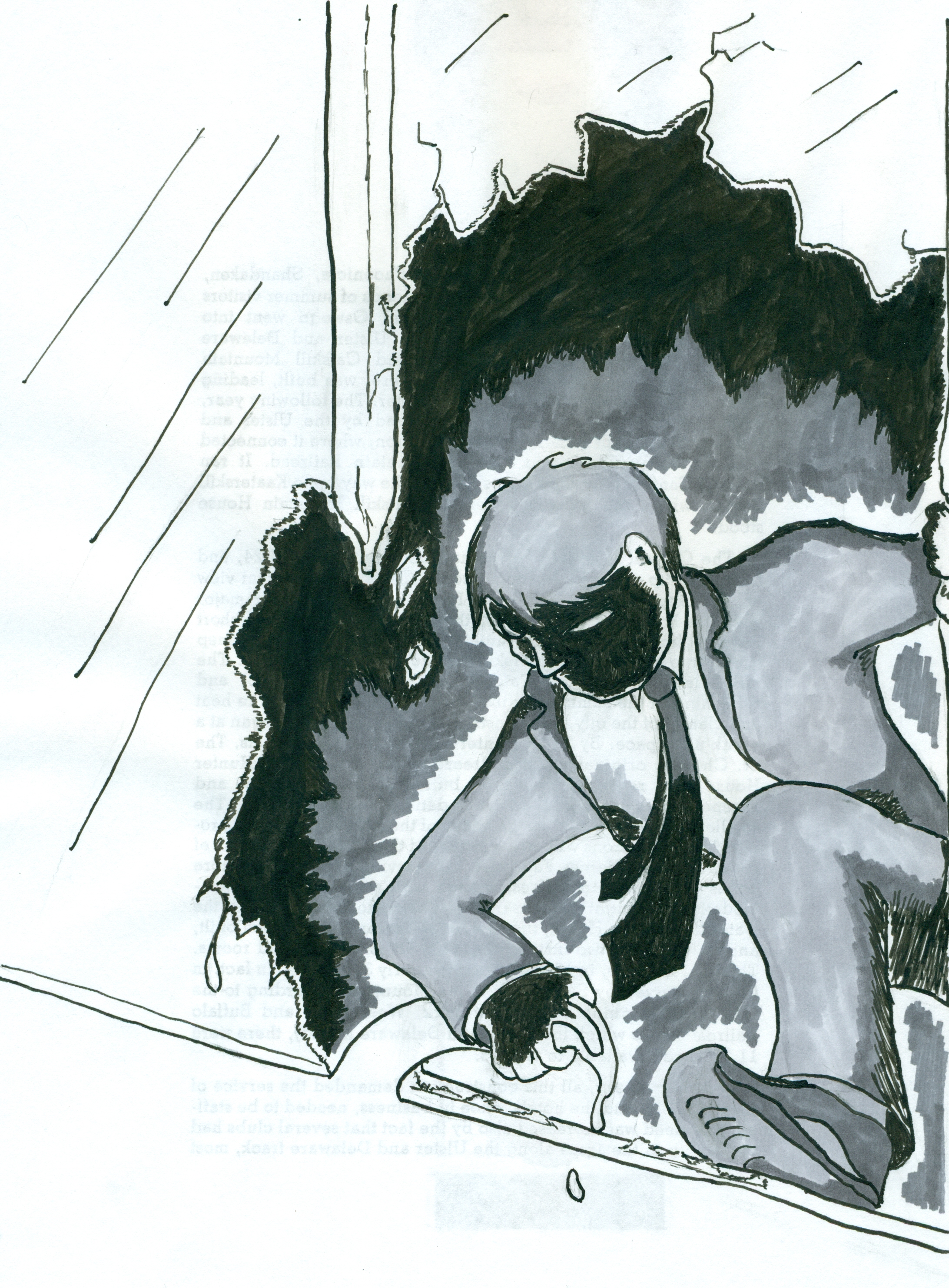
Original Art: Helix Is Unhappy

It’s been a while since the last Original Art section but hopefully this makes up for it! It’s a shot of Helix on his way to the high point of the Heat Wave storyline! Can’t say much more than that if I want to avoid spoilers for the new readers, so enjoy:

HelixDescends0001

He’s not happy, Bob. Not. Happy.

As always, click to enlarge. Cheers!

Shadow and Brightmoor (Part Two)

It was dark, and many of the streetlights were burnt out. That was just one of many basic services that Brightmoor had to learn to live without. The people in the part of the neighborhood that called itself the Farmway typically pestered the city enough to get them replaced in a reasonable timeframe, but out here the streets were poorly lit after night fell. On the other hand, even in the dark the cheery sounds of small farm animals, chickens and the occasional goat, could be heard bringing a little cheer to the night. Technically that was against some city ordinances, but with the loosened city presence had come a sort of tacit permission to ignore some city zoning laws, as well.

On his pass through the block earlier that afternoon, Marcus had taken note of the six houses that he guessed belonged to the man Xayvion called “old Freddie”. From the sound of things, Freddie was one of the people who had come to, or lived in, Detroit when the economy tanked and still had enough resources to grab up suddenly cheap real estate. Most of them had done creative things with it. The Farmway got it’s name because there was a lot of urban farming going on there. It wasn’t making a whole lot of money yet, but the people living there were in no danger of starving. More than a few people bought or “borrowed” abandoned lots for farm space. From the looks of things, Freddie had been one of the people who had caught the vision.

Poking around the property that afternoon he’d found a small pile of rotting lumber and signs that someone had started building a raised bed behind the house at one end of street. A look inside the house had shown that most of the furnishings and doors had been pulled out, either by the property owner or by scrappers it was impossible to tell.

He’s also seen signs that bothered him, and gotten the feeling he was being watched, which confirmed the suspicions he’d had when Xayvion had described Freddie’s behavior. That was what had taken him out to see Lord Caledonensis. And that was what led him to attempt something profoundly unwise that evening.

The string of houses Marcus had identified as of interest were a mess. Not just in the literal sense of being run down and partly overgrown with weeds, although they were that, too. But on top of that they were a tangled mess of criss-crossed, misaligned threads that tangled up the greater Weave around them. Half the street was quivering with the tension the threads were creating. Marcus ran a finger across one particularly bad tangle of threads as he approached the house at the center of the snarl. Untangling the mess was the kind of thing that could take days for a skilled weaver, or months if he allowed it to unravel naturally. In the mean time, it could cause all kinds of problems. And that was assuming no one was actively making it worse.

Marcus pulled out his phone and made a quick call, then slapped his thighs lightly and let himself in the house, carefully reaching back and drawing his sword. It was a three foot long, broad bladed weapon forged out of silver and cold iron that was itself a knot of carefully woven magic that represented the great Weave and the Pattern it tried to follow. It was the only weaver related thing he had taken with him when he left Fort Wayne and he was glad to have it with him now. He made a mental promise to himself that he would stop using it against thugs and scrappers. Not only did it get the neighbors upset with him, not only was it a disgrace to the purposes that the sword embodied, it drastically raised the odds he could get arrested or see it confiscated. And then he’d be up a creek for real, especially if he intended to do something this harebrained again.

The inside of Freddie’s house was littered with the corpses of the kind of small rodents you saw a lot in urban and suburban areas. Rabbits, squirrels, chipmunks, even a raccoon or two. They all looked like they had been caught and strangled. Where they weren’t rotting it looked they had been gutted in a very messy way. Marcus suspected that knives hadn’t been involved so much as teeth. Foul smelling gunk caked the floor in the entrance hall and the rooms on either side. It didn’t really bear thinking about what it might be.

With sword in one hand and the other dipping in and out of his pocket, Marcus proceeded deeper into the tangle of out of place threads that ran towards the back of the house. He found himself wishing that he had come in through the back window or something. The whole back wall of the house turned out to be full of paraphernalia – the kinds of stuff popular culture had come to associate with magic and that still got used in a lot of the rituals many who tinkered with it performed.

If Marcus had any doubts that old Freddie had Invoked something before, they were gone as soon as the “magic” rubbish started popping up. The first piece he found was a large, wrought iron candlestick, a perennial favorite. It was at one point of a pentagram drawn in chalk on the floor. Marcus snorted. If Invoking didn’t drive the people who did it insane, the clichés involved would be almost funny.

With a few quick strokes of his sword he split the candlestick in half and carved a pair of parallel lines through the pentagram, the blade effortlessly severing both the objects and breaking the mess of tangled threads that had been anchored to them. The Weave convulsed slightly as the anchors that were holding the snarled threads in place disappeared and the Weave began to repair itself.

There was enough paraphernalia in the house to make Marcus think that it might have been as long as a year since Freddie Invoked whatever nonsense was now stuck in his head. He went through two rooms with at least a dozen items each, before he felt the impact. Something was trying to go out the back door.

He glanced back, intending to send one of the other Templars to check it out. But he was alone on this run, really he’d been alone since he left home. There was nothing to do but fish a pair of quarters out of his pocket and follow it up himself.

He found a dirty, unkempt man still trying to force his hand through the back door to pick up the small, silvery disk sitting on the step. “You must be Freddie,” Marcus said. “Or should I call you Fredrick?”

Freddie spun around, a snarl crossing his face. “Who are you?” He snapped. “This is private property.”

“No use playing dumb, Freddie Ruin,” Marcus said, holding up the quarters in his off hand and twirling them so the other man could see that they were just like those on the step, with George Washington’s head visible on both sides. “These doors are mine. One way or another, you’re not leaving this room until I’m done with you.”

Something intangible changed about the man and he suddenly seemed less human and more alien. He jerked to his feet as if pulled up by puppet strings, banging one shoulder on the doorframe in the process but giving no signs of actually feeling the impact. “So you’re supposed to be a Janus of some kind?” Freddie slammed his fist into the wall and the whole building shook slightly. “That name is ours!”

Marcus grinned. “Sorry, but your kind have misused it, just like you misuse pretty much anything you set your hand to. And once you mistreat something you forfeit any right to claim it – that makes it mine now.”

He let the two quarters fall to the ground and, instead of bouncing the stuck fast there, completing a web of threads that wouldn’t let anyone pass through the door until he removed them. Then he took the hilt of his broadsword in both hands and waded in.

Practically since the Round Table was organized, back in the misty days of yore, one of the responsibilities of those weavers who were trained in arms was to find and do battle with people who had Invoked sinister creatures. The records called them different things and mentioned various abilities, but they all agreed that no two were alike and, whatever they might be, they took over the mind and body of whoever had called on them and drove them mad.

Even if Freddie hadn’t recognized the two-headed symbol for the Greek god of doors, or left his home scattered with the usual dead animals and asorted paraphrenalia, the dense knot of distorted reality that was tied to him would have tipped Marcus to the fact that he had Invoked something. Time and space weren’t functioning in quite the normal way around old Fred, and that meant pretty much anything was possible.

But still, Freddie grabbing the wall and flinging himself up to the ceiling, which he dangled from using nothing but his fingertips, was way outside Marcus’ normal experience. He barely had time to turn to the side for a decent shoulder block before Freddie’s swinging feet caught him and sent him staggering back to the door.

Freddie dropped to the ground, ripping the ceiling joist he’d been clinging too down along with him. It made for a classic board-and-nail bludgeon and he came after Marcus swinging. The most prudent thing to do was step back through the door and let Freddie slam to a stop when he tried to cross the threshold.

This time it wasn’t a casual step or an exploratory poke, Freddie was out for blood and he slammed into Marcus’ weaving with all the weight of the Invoked presence riding his back. When he hit the threshold the entire doorframe seemed to flex and the pair of quarters that anchored the ward to the door actually skipped back an inch or two. Marcus ignored that and swung his sword in a diagonal cut, sheering through the joist Freddie held, leaving hims with about six inchest of board in one hand, and a good part of the door frame as well. Then he flipped his blade so the silver edge faced out and pressed the attack.

Whatever it was in the old man’s body, and by the dim light of the back windows Marcus could see that “old Freddie” was at least in his late fifties, thus truly ancient by Brightmoor standards, knew better than to let that sword too close to it. So it took the two by four end and flung it at Marcus and backedpedaled. Marcus followed at a brisk walk, point of his sword aimed down and across his body. They came to a stop when Freddie ran out of room to back up through.

With a sudden twist of the hips, Freddie dove low and to Marcus’ left, taking advantage of the fact that Marcus’ current stance made it hard to connect with anything other than a jab. Whatever was in Freddie knew that he would try not to hurt Freddie if at all possible and that meant cutting with the silver edge of the blade and nothing else, certainly no stabbing.

Marcus hissed and kicked his foot out to try and stomp the old man to the ground, but Freddie suddenly planted a hand and skidded to a stop, grabbed Marcus’ leg and tossed him onto his backside. Freddie reared up over him, his hands clasped together to make an all natural club that nearly smashed his head in. Marcus managed to roll out of the way just in time and Freddie left a small dent in the floor instead. The sound of breaking bone followed, but like most Invokers he seemed immune to the pain.

That didn’t mean Marcus could relax, though. The old man might be empowered by a supernatural force but that didn’t mean he stopped being an old man. The shock from the broken bones could very well be shorting out his nervous system, all the activity was a strain on his heart that it might not be able to take, there were a dozen other problems healthy Invokers could run into, and Freddie didn’t look like he’d been healthy back when he first Invoked – he certainly wasn’t after months under the influence.

Under normal circumstances, Marcus reflected grimly, this would have been over already. As soon as an Invoker focused on one Knight he was generally toast, because the Knight’s friends would hack the Invoked power off it’s host before it quite understood the situation. Group tactics wasn’t something they seemed to grasp very well. Without backup, things would take longer.

Marcus kicked his legs up and scissored them around Freddie’s waist, then threw his weight to one side and rolled his opponent down to the ground. Freddie grunted and started to push himself back up but Marcus lost no time chopping his sword down onto the other man’s back. The silver half of the sword chopped into his shoulders and slid back out like a knife through butter.

Freddie convulsed as the silver edge cut the ties the Invoked presence maintained with it’s host, sending it spinning back into wherever it came from, and forcing it to spend long minutes or even hours pulling itself back along the anchor lines it had created in the various pieces of magic junk Freddie had been creating for the last who knows how long. Of course, Marcus didn’t plan on giving it that time. Just like the silver edge could cut through any kind of magic bond he’d encountered in his life, he’d never found anything the iron side couldn’t cut either.

It looked like most of the paraphernalia in the house was gone, he didn’t see that many stray threads left in the house and most of them tied back  to him, not Freddie. But every Invoker had at least one prime object, something that was a part of the original Invocation and that was the nexus of the anchor lines that kept the presumptive magician chained to the thing that rode him. Nine times out of ten, it was a book of some sort and Janus hadn’t found anything like that so far.

A quick check of old Fred himself didn’t reveal anything like that, so Marcus figured it must be in the room somewhere. As he looked around he spotted a dark, squarish lump sitting by the door where he’d first found Freddie. Of course that made sense, neither Freddie or his ride-along would want to leave that behind. Marcus took a step in the book’s direction only to stop short when Freddie’s hand grabbed him around the ankle.

He lacked the manic, supernatural strength he’d had a moment ago. This was the old man, not the supernatural malevolence he’d summoned. Marcus tried to pull free but Freddie was surprisingly determined. “Stop…” He coughed once. “This is… best shot. Not going…”

With a growl, Marcus knelt down and pried Fred’s hand off his ankle and shook his head. “You’ve caused enough mischief already, friend.”

Freddie made another frantic grab but with only one hand and the strength of a man in his late fifties to work with, Marcus was able to get out of his reach easily. Unlike most of the paraphernalia, the book had to be handled carefully. It took a few minutes to strip off most of the out of place threads and pull a little slack into them so there wouldn’t be a backlash when he destroyed their anchor point. That could lead to all sorts of problems.

Then he set fire to the pages and left it to burn itself out on the concrete back step of the house. Then he slung Freddie over one shoulder and carried him to the front door. His cargo made little noises as he bounced along but Marcus wasn’t feeling particularly charitable. It was true, Freddie’s Invocation hadn’t run loose and killed anyone, but the sheer negligence involved in doing such a thing certainly biased Marcus against the man. There were hundreds of cautionary legends about deals with otherworldly forces for a reason – it was almost always a bad idea.

On reaching the door Freddie panicked. It appeared that Marcus’ earlier diagnosis had been right. Destroying his environment, killing most small animals he found and now agoraphobia, all symptoms of what was commonly known as the “Ruin” type of Invocation. While Invoked powers didn’t have any pattern in what they could do, what the did to people did fit into broad categories. Other than his new found dread of open places Freddie would probably recover mentally. Physically, it was another story.

Marcus left him just inside the door and took a post on the front step where he could watch the street and Freddie at the same time. Other than the quiet sounds of Freddie Ruin muttering to himself it was a quiet night. Marcus smiled slightly to himself, wondering how he had managed to find himself doing this kind of thing again. He had left home thinking he wanted to get away from his work as a Templar. Apparently he was wrong.

On the other hand, Templars were dedicated to the defense and growth of a particular place. Maybe he just hadn’t been in the right place back in Fort Wayne. He’d originally planned to leave town after Freddie was taken care of. But winter was coming on and at least he had a place to stay here. In the doorway Freddie moaned softly, almost but not quite enough to cover the sound of ambulance sirens drawing closer, finally responding to the call he’d placed before heading into the house. “Relax, Fred,” Marcus said. “Nights’ almost over.”

Part One
Fiction Index

Author’s Note:

Shadow and Brightmoor is a work of fiction and, like most works of fiction, most of the people and places are a not real. But, while the most of the specifics I’ve mentioned in this story are not real, Brightmoor is an actual part of the city of Detroit and the Farmway is likewise an unofficial subset of the neighborhood where people are taking new and innovative steps to fight urban blight and experiment with new urban lifestyles.

The people there are fighting a real, difficult battle against forces just as oppressive, if not more so, as what Marcus faces in this story. If you wish to know more about Neighbors Building Brightmoor (the neighborhood association Marcus mentions in Part One) and the Farmway, there’s an excellent article about them here.

The Long and Short of It (Where It is Writing)

One of the many things I’m currently juggling is completing the outline for Water Fall. It’s actually mostly finished, but my method of outlining has it’s own idiosyncrasies, which will undoubtedly be the subject of their own post some day soon. But today’s subject is more straightforward: Length. 

When you sit down with an eighty to hundred point beat outline in front of you the thought that you’re going to try and turn all that into a fully fleshed out novel/script/screenplay/whatever can be more than a little daunting. Water Fall is my third crack at writing a novel and the scope of the project is still intimidating, doubly so because it has to keep in mind, expand on and complete things started in Heat Wave. It’s a lot to keep in the air and I have a feeling that I’m going to wind up doing a lot more correcting and rewriting, just in the first draft, than I had to do with Heat Wave. That’s not a bad thing, but it can sometimes be overwhelming. 

But there’s nothing quite like the satisfaction when a long project is finished, and you can sit back (for about ten seconds, at least) and say, “Yes! I have accomplished something.” 

On the other hand, you might expect short stories to be much simpler to write. You just sit down and toss off a couple of thousand words and make sure you don’t contradict yourself in that short span of time, right? 

Well, not so much. For one thing, keeping a short story short is more difficult than it might seem at first glance. Two of the short stories I planned for this summer wound up far exceeding the length I expected of them – both #63 and Shadows and Brightmoor were supposed to be one installment. However, I really don’t want to publish anything too much over 5000 words in a single post, not only because I don’t want to overload people with the Wall of Text o’ Doom but because I simply cannot write that much, plus two other posts for a week, and get it out in good time with good quality. 

For another thing, short stories have little to no time to be leisurely. You can’t putter around when introducing your characters, setting or conflict. Things have to go from minute one or you’re going to wind up with a novella rather than a short story. Finding places to squeeze in all the detail you might want (or need) in your story can be daunting. 

Somewhere in the middle of that is the novella. I might try writing one of those sometime soon, but currently have no plans to work on one before the end of Water Fall sometime next year. But I suspect if you were to try it you’d find it to be somewhere between full novel and short story – just long enough to be intimidating, but short enough that you’ll still feel pressed for space. Fun, no? 

Writing is the use of words. You have to know them, use them sparingly and with maximum impact and keep with them until the job is done. No matter what the scope of your story, your building blocks are the same. There’s a saying among management circles at the library where I work: “How do you eat an elephant? One bite at a time.” 

The same is true of all stories: They’re written one word a time. 

Keep that in mind, love your words and no matter what kind of story you’re working on, at least the work will be a joy. 

Cool Things: Doomed by Cartoon

In many ways it seemed like William Tweed had it made. He was the boss of one of the most powerful political machines in the history of New York, and possibly the United States. He and his political underlings had arranged to keep large swaths of the public coffers at their personal disposal through graft and patronage. Their takings are estimated at a minimum of $1 billion in today’s money. Some estimates go as high as $8 billion.

Although Tweed would hold only a handful of high profile offices in his life, as an alderman and later as a commissioner he would engineer massive overpayments to contractors and companies that he owned or were owned by his friends and allies. Tammany Hall seemed to be in an unassailable position astride the New York City economy, gorging itself on public money and keeping many dependent on the money they doled out. But in the space of just a year or two a coalition of city fathers, turncoats and one unlikely character artist would break Tammany Hall’s power and leave it flailing for relevance in the new political landscape.

Doomed by Cartoon, by John Adler, tells the tale of Harper’s Weekly and Thomas Nast as they set out to call out and bring down Tweed and his ring.

Thomas Nast is not a well known name today, but many aspects of his work are now irrevocable parts of the American consciousness. Among other things, he created the modern image of Santa Clause and the association of the Republican Party with the elephant. He also helped to popularize the images of Columbia (America personified as statuesque Greco-Roman woman bearing sword and shield), Uncle Sam (Nast is credited with adding the goatee) and the Democratic donkey.

But few of his accomplishments equal the significance of his stand against Tammany Hall (although he is credited with being a deciding factor in the election of Grover Cleveland as well). The contrast between Tweed and Nast is stark. One was a big man, the other small. One was a wealthy man of far reaching influence in business, the other was a very poor business man and had little influence beyond beyond being a goad in public policy. In many ways, it was a bit of an American David and Goliath battle.

But Nast did far surpass Tweed in one respect, and that was his ability to influence people. While Tweed’s methods were usually straight forward bribes and blatant corruption that couldn’t be proved only because he was holding all the cards, Nast leveraged humor, cultural touchstones and memorable images into a platform that goaded his opponents to distraction.

While it’s fair to say that there were far more factors at work in Tweed’s downfall than Nast – inside information, a timely riot, news exposes in other papers – it was Nast’s constant attacks in Harper’s Weekly that kept the issue before the people. Tweed himself acknowledged Nast’s influence when he said, “I don’t give a straw for your newspaper articles; my constituents don’t know how to read, but they can’t help seeing them damned pictures.”

In fact, attempts would be made to bribe Nast into leaving the country for a while, with offers of half a million dollars (worth considerably more then than now) being made. But in the end Nast stayed in New York Tweed went to jail. In an ironic coda, when Tweed escaped a few years later and made his way to Spain by boat, the Spanish police would identify and arrest him using a Nast cartoon as a reference.

It’s actually a rather straightforward political story, in as much as political stories can be straightforward, but what makes Doomed by Cartoon unique is that it includes over 160 Nast illustrations, giving them context and pointing out the ways many of them tie into the events of the Tweed era. As an amateur artist and a student of politics I found it very interesting. Maybe you will too.

Shadow and Brightmoor (Part One)

“Okay, so now we got apple trees.” Xayvion gave one of them a rap with his knuckles. “And you spent the last six weeks harping on this why? They don’t look like much.”

“Apple trees have been doing good for the American people for centuries. Since before we even counted as a country. Besides, these are Harrison apple trees, express delivered by my cousin as a personal favor.” Marcus Harrison handed his shovel to the eight year old boy who had been helping him plant the last tree on Benton Harbor Boulevard. He used the motion to hide his other hand as it looped an invisible pair of half hitches around the trunk of the tree, weaving it into the larger pattern connecting the two dozen apple trees he’d managed to convince his cousin to send him on short notice. The connection sent the tree and it’s branches swaying lightly, as if a wind  was blowing in it’s branches. Marcus smiled. “See? They’re special.”

Xayvion snorted. “More like I’m strong enough to have ’em shaking scared.

Marcus’ attempt to think up a good comeback stalled out when he noticed a beat up old truck slowly rolling down the street. It wouldn’t have looked out of place most places in America, in fact, he’d owned one a lot like it once. It was a dingy green, with a heavy steel toolbox across the back bed. Two men sat in the cab, pretending to pay no attention to anything around them. One of them saw Marcus had noticed them and gave him a hard look.

“We’ve got scrappers,” Marcus said under his breath.

“Yeah, well most of them know better than to hang around Brightmoor,” Xayvion said with a grin. “And after last time? Word will get around. You can go anywhere you want in Detroit and steal scrap out of houses. Only here does someone pull a sword on you for it.”

“He had it coming,” Marcus pointed out, his feet taking him slowly after the truck. “Get on your phone and call your mother. We may have to run them off.” He’d learned much to his chagrin that the police rarely showed up in time to deal with minor vandals in Brightmoor – when they came at all. But he’d also gotten a stern lecture about letting the locals deal with it their own way, and while they didn’t shy away form confrontation, the threat of violence was not an accepted part of their modus operandi. Not that he would have actually bothered to cut them with his sword.

Well, maybe a little.

“It’s okay,” Xayvion said. “They’re probably just headed to old Freddy’s empty houses.” He waved vaguely in the direction of St. Joe, the cross street about a half a block away. “He’s always tearing stuff out of there and tossing it by the road. The scrappers come by and pick through it about once a week, take whatever and leave.”

“And you put up with that?” Marcus asked. In his experience, the people left in Brightmoor didn’t really like it when their neighborhood got messed up.

“They’re his houses,” Xayvion said with a shrug. “We can’t make him not mess them up. Mom says he’s got more right to do that than some.”

Marcus gave him a sly look out of the corner of his eye. “She wouldn’t be referring to a band of mischievous vandals who leave murals on abandoned houses, would she?”

“I don’t even know what you just said,” Xayvion said. “She’s talking about the way we paint the run down shacks so the place doesn’t look like crap.”

“Praise the Lord and pass the paintbrush.” Marcus snorted and shook his head. He’d been to one of those church outreaches and it had to be one of the ten strangest thing’s he’d ever lived through. Still, he didn’t think that the borders of the part of Brightmoor unofficially known as the Farmway extended along St. Joe in that direction. “This Freddie guy a part of the NBB?”

“I don’t think so,” Xayvion said slowly. “He moved in a couple years ago, I know he talked about tearing down some houses and putting in something there. But people just stopped talking about him much last fall and the scrappers started coming.”

Marcus walked back to the place where they’d planted the apple trees. Finding buyers for them and getting them delivered had been his first contribution to Brightmoor, and of all the different aspects of the family business he had expected to find a use for in Brightmoor, orchard keeper had not been high on the list. In fact, avoiding the family business entirely had been the major reason he had come to Detroit in the first place. Ironically, he was about to put his hand back into yet another aspect of it.

He hefted his backpack and dug his phone out of it, pausing long enough to check that his sword was still tucked along one side, the hilt poking out of the top for easy access. It always paid to be careful.

“You’re not planning on looking for trouble, are you?” Xayvion asked.

“Just going to make sure they really leave,” Janus said, slinging the pack onto his back and thumbing his phone to life. “You’d better go and let your mom know there were scrappers in the area, so she can get the word out. If they come back and want to top off their load, people can be on the lookout.”

“All right,” Xayvion said doubtfully. “But don’t go starting nothing. Monique says you got a temper and we can’t have you running loose and scaring people. The city ignores us right now, we don’t want them to change their mind.”

“No swordplay, I promise.” Marcus started down the street, then paused and glanced back at Xayvion. “By the way, is there a bank around here?”

“A bank?” The kid asked, clearly thrown by the sudden change in subject.

“Yeah, you know, places full of suits and money? I need to get a roll of quarters…”

——–

Marcus had met a lot of different kinds of weavers in his life, but Detroit’s Lord Caledonensis was the first one who managed to claim leadership of the local Order of Merlin and run an art gallery. There were similarities between art and weaving, he supposed, but he’d never expected a person who specialized in highly theoretical magic weaving to take an interest in those aspects of it.

Then again, it was the nature of research and development to prize creativity, so maybe it wasn’t so surprising.

Either way, he felt a bit like a bull in a china shop as he walked in, his jeans and T-shirt still dirty from the morning’s work, and loomed over the saleswoman. Looming wasn’t what he intended, of course, but he’d inherited the famous Harrison build that had made his family natural farmers since time immemorial. He did his best to slouch in a non-threatening fashion and asked for the owner. It took twenty minutes of wheedling before he finally got her to page the weaver Lord and tell him it was Council business. From the way the woman acted when he’d first told her that it was clear she wasn’t a part of any local weaver’s Order, so Marcus was just grateful she’d passed the message on and he settled in to wait.

It turned out he didn’t have to wait long. About five minutes after his message was passed, a short, round man with paint on his fingers made his way out of the back of the gallery and shook hands. Marcus couldn’t help studying the man with a critical eye. He’d only known two other men who had held the title Caledonensis in his life but they had both been somewhat more, well, wizardly. He wasn’t sure exactly what he had been expecting from Detroit’s leading theoretical weaver, but it hadn’t been someone who looked like he taught middle school art classes.

Not that there was anything wrong with middle school art classes, or teaching them.

“Well, this is something of a surprise,” the weaver lord said, pumping Marcus’ hand up and down enthusiastically. “I haven’t met an out-of-towner in some time.”

“Pleasure is likewise, m’lord,” Marcus said quietly, old habits slipping back into place almost, but not quite, without any effort at all. “A little business in town I was hoping you could help me with.”

“Of course.” Lord Caledonensis glanced at his receptionist then said, “Well, business is best conducted in the office. If you’d follow me?”

The shorter man escorted Marcus back into a room that qualified as an office only in that it did contain a desk and was probably the place Caledonensis managed his business from. But the desk and pair of guest chairs by it were mostly a sideshow, the bulk of the room was dedicated to hanging canvases and a large easel set up in the center of the floor. The other man had apparently been working on one of those lovely abstract art things before Marcus had called him away.

Rather than giving him a chair, Lord Caledonensis took Marcus on a slow but purposeful tour of the canvases on the walls. Most of it was the kind of thing that didn’t make much sense to a man who hadn’t taken art classes for half his life, so Marcus kept most of his attention on the conversation, although he tried to be rude about it. After introductions, the Merlinite got straight down to business.

“I have to confess I wasn’t sure I was going to see a new weaver come into Detroit in my lifetime,” the portly weaver said. “I am a bit curious as to what brought you to us.”

“Personal business, actually,” Marcus said with a shrug. “I left the Anthony Wayne chapter of the Knights Templar a couple of years ago and wandered into Detroit. It was my intention not to show my face before an Arbiter’s Council ever again.”

“A wandering Templar?” The other man looked honestly confused. “A bit of a contradiction, isn’t it?”

“As I said, m’lord, I resigned. It’s strictly coincidence I’m here, and I was only able to find you by pestering my cousin until he pulled in some favors and found out your name.”

“Well.” Caledonensis peered at him with an evaluating squint. It was a bit unnerving. “I’m afraid your stated intention of never appearing before a Council again will not be broken, at least not yet. You see, there is no Council in Detroit. At least, not any more.”

“What?” Marcus felt a little wind go out of his sails. “Why not?”

“Not enough membership,” Caledonensis said. “There are only three Orders left functioning in the city these days. The Order of Merlin, of course, along with The Order of the White Ash and the Watchers in the Howling Dark. That’s not enough for quorum, even if we had an aware non-weaver who was willing to sit on the Council with us, which we don’t. The local Council was officially dissolved ten months ago.”

“The Knight’s Hospitaller aren’t here any longer?” Marcus asked, a growing feeling of unease gnawing in his gut.

“No. The membership of the Motor City branch had been declining for the last four years. They officially disbanded and merged with the Crossroads of America chapter, which was actually what led to the Council folding.” Caledonensis’ voice took on a dissatisfied tone. “Tom Cross arranged for it.”

“That’s Tom,” Marcus murmured. “Expanding the borders by any means available.”

“Regardless, there’s no Council left in Detroit,” Caledonensis said, a bitter not creeping into his voice. “The Order of Merlin is also looking at the possibility of combining our section with-”

“Lord Caledonensis, forgive me but I’m not interested in the political details. Even in Fort Wayne I wasn’t seneschal.” Marcus waved his hand vaguely in the direction of Brightmoor. “What bothers me is I think I’ve found an Invoker and I’m trying to find enough war weavers to safely contain it.”

The shorter man sighed. “That’s very noble of you, Marcus, but there’s nothing I can do to help you. Sam Cross wants all Hospitaller activities routed through the Allen County Council in Fort Wayne. I don’t understand how he expects to manage a Knight chapter than covers four states from there but there’s not much I can do from here to change his mind.”

“That’s true.” Marcus rubbed his forehead. Like Lord Caledonensis, Samaritan Cross was the title given to the leader of a branch Order, in his case a chapter of the Knight’s Hospitaller. He’d worked with them in Fort Wayne but not Sam Cross directly. “Okay, I’ll try and work through some people I know, but Invokers just get worse as time goes by. Is there any chance that you-”

“No.” It was the Merlinite’s turn to cut him off. “Marcus, people are abandoning this city in record numbers and not even weavers have found a way to unravel that pattern yet. Until some kind of agreement can be restored about how to best serve both the weavers and the city as a whole, each Order must look to it’s own. I have no one I can spare to help you.”

Marcus felt his temper surge but firmly tamped it down. “Very well, m’lord.” He absently put one hand in his coat pocket and finered the roll of quarters there. “I figured that this was a possibility, though it’s upsetting. I’ve found creative solutions for this kind of thing in the past, I’ll do it again. I can find my own way out.”

“Wait a minute, Marcus,” Caledonensis called. “Don’t be rash. Even Mad Anthony’s Templars wouldn’t try and take on an Invoker alone!”

But the only person who could hear him was the receptionist. Marcus was long gone.