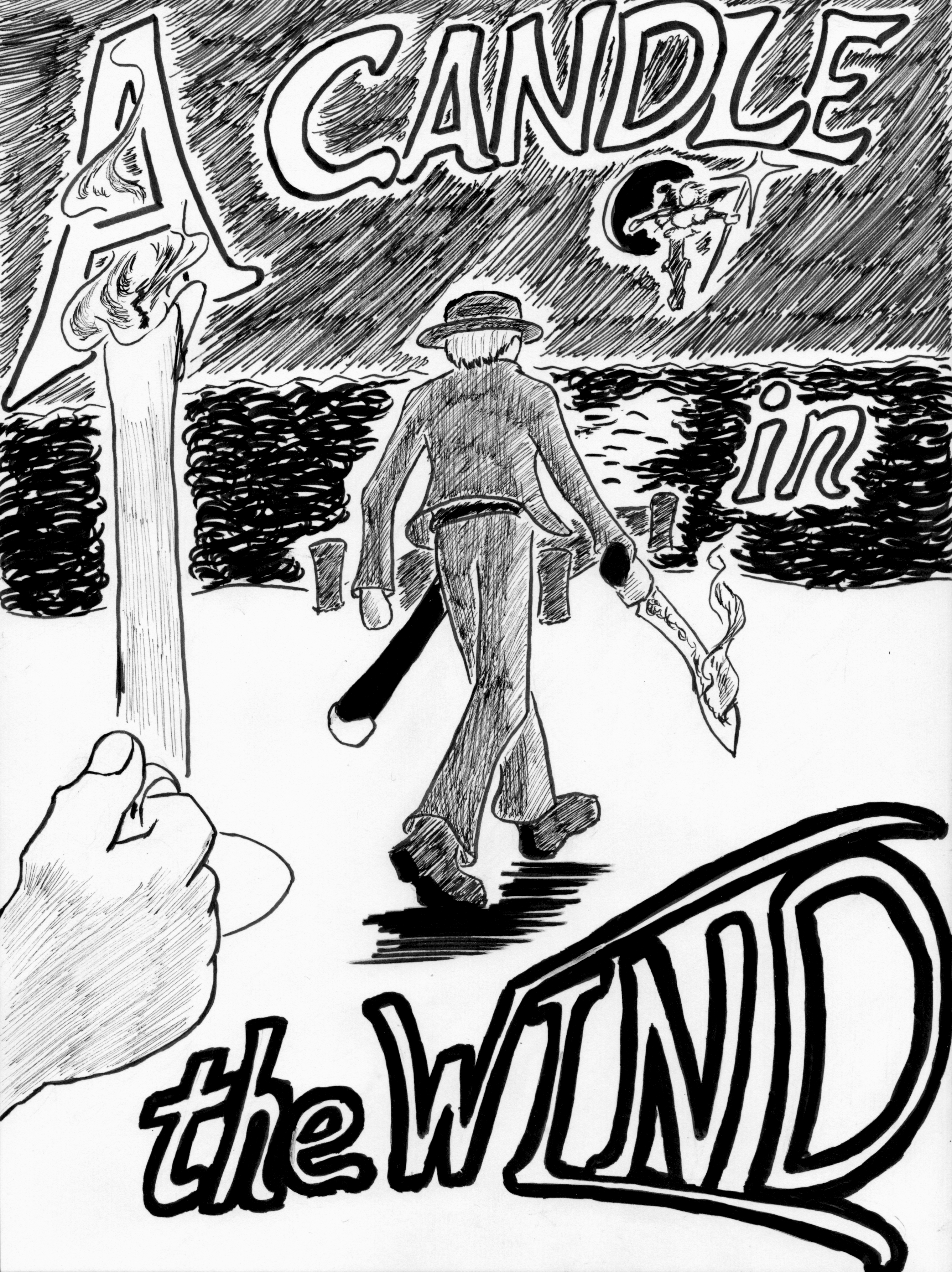
A Series on Process – Outlining

At the beginning of the year I set myself a number of writing goals, one of which was to document and share my own process of writing. During the writing of A Candle in the Wind I took a few notes beyond the normal. Now I share the outcome with you, in the hopes that there is something here that can help the writer looking to refine their own process. This is just what I’ve found works best for my own writing. I encourage anyone trying to streamline their own writing process to experiment. There’s no guarantee any of this will prove helpful but creative writing is one of those things where you don’t really know if a technique will fit you until you try.

Note that the point of this isn’t to tell you how to come up with an idea, premise, characters or setting. This is about how you turn those things into a story. So in writing this I’m going to presume you have all that stuff worked out already and talk about how you arrange those things into a narrative.

The first thing I do is outline my story.

A lot of people say that outlining takes spontaneity or life from your story. My understanding from what they describe is that they feel shackled by their outline and cannot depart from it once they’ve written it down or the story feels listless if written from an outline. These are both the result of mindset, I believe. Some people want to explore their narrative as they write it and then just tweak and refine the narrative once they have it all down. Others lose interest in the story once they have all the beats worked out.

While neither of these are an innate shortcoming of outlining your story if you find either of these things to be the case outlining is not likely to be a helpful technique for you. Fighting that bent in your personality probably isn’t worthwhile. Everyone creates differently and it’s better to lean into your own proclivities than to try and contort your own thought processes to a particular technique. But if neither of these are the case I strongly suggest outlining as a huge time saver before you get into the meat of your story.

The point of an outline is to establish a structure and check for major contradictions before you spend hours typing out early chapters. In general I try to lay out between 15 and 25 basic plot beats I want to take place. Some outlining guides suggest including “up” or “down” in your beats but that is not something I do any longer, although I did try it at one time.

Once I have the beats laid out I work backwards, checking if I need to set up anything early on that will pay off later in the story. I also look for beats that contradict each other. Once the outline is written I leave it for two or three days then reread it with fresh eyes, looking for contradictions and asking if I like the story. In general the beats get rewritten 4-5 times. For an idea of what the finished product looks like, here’s the final outline from A Candle in the Wind.

  • Roy is in the jail of Riker’s Cove, watched by Sheriff Avery Warwick
  • We learn what brings him to the Cove, get the first hints of Heinrich von Nighburg’s identity and why Warwick wants him to leave
  • Roy agrees to leave and take the other members of Tyson’s Nine with him but the Fairchilds sneak by into town
  • Roy rallies the available members of the Nine and they make a new plan to sneak by the Sheriff
  • The Fairchilds and Warwick meet when Cassandra frees a child from Nighburg’s influence
  • Brandon and Cassie leverage their saving the Strathmore boy to convince Warwick to let Roy and company back into the town
  • Roy and the Fairchilds reunite but before anything is discussed Nighburg retaliates, sacrificing a captured child to the Voices
  • Roy and Avery get a glimpse of the mindscape before breaking Nighburg’s enchantment and ending Nighburg’s attack
  • Roy and Co regroup and meet with Jonathan Riker’s son to plan their attack on Nighburg’s lighthouse
  • We learn that Jonathan was the one who called in the favor Tyson’s Nine owed his father and the group makes a plan
  • Strathmore joins the group and they break into the lighthouse, discovering the mirror into Nighburg’s extradimensional manse
  • The manse is explored as Nighburg makes several stealthy mental attacks on them
  • Nighburg slips past the town’s defenders as the Voices play havoc with their emotions and awareness
  • He attempts to fulfill his ritual during the eclipse by executing Jenny Riker on the lighthouse beacon but Strathmore intervenes, dying in the process
  • Strathmore’s life is enough to push the ritual halfway to completion and Roy is forced to fight Nighburg in the beacon chamber to prevent it’s completion
  • When Roy throws Nighburg off the lighthouse he accidentally completes the ritual and the Voices of Taun begin to reach into the world fully
  • We see the defenders of Riker’s Cove rally and hold them off for a time but their stamina wanes
  • The Strongest Man in the World arrives at the last moment, the last of Tyson’s Nine, and wards off the Voices, returning the world to normal
  • Characters go their own ways, with the Strongest Man warning Roy that now that he’s touched creatures from Beyond he will never be as firmly a part of his world as he was before

Since I just lay out beats in a text file and edit them as I go I don’t have a change log of the entire thing. It didn’t occur to me to save it. That said, I don’t recall very many major changes at the outlining stage. If you’ve read A Candle in the Wind, however, you can see that some elements did change between this point and the final product.

For example, many things were added, like the mayor of Riker’s Cove or Chester Tanner entering the narrative and the Statue of Jonathan Riker serving as a framing device, but the essential structure only changed in a couple of points. Tanner turned out to be related to the child Nighburg killed. That meant it made more sense for him to go into the tower rather than Strathmore – after all, Stu still needed his dad and Chester’s nephew… well, he didn’t. That change was at once important and not really that big of a deal. It required the change of one character for another but very little in the outline rested on that side character so the replacement was fairly easy to make.

By working out most of the major structural changes at the point where the entire story is less than a page of text it’s possible to check for contradictions quickly and consider the implications of changes on the broad scale without having to streamline details over and over again. This is the biggest strength of the outline.

The second thing is that there is a lot of room for improvisation and creativity between those major story beats. As I said already, the use of the statue as a framing device didn’t come around until after this step. I had all the characters and magic powers in mind before I started on this but some of the interactions, like Brandon serving as the arms of an enlarged lightbox for Johan, were things that came up on the fly. Again, some say writing an outline robs the story of spontaneity but I think that has more to do with a writer’s perception than reality.

As I said before, some authors will undoubtedly find outlining their story robs them of a drive to write it because now they know how it ends. If that’s the case for you then by all means, don’t use an outline. But if you’ve been discouraged from using one because you’ve been told you’re putting shackles on yourself I’d highly encourage you to try it once or twice. It may be just what you need to get yourself across the finish line. Tune in next week and we’ll talk about how to get from an outline to scenes.

Under the Hood

A couple of weeks ago I wrote about miracles and magic and, in the process, I mentioned hard and soft magic systems. This is an aspect of storytelling that many writers have very strong opinions about. Having strong opinions about storytelling is fine! In fact, that is a big part of what we do here, on this particular corner of the Internet! As I stated before, the question of hard magic versus soft magic is a question of systems. Hard magic is very systematized, with rules, costs, predictable outcomes, and so forth where as soft magic works because it works, with no clear rational.

Each of these approaches to showing magic in your story has its pros and cons. There’s also no clear and obvious lines where one class of magic starts and the other ends, which we’re going to look at in more detail in a bit but before that we have to talk about why the divide exists in the first place.

Every story has a goal. Whether it’s to create a mood, recount events or help you get to know a cast of characters one of the most important things for a storyteller is to keep that goal in mind and choose the techniques that bring you closest to fulfilling that goal. Many people who write about minutia like hard or soft magic systems don’t consider goals when they do. They analyze magic as if it were a law of nature in and of itself rather than a technique used to leverage the audience further down the path towards your goal, a toolkit to achieve narrative ends.

So for starters, what is in the hard magic toolkit?

The first and biggest aspect is a sense of cause and effect for things that normally cannot happen in real life. All narrative is built on cause and effect. A thing happens, which causes another thing to happen, which causes a final thing to happen which forces a character to make a choice and do something which causes another thing to – well, you get the idea. When something that is impossible happens in your story you may wish to assign it a cause. When impossibilities and their causes start to link together in a system you have hard magic in a nutshell.

The second thing in the toolkit is a sense of stakes. Like a dwindling fuel supply or the bullets in a gun, knowing exactly how much longer a person can do magic before he’s out of gas makes each use of it more tense and more important to how likely that person is to succeed at what they’re trying. This works in many ways. If iron cancels out all magic and the audience knows the villain is hiding an iron knife in their pocket as the confront the hero then we know that the hero is in danger he cannot anticipate. In essence, the more concrete and predictable your magic system the bigger the part it can play in tension or suspense based narrative techniques.

Finally, a hard magic system allows for more creativity in how goals are accomplished. In many stories with a soft magic system a conflict with magic or the harnessing of magic to accomplish a task boils down to concentrating harder or reaching some kind of personal epiphany. Hard magic systems create opportunities for surprising uses of existing magical mechanisms or lateral thinking with simple abilities. These ‘a-ha!’ moments are a lot of fun for the reader. Predicting them ahead of time is very satisfying for the audience as well.

So at what cost do we bring these tools to bear?

Well, first there’s the issue of memory. When the reader has to learn a bunch of things about the way your world works it can be hard to keep track of it all. Especially because there’s never going to be a chance for the reader to apply what they learn. Knowledge that goes unused is the soonest forgotten. Second is the question of complexity. The more moving parts a story has going the more likely your audience is to misunderstand some part of it and loose track of what your story is about.

But the greatest issue might be the time taken in explaining a hard magic system. It’s not fun to stop in the middle of a thrilling car chase for a lecture on how the internal combustion engine works. By the same token, lectures on how magic functions aren’t the most thrilling fiction out there. Finding the best way to explain the details is one of the biggest hurdles to a hard magic system out there.

What is the soft magic tool kit?

It offers you the chance to do things way outside the normal human experience, just like hard magic does, but it also offers a sense of mystery or menace rooted in how little people can actually understand what is happening around them. Soft magic puts the focus on how characters react to the unexpected or supernatural. The demands put on people by circumstances outside of their control are totally different from the demands of controlling a situation by knowledge and skill.

In short, while hard magic is about ingenuity and circumstance soft magic is all about resilience and determination. Finding your way in a world of soft magic is more about you than about the magic. Instead, the magic highlights aspects of a character’s personality, usually in a poetic or ironic fashion. Alternatively it gives voice to an aspect of the world that normally wouldn’t be accessible to the human experience. Consider Dr. Seuss’s Lorax, for example. He’s certainly a magical creature and, as he himself says, he speaks for the trees. Without the soft magic of the Lorax, his eponymous story could not take place.

Now that I’ve laid out these two types of magic, let me ask you a question – what kind of magic do you think JRR Tolkien created for the world of Middle Earth?

If you’ve read deeply about the world and the man, you know this is a trick question. Tolkien doesn’t dive into the supernatural mechanics of his world in The Lord of the Rings and that would seem to indicate a soft magic system. Gandalf, Saruman and Sauron all have potent magical powers. However we rarely see them used and we have no idea how they work when we do see them. Very squishy stuff.

The problem is, Tolkien did have pretty clear mechanics for how all the magic in his world worked. There were rules he put on the system. And, in point of fact, he spent a lot of time making sure the magic and its functions were consistent from beginning to end. He just didn’t sit down and explain it all to the audience and by doing so he turned a hard magic into a soft magic.

All of this is context for understanding the question that I’m really interested in as I write this post. That question being, why make this change? Tolkien could have gone under the hood and explained the One Ring and how the principles under-girding it allowed Sauron to so easily subvert others. He could have explained Gandalf’s command of flames. After all, he understood these things in exhaustive detail, why not take us under the hood, so to speak, and show us the full breadth and potential of his world?

The short answer is he was not writing a story that needed to. Tolkien was a linguist – a philologist, to be exact – and his stories founded in a world that existed to explain languages. However not just any language, poetic language. The great poetic narratives like Beowulf were the focus of Tolkien’s study and were undoubtedly part of his inspiration as he started to craft Middle Earth. By that token, his story was about the great emotional and poetic elements of life. Getting into the nitty gritty of magic really doesn’t play well into the ideas at the heart of his narratives so he chose to ignore them to keep the focus on the sweeping strokes of the human experience.

So ultimately the thing that interests me about hard vs soft magic is less the mechanics of it, though I do think its a worthwhile distinction. What interests me is the why. Every step a writer takes should be made deliberately to help you tell your story or, if it’s not aimed directly at advancing your narrative, shoring up the world and themes of your story. It’s okay to have a hard magic system and know all the ins and outs of the paranormal. However if these details pull the focus away from what you set out to do you may find it’s better to do as Tolkien did and never show the mechanics under the hood.

Ultimately your magic system isn’t supposed to be the heart of your story. Like world building it exists to help your audience get into the story and hold their attention on the plot, characters and themes. Delve as deep into it as you need to in order to maximize those elements. Allowing the magic system to surpass them is going to decrease the impact of those central things substantially unless that system is purposefully designed to go along with those elements.

Just like the hard magic/soft magic scale, the under the hood scale has a lot of gradations. You may need to rewrite things substantially to find the write point in order to find that balance point. But spending the time to be as deliberate as possible in building your story will make it better and that’s worthwhile!

Miracles and Magic

Alchemists have been promising us they are on the verge of creating life from nothing, then granting mankind immortality since long before the word alchemy existed. Even today scientists, as we call modern alchemists, insist the Singularity is about to merge us all with the machine for the rest of eternity. Or perhaps we’ll clone ourselves into immortality. Perhaps no salvation will come to our generation but our children can be genehacked into perfection and all suffering on Earth after they take over will be averted.

Regardless of whether it’s the promise of immortality, the power to see the future or control over the forces of nature magic has always been the promise of control over things mankind previously thought we could not control. Miracles, in contrast, represent an intervention into the natural order by something transcendent. They are the opposite of magic in that they represent things moving even further out of control. The transcendent does not just move beyond the material it also surpasses human understanding and control, after all.

Thus these two forces, magic and miracles, often stand in stark contrast.

A brief aside. In fantasy fiction there is a spectrum known as the hard magic-soft magic spectrum, which is used to assess how well the audience understands the functioning of the supernatural power system in the fiction. Hard magic has clear rules. The characters and readers should understand what it can do, what it can’t and what it costs. Soft magic is mysterious. Its function is hard to understand and dealing with it is extremely dangerous in no small part because it is so poorly understood. It’s generally understood that hard magic exists to build stakes while soft magic exists to build wonder or fear.

For the purposes of our discussion this distinction is irrelevant. It is tempting to map miracles onto soft magic and magic as a source of control onto hard magic. However that ignores what I actually want to get at today.

As you may have already gathered from the opening paragraph, for the purposes of this discussion science counts as a kind of magic. Most scientific principles started as bits of occult knowledge. Chemistry? First it was alchemy. Medicine? Partly the herblore of witches and shaman, partly learned by heretics who cut up dead bodies.

Now it’s true that as the Church gathered the writings of the Greek philosophers many members of the clergy gained an interest in science and started discovering its principles themselves. Eventually the Church would conclude that nothing human reason discovered contradicted God’s ability to intervene in the world as He chose. However, be it the ordered realms of science or the wild fetishes of the witch doctor the tension is the same. Magic seeks to seize control of the world. Miracles take the control of the world away from mortals and places it in the hands of the transcendent.

Reconciling these two things is one of the roles of religious belief. Not every religion will reach the same balance point as Christians did and some will reject any compromise in favor of one extreme or the other. But sooner or later they will find some point of balance – that’s the point of systematic theology.

Thus, when writing a system of belief what is less important is the hard or soft nature of your magic system and more how a person of belief feels about the control magic seeks. Continuing with our starting metaphor, the religions of Star Trek, this is one area where they all seem to agree. Both the Vulcans and Klingons have a strong emphasis on wielding science as a way to gain the control needed to pursue their transcendent goals. The Bajorans largely accept science as a part of understanding the world. They often insist that the Prophets can work outside the bounds of science but very few Bajorans disregard science entirely. In fact, in doing research for this post, I could not find any reference to their rejecting science on religious grounds at all.

Granted, I did not have time to go back and rewatch Deep Space Nine while writing this post. Don’t consider this definitive.

The point is, by and large, there is little tension between the forces of magic and miracles in Bajoran thought. While the miracles the Prophets create, namely creating a wormhole and predicting the future, are interesting to the Federation rarely do people question their scientific interest in them. The Bajorans see the Prophets themselves as divine whether their gifts are understood or not.

I don’t have a personal problem with that perspective but I know there are many people who would and have very clear reasons for why they do. The notion that scientific understanding is a method for controlling our world that is granted to us by the divine order isn’t new. But it is very specific. A quick study of Greek myth, for example, shows us a strong belief in mankind’s actions being controlled by fate rather than by men. Those who challenge the Fates or the Gods suffer for it. Their efforts never see success. There are beings that use “magic” in their mythology but they descendants of gods, at the very least, and their powers are extensions of the divine and transcendent rather than magic for the purpose of this discussion.

In short, magic in Greek myth is transgressing on the divine and inviting punishment.

There’s a lot of middle ground between the Greek view of magic and the Star Trek view of magic. Some religions might see magic as valid in some areas and invalid in others. Many smaller religious sects in modern America reject medical intervention because they view it as an attempt to usurp the power to choose when people live and when they die. In more paganistic belief systems farming techniques might be seen in usurping the harvest.

So, for the storyteller the first real question of miracles and magic is, what can people do to take control of their circumstances without transgressing their beliefs?

One aspect of miracles and magic that the modern storyteller does do quiet well is grapple with people confronting the miraculous. Most horror stories have that element to them. A film like It Follows presents us with a force beyond human understanding that can’t be reasoned with, only appeased for a time. These chilling tales tackle the second question of miracles and magic. Namely, what will people do when confronting the transcendent tells them that they will never have control of some part of their lives?

Many tales that involve magic and religion often put these two forces at odds but few of these tales get down to the reasons that cause the division. Of course you can call many things “magic” or “religion” and create a coherent tale. But the separation we’ve put between the old ideas we called magic and the modern conception of science conceals many of the old threads that put religion and magic in tension. In fairness not every story needs to engage with the themes of control and transcendence. The thematic power is there, though, and I find the restriction of this idea to the horror genre a little sad. Hopefully we’ll see the rich vein of ideas come back into the limelight in the future.

Why Systemic Theology?

We’re not going to be addressing systemic theology on a large scale today. It’s a huge topic that people can, and often do, study for their entire lives on a scope ranging from personal reflection to rigorous academic investigation. It’s also important to note that very few people embark on those studies. They’re not topics that interest most people nor is the study of them very accessible to most people, as writings and talks on systemic theology are generally addressed towards those who are already very aware of the questions and contradictions that they attempt to address. That doesn’t change the fact that big, world changing beliefs have days and years of constant, diligent, intelligent thought behind them. The problem this poses to a storyteller is twofold.

First, when dealing with anything as all encompassing as religion, if your story is going to address the topic then if you fail to adequately understand it you will come off as insulting and uninformed. Second, systematic theology is so complex, obscure and full of jargon most people aren’t familiar with it. The observant will notice that these two things are somewhat in tension.

There is no direct contradiction, mind you, but the first thing the average writer must work with is the fact that most people who profess a religion do not know the full intricacies and nuances of hundreds or thousands of years of religious study and meditation. That’s not a judgment, just a fact of life. I drive a car with only a basic understanding of what it is and I go to church with only a marginally greater understanding of God. What writers must understand is that systematic theology does exist. This is something modern Western culture seems to entirely reject, as if acknowledging the fact that people work hard to create coherent, consistent ways of understanding their beliefs is bad.

Modern writing’s approach to belief is the Bajoran approach. To the extent people believe anything, they engage with it as a way to promote a nebulously understood ‘good’ for their community that comes from the solidarity and continuity of religious expression. This approach identifies strengths of religion – solidarity and continuity – and mistakes them for the purpose. However, as stated in my introduction to this topic, we are defining religion as something that connects its adherents to a concept or being that transcends the material. Solidarity and continuity are certainly immaterial concepts. The problem with them is that they do not transcend the material, nor do those religions focused on them ever insist that they do.

Consider the Vulcan belief in logic. Nothing about logic is bound up in the Vulcan people, it is entirely abstract. If there were no Vulcans, logic would still exist. Its basic principles would still be discoverable by anyone with an ordered mind and a desire to systematize the world. In fact, it is the discovery of those principles that drives Vulcan belief. While the methods Vulcans use to discover logic are unique to their people and build a sense of shared community and understanding among them, logic is not dependent on Vulcans. In fact, Vulcans find particular insight from the methods used to uncover logic by other species.

In short, logic is transcendent. Logic is logic regardless of the who, what or where and will continue to be so no matter how much time passes.

The Klingon belief in honor is rooted in courage and conquest, virtues of a warrior who bends the universe to his will. In the far past, the Klingons were attacked by a spacefaring people. Their homeworld was stripped of many vital resources then the invaders departed, leaving the castoffs of their technology on Qo’nos. Impoverished and enraged by this travesty, the Klingons fell into petty infighting. Eventually they would be united by Kahless the Unforgettable, who conquered the planet, taught them the importance of honor then pointed his people towards the stars.

The Klingon understanding of honor is rooted in the example Kahless set. It stands in stark contrast to the Federation’s understanding of honor. Starfleet honor is rooted in loyalty, excellence and the promotion of the common good. And yet from the moment we first see Kirk meet Kor we see that these different senses of honor result in similar actions and attitudes. These similarities and contrasts are part of what make the Klingons such a powerful foil.

Honor is transcendent, it will exist whether or not anyone holds to it. And yet the ways people hold to it create a very rich and nuanced understanding of what exactly honor is and how we can try to reach it. By showing the many different shapes honor can take when it interacts with specific circumstances, personalities and cultures we get a better understanding of those conditions, peoples and cultures.

Neither the Vulcans nor the Klingons have anything approaching a systematic theology. At least not one that we see on camera. Even if creating such a thing was one of the goals the writers had when inventing these cultures they couldn’t have the depth of thought and nuance we see in the real world theologies of long lasting world religions.

Yet we can still see how the core, transcendent pillars of their beliefs function. They inform vast swaths of their cultures and thoughts and no one looks at them quite the same way. If there were a religion like the Klingons’ or the Vulcans’ I can easily believe it would have a systematic theology. By the same token, I don’t think members of those species would be upset with how their religions are presented in Star Trek. It is handled with nuance, depth and empathy, even if the writers are not adherents themselves.

The Bajoran religion isn’t quite so lucky.

The Prophets are so named because they often predict the future to benefit the Bajoran people. These predictions, along with the religious rituals and traditions of the Bajoran people who are waiting for new prophecies, exist mostly to keep the Bajorans alive and give them a sense of community, rather than to give them an understanding of the Prophets. They are mechanisms for survival rather than transcendence. Unlike the Vulcan understanding of logic, the rituals and Prophecies the Bajorans study cannot serve as a bridge to other civilizations. They’re too particular to share.

Even Benjamin Sisko, the Emissary, a human being who is seen as a go-between anointed by the Prophets to prepare the Bajorans for a major crisis, doesn’t deepen this facet of Bajoran spiritual life at all. He occasionally gets cryptic prophecies but the key to unlocking them is the circumstances he’s in, not his understanding of the Prophets or some transcendent virtue they teach.

These survival driven tenants also negate nuance. Because prophecy and ritual are entirely circumstantial none of the different perspectives or cultural approaches to reach the same end can exist. There cannot be a broad examination of what it means to interact with the Prophets in different situations. The Prophets give revelations to relate to single circumstances for a single group of people or a single person.

We never really get a clear idea of why the Prophets behave this way. In the best case, their interest in Bajor seems to be some kind of inter dimensional charity project. Because these transcendent figures are so nebulous I never get the feel that the Bajorans have any kind of systematic understanding of them. (They do have a highly politicized clerical hierarchy, but that’s outside the scope of this post.)

It’s fine for transcendent figures to have specific points of interaction with those who seek them, by the way, and to be incomprehensible to those they interact with. The problem arises when those seeking the transcendent make no attempt to draw lines connecting those points of contact. They don’t have to all agree on how to connect those points or the order to draw the lines. No one ever has, no matter what clerics and priests sometimes tell you.

The point is they have to try. That’s the key to writing a belief system that implies a systematic theology without actually trying to create one. As a bonus, you’ll unlock all the nuance and depth of character we see in the Klingons and the Vulcans free of charge! Try it some time. The effort won’t be wasted.

A Candle in the Wind – Chapter Nineteen

Previous Chapter

As the first rays of dawn hit the head of Jonathan Riker’s statue a cloud of dust swept over it born on a thunderous rush of wind. No change in weather was in the offing. However when the dust settled the only change that spoke to the source of the gust was a lone man picking his way through the graveyard. There was an odd quality to the man. It had little to do with his rumpled brown duster, heavy boots or even the unusual shirt wrapped around his torso. His face was unlined but his eyes were deep and hard. Unnatural streaks of silvery hair shot through his bangs and long ponytail but otherwise there was an unsettling, ageless quality to him.

The man stopped by at the Riker family crypt and nodded in greeting. Then he turned his attention to the unnatural eclipse locked in place over the bay. “My apologies, Jonathan,” the stranger said. “I kept telling myself I’d sort that one out eventually but others kept making demands on my time and I never got to devote my full attention to running him down. This never should’ve landed on your doorstep.”

With a twitch of one hand he moved the edge of his coat back and unlimbered his weapon. It was a long, gently curving sword with minimal hand guard and no mount to hold a sulfurite crystal. To the casual weapon enthusiast it might look like a Hodekkian tachi. Those familiar with such weapons could tell it was no such thing as soon as he drew it. A gleaming pattern like oil ran down the edge of the blade, nothing like a tachi’s hamon, and the hilt wasn’t wrapped in the diamond patter most Hodekki weapons favored. Still it gleamed brightly in the growing light of dawn.

The stranger casually threw the weapon over one shoulder as he studied the lighthouse, the bay, and the magic and crowd surrounding them both. “A fine place you’ve made here. I’ll step lightly. Someone kept old Heinrich from dragging your town off the face of the map and I’ll leave as much of their hard work in place as I can. Don’t worry about the cost. I’ll just take him back with me as payment. Unless he runs again. Either way, I guess we can call it even.”

He raised his sword to salute the founder of Riker’s Cove, then walked out of the graveyard at a sedate pace. As soon as the gate to that place was fully behind him he vanished from the human eye with a loud bang. A deep bootprint crushed into the dirt path was all he left behind him. Even if they had been looking that way, no one in the town watching what happened would have understood what they saw. From its vantage on the bluffs the statue of Jonathan Riker was better suited to the task.

Beyond that, its eyes of stone saw many things human eyes could not.

It clearly saw the stranger tear through town, barely more than a blur, once more pulling a wave of dust and debris in his wake. Sunlight glanced of his blade, reflecting in a dozen windows as he passed by. The force of his passage rattled doors in their frames and tore shingles from the roofs but none of the townsfolk at the docks heard him approach. Like the dust, the sound of his footsteps roiled along behind him.

Before he reached the docks the stranger slowed just a hair, leaping up the harbor master’s shack and using it as a platform to leap over the assembled crowds. In spite of his reduced speed the thunder following in his wake leveled the building and scattered the people like leaves. The candles they held were dropped or thrown aside yet didn’t blow out. In spite of the wall between their time and that of their creator the magic of the candles had linked themselves to Avery’s spell and now far more than simple combustion kept them lit.

As he flew through the air the stranger lifted his sword overhead in both hands, blade aglow with the force of daybreak. He landed only two steps from the edge of the lighthouse’s prison. The man rolled his momentum forward one step and struck straight down with his blade.

Heinrich von Nighburg’s bubble of warped time parted before it.

With a single flowing cut the moon prism split asunder and the stranger rolled back, letting the momentum carry him around and back into the wave of dust and thunder following in his wake. Once again he shifted his weight and looped his momentum forward again. The crackling wave of sound and air caught up the candle flames and the magic they contained as if it would drive the stranger’s sword forward again, this time with all the collective power of Riker’s Cove behind it. With a flick of the wrist, as simple yet delicate as skipping a stone, he sent that power upwards towards the malignant sky. The second wave cut away the malignancy there as easily as the first split the prism.

In the space of two, perhaps three heartbeats it was over. The sound and fury was past, the unnaturally long eclipse ended and a single, mangled body fell from the sky into the waves of the Cove once more.

To the people of the town it looked downright miraculous. One moment they were gathered, staring at the twisted sky, then there was a blinding flash and a thunderclap and they found themselves on the ground, looking up at a normal morning horizon, a total stranger standing in their midst with a satisfied look on his face. Satisfaction that quickly turned sour.

“Gotterdammerung,” he said, sheathing his weapon as he waded into the surf. “Why did he have to land in the ocean?”

Roy was just beginning to think he couldn’t hold the flame anymore when a sound like ripping cloth tore through the beacon chamber. The cacophony of voices from the sky paused, as if they all drew a breath at once. In that moment of quiet Roy thought he heard the echoes of Sam Jenkins laughing then dawn broke over the lighthouse in a thunderclap. A surge of power carried quiet thoughts of concern and hope from the shore, quickly overwhelmed by singular purpose.

Something shifted in the mindscape and the flame Roy was holding flared ten times as bright. Deep inside it, Johan’s sunstone flared up, then burst. The power swept away the candle flame, the sunstone and the last wisps of Avery’s control over the mindscape then shattered all the glass in the lighthouse reflectors for good measure. It would’ve been a scary sight if the six of them weren’t blinded by the sunstone flaring already.

When Roy could see again he looked around and saw nothing. The rest of the roof had been torn away and they had an unobstructed view of the early morning sunrise over Riker’s Cove. The sky over the waters was empty.

“Dust and ashes.” Roy dashed to the edge of the building and looked down but he didn’t see anything disturbing the waters of the bay.

“What happened?” Brandon asked, the bark of his yew retreating back into his body as he shifted back to a more normal appearance. “Did he escape with that thing?”

“I don’t think that was something that would just vanish,” Avery replied, still lying flat on his back. “Felt like the kind of creature that likes to let others know it’s around.”

“Doesn’t matter,” Roy snapped, hustling back to the stairs. “Whether his patron is here or not, I’m not letting that blackguard leave this town alive.”

Proud Elk was only a step behind him. “As always, Bright Coals, when it comes to hunting vile creatures you see the clearest.”

From the clattering on the stairs Roy could tell there were only two people behind him and he didn’t have to stop and look to know who they were. Avery and the Fairchilds were dependable enough souls but they’d never seen something like that before and it was the kind of experience that took some getting over the first time you did it. Besides, it was the three of them who owed Jonathan the most. The three of the them should finish it.

Roy’s first instinct was to head to the mirror and return to the manse, which seemed like the most likely place for von Nighburg to go after… whatever happened up there. But when they reached the bottom of the stairs they found the glass in it shattered just like the reflectors up above. A quick glance to Johan, a shake of the head, and Roy knew there was no way they were going to do anything with the mirror so he continued down to the base of the tower. Maybe the wizard was somewhere in the bay.

However as he reached the stairs to the ground floor Roy was greeted by two familiar voices speaking. One was Samson Riker. The other he hadn’t heard in a long, long time.

“Dangerous in here,” Riker was saying.

“Probably the most dangerous place left in town.” The other was speaking in a cheeky tone. “There’s no sign of Heinrich in the bay so if he’s anywhere it’s going to be in here.”

“Check again.”

Roy cleared this throat and approached the two men, politely declining Jenny’s offer to take her spot next to her father. “Nothing to see in here. Von Nighburg had some kind of a bolthole built on the other side of a mirror. The sheriff called it a shallowing. Problem is the mirror leading to it is shattered and near as we can tell no one’s getting through it.”

The stranger made an irritated noise and shoved his hands into the pockets of his brown duster. “Frustrating. Heinrich is pretty good at contingency plans but he’s never been so gifted at running away.”

Riker glanced at Roy and raised one eyebrow and tilted his head out towards the water. “You gonna check?”

“No. If he says von Nighburg ain’t out there then he’s not there.”

“You seem awfully confident about that,” Avery said, climbing down the stairs with tired, heavy footsteps, the Fairchilds right behind him. “I thought you said everyone else you asked to come was unavailable.”

“They were.” Roy gestured at the stranger. “This is the one we didn’t ask. Sheriff, Fairchilds, Mr. Riker, allow me to introduce you to the one the Sanna call The Strongest Man in the World.”

Writing Vlog – 09-13-2023

I’m wrapping up a project and getting ready for a couple of more, plus talking all about it in today’s writing vlog!

Weekly Writing Vlog – 04-12-2023

Weekly writing vlog is pretty short but I’ll be taking a week off so hopefully when I’m back in two weeks I’ll have a lot to share!

Writing Vlog – 03-08-2023

Weekly writing vlog brings a quick update on various topics but mostly the state of short stories.

When Spoof isn’t Enough

From the title page Out of the Soylent Planet is utterly unrepentant about what it is. Robert Kroese has written a pretty fast moving and incredibly silly book about an intergalactic conman named Rex Nihilo and his long-suffering robot sidekick Sasha. It has lasguns. It has spaceships. It has lots and lots and lots of robots who are all forbidden from having any kind of original thoughts (Sasha included.) What it didn’t manage that well was laughs, at least not in my book.

Right off the bat I should note that humor is an extremely subjective topic and the fact that I didn’t find Kroese’s work funny doesn’t mean you’ll be equally unimpressed. I’ve heard several people say they thought it was hilarious. From a totally dispassionate point of view Kroese builds a number of jokes in very workmanlike fashion and executes on them well. That’s fine, but workmanlike humor kind of misses the point, at least in my opinion. Again, humor is hard to quantify.

All that said, I don’t intend to critique the humor in this review. I recommend reading a sample of one of the Rex Nihilo books and seeing if you laugh at it, since Kroese’s humor doesn’t change much in nature or tone over the course of the book. What you see is what you will get. You’ll probably get a better grasp of how much you’ll like his sense of humor firsthand rather than trying to see it through the lens of this review.

Instead, I’m going to recommend you avoid this book because the story and characters are very lackluster. I’m not a fan of negative reviews overall, mainly because poor quality media tends to fall into the same pitfalls over and over again. However, while I didn’t like Kroese’s humor and I thought his story had a lot of flaws, I can say it was original! In a way. Which is to say, I found its failures unique and refreshing in their own way.

As I said at the beginning, from the title onward Soylent Planet wears its idea on its sleeve. It is all about making fun of well known scifi ideas and properties. It begins with a chapter long sendup of Star Wars. The issue I have with it is that the Star Wars parody plays out along side the introduction of our characters rather than serving as the introduction to our characters. Rex and Sasha play no direct part in that parody they just watch it play out. It’s parody for the sake of parody, rather than a parody that also tells a story of its own. It’s more a distraction from the story than an enhancement for it and it had the side effect of making our protagonists less than the most interesting thing in the room.

If nothing else, this isn’t a running issue in the story. After this strange introductory chapter Rex and Sasha step up into center stage and their decisions do drive the story and are the major focus of the narrative, rather than being a sort of side show to a parody Kroese is running in parallel. However once Rex and Sasha are in the limelight we run into another problem. Rex is a character that borders on total incompetence who manages to stumble through things on luck. Again, this can work in a humorous story. The Pink Panther films comes to mind. The effectiveness of that is down to the quality of the humor in the story, which again is going to vary from reader to reader. I’ve already said all I have to say about that.

Sasha, on the other hand, is a robot who is forbidden to have original thoughts of her own. If she approaches such a thought, a safety mechanism reboots her. That’s an interesting idea, reminiscent of the narcoleptic character in the movie Rat Race, and seems like it should be the center of numerous gags. It’s not. Instead, it’s a plot device that allows Rex to escape the final danger he faces which is fine, in and of itself. I’m not saying that Kroese should have cut this plot device from the climax of the story, I think the two things could easily coexist. I just felt like neither character really had a central element that really held the story together.

Instead, Rex seems to bounce around from one scenario to another, spoofing on famous scifi ideas, and Sasha is dragged along in his wake. Both characters feel dragged by the plot, reacting rather than acting. Now, character agency is a tricky thing and I do think that passive or reactive characters are just as good as active ones, contrary to popular belief. But I like my reactive characters to have strong, well define core motivations that define their reactions. While Sasha is programmed to serve, that’s as close as either character gets to such a central motivation. I would’ve liked to see a stronger core to both characters to balance their passivity in this book.

What I can praise Kroese for is a good setup and payoff for the plot. He does a reasonable job of putting all the pieces in place for his climax before he gets there and he clearly enjoyed writing it. While many of the transitions in the story are clunky, the core idea is pretty polished. I want to enjoy this book. It’s just crammed full of things that make it hard for me. I wanted this story to have a point, to do something of its own with its characters and world. Kroese built it to spoof on scifi ideas and tropes instead. He executed on that idea pretty well in Soylent Planet. Whether you’ll enjoy that or not is a matter of taste.