When Art Turns to Contempt

The fundamental unit of Art is Truth. 

A person can labor to create something but unless it is grounded in something true sharing that creation with another will be difficult if not impossible. The things that are true are the only things we can really share. Art that lacks truth has no shared threads to connect artist and audience and becomes an entirely subjective mess, something to argue about or project oneself onto rather than a vehicle to communicate the deepest concepts of the human experience. 

It’s not impossible to express truth about something that inspires contempt. In fact, contempt is often born from a specific piece of truth that inspires disgust and eventually, yes, contempt in the people who learn it. The problem is that contempt then warps everything we know about a person. Perhaps we learn that someone’s car broke down because they never changed the oil in it. (I am changing the oil in my car every six months, dad, please relax.) Someone who hears this may begin holding this negligent fool in contempt, because obviously they don’t take care of their possessions and who can trust someone like that? 

The problem is, while the negligence is true, there are other truths. A family member was in the hospital and all their time was consumed in caring for them. They were too strapped for cash to afford a visit to the mechanic. Their hospitalized family member was the one who was in charge of scheduling the car maintenance in the first place and they didn’t know where things were in the cycle anyways. All of this truth is overwritten by contempt. The psychological mechanics of contempt are undoubtedly deep and complex, and perhaps it has a greater purpose in our minds, but that’s not really the point I’m here to discuss today. 

Modern art is driven by contempt. 

From cinema to sculpture, painting to prose, all our cultural centers are populated by people who hold their fellow man in contempt. Our cultural betters are contemptuous of the poor, and will pay them to rot in their homes or on the streets, so long as they stay out of the way. They see the impact an expanding civilization has on the planet and assure themselves it would be better if people just stopped having children and families. Most recently, we discover they don’t even want to breath the same air we do. 

The exact source of this contempt is hard to place and is probably as irrelevant as the mechanics and role of contempt because the real problem with all this contempt for art is that it warps a creator’s concept of truth. (There are other problems for society at large, of course.) When your sense of the world is badly distorted, to the point where most people you meet transform into jingoistic caricatures in the very moment you speak to them, you cannot put truth in your art. Yet such is the behavior of our cultural betters. 

The result is art and story that looks like a funhouse mirror. We’re encouraged to refrain from judgement and look at the circumstances of a person and how they influence moral choices. But the only moral subject we discuss in fiction is race. We’re told people need to be in control of their lives and be strong. But in fiction we’re told that strength is mourning how we are victimized by forces beyond our control. We’re told it’s important to build our own identity. But many who attempt to do so are shamed for abandoning an identity they supposedly share with dozens of others strictly on a basis of genetics and place of birth. 

Contempt has convinced our cultural betters they can simply talk down to us, telling us stories full of contradictions and nonsense, and we’ll eat it up. To an extent, they’ve been proven right. But their myopic vision is poisoning their art and it’s quickly falling apart under the strain of its own nonsense. We’re navigating a horribly depressing artistic world these days. But my purpose isn’t to spend a long time commiserating over the decline of our entertainment and culture. My purpose is to chart the dangers so I can effectively navigate around them. And I am a writer, so I write the process down and share it to help me understand what I am seeing. 

So this is my thesis for the fall. Contempt has warped our culture and we must unpack all the damage it is doing so we can avoid it. What is it hiding from our view? What do we have to reinfuse to our storytelling to restore the balance? Hopefully we will come out the other side wiser for the exploration. 

Writing Vlog 09-29-2021

My latest writing Vlog, ending one project and talking new ones:

Night Train to Hardwick – Afterwords

Well, after three and a half months we’ve reached the end of another one of Roy’s strange adventures. Hopefully you all enjoyed that smaller, more intimate tale. One thing that writing these pulpy stories has really clarified to me is how fluid the process of crafting a story is. I spent a lot of time jumping from one thread to another. You can generally break down a story into: characters, events and themes. As a writer I’ve always found events come the easiest to me, with characters and themes building out of them. I have occasionally started with an idea for a theme that birthed a scene I really wanted to write, and built the characters and events to go with that. But generally I assemble a story from a bunch of different ideas for scenes that coalesce into character beats and generate a thematic through line as they get refined. 

A Roy Harper adventure presents different issues. While I’ve written a trilogy of books and used recurring characters before, the Sumter novels were planned ahead of time and the characters had defined arcs throughout and my recurring characters did fine on their first outing but I struggled with them afterwards. So telling a series of adventures that had separate settings, supporting characters and thematic elements to work with is a new challenge for me. Hopefully I’ve done alright. 

Most people say you should start with one of the three factors I mentioned and of the three characters and themes are the most often sited. Events – or what many people would call the plot – are often a distant third in the trifecta of story. I’ve often felt like an anomaly among storytellers given my intense focus on them in writing although I recognize the emphasis on these elements may just be the influence of highly intimate storytelling mediums like movies and TV on the modern zeitgeist. Either way, I’ve persisted in my own style until now. 

And I don’t expect I will change much. But I have gained a new appreciation for the care needed when working with an existing character. Roy has strong character elements like regret, a desire for penance and redemption, and a single minded focus on what’s in front of him. These grew as much out of what Firespinner needed him to be as any intention on my own part. However, as I put together the events of Night Train to Hardwick I found that many of the events clashed badly with Roy’s character. His natural response to them would draw him away from his strongest character elements and force me to ignore them, downplaying what made writing him and (hopefully) reading him interesting. Alternatively I could introduce new character elements to examine through the lens of events or I could modify events to suit Roy better. 

Introducing new character elements risked diluting what I already had before Roy was firmly established in my mind and that of the audience. So I decided not to do that. Which really only left me with the option to modify events. 

I didn’t want to the situation to suit Roy too closely, so as to avoid contrivance. In the end, I may have failed at that. However, the new series of events matched Roy much better and I feel we got a great chance to see his deepest foibles play out in new and interesting ways. Exploring the relation between the three big story elements was definitely fun but also an exercise in storycraft that I think was good for me as a writer. In all this I consider Hardwick to be a success not only as a story but as an opportunity to develop my skills. 

My goal with the Roy Harper adventures is simple, fun storytelling. I hope that you enjoyed this outing with the character and that you’ll return for my next fiction project. In the mean time, as is my habit, I will be taking the next week off as I prepare my next project. There will be about a month of essays between now and the launch of that project, so if you like my thoughts on fiction there’s something to look forward to in the interim. Until then, take care! 

Weekly Writing Vlog 05

Latest writing vlog from me – more rambling about upcoming projects.

https://youtu.be/u0pGv0lACoQ

Firespinner Afterwords: Roy Harper and The Gospel of Earth

We’ve reached the end of another tale, one I truly enjoyed writing and I hope you enjoyed reading! As always, here are a few closing thoughts. 

As of late I’ve been exploring points of view in my fiction. This wasn’t intentional, it largely came about accidentally as I worked on the Triad World novels, themselves a kind of flash of inspiration that turned into a much larger project than I had expected. However, as I worked on Schrodinger’s Book and Martian Scriptures I found that my desire to use points of view to comment on each other was growing. This theme kind of made it into my comic project, Hexwood: Dust and Ashes, in the way the modern and traditional takes on magic fought a war over different visions of the future. However that story proved to be a bad forum for that discussion – comics don’t handle nuanced philosophical differences very well – and most of that debate got cut out. 

Then I decided to write the novella Firespinner  to run concurrent to Hexwood’s crowd funding campaign. Several missteps took place in that process but one thing that did happen, without my really intending it to, was that many of the themes cut from Hexwood started to appear as hints and suggestions in Firespinner. As I worked on that story, several new ways to approach those points of view, in both plot elements and narrative techniques, occurred to me. At this point I have ideas for several more stories focused on Roy Harper that I want to work on in the near future. 

I also want to write a third, and probably final, Triad Worlds novel, The Gospel According to Earth, which will wrap up several of the major outstanding plot threads of the first two and put something of bow on the whole project. While I have some ideas what Gospel will be about, along with some ideas of what will drive the conflict and characters of the story, many, many of the particulars are foggy and I’m not confident I can execute on all of the characters correctly. I also have a short list of short stories I’d like to write at some point, but none of them tickle my fancy right now. 

So while I work to sort out The Gospel According to Earth I’ve decided to continue with Roy’s story. I’m currently working on Night Train to Hardwick, a direct sequel to Firespinner. Since a lot of the flavor of Roy’s world is already built Hardwick is a story that will let me move some of the time I would normally spend on world building and establishing a setting over to doing those things for Gospel. I’m sure long time readers and new readers alike are wondering if stories featuring Roy have an overarching arc or are designed to stand alone. The answer is a little bit of both. 

The Roy Harper Adventures (for lack of a better name) represent my making a foray into pulp formatting, creating a series of lighter, fast paced adventure stories with recurring themes and characters that one can pick up and put down in pretty much any order and still enjoy. Yes, there will be a chronological order to these tales, and sticklers can certainly go to the beginning and read them in order, but my hope is that the common threads will only serve to offer small payoffs and satisfaction for long time readers. They are not going to build in the same way the chapters of a book or the books in a tightly written series would. Hopefully that fits with your expectations, dear reader, because as I’ve written in this style I’ve found that I like it very much. 

As is my wont, I’ll be taking a week off now that Firespinner is done, then there will be a month of essays between installments of fiction. After that month is over we’ll move on to Night Train to Hardwick and the further adventures of everyone’s favorite pyrokinetic Westerner. See you in two weeks! 

World Building: Hexwood

At the core of the idea of a Weird Western is the desire to translate a specific period of time and its attendant cultural norms into something comprehensible to modern audiences. That’s a challenge all historical fiction faces but by switching in fantasy elements you can both simplify the process and slip in direct analogs to the present day. I find these kinds of mental challenges fun and engaging and I’ve written about my approach to world building before so I thought I would share a few takes from the Weird Western I’ve been working on. 

Hexwood: Dust and Ashes started as a germ of an idea three years ago. I knew I wanted to tell a story about a gold rush but, instead of gold, I wanted people digging for magic. The initial pieces of the world fell into place quickly. The geography had the shape of the world of the late 1800s and the story would be set in what we know as North America but with different political boundaries. The culture would be dependent on digging up magic rocks to continue functioning. On top of the usual dangers of the Old West the ecosystem would be rife with supernatural monsters and killer trees. And there would be flying trains. 

The flying trains were very important. 

As is typical when I am working on the early stages of a story I found old ideas, some abandoned, some that I had intended to use in other ways, some that I intend to use again in much the same way, all falling into place as I solidified my ideas. Many ideas I had got cut and set aside for another time. And, in time, I had a complete tale to tell and a world to tell it in. While I can’t get too deep into all the things added and cut I thought I’d share a bit of my thought process as I addressed these issues in the hopes it will entertain you, and perhaps help you build a world of your own. 

Here are how a few of the ideas in Hexwood developed. 

Sulfurite 

The world of Hexwood started with the idea of magic rocks. Well, truthfully it started with the name but the first element of the story I thought of was magic rocks. I liked the idea of miners delving deep for the essence of magic but, as I began to flesh out the idea, I quickly had to decide what kind of magic I wanted them to dig for. That was a bit of a problem. 

A lot of things went out the window immediately. It couldn’t be fairy tale magic, which is mostly about transformations, illusions and curses. Those things are too immaterial to dig out of the ground. It also couldn’t be things like the magic of stars or lightning or the deep oceans. The stars and storms aren’t things you can find underground and the ocean, while terrible and mysterious, has its magical qualities whether it is underground or not. That basically left the elements of earth and fire or the powers of the Underworld. 

The Underworld is overdone, so it went off the list. 

That left earth and fire. After some deliberation I chose fire, in part because I thought it would be interesting to experiment with a mythos similar to that of Dark Souls. I won’t delve too deep into those ideas because the idea of setting Hexwood in a world after an Age of Fire got scrapped very early but it did push me to the core idea of most magic in Hexwood, which was Fire itself. 

Yes, I decided early on that the simple act of something burning would be an expression of magic and when that magic was used on metals you would get a basic effect. Silver shape itself like a living creature, tin would push away from the source of heat, aluminum would counteract gravity, and so on. To make using magic in this way practical people stored the magic of fire in a special kind of rock called sulfurite. With the basics of what I came to call volcanic magic in place, and the name of my magic rocks decided, it was time to move on. How did I build a West to put them in? 

Dolmenfall 

In my mind the first hurdle to creating a world that paralleled the Old West was the influence of the American Civil War. While the Gold Rush started in 1849 and marks the start of the Old West in many reckonings most Westerns are set after the Civil War and incorporate the resulting changes to weapons, warfare and culture into their narratives. If I wanted to evoke the West properly there needed to be a similar defining event not too far in Hexwood’s past. 

I’m not sure where the idea for Dolmenfall originally came from but I do know what I was avoiding when I decided on it. My goal with Dolmenfall was to create a devastating internal conflict in Columbia (the nation where Hexwood is located) without referring to slavery or race. Far too much time is spent in culture today dwelling on these topics, I wanted something different and fresh. But in order to really evoke the same kind of tensions as the Civil War it needed to have elements that provoked strong distrust on both sides, as well as a clear potential for power imbalances that needed to be reckoned with but ultimately wasn’t until violence forced the issue. 

After some thought I decided that the theme of this conflict should be Old versus New. In many ways the Civil War was also a conflict of old and new ways, with slavery being one of humanity’s oldest institutions and America’s economic and cultural ideas of freedom still one of the newest ideas in culture and governance. But again, to avoid making this too on the nose, I chose to make it a conflict between old magic and new. Mark Pendleton, the protagonist of the story, worked best if he fought on the losing side and so he wound up a representative of old magic. 

Sulfurite is a lot like coal, it’s something you dig out of the ground that makes fire. Granted, sulfurite is rechargeable and basically functions as a battery that holds fire rather than electricity but the general principle is actually not that different than coal and thus I’d been thinking of volcanic magic as a very industrial flavor of magic. New, a little untrustworthy but very powerful. Thus it didn’t make sense for Mark to use volcanic magic, or at least not exclusively, so he had to use a different flavor of magic that was preindustrial and at least somewhat philosophically opposed to mechanization. When developing my main character I decided I wanted his magic to feel more ecclesiastical, so Mark got incense and a dowsing rod. I knew he’d need more than that but the later changes to Mark’s magic powers had more to do with his character than the world building, and with two plant based magics as a starting place – Mark specifically burns mandrake roots to use his central power and dowsing rods are wooden – I found myself thinking of him as a druid. That perfectly fit the bill for a system of old magic that would oppose a more “industrial” magic so I settled on the “Civil War” conflict in the setting being a conflict between druidic and volcanic magics rather than a war over economies and slavery. 

With druids in the mix my mind immediately went to Stonehenge. Now that monument predates known druidic traditions but what I really needed was something that would emphasize the Anglo nature of the druidic tradition and Stonehenge is a truly iconic English megalith. So I made stone circles like Stonehenge an integral part of the druidic tradition. Mark trained at one, called Moraine Henge, fought to protect it during the Columbian Civil War (not a name that stuck), and watched it destroyed when his side lost. The individual stone formations – dolmen – were smashed and the druidic tradition ended, at least for a time. The only thing left was to give the conflict a name – or better yet, two. The American Civil War actually has two names, after all (the other is the War of Northern Aggression, and yes some people still refer to it as such) and each illustrates how one side thought of the conflict. So in Hexwood you may hear some people refer to the Lakeshire War – a reference to where the war was fought, certainly, but also the people blamed for starting the conflict. Other people refer to the war by its outcome – Dolmenfall, a reference to the destruction of a treasured and irreplaceable cultural touchstone. 

Raging Skies, Burning Stone and Arthur Phoenixborn 

For the last five or six years the idea of doing something with the mythology of King Arthur has percolated in the back of my mind. Ideas ran from the Once and Future King returning to aid modern day Britain, as the legends promised, to a clash between the Knights of the Round Table and other equally legendary figures, such as Greek heroes or Taoist Immortals. Nothing ever came of any of those ideas. 

So when I was trying to ground Mark’s druidic traditions back into a larger cultural context King Arthur came to mind quite naturally. It took a little massaging but I managed to work disparate parts of various Arthurian story ideas I had tinkered with into a unified system and installed it as the mythical framework for the nation of Avalon, the England of Mark’s world, replacing the increasingly incongruous Dark Souls style mythos. It also let me establish a cultural throughline that would otherwise have been very difficult to explain. 

You see, the English cultural heritage that underpins American culture, including the Old West, is distinctly Christian in nature, trading on ideas about Kings submitting to laws, mercy as a component of justice, and the imperfect nature of man that only the Western Christian tradition has ever seriously tried to put into practice. What’s interesting about Arthur is that much of his mythos seems to be an attempt to assimilate those Christian ideas into the culture of the old Angles, with Arthur himself serving as a clear Messianic figure. 

My original intent with importing Arthur into the world of Hexwood was just to give the nation of Avalon a suitably mystical feeling origin. But once I realized I needed to ground the philosophies of Avalon and Columbia in something substantial in order for them to ring true Avalon’s First and Forever King started to take on more significance. He died and came back, gaining the title of Pheonixborn (replacing our Arthur’s title of Pendragon, which sounded too much like Pendleton for me to use). He united the druids and founded the Knights of the Stone Circle to place their powers at the service of the people, rather than the other way around. And he picked up two guardian deities, the Lord in Raging Skies and Lady in Burning Stone, to emphasize the idea that even the King himself should submit to authority, law and other abstract truths in order to build a stronger nation. While I wouldn’t go so far as to call it a coherent religion it does go a long way to fleshing out the philosophical underpinnings of the world outside the town of Hexwood, where Mark and his friends live. 

And there you have it. These were the first three major steps in fleshing out a world around my simply story about magic rocks. It barely scratches the surface of all the different things I tinkered with while building Hexwood‘s world and I’m sure more things will be added and subtracted in the days to come. But hopefully you enjoyed this little glance into the process and how just one idea can quickly spiral out into many layers of complexity if you just think about it for a bit. 

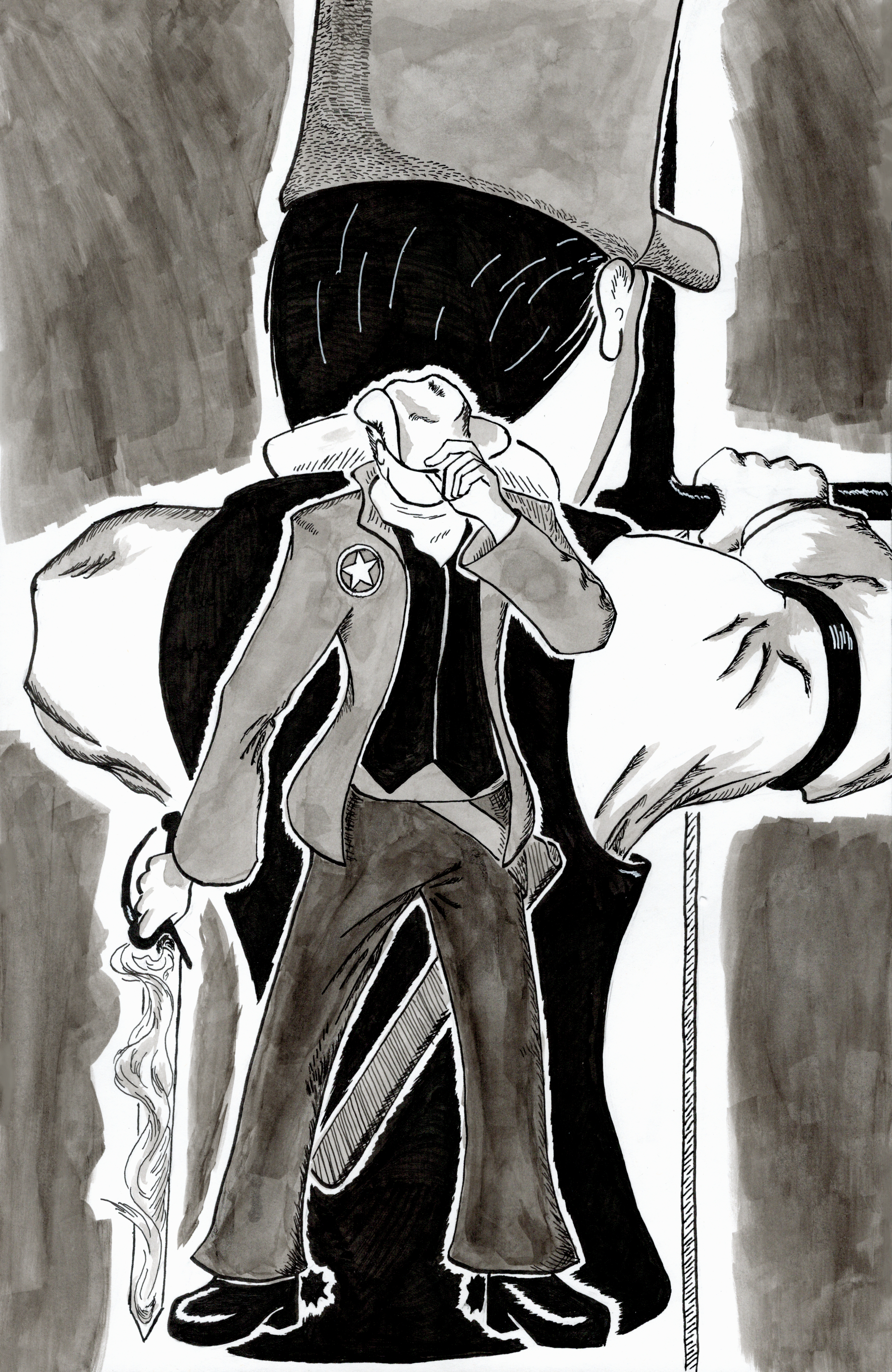
What? You wanted to read a story in that world? Well, Hexwood is a comic, you see. It’s not quite done with production although I can share the cover art with you here: 

But I don’t plan on publishing the script here. Still. Maybe we can work something out. Come back next week. You may be pleasantly surprised. 
Genrely Speaking: Weird Western

Boy oh boy we have not done this in a while. Long time readers know that genres are a thing that fascinate me, they are at once an attempt to codify stories and make discussing them easier and, at the same time, somewhat arbitrary groupings that carry different connotations among different people. For whatever reason the standards, exceptions and idiosyncrasies of genre classification entice me to think about stories through new lenses as I try and narrow down exactly what defines a story and its thematic content. Now all genres are broad categories and they tend to spawn a bunch of subgenres that narrow the scope to an extent, which for the purpose of Genrely Speaking are counted as regular genres rather than some beast of their own. A subgenre is almost narrow enough to be a useful tool for analysis rather than just a section in the library. 

That is, when it’s not just two genres pasted one on top of the other. 

Enter: The Weird Western. 

As the name implies this genre is built on a base of the Western. It has all the open horizons, independent lives and harsh consequences as that genre but it layers something… extra on top of that. That extra usually comes in the form of some kind of Space Opera or Low Fantasy (or, on rare occasions, some other Fantasy genre). On the one hand a Space Western can serve as a look at technology or social trends when they’re boiled down to just one or a handful of people surviving in harsh places. On the other a Fantasy Western takes many of the superstitions and traditions of the West and makes them real, living forces that the protagonists have to deal with on a daily basis. 

Given the many facets this broad genre can take I’m going to confine “weird western” to the realm of the second half of the blend, the Western with Low Fantasy, and refer to the first half as a Space Western. Note that this doesn’t rule out the Weird Space Western for the truly ambitious writer (see: Jack Irons, the Steel Cowboy.) Given this context, what are the pillars of the Weird Western? 

  1. Personification of the forces of change. This can take many forms, from clashes between Native American and European figures of myth to the personifications of railways directing expansion west to some kind of magical disaster driving people across the plains, some form of the supernatural will be involved in humanity’s move westward. This is true even if the Weird Western is set in some fictional world with no historical ties to the United States. One interpretation of this theme that I found particularly interesting was Cherie Priest’s Clockwork Century, where zombies started slowly overrunning the West in a metaphor for the creeping dehumanization of mechanization. 
  2. Magic as a treasure to acquire. The West was a place where people grabbed for a great many things. Land, water, livestock, transportation and precious metals to name a few. While all of those things still hold value in most Weird Westerns most of the players in the story are more interested in magic, which serves as a stand in that simplifies and streamlines the many different conflicts of a traditional Western into something a modern audience can easily understand. As modern culture has moved away from the kinds of work that defined the Old West fights over pasture or farm land and the relentless expansion of the railways have lost some of their immediate impact. Many Americans today don’t even own their own property, much less property that they use to sustain themselves. They are more used to wealth and prosperity in the abstract, in terms of bank balance, investment and the like. Magic in a Weird Western typically serves as an analogy to these more familiar landmarks of prosperity and survival and frames the characters’ desires in a format modern readers instantly resonate with. 
  3. A focus on outsiders. While the Western has always had its love for characters from ‘outside’ communities, from the traveling gunfighter to the displaced veteran, they still tend to focus heavily on specific communities. High Noon, Shane and Tombstone all feature very, very local stories with mostly local casts adding maybe one or two outsiders to provide prospective or an audience vantage point. This makes the narrative a bit more grounded and lends the tale an air of believability (roving gunslingers were by far the exception in the West, after all). In Weird Westerns outsiders are often a much bigger part of the narrative, with large numbers of them roving the West in search of the things that make them powerful and effective. Or, on the flip side, the story may feature people who have been displaced from a quiet town or camp and forced into bigger, more mystical environments that they must then learn to survive in. This lends the Weird Western Genre a tendency to build casts of hunter gatherers, rather than farmers or miners. If not balanced properly it can undercut the Western feel of a story (see the novel A Few Souls More for an example of this). 

What are the weaknesses of the Weird Western? It combines two genres that have a limited appeal. The most popular flavors of fantasy are some kind of Modern or Urban Fantasy and High or Epic Fantasy while Western is a genre few people pay much attention to at all. The tropes and archetypes that define the genre just aren’t as immediate and appealing to most people as they used to be. 

The genre also runs a serious risk of doing too much to really excel at any one thing. Most Weird Westerns try to blend a magic system or two with building a realistic supernatural West, strong characters, historical events and real world cultures. They also need a good plot, the ability to write dialog that is at once snappy and somewhat archaic and a sense of the bittersweet nature of a vanishing frontier. The author needs to do all of these things while balancing them so neither half of the Weird/West balance overwhelms the other. It’s a hard genre to do well and not a lot of people will be excited even if you execute perfectly. 

What are the strengths of the Weird Western? Like many forms of fantasy it gives us the ability to examine difficult questions at a bit of a remove. But more than that, when done right it taps into a section of myth that is powerful and currently quite fresh and new to the modern mind. The West is also one of the best settings to juxtapose modern knowledge and understanding with the conflicts of might and right, civilization and nature. Many of the conflicts we face today are the same as were fought in the West, and with the supernatural to personify the clashing forces there’s much you can say quickly and easily in the Weird West. 

The biggest struggle in the Weird West is building a world that will hold both the supernatural and mundane human portions of the narrative. The West was a very specific place and time, as I’ve mentioned before, and you have to be careful how you introduce anything new to it if you wish to keep the defining elements of the Western present. It’s fun, for sure, but also a tricky challenge. There may be something to talk about there. Hm… maybe we’ll take a crack at that next week. 

Fantasy is Inescapable

One of the most common complaints a modern fantasist hears about his or her work is that fantasy stories are so incredibly trivial. By the same token every modern fantasist has written some kind of rebuttal to this notion. George MacDonald, C.S. Lewis, J.R.R. Tolkien, each took up the standard in turn. Other authors, from bestsellers like George R.R. Martin and Stephen King to lesser known talents like Bill Willingham and Larry Correia, have donned the mantel and defended the fantastical in turn. While I’ve looked at the question of why we love fantasy myself, years ago, I’ve never thought about how to defend the fantastical tale if I had to justify its existence. 

Even now I’m not sure why people question fantasy. We’re surrounded by things that evoke wonder every day. Sunrise and sunset, birth and death, history and nature, all hint at deeper truths that underpin the world as we know it. Humanity’s response to these deep truths has always been the fantastic. From the earliest days of recorded civilization we have had a very sophisticated and story driven way of grappling with the portions of the world beyond our comprehension. 

From the beginning of recorded history the fantastic has come and gone in the stories we read. Gilgamesh fought and befriended Enkidu, the wild man, and together they slew the Bull of Heaven. Then Enkidu died and his death drove Gilgamesh to seek immortality. In a nutshell we see the contest of man versus nature, the cost of building a civilization and how it drives men to memorialize these sacrifices in the fabric of their culture. A sociologist or anthropologist could discuss these concepts in terms of numbers, pressures or psychological drives and add a great deal to the overall picture. But in a single fantasy the basic concepts are expounded on and laid bare to the casual listener in a way no other kind of discussion can. 

The English language is no stranger to fantastic stories either. From the early days of King Arthur’s legends to the plays of Shakespeare, fantastic characters have given voice to such abstract forces as the legitimacy of rulers, the forces of nature and the human drive for vengeance. Edgar Allen Poe transformed the influence of a hostile and overprotective father into a garden of poison that would slowly kill or warp those who lived in it. George MacDonald transformed the battle between good and evil in the human heart into the slow, horrific distortion of the human body. All of these were serious stories for sober minded men attempting to understand the world as it is. They left their marks, great and small, in our own understanding of the world. But all pale before the king. 

The most influential novel in the English language is undoubtedly Charles Dickens’ A Christmas Carol. It’s been parodied or homaged in every long running TV show or, in the old days, radio play. It’s been adapted to stage and film more than any other story in the Western canon. Everyone from Sir Patrick Stewart to the Muppets has taken a crack at it. And on a very fundamental level, A Christmas Carol is a fantasy. 

Ebenezer Scrooge is surrounded by ghosts. These specters embody any and every idea about the human condition you could want – greed, generosity, family, loneliness, regret, past, present, future, death, redemption and second chances. All of these things have faces and voices – or a lack thereof – that makes their impact on Scrooge felt with greater strength than millions of pages of academic prattle about these concepts ever could. In fact, millions of pages of thoughts on A Christmas Carol undoubtedly exist, but none of it comes close to equaling the thing itself. 

And this is a truth paralleled in Dickens’ tale itself. Scrooge understands all the fundamentals of Christmas from the first word of the book. But that simple understanding is insufficient. Ebeneezer understands Christmas but he cannot live it until he meets with it. And he hasn’t met Christmas in such a long time that it will take something fantastic – or, in the book’s own words, wondrous – to effect that meeting. This is why the first words of the book remind us of a simple fact: Marley was dead, to begin with. And later on Dickens reiterates this theme with the following words: 

“There is no doubt that Marley was dead. This must be distinctly understood, or nothing wonderful can come of the story I am going to relate.” 

The meeting of Scrooge and Marley, seven years after Marley’s death, was a wonder that opened the door for Christmas to meet Scrooge as well. And it was this meeting that would turn the grasping, clutching covetous old sinner into a man who could live Christmas all the year round. A transformation easy to miss in the mundane world but obvious  to all when it speaks to us through fantasy. 

A Christmas Carol is one of the first stories I can clearly remember my mother reading to me. It was the first play I saw live on the stage. And, perhaps because of this, I have never once had an issue with abstract ideas like generosity or regret wearing a human face and speaking its own mind. Add in a lot of reading of myth in high school and I’ve always assumed fantasy is an integral part of human culture. We need to hear the voices of progress and nature, heroism and despair, judgement and redemption. We need these things to be more than abstracts, we need them to walk among us and talk to us before we can truly come to grips with them, as Ebeneezer Scrooge did. If giving voice to those concepts, if giving them the power to make their will known, somehow classifies my stories as fantasies then that is what they must be. That is how humans are best equipped to hear them and that is how I want to tell them. 

The Loss of Western Symbolism

So remember when I talked about the use of goblins as a metaphor for human frailty? Well I’ve been thinking a lot about modern failures to make effective use of traditional symbolism and I’ve reached an almost inevitable conclusion – many Western symbols have been undermined to the point where they are entirely useless as storytelling tools. Yes, a lot my thoughts of late have been returning to various themes and my essays will be reflecting this. So let’s talk about symbolism. 

Symbols are the bedrock of communication. Words are essentially symbols for abstract concepts. On a lower level, even letters are symbols for individual sounds. We string three letters together to write ‘cat’. Those symbols tell us to think of a specific series of sounds which in turn we connect to the concept of a domesticated animal that humans adopted for the purpose of shedding fur on all of our black clothing. Language is essentially symbolic. Imagine if I were to write a sentence where short grinder hammerhead portal normalize traffic wrangle. Nothing would make sense, right? I can’t just use a word and change the meaning it symbolizes to something else, that would strip all attempts at communication of meaning and purpose. 

Our larger scale cultural symbols are just as important and just as vital to cultural coherence as words are to coherent communication. So I’ve been thinking about them and mulling them over and asking myself – are we even trying to communicate the core of these symbols anymore? Or is one of the reasons our culture seems unable to cohere any longer because we’ve abandoned the language that’s supposed to be holding them together? 

As with many big questions of this nature I have few answers. But there are two interesting data points to look at: Monsters and Relics. Let’s break them down, shall we? 

Monsters 

I already talked some about the nature of monsters in fiction when I talked about Goblin Slayer but let’s look a little deeper. Beginning with the Greeks monsters were seen as symbols of the ills of the human condition. In fact, many monsters were a result of human misbehavior if not actual humans transformed for evil actions. As examples Arachne was transformed for her pride and Medusa for lust and adultery (and public fornication). 

Moving forward into medieval times we see interesting stories like Saint George and the Dragon, where a country is poisoned by the influence of an evil creature that is devouring their children. George captures and executes the beast and the country is converted to Christianity. It’s an interesting inversion of the Fisher King, where the ills of a country are personified rather than its health. But the material point is that the recovery of the land is tied to a new moral system, symbolized in George’s battle with the Dragon. 

A wonderful modern take on this symbolic application is George (not a dragon slayer) MacDonald’s The Princess and Curdie, where a simple miner boy finds he has to fight an entire royal court that is slowly transforming into an army of monsters. Again, the transformation into monsters is driven by failings of character. 

But in modern tales there’s a strong resistance to allowing monsters to fill this symbolic purpose. Part of this comes from the creative desire to do something new, and rather than carve out new expressions of a symbolic theme many creators have chosen to just look at the symbols in a new light. Unfortunately that new light is almost entirely a literalistic one. Rather than look at monsters as metaphors almost all modern fantasies and fables try to grapple with monsters as stand-alone creatures that must be complete in and of themselves. 

Consider The Dragon Prince. The whole premise of this show is that there is an entire nation of exotic and fabled creatures brimming with magic and culture, and humans are locked in a struggle with them. There’s nothing wrong with that premise. But the story constantly invokes the symbology of dragons, complete with their hording, their vengefulness, their pride and their destructive temperament. And instead of overcoming them, the characters simply decide they must live with the dragons. 

And there’s a life lesson there, for sure. You will meet people like this, and you will have to live with them. But what this take on the symbolism of monsters misses is that, while classic monsters cannot exist without humanity, neither can humanity exist without monsters. 

The pat, easy answer of The Dragon Prince is that our difficulties are primarily external. They stem from misunderstandings or an unwillingness to compromise, not from flaws of character we must grapple with and overcome. But this kind of simplistic externalizing of internal struggles is far and away the norm these days, robbing a powerful symbol of its cultural impact. 

Relics 

This isn’t really the best word for what I’m getting at, as a ‘relic’ generally refers an item of some kind of great cultural or spiritual significance whereas here I mainly refer to items that take the measure of a man. Again, in early myths we see relics as measures time and again. The most common measure these relics took was the worthiness of a ruler. That’s seen in early forms in things such as the Golden Fleece but probably most significantly in the swords of King Arthur. Both the Sword in the Stone and Excalibur (when they aren’t the same sword, your legend may vary) are weapons that only worthy men can acquire. This was kind of a theme in the British Isles, as the Dyrnwyn was another, lesser known British sword that supposedly burst into a flaming weapon in the hands of a worthy man. Additional British relics include a whetstone that would only give sharp weapons to brave men, a coat that only fit the brave, and a mantle that only reached the ground on a woman who had honored her marriage vows. 

We see this theme in legends of the Norse as well. Modern culture brings to mind Mjolnir, the hammer of Thor, which only the thunder god was supposedly strong enough to lift – but in the ancient legends the weapon wasn’t limited in that way. In fact, it was stolen more than once. But Sigmund the Volsung also acquired a magic sword which only he could only pull free. The sword is as much a curse to Sigmund as a blessing but does serve as a mark of his exceptional nature as acknowledged by Odin. 

Of course the relic as measure of a man is a symbol we see in modern fiction as well. Even in the very recent examples of the MCU it’s everywhere. Not only is there the modern interpretation of Mjolnir but there’s Captain America’s shield, an item he receives in acknowledgement of his status as America’s greatest soldier and can only use effectively because of his skill and intelligence, and even Iron Man’s armor, which he wields by virtue of his scientific brilliance and character (such as it is). 

However, even the relic is beginning to fall from grace. In the MCU, Mjolnir was destroyed and Thor had to learn to do without it. In the Hard Magic novel series there are relics which serve to keep magic safe and usable but, eventually, are destroyed in favor of making magic more accessible. In fact, in many urban fantasy series relics that take the measure of their user get subverted into items that restrain their owner, a kind of shackle that keeps their owners on a preset path. In other cases they’re simply powerless items used to prop up shams or pretenders. 

Where the transformation of the monster is a somewhat understandable outgrowth of a more literal minded culture and the creative mind’s constant striving for new takes on old stories, the subversion of the relic strikes me as more an outgrowth of the dreaded postmodernism. A weapon like Excalibur cannot actually measure a person’s worthiness to rule so it has to be a prop intended to make people appear worthy to rule. The loss we suffer from this kind of perspective is pronounced. 

One of the things a relic as a symbol for worthiness can easily illustrate is why we must be cautious with those who are entrusted with power. All the British relics that measure worthiness inflict consequences on those who attempt to use them but are unworthy. Consider the cook pot – brave men can eat from it but cowards will starve. So be brave! Keep yourself and your community fed! Relics create an immediate sense of what the stakes are for having or not having the qualities they measure. Subverting them as a symbol for virtue internalizes something that should be external – if what we need comes from within ourselves or is just an idea we project onto the item to justify ourselves then, in almost paradoxical fashion, the consequences of falling short of that standard are no long our fault but the fault of our circumstances. Cowardice isn’t what led us to starve, there simply wasn’t a brave person here to get food and share it with us. Or perhaps we were just caught up in how society told us we should eat instead of considering new ways of thinking about meals (like food poisoning!) 

There are a lot of reasons to want to tweak things like symbolism in your storytelling. But every time this is done it’s like assigning a new meaning to a word. The more it’s done, the more overworn the word or symbol becomes and the harder it is to clearly convey the other concepts the word addresses. That’s a loss for communication, and it really needs to stop. Our symbolic language is part of our culture, part of how we share ideas, and if we lose it then art and culture become that much harder to propagate.

Five Betrayals of Alita’s Character in the Battle Angle Movie

A couple of years ago I wrote a breakdown on the failures of the movie Alita: Battle Angle to properly translate the villain of Yukito Kishiro’s manga (Gunmn in the Japanese, Battle Angle Alita for us English speakers). For a while I considered doing a full breakdown of that adaptation and all the many ways it failed but ultimately I didn’t want to spend any more money or time on a film that fell so short of what I wanted. So I forgot about it. 

Then they decided to rerelease the film in theaters.  

This could be a last ditch attempt to salvage the theater industry by pumping old films back into them. I know many fans of Alita hope this will lead to a sequel. What these people need to understand is that, even if they get a sequel, they will not get what they want. The Alita film does not understand the characters of its source material and it cannot develop them effectively. While Alita and her friends were not horribly betrayed like Nova was I don’t really believe James Cameron can effectively develop the story – this is the man who wrote Avatar after all. Beyond that, I don’t think he wants to develop the story of Alita, I think he is using the visuals Kishiro developed to try and tell his own story that, as I said before, is trite and overplayed these days. If my breakdown of Nova didn’t convince you of that, or you just don’t want to go back and read that post, here are five ways Cameron betrayed the heroine’s character in his film. 

  1. Movie Alita fails to learn. While manga Alita is not a genius like Nova or Ido she does learn and grow from the things she experiences. In fact she quickly picks up on Nova’s headgames and does her best to work around them. She rarely succeeds, as Nova is a truly formidable villain, but she does learn and grow. Movie Alita doesn’t seem to learn her enemies’ gambits at all. In fact, even though Vector’s deal to send Hugo to Zalem proves to be a flat out lie she immediately turns around and trusts that Motorball champions get to go to Zalem, even though this promise ultimately comes from the exact same place. Zalem itself. It makes her look incredibly stupid and shows that she’s not at all the same character as Kishiro’s heroine. 
  2. Movie Alita shows no compassion to her enemies. From the end of her encounter with Makaku, manga Alita showed the ability to form an understanding of her enemies and shows a deep sense of compassion for their circumstances and how they reached the place they did. She still defeats them but rarely does she fail to acknowledge their humanity. There are a few instances where Alita completely dismisses her opponents and just fights them senselessly and when she does it’s a moral failing on her part. Instead it is her acts of compassion, not her acts of violence, that have the biggest impact on the world and ultimately defeat Nova. Movie Alita never shows this connection with or sympathy for the evil people she must dispatch. She is far less humane than she should be. Worse, she executes Vector in cold blood when he poses no threat to her at all. This deprives Vector of his opportunity to grow and transform into a major pillar of society future as Kishiro’s Vector did. In spite of the many failures of the movie elsewhere Vector’s murder is what ultimately convinced me Cameron didn’t understand Alita. 
  3. Movie Alita cannot face the lessons of Motorball. The unfortunate truth is, by transforming Motorball into just another obstacle between Alita and Nova, the movie abandons the lesson Motorball teaches manga Alita. In the manga Motorball was one of the lowest points in Alita’s life. After losing Hugo she dives into Motorball so she can find a way to indulge her violent impulses without running into trouble. Except ultimately Alita does run in to trouble, and leaves the sport after a resounding defeat at the hands of Emperor Jashugan. She’s warned by her former teammate that she’s bad for the sport because she never came there for Motorball but just because she was seeking selfish fulfillment and that makes it impossible for her to be a true Motorball player. This rebuke was a decisive moment where Alita began to overcome her selfish impulses. Add in the low likelihood that Jashugan will decisively defeat Alita if he’s a barrier between movie Alita and Nova, thus depriving her of an insurmountable obstacle, there’s little chance movie Alita will get any of the value Motorball brought to manga Alita. 
  4. Movie Alita will never face her karma. In the manga Alita’s intervention between Zapan and Hugo was fundamentally unjust. Manga Zapan went looking for the spine thief by posing as a victim and trying to capture Hugo when Hugo tried to steal his spine. Manga Hugo never changed direction and thus earned his comeuppance from Zapan. Tearing Zapan’s face off was a grave injustice driven by Alita’s selfish blindness to Hugo’s evil actions. When Zapan and Alita fought again later on Alita was forced to face all the destruction her selfishness caused to both Zapan and her community. By allowing movie Hugo to turn over a new leaf and turning Zapan into a disgruntled rival who hunted Hugo as a sideways way to get back at Alita, the movie incarnation of Alita will not grow through facing the consequences of a significant selfish action. 

WARNING – SPOILERS FOR THE BATTLE ANGLE ALITA MANGA 

  1. Movie Alita cannot accept the Secret of Zalem. It’s a significant manga plot point that Zalem removes the biological brain of its citizens and replaces them with solid state computer chips. Zalemites are not told this substitution takes place. In typical cyberpunk fashion, once they learn this fact most Zalemites suffer mental breakdowns as they grapple with their sense of self and what this substitution might mean about what they are. Many Earth bound humans are also repulsed by this fact. There are three characters utterly unphased by this revelation – Lou (unimportant to this analysis), Alita and Nova. Nova’s sense of ego overrides any sense of humanity in the traditional sense, he’s far too monstrous to bother with the physical pieces that make up bodies, even his own, he’s lost in the intellectual challenges he wants to tackle. Conversely by the time Alita learns the secret of Zalem she’s developed such a sense of compassion for others that she treasures humanity no matter what physical parts make it up. Without the final secret of Zalem to bring out this part of her character Alita cannot reach the zenith of her character or show her ultimate contrast with her villain. And the hard reality is, movie Zalem does not use brain chips. Nova, Ido and the rest all have normal meat brains. How do I know this? Because we see Chiren after she’s been broken down for parts by Vector and her brain is clearly visible. Chiren is supposedly from Zalem. Thus brain chips are definitely off the table and with them the Secret of Zalem. 

SPOILERS END HERE 

Now I know, it’s possible to have two stories start in the same place and end in completely different places. Keep a hero the same and change the villain and you can still tell a compelling story, just with your hero growing in different and new ways. And I suppose that means an Alita sequel could be a decent film, even if it’s got nothing to do with Kishiro’s tale. But my core premise has and always will be, that Alita: Battle Angel should have been a retelling of Yukito Kishiro’s classic cyberpunk manga. Not Susan Collins’ dystopian YA novels. Not Cameron’s Avatar with cyborgs instead of blue people. But the latter two are closer to what we got. As far as I’m concerned Cameron can keep it.