The Last Note

This is a story that has lived on my hard drive for almost two years. It’s not terribly deep but it was very fun to write and explores some ideas I’ve wanted to play with for a long time. I’m not sure we’re coming back to Jack and Penny any time soon but I hope you enjoy this brief adventure anyways.


The wind whistled by at a high, sour F-sharp its breathy, mocking tone accompanied by the revving percussion of his motorcycle engine. It was all Jack heard as he fell. Chunks of the Syracuse 105 tumbled into the abyss all about him, eerily silent for such heavy things. One minute he’d been driving along, trying to get to his gig at The Wreck on time, the next he was free falling. Jack had always expected he’d die of something fun, like booze or women. It was the way of all great musicians.

On the other hand, falling to his death after a bridge collapsed under him at least had the appeal of novelty. It would’ve been nice to get a little famous before leaving stage. Sample some of that booze, dance with a few of those women, write some swingers about it all. Swing was his genre, after all, not jazz. The high and mighty of Ithaca far preferred jazz, though, and Jack Antixerxes had always prided himself on picking out a tune and running with it.

The shush of falling water filled his ears. For the first time since his bike had tumbled off the end of the collapsing causeway Jack pried his eyes open. It was taking a long time to hit the ocean’s surface and now he could see why. An enormous sinkhole had opened in the bay and the surf, the bridge and all the vehicles once on that bridge were tumbling further down into the belly of the earth. Jack and his bike were already past the usual bottom of Syracuse Bay with no visible endpoint to their drop.

Stranger still, a glance behind told him the hole he’d just tumbled through was getting smaller, not larger in spite of the water rushing in. A dim memory of the news reporting collapsing shorelines and freak mudslides a few times in the last couple of months surfaced in Jack’s mind. He hadn’t given it much thought at the time. Who was playing in what bars or dance halls was far more interesting. Now he wished he’d payed more attention, perhaps there had been some clue to surviving his predicament there. Or not. It was really too late to know for sure.

When Jack realized he could finally see the ground rising up below it banished that train of thought from his mind. He’d always hoped the boys from the band would play his funeral. Turned out his last song was the roar of a motorcycle, the rush of water and the taunting whistle of the wind. Not what he’d hoped for but not terrible, either. Better than some tunes he’d heard.

Still, it was one song he wasn’t ready to vibe with just yet. He’d tucked his knees in a last ditch effort to roll with the impact, fighting the confines of a suit jacket that didn’t have much room to give, when a rumbling arpeggio rose up out of the dark below. Two beats later a sharp, high countermelody answered it. The air around the falling derbies thrummed with power and dissonance then Jack felt his momentum slow. His bike shot past, narrowly missing his skull, then it slowed too and for a brief, stomach turning moment everything hung in the air as if weightless. The ground was only four or five feet below. The motorcycle was practically standing upright on its front tire and, with no clear idea of what in Hades name was going on, Jack decided the best thing to do was unhook the bungee cords holding his case down and pull it off the back of his bike.

He’d just got his arms around it when everything remembered it was supposed to be falling. Jack landed with a heavy thud and rolled to one side to avoid his bike toppling over on top of him. The roll turned into a frantic sprint as he tried to outrun the waves of water, rubble and metal still falling. He saw one sedan crushed between blocks of cement and the cave floor. A double semi truck was its own undoing, crushing the driver’s cab under the weight of whatever cargo it had been hauling. At least one other car landed upside down.

Jack almost didn’t make it himself. Between the ankle deep water already on the ground and the sheets of extra liquid that were still falling it was hard enough to keep his feet. Add in the concrete, cars and rocks and it was a miracle he wasn’t killed outright. He might not have made it if the high harmonies he’d heard a moment ago hadn’t reasserted themselves. Once again his stomach flip-flopped and once again gravity turned strange. His feet nearly pulled clear off the ground as he ran but the rapid descent of the deadly rain turned to a lazy drizzle and Jack managed to get clear of the worst of it before stumbling and loosing all grip on the rock below.

The new melody cut out and he fell flat for the second time in the last minute. At least this time he managed to protect his case with his body. As things stood he worried the previous fall was going to leave a permanent dent in his instrument.

It was a small price to pay. After all, he was alive.

Jack pulled himself up into something like a sitting position and stared out at a football field’s worth of rubble and smashed cars. Far above, the last rays of afternoon light from Syracuse Bay vanished. Suddenly the only light in the cavern came from small burning oil slicks released by wrecked cars, glinting on stray bits of metal and ocean water.

Or was it? Jack dragged himself to his feet, staring into the dark just beyond the debris. It looked like something out there was flickering like a giant bonfire. He whispered, “Charon? That you?”

A hand grabbed his elbow in a vice-like grip. Jack jumped with an inarticulate yell. The hand didn’t let go but instead pulled him down into a crouch then another hand slapped over his mouth, cutting him off. Which was just as well, D-Major wasn’t really his key. Not for singing, anyway.

“Shhh.” As Jack’s eyes adjusted to the dimmer light he made out the shape of a woman who was holding a finger up and making the world’s universally acknowledged ‘be quiet’ gesture. So it wasn’t Charon, at least. When he nodded she moved her hand off his mouth and softly said, “Hesiod.”

“Jack.” She’d let go of his elbow to shush him so he patted his chest to make it clear he meant himself. “What’s going on?”

She shook her head in frustration and pointed out over the wreckage to a faint light approaching them. Jack’s eyes, still adjusting from the bright Syracuse sun, struggled to work out what it was. After a moment he decided it was a torch held overhead of a large, muscular looking man who was picking over the debris. Jack had a moment of vertigo as he tried to work out why that was off. Then he realized the man was in the process of flipping a big SUV up off its side.

The vehicle was about as long as one of the creature’s arms. That made it at least twenty five feet tall. Someone inside was screaming but that stopped once the giant ripped a door off and dragged the man out by the arm. Then it shifted its grip and bashed the man’s skull against the ground and the screaming cut off. Jack felt bile rise in his throat. When the creature raised the corpse up to its mouth and tore a limb off in its teeth Jack retched and ejected the early dinner he’d eaten before leaving his apartment.

“Hesiod mustn’t catch us,” the woman hissed, grabbing his arm again and pulling him away from the puddle of vomit while maintaining a low crouch. “Shhh.”

A last look over his shoulder as she dragged him away confirmed that Hesiod was still searching the wreckage of the cave-in even as he ate. In the flickering light of its massive torch Jack couldn’t be sure but he thought it had just one eye in the middle of its forehead. The grinding sound of its chewing seemed to fill the entire cavern. For once, not even Jack could pick out a tune from the noise. Then the creature let out a bellowing cry, something in a language that sounded vaguely like Athenian but so poorly spoken as to be gibberish.

“He sees us,” the girl snapped. “Just run.”

She suited actions to words and stood up, taking off in a dead sprint, and Jack did his best to keep up. He struggled for a moment until he realized he had to follow directly behind her. Somehow the rough terrain of the cavern didn’t hamper her footing and if he did his best to match her steps he found the path fairly smooth. The voice of the giant rose behind them in an eerie cadence. Now that he could place it Jack knew this creature was the source of the deep, rumbling song he’d heard when falling. The melody was much more monotonous than previous, less a climbing arpeggio and more a simple chord sung in a five note rotation. A low rumble created a percussive backing.

The strange woman slowed her pace a bit and took up another tune, breathier than the high pitched tunes from before but still recognizable as the same voice. The tempo of the rumble slowed, then stopped. She was clearly struggling to keep moving while singing but somehow she managed both. However a few seconds later they were forced to stop when they reached the wall of the cavern. A small opening in the wall, just large enough for Jack to push his head and one arm through, trembled in time with the conflicting songs. One moment it was closing itself off, the next opening wider. A dim light on the other side of the opening showed a tall but narrow tunnel winding off into the earth. Jack frowned. Clearly this was their escape route. Just as clearly the music was manipulating it somehow, just like the earlier song had obviously opened and closed the roof of the cavern earlier.

He had no idea how or why this was happening but Jack could vibe with it. The girl was frantically pushing at the sides of the hole, as if she could tilt the scales in her favor through sheer strength. Jack flipped his case open, took out his mouthpiece and attached it to his trombone. The key was G-Minor and the tempo was three/four time. Not ideal for swing but manageable.

Blow out the spit valve, work the slide, take a deep breath and away he went. First he just matched the girl’s song but dropped an octave. She dropped a bar in shock when the bone’s bright, brassy tone blared out and Jack realized he was playing full blast. Probably nerves. He adjusted down to half strength and added the swing, working the slide a little looser and bobbing the bell of the horn back and forth with the beat. Two bars later the opening in the cavern wall started opening again. As soon as it was wide enough the girl wormed her way through.

It took another fifteen seconds for the tunnel to open enough for Jack to get through with his trombone and, since he still wasn’t sure how this all worked, he wasn’t willing to stop playing it long enough to make his escape. It was a near thing, though. By the time Jack made it through the giant was close enough to clearly see its single glaring eye, matted red hair and wild beard in the flickering light of the torch it held overhead. Jack was expecting Hesiod to be an ugly brute but, except for his receding hairline, he was actually kind of handsome. He wore a ragged tunic made of a patchwork of fabric and a suit of scale armor that looked like it was assembled from scrap metal and car doors.

There was an army of other cyclopes marching along behind him. They were about as tall as Hesiod’s knees, larger than most people but still far smaller than the titanic creature they followed. Hesiod’s eye shifted slightly and Jack instinctively knew he’d been spotted. The giant made a gesture and the army with him burst into full chorus. The opening in the wall started to grind closed again and Jack quickly ducked further back, his shoulders scraping against the stone as it closed in.

The girl grabbed one elbow and pulled him deeper and deeper. She’d stopped singing and as soon as he was clear of the closing stone she pushed the bone’s mouthpiece away from his lips. With their music stopped and Hesiod’s blaring the tunnel mouth collapsed immediately. It didn’t stop there, either. Jack found himself once again running for his life, charging down a dimly lit corridor, trying to match the movements of the strange woman. Behind him the tunnel clamped down like a monstrous throat trying to force him into the belly of Gaia itself.

Jack wasn’t sure how long they ran but eventually the sound of grinding stone behind them stopped. All he could hear was the pounding of footsteps on stone and blood in his ears so he slowed to a stop, gasping for air. “Sorry, beautiful,” he wheezed. “I gotta rest for a few or that big guy will just eat me after my heart bursts.”

The woman didn’t really look like she was in any better shape. As soon as Jack spoke she also stopped and staggered back to him, chest heaving. It was quite distracting. “How…” She gulped down another lungful of air. “How did you know the song of the stone? I didn’t think any of the ancient songs were still known on the surface.”

“It wasn’t hard, the tune was pretty simple.” As his breathing stabilized Jack turned his attention to his bone, trying to figure out the best way to transport it. He’d left the carry strap in his case, which was still back in the big cavern, but the clip for it was still on his instrument. Jack grabbed the knot of his tie and pulled it off. “So simple I can’t believe that was all it took to move stone like magic. If we could do that in Syracuse someone would have figured it out by now.”

The girl pointed to a glowing seam in the rock of the tunnel wall that poured out dim, orangish light. “The Waymaker’s Veins no longer run all the way to the surface, the turn of the earth has cut them off. Without the power they bring the songs lack force.”

“Great.” His tie wasn’t long enough to create a comfortable sling for his trombone on its own but it supported enough of the weight he could hold it in one hand indefinitely. “So, I’m Jack.”

“You said that.”

“I was asking your name.”

“Penelope.” For the first time since he’d met her Jack had enough time to take a solid look at the woman. She wore a long, ragged piece of cloth wrapped around her waist in a loose skirt, tied down with a length of nylon rope. She’d tied pieces of tire rubber to her feet with more rags. The only thing she wore that looked like it was originally meant to be clothing was an oversized jacket with the sleeves rolled up to her elbows. Underneath it she’d wound more lengths of cloth around and across, using them to hold up a chest that probably would have required custom made support even if she lived on the surface. She was about six inches shorter than he was. In the orange light of the tunnel, her waist length hair looked like it was light brown. She wore it in a loose pony tail tied at the nape of her neck.

The strangest part of her appearance was the skin hugging gray glove that seemed to fit her right arm like a second skin. A strip of similar material covered her eyes. The gray was so neutral he’d mistaken it for shadows in the poor lighting of the cavern and it was still hard to pick out in the somewhat brighter light created by the veins.

Jack frowned. “Where are you from, Penny?”

“The surface, originally. When I was six I was brought down here in much the same way you were but most of the others on my bus were killed an eaten by Aresians like Hesiod.” She said it in a flat monotone that rushed by faster than they’d run from the cyclopes. “A couple of us were found by the T’ul first and they led us away to T’ultown but I’m the only one that was healthy enough to survive.”

Penny turned and started off down the tunnel again, her posture close and guarded but her pace fitted to their circumstances. With nowhere else to go, Jack tagged along, trying to pick which absurd thing she’d said to ask about first. Finally, he decided on, “Aresians? Like, creatures from Ares? The planet Ares?”

“Yes.”

“I don’t know if they teach it in kindergarten but Ithaca has landed automatons on Ares and there’s no life there.”

“Not anymore.”

“Sure. Okay, so there’s a bunch of Aresian cyclopes living under Syracuse.” Honestly, Jack wasn’t okay with that but he’d seen them himself so he’d have to go with the flow. “Why do they eat humans? We’re native to the third planet, not the fourth.”

“Because that’s what makes it possible for them to grow so large. Also, they hate us.”

More things he didn’t like to contemplate. He was debating whether to ask about T’uls or the nutritional value of the average person when Penelope abruptly dropped to a crouch and slipped out of the tunnel they’d been in so far. It opened out into another dim cavern, the extent of which was difficult to judge. Like the tunnel, it was lit by a pale, diffuse orange light from Waymaker’s Veins although, unlike in the cavern, the veins Jack could see were wide enough they could be sidewalks. He started to step out beside Penelope but she pulled him down into a crouch as well. “We need to cross open ground now. This is the riskiest part of the trip so try to stay low.”

“More Aresians?”

“And other things.” Satisfied with what she saw she motioned for Jack to follow her out into the new cavern. He was not prepared for what was out there. It was less a cavern and more a chasm, sloping down from the opening into the Stygian abyss far below. More surprising, the slope of the chasm they stood on was carved into terraces, each the depth of a football field, and each terrace was packed with buildings.

In the orange twilight of the veins it was hard to pick out anything particular. The city sprawled over the side of the chasm like a primordial serpent, the tops of the buildings half lit like scales. Wind quietly moaned through the abyss, a mournful, high E.

“Don’t listen to that,” Penelope said.

“Why not?”

“It’s not healthy.” That was all the explanation she offered before scrambling down the slope towards the first terrace.

Jack scuttled after, trying to keep his footing while juggling his instrument. Either marching band was further back than he’d thought or hustling through back halls and side stairs in old stadiums hadn’t actually prepared him to take a bone anywhere on Gaia like he’d once thought. “Pretty big place,” Jack mused. “Your T’ul must’ve been down her a long time.”

“Ever since the Waymakers finished their song,” Penelope replied. “This isn’t T’ultown, though. That’s deeper still, past the terraces, near the base of the chasm. No one lives here anymore.”

Jack stared at the massive city in dubious fashion. “Long way down.”

“I have a base camp I set up here after I picked up on Hesiod’s trail. It’s not far down the terrace in that direction.” She pointed off to the right to a part of the city that, if he squinted, looked like it was a little brighter than the rest. Or maybe that was his imagination.

Penelope set off along the rim of the chasm, picking her way across the rough terrain with her usual nimbleness. Once again, Jack did his best to keep up. “Couldn’t we use the streets? I can’t see in the dark as well as you can and we’d probably make better time on flat ground.”

“Maybe. But we’re better off not getting too close to the Central Gate.”

“Which is what? The way in and out of the city? Who built this place if not your T’ul, anyway?”

“Hard to say. The T’ul don’t know and they don’t like to come here on their own. The foundations could have been laid down by humans before the Waymakers came. Or the city could’ve been built by the Aresians, the Vish or any of the other peoples of the worlds that ring the sun.”

“Wait, there’s more than just Aresians on Earth? Since when?”

“Since as long as anyone down here remembers. Don’t listen.” She stepped into a flattened channel that led deeper into the city. Jack wasn’t sure what she meant until he followed her into the channel and the distant moaning that made up the chasm’s white noise rose to a powerful tone that seemed to fill the world.

Penelope hurried across the channel but Jack paused. Somewhere, deep in his gut, a new thought took root. There was a tune there and he had to play it. Then Penelope grabbed him and dragged him off the path. The urge passed. “What was that?”

“The Gate. It still remembers the last song of the Waymakers. That’s why I avoid it. So do most sane peoples down here, assuming they wish to stay sane.” She started forward again.

Jack stared back at the channel for a long moment. The sound was still drifting up from the city but the power it had a moment ago was gone. The feeling that a tune was there, however…

He hustled to catch up to his guide. “Listen, I know you’re the one who knows her way around down here and I don’t want to get eaten but do you think you could just explain all this to me from the beginning?”

Penelope sighed. “Fine. It would be easier back at camp but the short version goes like this. Sometime before history begins there were Gates between the rings of the sun. Humans, Aresians, Vish and others used these gates to travel from one ring to the next – planets, as we call them now. At first the gates could only be used when the planets were aligned. Then someone figured out how to power the gates so they could be used regardless of where a planet was.”

“Who was that?”

“Everyone says it was someone else. The Vish blame the Aresians, Aresians blame the Jad and so on. The one thing they all agree on is that humans didn’t change the Gates.”

“Why are they sure of that?”

“Because Earth is still a habitable world and humans were originally the weakest children of the Sun.” Penelope pointed towards the chasm. “To power the Gates when the rings were out of step it was necessary to harvest immense power from the heart of a world. But doing that cooled that ring and it slowly became uninhabitable. No one noticed for a time but, once it became clear the other worlds were dying, the peoples of those worlds made plans for survival. Or should I say, they all made the same plan.”

Jack nodded. “They came to Earth because we hadn’t changed our Gate to travel whenever we wanted. So our planet was still habitable. So a bunch of people came here from other planets and tried to take over? It must have been a bloodbath.”

“You’re half right. This one is safe.” Penelope stepped down into another channel then turned to follow it. For a brief second Jack hesitated, the memory of the last time still painfully fresh. However Penelope looked fine and he’d already lived through at least two things that should kill him that day. What could a third hurt?

He stepped into the channel and found that nothing changed. Except the light got a little brighter. One of the wide, orange veins rose up out of the ground in front of them and ran down the center of the channel until it turned into a road. “Nice place.”

“It may have been, when people lived here.” Penelope led him into the heart of the city. “There was a terrible war when the other children of the Sun came here and humanity was losing, badly. Things changed when the Waymakers opened the Gate.”

“More people? Where’d they come from, another solar system?”

“In a sense.” Penelope started rubbing at her left wrist absently, the strange fabric of her glove shining dully in the dim light. “The Waymakers came from Earth, but not the Earth we know. There are worlds in this same place but locked away on the other side of the horizon. Their rules are different but the world is the same. Do you understand?”

“You mean like a parallel reality? Alternate timeline? Something like that?”

“Something like it. The Waymakers sought to unify all of the Earths so that a man might walk the extent of it from the dawn of creation until the end of Eternity. Or so the T’ul say. There has never been a human civilization like them before and there never will be again. They took the Gates and powered them with the might of their will then traveled to all the rings of the Sun. They plundered the other planets to replenish all that Earth had lost and they smote the other children of the Sun until the Waymakers alone were undisputed masters of the rings.” A wan smile played across her lips. “The humans of our Earth believed they had been saved. Maybe they were. But the Waymakers had one inescapable flaw.”

“They flew too close to the sun,” Jack mused.

Penelope looked shocked. Even with her eyes covered by that strange band, which Jack guessed had something to do with her supernaturally good senses, it was still possible to read that expression. “They still tell the story up above?”

“I don’t know if Icarus was inspired by your Waymakers or not although his father certainly had a gift for building things.” Jack shrugged. “Either way, it’s a mistake that lots of people still make. I take it the Waymakers’ project of unifying Earths exposed them to something that brought them low?”

Penelope nodded glumly. “Eventually, although it took ages. The T’ul never told me what it was but eventually their hubris undermined them, their civilization crumbled and their Gates began to sing their last song. It took a century for it to finish but when it did the Gates changed. They’re not doorways to other Earths, or even the other rings anymore. Now, they sing the Waymaker’s last song and all who hear it join in until the Gates drag them away.”

It was a solemn image, made all the more distressing by the constant drone of the Gate in the distance. At some time in the forgotten past humanity had ruled the solar system and brought the people of all nine planets to heel. Now all that power was gone but the hatred that feat had engendered remained. Penelope’s story sounded strange, although no more strange than anything else he’d seen that day. That didn’t mean he bought it. Like any other Ithacan of his generation, Jack had come of age along with the Internet. He knew anyone could tell a story. If enough people believed it that tale would never be forgotten. None of that made it true.

Although the glowing lines of magic power that you could access with music did make it seem like anything was possible.

“So the Aresians use the Wayfinder’s Veins to catch people and eat them so they grow larger, right? They open up a hole and pull people like you and me in. How long have they been doing that?”

“I don’t know. It’s hard to keep track of time down here. I’m not even sure how old I am, although the T’ul tell me I’m physiologically an adult.”

He shot her a sideways look. “They taught you some pretty big words, too, unless you went to a kindergarten for the ludicrously gifted. How do they know so much about us?”

“When they decide to trust you, they can explain it to you.”

Jack opened his mouth to complain but a distant, basso profundo voice singing a rhythmic chant drifted over the terrace. His stomach did a flip-flop. It sounded like it was on the side opposite the Gate. “Is that Hesiod?”

“There must have been a speed line I didn’t know about,” Penelope hissed.

“I thought this was your home turf!”

“I’ve only been on this terrace for about a month, there’s a lot I don’t know about it!” She pulled him onto the wide, orange line and pointed to his trombone. “Can you pick up any song on that thing?”

“Anything the human voice can sing.” He moved his horn to the ready position and worked the slide a bit to limber up. “Give me a few bars and I’ll fill in the rest.”

Penelope replied by piping out a series of staccato notes with very little variance to them, a marching anthem turned up to eleven. A pulse of light rose up from the Wayfinder’s Vein and an invisible hand pushed them forward. The tune wasn’t bad but, like anything, Jack felt it could benefit from punching it up with a little swing. He blasted the notes from his bone then added that swing and their speed doubled.

This little tune had unexpected twists to it, though. Turning from one vein to another required changes to the progression of notes and the first time Penelope sang it Jack didn’t see it coming. The resulting twist in their momentum flung him off the vein and he probably would have broken something if Penelope hadn’t grabbed him with her right arm and dragged him back. For a moment he thought he saw muscles like steel cords rippling under that gray glove. The next time they turned, Penelope sang the altered series of notes twice so he heard them coming ahead of time.

At first the thrill of traveling by music banished all other thoughts from Jack’s mind. Every swingin’ musician said they could feel the music move them but at that moment Jack knew none of them had ever felt it like this. But as the initial rush faded he realized Hesiod’s cover of their song wasn’t getting further away. It was getting closer. Louder. Coming from more directions.

They were getting surrounded. Penelope was turning down one vein then another, taking them up and down the terrace. At one point they headed along a vein that eventually sloped down to the next terrace below. However there was a mob of normal sized cyclopes down there, waving torches in time to their marching tune as they shot along a parallel vein.

Penelope quickly turned them back up and towards the tunnel they’d emerged from. The sound of Hesiod’s song echoed off the stone buildings around them, getting closer all the time, but another sound was starting to overpower it. A long, moaning high E.

Penelope abruptly stopped singing. It took a second for Jack to notice and follow suit, a moment more for their momentum to fade and bring them to a stop at a major crossroad where four of the great Waymaker’s Veins met in an intersection. In three directions groups of Aresians approached at the speed of song. The group opposite the empty path was led by the towering bulk of Hesiod the giant, waving a torch the size of a small tree in the air, the torchlight glinting of dozens of sinister eyes clustered around him. He boomed out a word in his garbled Athenian and the songs of the cyclopes faded as well.

For a moment only the Gate could be heard. Then Hesiod boomed out more gibberish that had the sound of a taunting question. “What’d he say?”

“He asked if we’d like to be devoured by him or the Gate.”

Jack licked his lips, trying to think of something witty to say. He came up blank. “You have a preference?”

“I’ve been avoiding Aresians since I came down here, I’m not about to give them what they want now.”

“Gate it is.” He wet his lips one last time then put them to the mouthpiece once more. Penelope piped out the downbeat and he joined in to send them sweeping away from the giant and into the embrace of the Gate’s song. It was hard to keep track of things after that.

The high E overwhelmed every attempt he made at independent thought. As hard as it was to believe, Jack felt like the Gate was truly mourning. He had visions of crowds of humanity teeming down the streets of the terraced chasm to the Gate, pouring through it at all hours of the day. There had been purpose and possibility to their travels and, in turn, purpose and possibility for the Gate. It had looked over endless vistas in those days. Now it saw nothing but darkness. No one saw purpose in it and so its potential faded away. All it could do was sing the last song it knew and wait.

Jack and Penelope found themselves standing in front of a massive oval, partly buried in the ground yet still taller than Hesiod standing upright. The opening was… nothing. The other side did not show through it, it did not glow with the power of the Waymaker’s Veins nor was the opening black with night. When Jack looked away from it, he could not remember anything about the portal. When he looked at it he could not think at all.

“It wants us to go through,” Penelope whispered.

“I think you’re right.”

“Why?”

“Why did you try to keep Hesiod from catching and eating me?”

She was quiet for a moment. “You think it’s lonely?”

“Not quite.” Jack pursed his lips once, then twice, and raised up his trombone. “It’s been a good set, Penny. Think you can follow my lead this time?”

She laughed softly. “I never learned songs quickly but I’ll try.”

He brought the slide in and tested a note or two, looking for that high E. Once he had it he started towards the Gate and matched it’s note, mournful moan to brassy blast, and he started in on his set. The boys had planned a killer show and it was a shame to let all that practice go to waste. If the booze and the women were out of reach then playing his own way out would just have to do.

Every night begins with the dance, an explosion of joy and energy. Jack swung his way towards the gate, Penelope struggling to follow the tune as much as his steps. The Gate was unmoved. He segued into a smoky tune of desire and longing. Penelope slipped an arm through his as the Gate drew them near. Finally Jack dropped the bell of the horn low and played a soft, slow song for family left at home, sung by a soldier as he lay among the dying. The Gate stooped low to catch every note.

The song ended as the sun set on the soldier’s last breath. Jack barely breathed himself, that barest gust of wind playing the same high E he’d started with. He held it as he stepped through the opening. The Gate whisked Jack and Penelope away. For a moment he couldn’t see anything and he felt the Gate’s moaning note fade away as nothingness engulfed him. Jack pulled away from the mouthpiece and took a deep breath. The Gate thought things were over but that was its mistake. For as long as it stood in the middle of that city the song of the Waymakers had never ceased. It didn’t know that a tune could end. It didn’t know the world still turned. It just clung to that last note, wondering why no one was there to sing with it anymore.

What it didn’t realize was that if you never let go of the last note you never had a chance to hear the coda. Jack adjusted the slide and dropped from E to G, from minor to major, and played the next sunrise. The cry of a child, born at dawn of the first day of the year, a promise of life in exchange for death. Of hope after loss. Of a new song to follow the old, if you have the courage to push past the end.

The Gate shuddered. For what felt like an eternity nothing else happened.

Then it showed them a glimpse of other worlds. The red plains of Ares. The roaring storms of Dias. The sweeping oceans of Gaia. But now that the show was over Jack just wanted to hit the green room and talk over the set with his band.

The vistas vanished and the Gate went still. All Jack could feel was Penelope, still clinging to his arm.

Then a door slammed shut behind him and they were standing under a flickering florescent light, backstage at The Wreck. A battered, threadbare couch sat in the corner to his left and a mirror sat over a counter to his right. Jack felt a smile creeping across his face. Penelope tensed. “Where are we?”

He indulged a full grin. “A dance club in Syracuse City. Hopefully in time for the after party.”

“We’re not dead?”

Jack burst out laughing. “Not yet! Let’s see if we can squeeze in another set or two before they chase us off the stage.”


If you enjoyed this story or just want to support the work I do here consider picking up Have Spell, Will Travel, my short story anthology available on Amazon here:

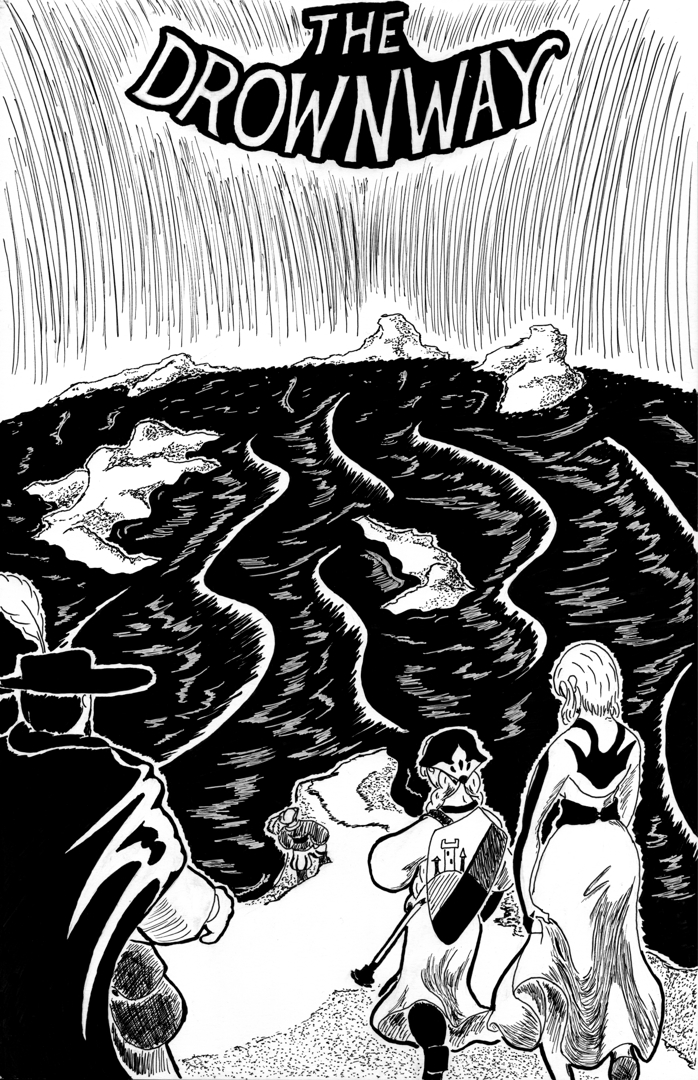
Coming Soon: The Drownway

Well, it’s a new year and that means it’s time for a new project. I had a number of possible projects to work on after the end of The Sidereal Saga, which is the usual way of things as I get ready to write a new tale. It’s pretty rare for authors to lack ideas to develop, although it does happen from time to time, so when it’s time for something new the biggest challenge is deciding on what you want to do. The second biggest challenge is sticking with the idea until it’s fully written.

One of the simplest ways for me to determine what a good idea to focus on is to look through the stuff I’ve written in the last year or so and see how well it matches up to waiting ideas. That is one of the reasons I publish a number of short fiction projects before launching another large one. The short fiction helps clear my mind and determine what I’m really interested in versus what I only have a few hundred or thousand words worth of story for. If I can write two or three short stories about a character or a world I can undoubtedly write a novella or a novel about it.

So no beating around the bush – if you read my previous short stories last year you may have noticed a couple revolving around the world of Nerona, a place based on medieval Italy in the Borgia era. My next project, The Drownway, will be set in that world. To go along with it there will be two Nerona short stories, including The Shadowed Canal, which originally appeared in Issue #2 of Anvil Magazine. There will also be a couple of other stories going up as well, so we will not really get into The Drownway before February. However, before we begin I wanted to take a little time and give a brief overview of what inspired the story.

That’s kind of difficult in this case because the idea behind The Drownway is actually pretty simple. There is a rich and deep history of telling stories about people that go to dangerous places, explore them and make them a little bit safer for anyone who follows in their footsteps. In most cases those stories are just that – history. However history is a great model for the fiction writer and I, for one, find it a very rich one. Yet there are other forms for this story to take.

The great exploration tales of the past involved huge expeditions, ships and provisions, casts of characters to wide and varied to encompass in a single tale. You can, of course, focus in on a handful of characters. I did just that in the Triad World novels. However there is another model.

The pulps often presented explorers as a handful of adventurers who went into the frontier or into ancient places and mapped out the dangers. They fight the monsters, they mark the dangers and they come back to accolades. Now I have my issues with the pulps in both their modern and classic incarnations but the style has endured for good reasons. The real perk of this kind of pulp exploration story is in its focus on pure entertainment. It offers a chance for a larger than life personality to reshape a little part of the world for the amusement of the audience in addition to reminding us the world can be made a better place by courage and vision. That is what I hope to do with The Drownway. I hope you will join me for the ride!

If you’re curious what my writing is like there’s a large archive of it available here. If you’d like to support this endeavor the best way to do so is by picking up a copy of my book, Have Spell, Will Travel. It’s available through this handy, dandy link:

Fiction returns next week! See you then.

The Eucatastrophy of One Piece

I try to keep my rambling about my favorite manga to a minimum around here. It could very easily be my exclusive focus if I let it and there are so many other topics I want to write about so a certain restraint is called for. Three essays on the topic in one outing is certainly more than I had planned on and two of them on a single series is certainly excessive. Yet there is something in One Piece that I have been contemplating for a while that bears examination.

Eucatastrophe is a literary term coined by JRR Tolkien to describe the moment in a story where things go suddenly and inexplicably right for the protagonist. In short, it is the opposite of a catastrophe. It was Tolkien’s stance that eucatastrophe was the highest form of fairy story just a tragedy was the highest form of drama. They exist to remind the audience of the power of providence. They serve to reward moral behavior. And, let’s face it, when done well they serve to put a smile on our face that will not soon go away. The problem comes about when they are not done well.

The eucatastrophe is a literary device that is often employed by Eiichiro Oda, the author of One Piece. However it is also one of his most controversial tropes. That’s not surprising to anyone familiar with the Internet’s fascination with both trope talk and pessimism but it does bear examination. However conducting that examination is going to require an examination of several events scattered across several thousand pages of illustrated story. I don’t have time to recap all of it so if you’re not already familiar with One Piece you may feel a little lost. My apologies but it can’t be helped in this case. And, of course:

SPOILER WARNING

Oda has a terrible habit of not killing his characters. By this i don’t mean that he doesn’t put his characters in situations that would kill them. The problem is more that he puts them in situations that should kill them, then they just don’t die for no clear reason.

The most obvious example of this is the character Pell, who takes an explosive device that will supposedly level most of a city, and flies it away so no one is harmed. He is still holding it when it detonates. Yet Pell survives and returns home about a week later with nothing more than a bandage wrapped around his head.

A similar case is the butler Merry, who is stabbed through the chest five times, left on the ground overnight, and is up and walking again just days later. The butlers of One Piece are made of impressive stuff, it would seem.

It has been argued that all people in Oda’s world are of superhuman toughness as practically everyone in his story seems stronger, tougher and cooler than a normal person. However that’s not particularly satisfying either. We do see people die in One Piece. The obvious example is Nami’s adoptive mother Belle-Mere, who is executed by the pirate Arlong, but there are plenty of others. Typically they are the friends and family if main characters. This provides us insight into the nature of our cast and an emotional moment to connect them to. Oda is quite good art creating these moments.

However, after writing his story for nearly thirty years, Oda’s patterns are quite clear to anyone who goes looking for them. Deaths in One Piece exist to create emotional moments. The often cruel and arbitrary nature of death in the real world is absent from the world Oda creates. Instead deaths are clearly and deliberately calculated to evoke the strong emotional response Oda desires from his audience. In theory there is nothing wrong with that. I’ve often stated that I believe one of the goals of an author is to create an emotional response in their readership and, over time, I’ve refined that notion to include a corollary, that the best emotion to create in the audience is one in harmony with the characters in the story.

By creating moments where his characters and the audience are both moved to mourn a death Oda pursues this goal. The problem is when he reveals a death he implied took place did not actually take place it fractures this emotional resonance. The characters in the story feel relief, the weight of grief suddenly vanishing from them. The audience realizes their emotions were being manipulated. This shatters the harmony between audience and character and frequently undoes the investment the audience had in the previous emotional moment. In some cases that investment turns into actual hostility towards the creator or the story.

This brings me to the curious case of Jaguar D. Saul and many of the events surrounding him. Saul was a vital character in the history of Nico Robin, one of the main cast of One Piece. We last saw Saul frozen solid on a burning island. Before he was frozen he gave Robin a goal: to live out her life and find friends who would care for her in the place of the family she lost.

Saul was Robin’s last tie to her childhood hopes and dreams. When the audience learned of his death it contextualized one of One Piece’s most complex main characters, who started as a cold and distant antagonist and had slowly been pulled into the fold to become a beloved member of the crew. The Water Seven Saga, where we learned about Robin’s childhood and her brief but impactful relationship with Saul, is widely considered one of the best stories in One Piece. So when it was revealed that Saul was still alive the audience was disappointed, to say the least. To make matters worse, the reveal that Saul was still alive came coupled with not one but two other characters who appeared to die but, in point of fact, did not. These three case studies in “fake out” deaths are illuminating. You see, the audience had no real issue with two of them but a third has really irritated a lot of people. Most interesting is the fact that the fake death of Saul, which had the biggest emotional impact of these three false deaths, is the one the audience has accepted the most readily.

While Saul’s case is the one which prompted this essay I’m going to briefly discuss all three fake out deaths to make my point. But before that, there is one element present in all three cases that most people have cited but I’m going to dismiss by examining Saul’s case on its own. That is the issue of “justifying” the character’s survival.

Saul was presumed dead because he was “frozen solid” by a character with the power to create ice. This is not the first time we’ve seen this power in use nor is it the first time we’ve seen people survive being frozen solid in this way. In fact, Robin herself survives one such attack. When added to the fact that Saul was on the shores of a burning island it’s not unreasonable for him to thaw out in the heat then take refuge in the ocean and thus survive both freezing and burning. At least, not by the logic of One Piece. Given that Saul was also a wanted man, the fact that he never revealed his survival to the outside world but rather retreated to an isolated island where he could lay low also makes sense.

None of this is discussed when people analyze the impact of Saul’s apparent death and survival. That isn’t because the logic of his survival is flawed but rather because the logic is irrelevant. What people are really trying to grapple with is, as I have already stated, their emotional investment in the story and whether it was misplaced. I believe this is also true in the case of Bartholomew Kuma and Dr. Vegapunk, the other two characters who “died” and survived alongside Saul.

Kuma, like Robin, was introduced as an antagonist. Unlike Robin, Kuma was much harder to pin down as friend or foe (and I’m not saying Robin was easy to work out.) Over time we came to understand that Kuma, who was uniquely strong and robust, even in the One Pieceworld, was being used as part of an experimental program to create cyborgs. The project was headed by Dr. Vegapunk. Kuma submitted to the experiments in exchange for medical treatment for his daughter, Bonney, which Vegapunk also oversaw.

However, Kuma was also a wanted man and Vegapunk worked for the government. This created a certain conflict of interests.

In order to overcome that conflict the government demanded that Kuma surrender his free will and allow his consciousness to be completely eradicated, replaced with machine programming. Kuma agreed to this happily out of his love for Bonney. The scene where Kuma and Vegapunk reflect on Kuma’s life before throwing the switch that transforms him into an unfeeling machine is one of the most tragic scenes in One Piece, a series known for making it’s audience weepy. Less than a year later the audience learned that Vegapunk would probably be able to undo the modifications and restore Kuma’s thinking mind.

Of course he was willing to do this because Vegapunk had made discoveries that put him at odds with the World Government and they had ordered his execution. Eventually that execution was carried out and Vegapunk was dead. Except the most brilliant man in the world had made provisions for that, creating a clone and backing up his memories using technology the audience knew he already had.

On a spectrum of audience reactions, Vegapunk surviving his execution is the most disliked by far. Yes, it was in keeping with his character as a forward planner and an inventor but it wasn’t particularly satisfying. While Vegapunk has only been making appearances “on screen” in the story for two years or so he had quickly won the audience over. He was a sympathetic figure to Kuma and his daughter Bonney and he had a certain kind of integrity to him. His death caused a lot of consternation among the cast and the readership. The offhanded reveal that he had a cloned body ready to go just didn’t sit right, even though all the pieces were in place for it. In fact, most people saw those pieces in place and fumed about the inevitable reversing of Vegapunk’s death long before it was made official.

This is a clear case of a moment intended to create harmony between audience and character emotions instead creating dissonance. Oda has been writing One Piece for nearly thirty years and the audience knows his tricks. When we see them coming it prevents our investing in his story even when the emotional moments are fairly good in and of themselves.

On the other hand, the revivals of Kuma and especially Saul were taken very gracefully by the fanbase. The euchatastrophe that Oda offers lands much better in these two cases and I think it’s vital for anyone who wishes to include such an element to at least try to understand why.

The first factor, in my humble opinion, is time. Robin lived for twenty two years from the moment she sailed away from Saul and the burning island of Ohara to the moment she reunited with him on Elbaf. It was a long and trying time for her, full of danger and sorrow. It also gave her the opportunity to meet her closest friends and allies and revive her passion for her childhood dreams. For the audience who read One Piece, the publication history from Ohara to Elbaf spans a period of nineteen years. Nineteen years.

I read One Piece in real time over that entire nineteen year span. I occasionally wondered if, given everything we knew about how Saul supposedly died, we would ever see him again. I watched Robin and the Straw Hats struggle and suffer through all the many cares of Oda’s world. When I heard of Saul’s survival I was a bit surprised, but not terribly. Then I watched as Robin changed her hairstyle to reflect how she looked as a child and got ready to meet Saul again. And eventually, when they met again, for the first time in decades, I was struck by a sudden and surprising sense of relief, as if something I didn’t even know I had been waiting for had inexplicably come to pass.

The moment had been building so gradually I didn’t even realize I had wanted it until it was already past.

The second factor is connection. Saul was a character with a big impact in spite of very little narrative presence. However Bartholomew Kuma has been a mover and a shaker in One Piece for a very long time, appearing in the story for the first time almost twenty three years ago in mid-2002, and having numerous contacts with the Straw Hats over the course of the story. His daughter Bonney appeared six years later, although we wouldn’t know they were related for another decade. We’ve seen Kuma with free will and without it and he has been an antagonist and surprising ally to the Straw Hats over the years.

While Kuma’s actions were often mysterious and his transformation into a machine with no human will was only fully explained in 2023, more than two decades after his introduction, we already knew all we needed to about him through the way other characters acted towards him. The villains of the tale were never fully comfortable with Kuma, even after replacing his mind with a machine, and the love and devotion of Kuma’s friends and daughter spoke volumes about him. That these factors would eventually merge to overcome mere mechanical forces and restore his humanity just makes sense. We’ve seen the tragedy Kuma’s family and friends suffered when they though he was lost. We also get several small moments where Bonney sits quietly with her father, trusting that the man she loves is still in there somewhere, no matter how machine like he behaves at the moment. These moments of connection to Kuma made it much easier to draw him back into the story. They build the emotional harmony between the characters and the audience and make it clear that what we felt when we saw Kuma “die” is not being undone. Rather, that emotional payoff is now the investment in another, even greater moment of resolution.

The third factor is providence. Eucatastrophe is inherently providential, a reaffirmation of what is good and worthwhile in the human condition as stronger than mere fate or circumstance. That Saul fought an ice man on a burning island and was frozen solid in the one place where circumstance would allow him to survive was providential. That the lonely child Kuma would meet and form a family willing to follow him into the worst places on earth and love him even when all his warmth and kindness were gone is nothing short of providential. That added element, the feeling that you can’t quite earn these moments of grace, is ultimately what makes them work. Sometimes the world is just arbitrary and capricious enough that you lose what you love most. Sometimes its providential enough that you get it all back.

Ultimately, I think it’s these three factors that make the difference between “fake” deaths like Saul and Kuma and “fake out” deaths like Vegapunk’s. Vegapunk had no providence in his revival, just his own scientific prowess, he had little connection to other characters outside his role as the most brilliant man in the world (except Kizaru, a subject way outside of the scope for today’s essay) and he hadn’t been around in the story long enough for the sudden reversals in his fate to feel organic.

However there is one other thing to keep in mind if you set out to write a eucatastrophy. The trope is, in and of itself, an idea that revolves around the concept that the universe is created and maintained by a loving and graceful God that desires to know and be known. It assumes that the universe we live in wants us to feel and reciprocate God’s love. Thus, if you seek to write eucatastrophy you are writing a story that mimics that part of the universe in your story – and that notion about the universe has never been widely accepted. It’s very clear, from his persistence in writing One Piece in the way he does, that Oda has simply made his peace with the way the audience reacts to his eucatastrophies. He wants to write them, so he has poured more time and skill into making them the best they can be. If you or I wish to write euchatastrophy, I suggest we make the same peace with whatever response we may get.

Merry Christmas!

I hope all my readers are enjoying Christmas with their family and friends! As is traditional around these parts I will be taking two weeks off and coming back after the new year. I hope to continue entertaining you in 2025!

When to Press the Button

Have Spell, Will Travel is now published. (If you’re interested in picking up a copy just scroll down and follow the Amazon link at the end of this post.) So what are my thoughts on finally getting a book out? It’s hard to summarize them but I’ll do my best.

It all could have gone a lot faster.

I was nervous about having too many pieces of the process in motion at once, a hesitation I think is perfectly understandable. So I approached launching this book in very piecemeal fashion. I ordered a cover. I got beta readers. I went through the somewhat labor intensive process of running down a program that could make .epub files and creating my own. Then I discovered half the process could have been automated.

In short, I learned a lot that I won’t have to relearn the next time I do this. But the biggest thing I learned is that I really could juggle a lot more of this process at once if I’d put my mind to it. Now, editing and formatting Have Spell, Will Travel was not the only plate I was spinning. This blog was also a part of my creative endeavors and does demand a reasonable chunk of my time, in addition to that thing known as a day job. However the climb to publishing looked a lot more intimidating beforehand. Now that I have crossed the summit I’m not so sure what it was that I was really nervous about.

When I do this again I think I’ll be able to get through it much faster. Commissioning artwork is a fairly painless process, except for the financial aspect of it, and while it does require a good idea of what you want before you start, if you have that most of the work is the artist’s share. Most artists will need a month to six weeks to return you commission, unless something goes off the rails. The artist for Have Spell, Will Travel‘s cover goes by the handle Neutronboar and he works for a reasonable rate. I thoroughly enjoyed working with him.

I think the biggest mistake I made in timing everything was in choosing to wait to begin assembling my revised document until I had the interior art available. That was a process I think I could have done while the artist was at work. Yes, I would have had to go through and add in the interstitial art at a later point but there are ways to make that go much faster than I had originally anticipated.

In order to convert my text document to an .epub file I used a freeware program called Calibre. It is free, which means its UI isn’t the most intuitive and the software itself is not terribly optimized but it does what it needs to do and does it quite well. It can load text files with embedded graphics and turn them into preliminary files with no fuss.

Calibre will also recognize your page breaks and can turn them into a Table of Contents for you. This means that adding page breaks is the easiest way to format your book, something I did not originally appreciate. A few hiccups in the process occurred before I realized that. There is also the option to fill your Table of Contents from the first line of each new block of text, which saves a good deal of time putting that together. Again, I did not discover this option until I had already gone through three or four revisions of the document, filling out the ToC manually. More time lost. Another mistake I hope not to make again.

I think in the future I will put together a list of places where art and page breaks need to go as a separate file. That list will then let me Ctrl+F and search the master document to immediately find the relevant spots. My first formatting pass through Have Spell, Will Travel I just scrolled through the document and added features as needed. It worked well enough but I did miss a few spots on the first pass. And once again, it took up more time than needed.

The real rub to all this is, I’m not sure reading my explanation of the errors I made and how I intend to avoid them will make sense to someone who hasn’t gone through the process yet. The process of putting together an ebook and getting it to market is full of fidgety details. Most of them I never considered until I realized I’d overlooked them. I’ve read several other people discuss their journeys to releasing their first book and I didn’t have enough context from it to understand about 80% of what I’d read. However there was one thing I heard that I did manage to apply.

At some point you have to publish the book. All through this process I continued to find minor tweaks that needed to be made and I received a lot of feedback about story direction, balance, themes and the like. Most of it I implemented as quickly as I could. However some of it, while meaningful and fair, was impossible to make use of without significantly rewriting some chapters. I gave it considerable thought then decided that no, I did not want to make the time commitment needed to revise the chapters to that extent. The time had come to publish.

There is undoubtedly some better version of Have Spell, Will Travel out there, where the pacing is tighter, the dialog is snappier, the balance of exposition and plot advancement reaches Thanos-level perfection. Searching for that version of the book would be foolish. Many would say this is because the book could very well never get published – which is not wrong – but that is ultimately not why I chose to go forward.

Time is it’s own currency and, once spent, it cannot be refunded. While quality is a powerful factor in art it is not the only factor by any stretch of the imagination. Availability is almost as important. Audiences cannot discover what is not available to them. However, even if it is available audiences may take a long time to discover your story and it’s wise of you to give them as much time to find you as you can without sacrificing other factors. Or, at least, sacrificing them as little as possible. Wringing every last drop of quality out of a manuscript is not always worth the sacrifice of time you take away from your audience. Ultimately that is what drove me to press the button and publish the book.

And that is a brief overview of everything I learned while publishing Have Spell, Will Travel. Hopefully it was of interest to you, even if you’re not looking to publish anything on your own any time soon. If you’re interested in picking up your very own copy of Have Spell, Will Travel you can find it over on Amazon by clicking this handy link:

The Pulp Pacing Problem

The pulps were once an incredibly popular medium of entertainment known for publishing stories printed on inexpensive, leftover paper at incredibly cheap prices. These could be formatted as books but were just as often magazines collecting short stories or sometimes serializing novels on a monthly basis. Because there were so many magazines with so many stories they tended towards two major characteristics. The stories were experimental and they were short.

By experimental I mean they hit on any and every genre they could imagine and created a couple new ones along the way. By short I mean shorter than a similar story would be today.

Pulps are often considered to be the peak of fast paced storytelling, quickly setting up a character, situation and stakes and resolving the situation in a few thousand words. Pulp novels rarely last longer than 80,000 words and frequently got down to 50,000. By contrast, the modern novel is usually much longer, running around 75,000 words and up. Most acquisition editors today prefer longer manuscripts to shorter ones.

There is a fair argument to be made that the shortest story that says all it needs to say, and no more, is the ideal. From this point of view long novels are not ideal. In point of fact there are a lot of modern writers who admire the pulp era and strive to recapture some of the brevity and verve of that unique time in their own writing. Brevity being the soul of wit, I wish them the best. However, I think that trying to write in a style from a century ago for the modern reader is a bit of a mistake. After all, the ideal length of a story is the length that says all it needs to say.

The question is, how much do we need to say? Does it change from one era to the next?

This is a topic none of the pulp aficionados stop to examine so let us do so for just a moment or two. At the dawn of the twentieth century the world was a much different place. There were no high speed, intercontinental communications, for example, and schools of pedagogy tended to agree on an established set of classic literature and preferred interpretation. In short, cultures were more homogeneous and shared many cultural touchstones. The importance of this cannot be understated.

Let me reframe this using an example from my experience partaking in Japanese entertainment. There is a form of address in Japanese known as “keigo” which creates a structure of social relationships between speakers. There are loose equivalents for some keigo terms in English. The -san suffix could be thought of as a gender neutral version of a respectful “Mr.” or “Mrs.” while the term sensei refers to a person of learning and is often used for a teacher or a doctor.

There are also many keigo terms which don’t translate well. A senpai is someone who has proceeded you. In what have they proceeded you? It could be anything. A senpai could be an upperclassman, a colleague with seniority in the workplace or just another person with the same hobby who’s been involved with it longer.

A kohai is the opposite of a senpai, someone who came after you. The culture of Japan places a lot of importance on the relationship between senpai and kohai, loading implied duties of respect, care and even affection behind these two words. This cultural weight cannot be directly translated into an English word and often results in one of two things. Either the words will be left as-is, with footnotes or endnotes explaining their meaning and implications, or clunky and illfitting equivalents will be forced into the dialog. Neither one fully encapsulates the ideas the words imply.

All this from just two words in the keigo system, which is full of dozens or hundreds of such terms from different time periods and dialects. It’s a lot to take in for new readers. Both methods of adapting keigo come with considerable drawbacks but the concepts cannot be omitted from the story or the characters will not make sense. This is to be expected from a work written in another country.

They say the past is a foreign country as well.

As I mentioned before, the pulp writers were drawing on shared traditions, shared culture and shared education. If they mentioned Achilles, for example, we could be reasonably sure they were all drawing from the same source. The Iliad was still in on most secondary education reading lists. Just as importantly, there were very few other interpretations of the character to muddle the meaning and significance of his name.

Furthermore, pulps were primarily publishing to people in their immediate area. Books rarely went overseas due to the expense of shipping them, just for starters, but also due to frequent language and legal barriers it tended to be impractical. In the modern era, these obstacles no longer exist. Everything from distribution to copyright law is much simpler and that has made media audiences much broader and yet much narrower. Past audiences were quite restricted in what media they could afford and access. By necessity those audiences engaged with a much broader array of media and were much less picky about its genres and quality.

Now, when an audience can easily access media from anywhere in the world, new problems arise. You can no longer be sure what cultural context your audience comes from. If they find themselves unable to parse your prose there is a real possibility they will simply set aside what you have to offer and move on to something else. Dense prose full of allusion that doesn’t make sense or requires research to understand rarely holds attention now. Audiences are looking for something they can relate to what they know and yet anticipating what they know is harder than ever.

Even if your goal is to tell your story in the fewest words possible you must still face the reality that more words are needed to explain yourself now than in the past.

Added to these hurdles is the reality of modern day mediums. Brevity may be the soul of wit but prose is ill suited to the modern conception of brevity. The shortest, most information dense communication mediums in the modern era are all transmitted via the Internet and facilitated by companies like Twitter/X, TikTok and YouTube. They are multimedia and visual as much as verbal. Audiences craving the brief and concise turn to these places for their media fix. Rather than compete along the lines of brevity most successful prose opts for depth, the one angle of communication where it remains unrivaled. By exploring ideas as thoroughly and deeply as possible prose can still compete for audiences when up against these much more concise, information dense mediums.

It’s all well and good to admire punchy, fast paced storytelling. Again, I have no beef with the pulp fans who want to explore that style of writing in their own work and come back to that kind of writing over and over again. However I am not one of those writers who believes we are on the cusp of another golden age of pulp prose. The media and cultural environment just doesn’t suit it. Audiences who want that kind of story can get it many other places in forms that capitalize on the strengths of pulp far better than the written word. I believe we are now in the era of deep prose, and that is the style of writing I strive to achieve. Perhaps your experience is different, and if so please let me know. In the mean time, it’s probably time I started getting ready for my next project…

In the mean time, if you’re interested in supporting my work check out my previous project give a look at Have Spell, Will Travel, my weird western anthology on sale on Amazon! Give it a look using this handy link:

One Piece of the Puzzle

“One Piece Fan Letter” was a special episode of the One Piece anime series, released after episode 1122 but not counted as one of the numbered episodes. It is a fascinating and touching love letter to the series itself, from fans who have worked their way into positions where they can work on the show they love. This could be a disastrous concept. Fans writing themselves into stories they love has such a bad track record that one of the best known examples of bad writing, Mary Sue, was created as a satire of the practice. (Ironically, Mary Sue succeeds in this satire, which makes her story an example of good writing.)

As an artistic achievement “One Piece Fan Letter” is remarkable. The animation is beautiful, the story skillfully weaves a number of narratives from the book Straw Hat Stories and the characters grow to be memorable and lovable in a very brief window of time. However, I’m not here to break down the approaches and techniques used by directors Megumi Ishitani and Nanami Michibata and their teams. I’m not really the best person to tackle that. I’m pretty out of touch with the anime, its production and it’s history. However it does achieve something I find very impressive. The narrative creates several characters that feel like members of the audience who have ascended into the story, while avoiding the many pitfalls satirized by Mary Sue.

It’s difficult to discuss if you haven’t seen the episode and it’s about 25 minutes long so if you have the time, I’d recommend checking it out. It may not make a huge amount of sense if you’re not familiar with One Piece in some form or another, at least up to the Return to Sabaody Archipelago, but many of the broad strokes are clear even if you’re a novice. You can find it for free here:

https://www.crunchyroll.com/watch/G14UVQ5D5/one-piece-fan-letter

Now that we’re all on the same page, let’s start with the element I find the most interesting. None of the new characters in “Fan Letter” have names. The closest is the Marine captain called the Benevolent King of the Waves, who is known by a very grandiose epitaph. However the rest of the characters are known by their family or profession. The book seller, the wholesaler’s daughter, the green grocer’s boys. In one sense these people exist to be broad archetypes, entities that don’t even need names, because they represent the normal people in a world of pirates. Most normal people never make a name for themselves in any world. That goes double in a world as chaotic and cutthroat as one in the midst of a Golden Age of Piracy.

At the same time, a forgettable, nameless kind of character with a murky background is typical of a self insert protagonist. It could be a marker of lazy writing. But in practice, in “One Piece Fan Letter,” it is an invitation to the audience. These characters are like us, looking up towards the nearly mythical pirates of One Piece from their mundane, dreary lives and dreaming of adventure.

However the closest they can get is a distant admiration.

That brings me to the second element I find interesting, namely the separation between the protagonists of “Fan Letter” and the protagonists of One Piece as a whole. While all the episode’s new characters, including The Benevolent King of the Waves, catch at least a glimpse of the Straw Hat they admire, there is always a degree of remoteness to it.

The Benevolent King finds the tiny Chopper adorable. Yet the King is also a Marine officer with a duty to arrest pirates so he can’t give too much thought or deference to the Straw Hat’s mascot character. Several characters debate the world’s strongest swordsman, unaware that Zorro, one of the contenders, is in the bar with them. The elder green grocer boy admires Monkey D. Luffy. Not because he’s a pirate or even because Luffy did him a favor once. Rather, we see how Luffy’s desperate struggle to save his brother from execution gave the green grocer’s son the extra measure of inspiration needed to drag his own brother out of danger during the Paramount War. They were in the same place but their paths barely crossed for more than a second.

These are not direct connections. These are characters who see the Straw Hat Pirates from a distance and glean a little relief from mundanity or inspiration for the day by admiring them. There is no one this is more true for than the wholesaler’s daughter. When the Paramount War turned her world upside down she saw it as nothing more than a nuisance. In the years since Gold Rogers called the adventurous to the seas many pirates have sailed through her home, flexing their muscles and pushing people around on their quest for legendary treasure. The Paramount War was a particularly bad brush with the world of piracy but Sabaody Archipelago had seen many similar disruptions before and would doubtless see just as many after. The cynical child clearly believed there was nothing she could do about that.

Except one of the pirates responsible for that brush with piracy was Nami. Navigator for the Straw Hat Pirates, a woman with no particular powers beyond her sense for the weather, Nami held her own on that crew through her wits and charm. Over time, the wholesaler’s daughter convinced herself that if Nami could thrive in a world of power and violence so could she. And in the confines of this one brief story, she does just that.

The wholesaler’s daughter is one of the characters that changed the most from Straw Hat Stories to “One Piece Fan Letter” in that there was no such character in the book. The comparable character in Straw Hat Stories was, in fact, a man who admired Nami for… other reasons. This girl is, in my opinion, what really solidifies “Fan Letter” as a story about a self insert characters.

See, Ishitani and Michibata are two women who have had to make their way through the world of entertainment. It’s a world where the powerful often take advantage of the weak. They’ve had to make their way by wit and charm, and they clearly have a great admiration for Nami, who has done the same in a world much the same. They invite us along on an adventure to try and reach the characters that have inspired us over the years. It turns out those characters were much closer to us than we thought. At the same time, there is a gulf between us and them that cannot ever really be bridged, no matter how sincere our admiration or how meaningful the impact their stories had on us.

Stories are real, in a sense, but we cannot cross into them.

Yet we can look into them. If we are very, very lucky we can ever create a part of them. What Ishitani and Michibata chose to do with that rare, precious opportunity was to create a place for all of us to stand and admire those stories from a point just a little bit closer. Through the eyes of the wholesaler’s daughter. The green grocer’s boys. The book seller and the bar patrons and the Benevolent King of the Waves. Together share that admiration with one another for a few magical minutes. That was their love letter to the fans and I am very grateful for it.


I haven’t been fortunate enough to create a part of a cultural touchstone like One Piece but I have created a few stories of my own! If you’d like to support my work the simplest way to do so is to pick up my book Have Spell, Will Travel, available in ebook from Amazon today!

Get Have Spell, Will Travel Today!

For those who haven’t seen it yet, my first book went on sale a week ago! At $3.99 it’s a great pick-up for Cyber Monday so if you enjoy what I do here and have been looking for some way to support me this is a great way to chip in with no subscriptions or signups needed. Get it on Amazon today.

Of Rakugo and Legacy

One of the trends I hate the most in modern storytelling is the focus on the moment and the total disregard of the past. No longer do the facts of an existing story matter for high and mighty artists looking to do their own thing. This trend shows up everywhere nowadays. Amazon’s Rings of Power, Disney’s mangling of Star Wars (particularly the old Extended Universe), every Star Trek movie and series since the end of Enterprise – the list goes on and on. Old stories are cast aside to ‘make room’ for new stories, as if the old was some kind of barrier to achievement. There is an outright hostility to legacy in the major American studios these days.

There’s a lot you can say in response to that in the abstract, commenting on the way SoCal is childless, and thus views legacy as aberrant, or on the fetishization of rebellion that has defined the arts for the last hundred years or so. These kinds of observations are fine for what they are. But I am a storyteller and I tend to respond to these kinds of attitudes by reflecting on stories that see legacy not as some kind of obstacle or enemy to be overcome but as an asset or even the heart of the story.

Akane-banashi is a manga written by Yuki Suenaga and illustrated by Takamasa Moue that focuses on the art of rakugo. This is a traditional performing art that is somewhere between 200 and 250 years old that enjoyed it’s greatest influence in the early 1900s. It consists of a single person sitting in a formal pose and telling a story to the audience. Character, situation and action are all conveyed through use of pantomime, changes in voice and the use of a paper fan and piece of cloth as props. The performer is known as a rakugoka.

Shinta Arakawa is the stage name of Tehru Osami, a man studying to be a rakugoka. He has invested thirteen years of his life into mastering skills and studying under his master, Shiguma Arakawa, as a member of the prestigious Arakawa School of Rakugo. His family struggles to make ends meet, his daughter gets into fights at school when bullies call him a deadbeat and his wife’s family has never quite approved of him. Yet his daughter admires him, his wife supports him and his house is full of the magic of rakugo.

So Shinta continues to perform to small audiences, hoping to get promoted to the rank of shin’uchi, a rakugo headliner. Then he can get bigger gigs and a larger share of the profits. All he has to do is impress the leading performers in the Arakawa school at one big performance. In particular, he has to impress the school’s leader, Issho Arakawa.

Except he doesn’t. When Shinta and six other Arakawa prospects are given the opportunity to perform for Issho Arakawa and receive acknowledgment as shin’uchi the result is shocking. Issho expels all seven of them without explanation. While there’s nothing preventing them from starting over from scratch with another rakugo master in another school, Tehru does not have that luxury. His family is depending on him and he can’t keep them waiting any longer.

So Tehru Osami sets aside his stage name and gets a job selling concrete. He does well, draws an impressive salary and never tells a story again. His family eats better, his neighbors respect him more and his house… well, the magic of rakugo vanishes from it. And Akane – his daughter – is mortified.

A few months later she comes to Shiguma’s door and demands to learn the art of rakugo from him, so she can prove that the performances her father gave were not worthless. Taking up her father’s calling she sets out to prove her own mettle and redeem Shinta Arakawa’s name.

In and of itself, Akane’s struggle and goal is compelling.

However, the Osami family legacy is only the tip of the iceberg in Akane-banashi. Rakugo is a traditional art form, something that has much stronger connotations in Japan than in the US. It can only be passed down from a master to an apprentice. The very concept of legacy is built into the way it propagates. As Akane learns more and more about the art form she discovers that everyone who performs it carries at least as much emotional connection to rakugo as she does.

Ironically her biggest target, Issho Arakawa, is no exception to this. As the antagonist of Akane-banashi, Issho is a fascinating enigma. Rakugo is generally considered a form of comedy yet Issho is almost never shown smiling when he’s not performing. In fact, on first glance he’s a bit of a grump, always grumbling and complaining. Then we realize that’s an illusion. Issho is actually focused on his art form with a frightening, laserlike intensity that allows for no failure or contradiction.

When Akane finds an opportunity to confront Issho in person and ask why her father was expelled from the Arakawa school we gain our first major insight into his character. He deflects the question by telling Akane he is in mourning. Rakugo is dying, you see. In the modern age, with the Internet and smart phones affording the average person a constant bombardment of entertainment, there’s little hunger for the simple yet profound entertainment rakugo provides. Only the most captivating rakugoka have any hope of retaining an audience in that environment. In short, Issho feels he must carry the legacy of rakugo itself on his shoulders.

As time goes on we find that Shiguma, the man who taught both Tehru and Akane the art of rakugo, also bears a legacy from his master. One he hoped to pass on, first to Tehru and then to Akane. And it is a legacy he and Issho fought over, for it turns out the two of them both learned their art from the same man.

As time goes on and the story of Akane-banashi builds on itself the legacies of each character and the legacy of rakugo itself join together like the pieces of a mosaic. We go from a story about a single character, trying to master a craft and right a wrong, to a vast web spanning generations, all tied together by a passion for performance. Here the old is no impediment to expression. It is the very foundation of it. Even Issho Arakawa, for all his dour moods and callous behavior, presents hard but realistic lessons that the up and coming talent must eventually grapple with.

It is this web of generational legacy that makes this simple story about traditional comedy tick. It transforms a tale about finding a career from a straight forward, if beautifully illustrated, coming of age story to a deep, rich and compelling emotional journey. It makes rakugo more interesting than blockbuster movies with multimillion dollar budgets. And it is why, if you have any interest in the performing arts or legacies, you should absolutely make the time to read Akane-banashi.

A Slow Thaw

I admit that the Cameron Winter mysteries fill me with an odd sense of delight.

To explain that I feel I have to backpedal a bit to when I first read Andrew Klavan’s The Great Good Thing, a memoir of how he came to love writing, literature and eventually Christ. For a person who is fond of all three of those things, Klavan’s memoirs were fascinating reading. However after reading The Great Good Thing and listening to a few of his podcasts I thought I would try one of his novels out and bought a book titled Werewolf Cop.

Perhaps I should add a disclaimer.

In his nonfiction prose and his podcasting Klavan is witty, wry and humorous, beginning most of his shows with a two or three minute satire segment and inviting his audience to laugh with him through the fall of the Republic. I was aware that Klavan’s fiction was focused on gritty tales of crime. However I think I can be forgiven if my expectations for a book titled Werewolf Cop were slightly colored by how Klavan speaks when addressing his audience directly.

Klavan’s stories are fascinated with the darkest parts of human nature. They are also wrapped up in the question of how we, as people, must fight back against that darkness. However, in order to properly ask that question he first has to take us deep into the worst parts of our nature to confront who we really are when all the lies we tell us about how nice and kind we are get stripped away. We must know the enemy before we can fight it.

On my first reading of Werewolf Cop I was surprised by how dark the novel was, how little the surface level ridiculousness of the title bled through into the narrative and how closely tied to the existing culture the overall plot was. It wasn’t a bad book, in concept, but it lacked something in the execution. The protagonist was an interesting character but his ability to grapple with the evil of his situation seemed almost… off kilter. The darkness of the situation felt like it should have had a much bigger impact on him, on his family and on his life than we really got from the story. The impact of such a thing felt like it should have extended much further.

All this brings me back to Cameron Winter.

By structuring the series as a slow unfolding of Cameron’s past in conjunction with a series of very depraved crimes Winter must unravel in the present Klavan accomplishes two things. He allows Cameron to grapple with the present from a position of semi-detachment. At the same time he justifies Cameron’s distant attitude by telling us about Cameron’s past and the many deep marks it has already left on him. Klavan weaves the past and present together with great expertise. Stories play out over two time periods with the events in each period expounding upon those in the other.

In my review of the previous book in the series, The House of Love and Death, I mentioned that I thought Cam was at a turning point. After reading A Woman Underground I feel both vindicated and surprised. It is, indeed, a turning point in Cameron’s life but not quite the one that I was expecting. At the end of Love and Death Cameron was on the cusp of forming a healthy relationship with a woman for the first time in a long time. However at the opening of A Woman Underground we learn he hasn’t contacted Gwendolyn Lord, the woman in question, for over five months. He isn’t quite ready to take that step yet.

Then, for the first time in the series, Klavan allows a character from Cameron’s past to enter his life in the present of their own volition. Charlotte, the girl who is the source of half of Cameron’s neurosis, makes a brief and fleeting effort to contact him and throws everything in his life out of whack. The result is a slow rolling disaster that forces Cameron to finally face and resolve a small part of the misfortune that has twisted him into such knots for most of his life.

As usual, Klavan ties his plots of hard-hearted and selfish men and women with threads of modern day events. This is done more to create a backdrop for the story than for any political commentary, which I appreciate. Fans of recurring characters like the Recruiter or Stan-Stan will not be disappointed either. However the most controversial element of this story will probably be Charlotte herself.

By exhuming, staking and burying a ghost of his past Cameron has made a definitive step forward in his character arc, fundamentally changing the dynamic between himself and the rest of the cast he works with. Charlotte, who’s shadow defined most of the character work in the first four books of the series, is going to be much less of an element going forward. Some readers, particularly those enamored of the predictable formula of television, may dislike that. I am optimistic that it signals we are going to go even deeper into the element that made the series appeal to me in the first place: Cameron’s past and how it shapes his present.

There is also a meta commentary in this story on the nature of story itself, something most authors can’t help but slip into their work at some point or another. Both Cameron and Margaret, his therapist, comment on the hand of a storyteller at work in Cam’s life. It’s the first hint of faith we see from the stubbornly agnostic protagonist and a bit of a tongue in cheek fun from Klavan himself. More than that, there is an interesting subplot early in the story that hinges on an author. The use of fiction to push an agenda and reframe a story is an interesting twist. Normally this would be the plot element where an author makes their apologia for playing god but Klavan chooses to refrain from this particular cliché. Instead, that kind of editorializing author is left to a rather ignoble fate.

As an author myself I can agree with that message but as a reader it did feel a little intrusive. Fortunately this is not enough of a major plot thread to create a negative impact on an otherwise excellent story. While others may come away with a different opinion I implore you not to let doubts about such a storyline keep you from enjoying a well told tale. As usual, I look forward to reviewing Klavan’s next work, whether it be fiction or nonfiction. Hopefully it will come soon.


Speaking of books, I am proud to announce the release of my first book! It compiles eight stories of high adventure in a West that never was. Follow Roy Harper as he makes a living as a magic wielding mercenary, making the West a better one bounty at a time. Get it here:

http://www.amazon.com/dp/B0DNP7DC82